Typeface AI is an enterprise marketing AI platform that helps businesses create, manage, and scale brand-consistent campaigns through intelligent workflows and AI agents. Its platform combines brand intelligence, content generation, workflow orchestration, and governance to coordinate marketing teams, tools, and systems.
Typeface AI at a Glance
- Platform category: Enterprise generative AI and marketing orchestration.
- Primary purpose: Create and coordinate personalized, on-brand marketing campaigns.
- Core technology: Typeface Arc, its agentic marketing orchestration engine.
- Main users: Enterprise marketing, IT, and creative teams.
- Key capabilities: Brand intelligence, AI agents, campaign workflows, and creative integrations.
- Pricing: Custom enterprise pricing; publicly listed subscription prices are not available.
What Is Typeface AI?
Typeface AI is an enterprise-focused artificial intelligence platform designed to help organizations manage complex marketing operations.
Unlike a basic AI writing assistant, Typeface focuses on the entire marketing workflow. It connects brand knowledge, creative production, specialized AI agents, and campaign performance.
The platform helps organizations move beyond generating individual pieces of content. Teams can use it to coordinate campaigns, adapt messaging for different audiences, and maintain consistent brand standards.
Its positioning has evolved significantly. Typeface initially gained attention as a personalized generative AI content platform. By 2026, it had developed into an agentic marketing orchestration platform.
The company now promotes Typeface Arc as the foundation of this approach. typeface.ai+2
Typeface AI Is Not the Same as Type.ai
An important distinction for people researching this keyword:
- Typeface.ai: Enterprise marketing AI, brand intelligence, and campaign orchestration.
- Type.ai: A separate AI-powered writing and document-editing application.
These products serve different audiences and solve different problems. Confusing them can lead to inaccurate reviews, pricing information, and product recommendations. typeface.ai+1
How Does Typeface AI Work?
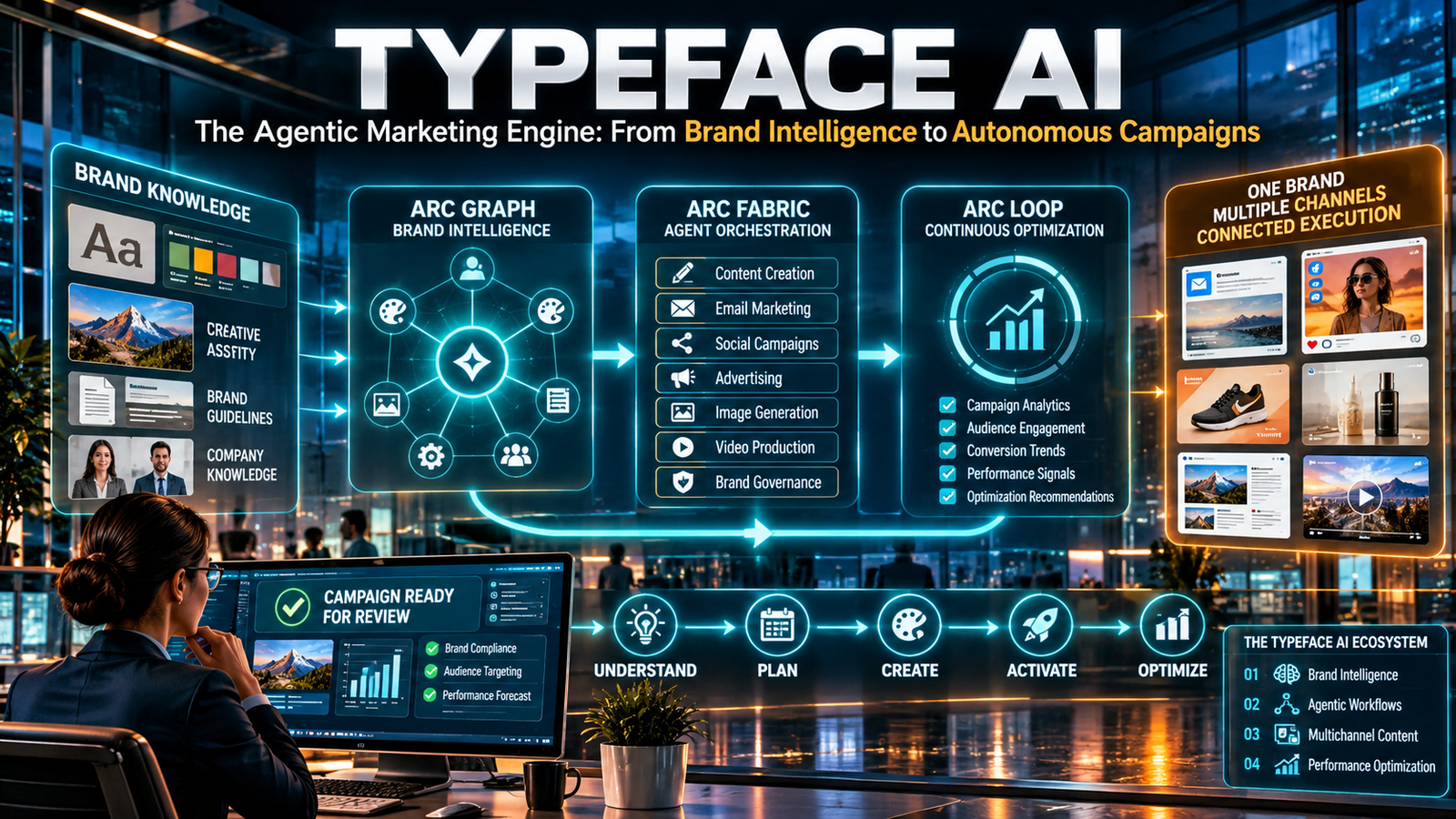
Typeface combines brand intelligence, specialized agents, integrations, and workflow automation.
Instead of relying on employees to repeatedly explain their company’s identity to an AI model, the platform aims to make brand information available as structured context.
The process can be understood through five stages.
How Typeface’s Arc Graph Keeps Content On-Brand at Scale
Typeface Arc Agents: AI Marketing Automation & Campaign Tools
Arc Agents | AI Marketing Specialists
10
1. Brand Information and Context
The process begins with company knowledge.
Marketing teams provide relevant brand guidelines, approved assets, messaging standards, audience information, and other organizational context.
This information helps establish the rules that generated content should follow.
2. AI Agent Selection and Workflow Planning
Teams describe the marketing outcome they want.
Specialized agents can then help plan the necessary activities, coordinate tasks, and produce relevant campaign materials.
For example, a campaign may require:
- Audience research.
- Marketing copy.
- Email content.
- Social media variations.
- Advertising creatives.
- Website messaging.
The objective is to coordinate these activities rather than treat every task as an isolated AI request.
3. Content Generation and Personalization
Typeface supports marketing content creation across different formats.
Teams can develop campaign variations for different audiences, channels, regions, and customer segments.
This approach is particularly useful for businesses managing multiple products or brands.
4. Brand Checks and Human Review
Generated material can be evaluated against established brand rules.
Automated checks help identify inconsistencies, while human review remains important for approvals and sensitive communications.
AI-generated content should not automatically be treated as publication-ready.
5. Performance Feedback and Optimization
The newer Typeface platform also focuses on connecting campaign performance with future content creation.
Its Arc Loop component is designed to use campaign data to inform subsequent marketing decisions.
This creates a feedback cycle:
Create → Review → Activate → Measure → Learn → Improve
Typeface describes this as a connected marketing system rather than a collection of independent content-generation tools. typeface.ai+2
Understanding Typeface Arc: Its Core Platform Architecture
One of the most important developments in Typeface AI is the evolution of its Arc platform.
In September 2026, Typeface introduced a new orchestration architecture built around three connected products: Arc Graph, Arc Fabric, and Arc Loop.
Arc Agents are another important part of the system, handling specialized marketing activities.
Typeface Feature Focus: March 2026
typeface.ai
Arc Graph: Brand Intelligence
Arc Graph provides the brand-context foundation.
It organizes company knowledge, identity, guidelines, assets, and relationships into structured information that AI systems can use.
Its capabilities include:
- Brand guidelines and compliance rules.
- Brand identity and voice.
- Parent and sub-brand relationships.
- Approved creative assets.
- Design systems, colors, and typography.
- Reusable organizational knowledge.
An important distinction is that Arc Graph is intended to do more than store brand documents.
It aims to make brand rules usable during AI-assisted work, including workflows outside the Typeface application.
Typeface also describes connections with external AI tools, including Claude, ChatGPT, and Gemini, through integrations and the Model Context Protocol (MCP). typeface.ai+1
Arc Fabric: Agent Creation and Orchestration
Arc Fabric provides the infrastructure for building and operating marketing agents.
It helps organizations turn successful individual workflows into repeatable processes.
Its main capabilities include:
- Custom agent creation.
- Workflow automation.
- Integration with business systems.
- Access and autonomy controls.
- Collaborative agent workspaces.
- API and MCP connectivity.
For example, a marketing department could create a reusable workflow for preparing product-launch campaigns.
Rather than rebuilding the process manually, authorized employees could use the same configured agent.
This can reduce repetitive work and make internal processes more consistent. typeface.ai+1
Arc Agents: Specialized Marketing Execution
Arc Agents are designed to perform specific marketing activities.
The platform has previously introduced specialized agents for email, web, advertisements, images, video, and brand-related workflows.
These agents help coordinate tasks that would otherwise require multiple disconnected applications.
A team might use them to create advertising variations, prepare email campaigns, or adapt visual assets for different marketing channels. typeface.ai+1
Arc Loop: Performance-Based Optimization
Arc Loop addresses a common problem in enterprise marketing: performance data often remains disconnected from the next campaign.
The component is designed to connect campaign results with future content decisions.
According to Typeface’s September 2026 product announcement, Arc Loop can receive performance information from sources including:
- Google Ads.
- Salesforce Marketing Cloud.
- HubSpot.
- Google BigQuery.
- Salesforce Data Cloud.
The company also describes CSV uploads as an alternative starting point.
Its intended workflow uses actual campaign signals to recommend content variations. Human approval remains part of the described process before publishing. typeface.ai
Why this architecture matters: The value proposition is not simply faster content generation. It is the connection between brand knowledge, repeatable execution, and measurable campaign learning.
Key Features of Typeface AI
Typeface’s feature set is designed around enterprise marketing operations.
| Feature | What it does | Business value |
|---|---|---|
| Brand intelligence | Structures brand guidelines and knowledge | Consistent messaging |
| AI agents | Handles specialized marketing tasks | Less repetitive work |
| Content generation | Produces marketing materials | Faster production |
| Personalization | Adapts content for audiences | More relevant campaigns |
| Workflow orchestration | Connects multi-step activities | Coordinated execution |
| Creative workflows | Supports visual and multimedia production | Faster asset development |
| Governance | Applies brand and access controls | Better oversight |
| Performance feedback | Connects campaign data with future work | Continuous improvement |
| Integrations | Connects external systems and tools | Reduced workflow fragmentation |
Multichannel Marketing Content
Marketing teams often need to produce different versions of the same message.
A product announcement, for example, might require a website landing page, email newsletter, paid advertisement, and several social posts.
Typeface aims to coordinate these outputs while maintaining a consistent brand identity.
Brand Consistency at Scale
Maintaining brand consistency becomes increasingly difficult when multiple teams create content.
The challenge grows when businesses operate across different regions, languages, and product categories.
Typeface addresses this problem through structured brand intelligence and automated content checks.
Custom AI Agents
Organizations can build workflows around their own processes.
This is important because different companies have different approval requirements, marketing channels, and operational structures.
A reusable agent can help standardize recurring work.
Creative Tool Integration
Typeface’s current website highlights workflows that allow creative professionals to work with familiar applications, including:
- Figma.
- Adobe Photoshop.
- Adobe Illustrator.
The platform also describes connections through APIs, MCP, and other integrations. Actual integration availability should be confirmed for the intended deployment. typeface.ai+1
Who Uses Typeface AI? Main Use Cases
Typeface is primarily designed for organizations with complex marketing requirements.
Its value becomes more relevant when businesses need to coordinate multiple teams, brands, channels, and campaigns.
1. Enterprise Marketing Departments
Large marketing departments can use Typeface to coordinate campaign production.
Potential applications include:
- Product-launch campaigns.
- Brand messaging.
- Email marketing.
- Social media campaigns.
- Paid advertising.
- Regional campaign variations.
2. E-Commerce and Retail Businesses
Retail companies frequently manage large product catalogs.
Each product may require descriptions, promotional copy, advertising assets, and channel-specific content.
AI-assisted workflows can help create and adapt these materials more efficiently.
Typeface’s website includes a customer example involving Post, which describes using the platform to convert product information into retailer-ready content. This is a customer-reported use case, not an independently verified performance benchmark. typeface.ai
3. Financial Services and Regulated Industries
Financial organizations must maintain strict control over marketing communications.
They may need additional review procedures, approval processes, and documented brand requirements.
Typeface’s governance positioning makes this an important target use case.
However, organizations must independently verify whether the platform meets their particular regulatory and operational obligations.
4. Global Brands and Multiple Business Units
International companies often manage several brands and regional marketing teams.
Typeface’s structured brand relationships and reusable workflows could help coordinate these operations.
For example, a global company could maintain shared brand standards while allowing regional teams to produce localized campaign variations.
5. Creative and Design Teams
Creative departments can use AI-assisted workflows to develop and adapt marketing assets.
The goal is not necessarily to replace designers.
Instead, the platform aims to reduce repetitive production work and help creative professionals spend more time on strategic decisions.
Benefits of Using Typeface AI
Typeface offers several potential advantages for organizations managing large content operations.
1. More coordinated workflows: Teams can connect research, creation, review, and campaign execution.
2. Better brand alignment: Structured guidelines can help reduce inconsistent messaging.
3. Scalable personalization: Organizations can prepare variations for different audiences and markets.
4. Reusable marketing processes: Custom agents can standardize recurring activities.
5. Cross-functional collaboration: Marketing, IT, and creative teams can work within connected workflows.
6. Performance-informed content: Arc Loop aims to bring campaign results into future content decisions.
These are intended capabilities. Actual business outcomes depend on implementation quality, data availability, employee adoption, and the effectiveness of the underlying workflows.
Typeface AI Pricing: How Much Does It Cost?
One of the most common questions about Typeface AI is its subscription cost.
Custom enterprise pricing
As of November 10, 2026, Typeface does not display a standard public subscription price on its official website.
Instead, the company directs prospective customers toward a personalized demo and sales discussion. typeface.ai+2
What Determines the Cost?
Although exact contract prices are not publicly confirmed, enterprise software purchasing typically involves evaluating several factors:
- Number of employees and authorized users.
- Content generation requirements.
- Number of brands and business units.
- Integration requirements.
- Custom agent development.
- Implementation and onboarding support.
- Governance and administrative requirements.
These are procurement considerations, not a confirmed Typeface pricing formula.
Is There a Free Version?
The official website promotes a product tour and personalized demonstrations.
It does not advertise a standard self-service free subscription comparable to consumer AI writing applications.
Organizations should ask the sales team about pilot access, trial availability, contract length, and usage limits before purchasing.
Questions to Ask Before Signing a Contract
A quoted subscription price does not necessarily represent the complete cost of ownership.
Ask about:
- Monthly or annual usage allowances.
- Image and video generation limits.
- Additional charges for high-volume usage.
- API and integration costs.
- Custom agent development fees.
- Implementation and training expenses.
- Contract renewal and cancellation terms.
- Data export and migration options.
These questions help businesses understand the actual financial commitment.
Typeface AI Security, Privacy, and Governance
Enterprise organizations cannot evaluate marketing AI solely on creative capabilities.
They also need to understand how the platform handles proprietary information, customer data, access permissions, and generated content.
Typeface publishes a dedicated security and governance section alongside its trust portal.
Security Certifications
According to Typeface’s official security information, the company reports the following certifications and audits:
| Certification | What it addresses |
|---|---|
| SOC 2 Type II | Controls relevant to security and service operations |
| ISO 27001 | Information security management |
| ISO/IEC 42001 | AI management systems |
| ISO 27701 | Privacy information management |
The company’s trust portal identifies these credentials and provides access to supporting documentation. Home+1
Data Protection and Access Controls
Typeface describes several security measures, including:
- Data encryption.
- Role-based access controls.
- Multi-factor authentication support.
- Security audits.
- Data deletion request procedures.
- Controls over third-party service providers.
Its security page also describes a multi-cloud, multi-tenant hosting environment using providers such as Microsoft Azure and Google Cloud. typeface.ai
Does SOC 2 Mean Zero Data Retention?
No.
SOC 2 Type II does not automatically mean a company offers Zero Data Retention (ZDR).
These concepts address different issues:
- SOC 2: Evaluates an organization’s controls against relevant trust service criteria.
- Zero Data Retention: Refers to specific arrangements governing whether and how submitted data is retained.
Businesses should request written answers about prompt retention, generated content storage, model-provider data handling, training usage, deletion timelines, and backup retention.
Do not assume these arrangements from a certification badge alone.
What Should Enterprise Buyers Verify?
Before uploading confidential campaign information, ask Typeface to clarify:
- Whether customer inputs are used to train shared models.
- Which third-party AI providers process information.
- Whether dedicated model environments are available.
- How long prompts and generated assets remain stored.
- Whether data residency requirements can be met.
- What happens to information after contract termination.
Request the relevant contractual terms and security documentation rather than relying exclusively on marketing statements.
Typeface AI vs. Competitors: Which Platform Should You Consider?
Typeface operates in a competitive enterprise AI market.
However, not every AI content platform solves the same problem. Some focus on writing, others on creative production, and others on enterprise governance.
The following comparison highlights relevant alternatives.
How to Use Jasper for Demand Gen (with Examples & Prompts) | The Jasper Blog
The latest features of Adobe GenStudio for Performance Marketing
Adobe GenStudio Introduces New Scaled Content Production Capabilities, Enhanced Model Customization with Adobe Firefly Foundry and a Growing Ecosystem of Ad Delivery Partners
6
| Platform | Target user | Key strength | Pricing transparency | Main consideration |
|---|---|---|---|---|
| Typeface | Enterprise marketing teams | Brand intelligence and agent orchestration | Custom quote | Enterprise implementation |
| Jasper | Marketing departments | Marketing-focused content workflows | Public and enterprise offerings vary | Compare workflow and governance requirements |
| Writer | Enterprise and technical teams | Governed enterprise AI workflows | Contact sales for relevant enterprise configurations | May require configuration and integration work |
| Adobe GenStudio | Creative and marketing organizations | Content production and campaign operations | Enterprise quotation | Evaluate its fit with existing Adobe workflows |
| Adobe Firefly | Designers and creative professionals | AI-assisted visual creation | Public plans available | Not a complete replacement for marketing orchestration |
This is a functional comparison, not an independent performance ranking. Pricing and packaging should be checked directly with each vendor. CIOPages+3
Typeface vs. Jasper
Jasper is a relevant alternative for marketing teams that need AI-assisted content production.
Its focus includes marketing workflows and brand-oriented content generation.
Typeface places greater emphasis on connecting structured brand intelligence, custom agents, and enterprise marketing operations.
Consider Jasper when your priority is marketing content workflows and a more accessible purchasing process.
Consider Typeface when you need deeper coordination between brand knowledge, agents, and enterprise campaign systems.
Typeface vs. Writer
Writer focuses on enterprise generative AI, organizational knowledge, and governed AI applications.
Both platforms address enterprise requirements, but their positioning differs.
Typeface emphasizes marketing-specific orchestration, creative production, and campaign optimization.
Writer is worth evaluating when the requirement extends beyond marketing into broader organizational AI workflows.
Typeface vs. Adobe GenStudio
Adobe GenStudio is particularly relevant for organizations already invested in Adobe’s creative and marketing ecosystem.
Its focus includes enterprise content supply chains and creative campaign operations.
Typeface offers a different approach centered on brand intelligence and coordinated AI agents.
Businesses should compare integration depth, content workflows, approval procedures, and the systems they already use.
Typeface vs. Adobe Firefly
These platforms overlap in AI-assisted creative production, but they are not direct equivalents.
Firefly focuses on generative creative capabilities.
Typeface aims to coordinate broader marketing activities, including brand context, agents, and campaign workflows.
A company may find value in using creative generation tools alongside a marketing orchestration platform rather than treating them as interchangeable products.
Limitations and Challenges of Typeface AI
Despite its enterprise capabilities, Typeface is not necessarily suitable for every organization.
Several practical limitations deserve attention.
1. Limited Public Pricing Information
The absence of public subscription prices makes initial budget comparisons difficult.
Small businesses may prefer tools with transparent monthly plans.
2. Enterprise-Oriented Implementation
Typeface’s capabilities are designed around organizational workflows.
Businesses may need to organize their brand documentation, integrations, permissions, and approval processes before realizing meaningful value.
3. Dependence on Brand Data Quality
AI systems cannot consistently follow brand requirements that are incomplete, contradictory, or outdated.
Companies should maintain accurate brand guidelines and approved content libraries.
4. Human Review Remains Necessary
Automated checks can identify certain problems, but they cannot guarantee factual accuracy or appropriate marketing decisions.
Human approval remains essential for sensitive campaigns and regulated communications.
5. Integration Complexity
A connected marketing system may involve multiple applications, data sources, and permissions.
Organizations should test the actual integrations they require instead of assuming every desired workflow is available.
6. Measuring Actual Return on Investment
Producing more content does not automatically produce better marketing results.
Businesses need measurable indicators, such as:
- Campaign production time.
- Cost per approved asset.
- Content approval turnaround.
- Campaign engagement.
- Conversion rates.
- Revenue contribution.
- Brand compliance rates.
Without these measurements, it becomes difficult to determine whether the platform creates sufficient business value.
Is Typeface AI Worth It?
Whether Typeface is worth considering depends on the complexity of your marketing operations.
It is not simply a question of whether the platform can generate good marketing copy.
The more important question is whether it can improve how your organization plans, produces, reviews, distributes, and learns from campaigns.
A practical suitability assessment
Large enterprise marketing teams
Potentially strong fit when managing several brands, channels, and regional teams.
Marketing operations departments
Worth evaluating when converting repetitive processes into governed AI workflows.
Global creative teams
Relevant when adapting campaigns across markets without losing brand consistency.
Freelancers and individual creators
Probably excessive if you only need occasional writing or image generation.
Small businesses
Compare simpler, transparent subscription tools before committing to an enterprise platform.
The strongest potential use case is an organization where fragmented marketing workflows create more problems than content generation itself.
Latest Typeface AI Developments in 2026
Typeface’s product direction has shifted toward agentic marketing orchestration.
Here are the important developments reflected in its official announcements.
| Date | Development | Why it matters |
|---|---|---|
| September 2025 | Arc Agents introduced | Expanded specialized marketing automation |
| March 2026 | Marketing Orchestration Engine announced | Connected brand intelligence, agents, and enterprise workflows |
| April 2026 | Arc Fabric development highlighted | Focused on reusable and governed marketing agents |
| July 2026 | Video and advertising agent improvements discussed | Expanded creative production workflows |
| September 22, 2026 | Next-generation orchestration engine introduced | Connected Arc Graph, Arc Fabric, and Arc Loop |
typeface.ai+4
The September 2026 Platform Evolution
The September announcement is particularly important.
Typeface described a more connected architecture in which:
- Arc Graph provides structured brand intelligence.
- Arc Fabric builds and operates agents.
- Arc Loop connects campaign performance with future content decisions.
This represents a move from individual generative AI tasks toward coordinated marketing operations.
It also expands the importance of integrations, governance, and organizational data quality.
These capabilities are the most relevant developments to examine when evaluating Typeface in late 2026. typeface.ai+1
Common Questions About Typeface AI
Is Typeface AI a free tool?
Typeface does not publicly advertise a standard free subscription plan. Its official website offers product demonstrations and sales consultations for organizations interested in the enterprise platform.
What is Typeface AI mainly used for?
Typeface AI is mainly used for enterprise marketing operations. It helps businesses coordinate brand intelligence, content generation, AI agents, campaign workflows, and marketing performance optimization.
Is Typeface AI suitable for small businesses?
It may be excessive for small businesses that only need occasional AI writing or image generation. Its enterprise-oriented architecture is more relevant to organizations managing multiple teams, brands, and marketing workflows.
Does Typeface AI support integrations with other tools?
Yes. Typeface describes integrations and connectivity through APIs, MCP, and creative and business applications. Its September 2026 announcement also discusses connections with tools such as ChatGPT, Claude, Gemini, Salesforce Marketing Cloud, HubSpot, and Google Ads. Specific availability should be confirmed with the vendor.
Is Typeface AI secure for enterprise use?
Typeface reports SOC 2 Type II, ISO 27001, and ISO/IEC 42001 credentials, alongside encryption and access controls. However, organizations should independently review its security documentation, contractual data-retention terms, and third-party processing arrangements before sharing confidential information. typeface.ai+2
Conclusion
Typeface AI represents an important development in enterprise marketing automation.
Its evolution from generative content creation toward agentic marketing orchestration is its most significant distinction.
The platform brings together brand intelligence, specialized agents, creative workflows, and campaign performance feedback.
For large organizations, this approach could help reduce fragmented processes and make marketing execution more consistent.
However, custom pricing, implementation requirements, data governance, and measurable ROI deserve careful evaluation.
The practical recommendation is straightforward: consider Typeface when your organization needs coordinated marketing operations, not simply another AI writing assistant. Request a demonstration, test your actual workflows, and evaluate the total cost before making a purchasing decision.