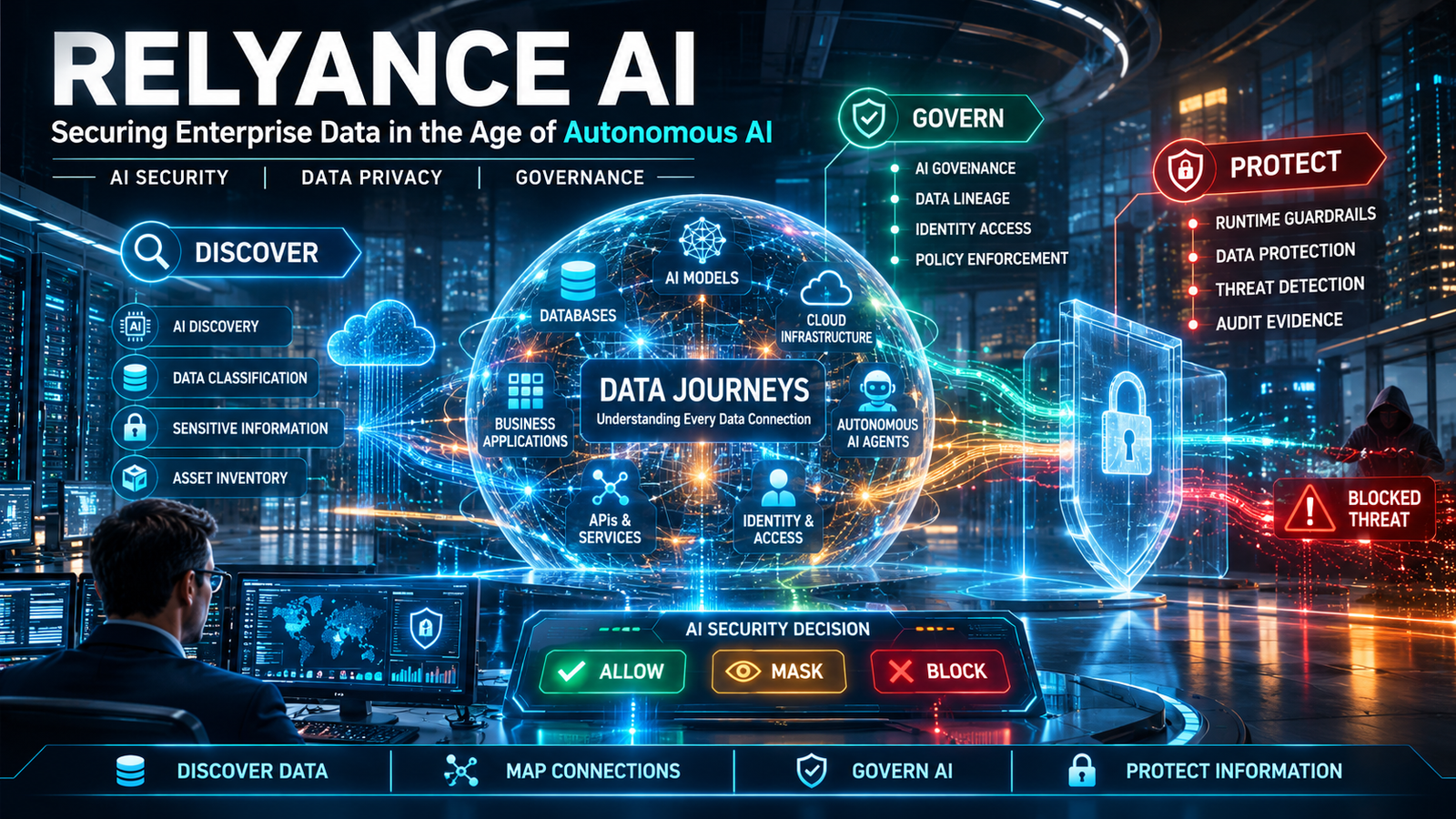
Relyance AI is an enterprise data security, privacy automation, and AI governance platform that helps organizations discover sensitive data, understand how it moves, and control how AI systems access it. Its platform combines data-flow intelligence, AI evaluations, runtime guardrails, and automated privacy workflows to reduce risks across modern enterprise environments.
Relyance AI at a Glance
- Platform category: Enterprise AI security, data privacy, and governance.
- Core technology: Data Journeys, a contextual graph of data, identities, systems, and AI connections.
- AI security: AI discovery, risk assessments, pre-release evaluations, and runtime guardrails.
- Privacy automation: Data mapping, Records of Processing Activities (ROPA), Data Subject Requests (DSRs), and assessments.
- Target users: CISOs, privacy teams, security engineers, compliance professionals, and enterprise AI developers.
- Pricing: Custom enterprise pricing; public plan prices are not disclosed.
What Is Relyance AI?
Relyance AI is an enterprise technology company focused on securing sensitive data and governing AI-driven business operations.
Organizations increasingly connect AI models to customer databases, internal documents, cloud platforms, and business applications. These connections introduce security and privacy risks that traditional monitoring tools may not fully capture.
For example, an AI-powered customer support agent might access customer records to answer questions. However, the same agent could accidentally expose personal information through an external model or perform an action beyond its intended permissions.
Relyance AI addresses this challenge by connecting data visibility with security controls and governance workflows.
Its approach goes beyond identifying where sensitive information is stored. It aims to explain:
- What sensitive information an organization holds.
- Where that information travels.
- Which employees, services, and AI agents can access it.
- Why particular systems access specific information.
- Whether those interactions comply with organizational policies.
- How security teams can identify and remediate risky data exposure.
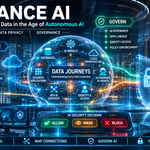
The platform is built around its Data Journeys technology, which connects information from source code, cloud infrastructure, identity providers, databases, SaaS applications, and AI services.
Relyance AI’s current product documentation describes two major capability areas: AI Security and Governance, and Privacy Automation.
How Does Relyance AI Work?
Relyance AI uses connected enterprise data sources to build a contextual understanding of an organization’s technology environment.
Rather than treating every database, application, or AI model as an isolated asset, the platform connects them through relationships and data flows.
1. Connect Enterprise Systems
Organizations connect their existing infrastructure to the platform.
Documented integration categories include:
- Source code repositories such as GitHub, GitLab, and Bitbucket.
- Cloud providers such as AWS, Google Cloud, and Microsoft Azure.
- Data platforms such as Snowflake and Databricks.
- Identity providers such as Okta and Microsoft Entra ID.
- AI providers such as OpenAI, Anthropic, Amazon Bedrock, and Vertex AI.
- SaaS applications and observability platforms.
Each integration contributes information about data location, access, movement, and processing.
2. Discover and Classify Sensitive Data
The platform analyzes connected environments to identify sensitive information.
This can include personally identifiable information (PII), financial records, customer information, and other regulated data categories.
Classification helps organizations understand which information requires stronger protection.
3. Map Data Journeys
Data Journeys connects information about applications, identities, infrastructure, and AI systems.
For example, a data journey might show how customer information moves from a production database into an internal application, then into a retrieval-augmented generation (RAG) pipeline and an external AI model.
This visibility helps security teams identify unnecessary access and potentially dangerous data transfers.
4. Identify and Govern Risky Activities
Organizations can use the resulting information to identify excessive permissions, unexpected data exposure, and AI governance problems.
Relyance AI also documents policy enforcement through development workflows and runtime controls.
5. Automate Governance and Compliance
The platform uses its data intelligence to support privacy records, assessments, consent management, and data subject request workflows.
The objective is to reduce the gap between documented compliance procedures and actual production systems.
Key Features of Relyance AI
1. AI Security and Governance
AI governance is one of the platform’s central capabilities.
Organizations can discover AI applications, models, agents, RAG pipelines, and Model Context Protocol (MCP) servers.
This is particularly relevant when employees and development teams introduce AI services without centralized approval.
The platform helps security teams understand which AI systems exist and what information they can potentially access.
Relevant capabilities include:
- AI asset discovery and inventory.
- Sensitive data classification.
- AI data-flow mapping.
- Access and permission analysis.
- Policy enforcement.
- AI risk identification.
- Governance workflow automation.
2. AI Evaluations and Runtime Guardrails
Relyance AI also describes pre-release evaluations and production runtime protection.
These capabilities address two different stages of the AI lifecycle.
Before deployment: Tailored evaluations test AI applications and agents against business-specific security and safety requirements.
During production: Runtime guardrails inspect AI interactions and actions against configured policies.
According to the company’s product documentation, Relyance Guard can allow, mask, escalate, or block requests.
Potential applications include:
- Preventing sensitive customer information from reaching external models.
- Detecting prompt injection attempts.
- Restricting unauthorized agent actions.
- Preventing excessive API permissions.
- Controlling access to sensitive internal systems.
- Recording decisions for security review.
An important distinction is that AI evaluations and runtime enforcement solve different problems. Passing a pre-release evaluation does not guarantee that an AI system will remain safe under every production condition.
3. Data Journeys and Data Lineage
Data Journeys is a central part of Relyance AI’s architecture.
It creates a connected view of how information moves between applications, infrastructure, identities, and external services.
This is useful because a data security issue rarely exists in isolation.
Consider an employee account with excessive permissions. The account itself might not appear dangerous. However, if it can access customer records and connect to an AI agent that sends information to an external provider, the combined exposure becomes more significant.
Data Journeys helps teams investigate these relationships instead of reviewing isolated security alerts.
4. Automated Privacy Management
Relyance AI also supports traditional enterprise privacy operations.
Its documented capabilities include:
- Records of Processing Activities (ROPA).
- Data Subject Request automation.
- Privacy Impact Assessments (PIAs).
- Data Protection Impact Assessments (DPIAs).
- Transfer Impact Assessments (TIAs).
- Consent management.
- Privacy risk monitoring.
These functions are relevant to organizations operating under regulations such as the GDPR and applicable US state privacy laws.
Automating these workflows can reduce repetitive administrative work, although organizations remain responsible for legal interpretation and regulatory compliance.
5. Relyance Agent
Relyance Agent is an AI assistant that works with information available across the Relyance platform.
According to its documentation, users can ask questions about data inventories, risks, policy violations, vendors, identities, AI governance, and assessments.
It can also assist with operational tasks, including creating remediation tasks and pre-filling assessments.
Importantly, the documentation states that the agent requests approval before making changes.
This makes it an operational interface for enterprise governance information rather than a general-purpose consumer chatbot.
What Is Lyo, and How Does It Relate to Relyance AI?
Lyo is an important part of Relyance AI’s product development.
On March 23, 2026, the company announced the commercial availability of Lyo, describing it as an autonomous data defense engineer.
Its purpose is to help organizations monitor and secure how AI agents interact with enterprise information.
The concept reflects a broader change in enterprise cybersecurity.
Traditional data security tools often focus on finding sensitive files, identifying permissions, and generating alerts.
Agentic AI introduces more complicated interactions. An AI agent may retrieve information, call external tools, interact with APIs, and initiate actions across several systems.
Lyo is designed to help organizations understand these interactions and respond to risky activity.
Relyance’s product positioning now also emphasizes tailored AI evaluations and Relyance Guard runtime enforcement.
These developments should be understood as parts of the company’s evolving platform, rather than assuming every historical product name represents a separate standalone service.
Who Should Use Relyance AI?
Relyance AI is primarily designed for organizations with complex data environments and significant AI governance requirements.
Enterprise Security Teams
Security teams can use the platform to understand how sensitive information interacts with applications, cloud infrastructure, and AI agents.
This is particularly relevant when multiple systems share customer or employee data.
Privacy and Compliance Professionals
Privacy teams can benefit from automated data inventories, processing records, assessments, and data subject request workflows.
These capabilities can help maintain more consistent compliance documentation.
AI Developers and Engineering Teams
Engineering teams can use AI governance and runtime controls to identify risky data access before deployment and during production.
The platform is particularly relevant to organizations building AI agents, internal copilots, and RAG applications.
CISOs and Technology Leaders
Security executives need visibility into how AI adoption changes organizational risk.
Relyance AI’s connected approach can help bring data security, identity access, and AI governance information into a shared operational picture.
Relyance AI Pricing: How Much Does It Cost?
Relyance AI does not publicly disclose a complete pricing schedule on its official website.
The platform uses a demo and sales-led evaluation process for enterprise customers.
Consequently, there is no reliably verified public monthly subscription price that applies to every organization.
Before requesting a quote, buyers should clarify:
- Whether pricing depends on connected systems or data volume.
- Whether AI security and privacy automation are separate packages.
- Whether runtime guardrails require additional licensing.
- Whether implementation and onboarding have separate costs.
- Whether integrations are included in the proposed package.
- Whether support, maintenance, and future expansions affect the contract.
- Whether trial access includes the capabilities needed for a realistic evaluation.
A useful way to evaluate the commercial offer is to calculate the total cost of ownership.
Include licensing, deployment, integration work, engineering time, training, and ongoing maintenance.
For enterprise buyers, this provides a more meaningful comparison than focusing on an advertised starting price.
Relyance AI Security, Privacy, and Compliance Considerations
Security and privacy claims deserve particular attention when evaluating an enterprise platform.
Relyance AI maintains a Security Center in its documentation, which lists SOC 2 reports for 2022, 2023, and 2024.
However, buyers should request the latest applicable report and review its scope, reporting period, exceptions, and control coverage.
SOC 2 reporting should not be confused with Zero Data Retention (ZDR). These are different concepts.
A SOC 2 report evaluates controls within a defined scope. ZDR concerns whether a provider retains submitted information. One does not automatically establish the other.
Organizations should investigate the following before deployment:
Data retention: What information does the platform collect, store, and retain?
AI provider exposure: Which external model providers receive data, and under what contractual conditions?
Access controls: How are administrator permissions, service identities, and sensitive information protected?
Data residency: Where is customer information processed and stored?
Encryption: What encryption protections apply to information in transit and at rest?
Auditability: Can the organization access detailed logs showing policy decisions and remediation activity?
Deployment architecture: What information is processed inside the customer’s environment, and what is transmitted to Relyance?
The answers should come from current contractual documents, technical documentation, and security assessments rather than marketing descriptions.
Relyance AI vs. Competitors: Which Alternatives Should You Consider?
Relyance AI operates in a competitive market involving enterprise privacy management, data security posture management, and AI governance.
Several established vendors address overlapping problems, but their product priorities differ.
| Platform | Primary focus | Potential strength | Pricing transparency |
|---|---|---|---|
| Relyance AI | AI security, data governance, and privacy automation | Connected data journeys and AI runtime controls | Custom pricing |
| OneTrust | Privacy, risk, and governance | Broad enterprise governance workflows | Quote-based for enterprise products |
| BigID | Data security, discovery, and AI governance | Sensitive data discovery and classification | Contact sales |
| Securiti | Data privacy, security, and AI governance | Integrated privacy and AI risk management | Contact sales |
| Transcend | Privacy automation | Configurable data subject request workflows | Contact sales |
Relyance AI vs. OneTrust
OneTrust is a broad enterprise platform covering privacy management, governance, risk, and compliance.
Its AI governance capabilities also include policy management and enforcement workflows.
Relyance AI places particular emphasis on connected data flows, AI security, and runtime enforcement.
Organizations with broad GRC requirements may prefer to evaluate OneTrust. Those prioritizing AI-specific data exposure and runtime controls should investigate Relyance’s architecture.
Relyance AI vs. BigID
BigID focuses heavily on enterprise data discovery, classification, security, privacy automation, and AI governance.
Its platform is relevant to organizations that need to understand sensitive data across complex environments.
Relyance AI offers an alternative approach centered on relationships between data, identities, code, and AI systems.
The choice depends on whether an organization’s primary requirement is extensive data discovery or contextual governance across AI interactions.
Relyance AI vs. Securiti
Securiti provides privacy automation, data security, and AI governance capabilities.
Its platform addresses AI discovery, risk assessment, data mapping, regulatory obligations, and security controls.
Both vendors target organizations that need to manage the relationship between sensitive information and AI systems.
A practical comparison should focus on integration coverage, runtime enforcement, privacy workflows, deployment requirements, and evidence quality.
Relyance AI vs. Transcend
Transcend is particularly relevant to privacy operations and automated data subject requests.
Its documentation describes configurable workflows for access, deletion, rectification, and other privacy requests.
Relyance AI covers a broader combination of AI security, data-flow intelligence, and privacy automation.
Transcend may be worth evaluating when privacy request fulfillment is the primary requirement. Relyance deserves consideration when AI security and contextual data governance are equally important.
Benefits and Limitations of Relyance AI
Potential Benefits
1. Connected visibility: Data Journeys provides a unified way to investigate relationships between data, applications, identities, and AI systems.
2. AI-focused security: The platform addresses risks associated with agents, model access, prompt injection, and sensitive data exposure.
3. Development and production coverage: Pre-release evaluations and runtime guardrails address different stages of the AI lifecycle.
4. Privacy workflow automation: Organizations can connect technical data visibility with privacy documentation and operational processes.
5. Cross-functional governance: Security, engineering, privacy, and compliance teams can work from related information rather than disconnected inventories.
Important Limitations
1. Enterprise-oriented positioning: Smaller organizations with limited infrastructure may not need the full range of capabilities.
2. Pricing uncertainty: Public pricing is unavailable, making early budget comparisons difficult.
3. Integration requirements: The quality of the resulting data map depends on successful connections and appropriate configuration.
4. Implementation complexity: Connecting code repositories, cloud systems, identities, databases, and AI services requires coordination.
5. Policy configuration: Runtime controls depend on correctly defined business policies, agent permissions, and data classifications.
6. Independent validation: Vendor-described performance and protection capabilities should be tested against real workloads before production adoption.
What to Evaluate Before Choosing Relyance AI
A product demonstration should test real operational scenarios rather than rely entirely on prepared examples.
Consider asking the vendor to demonstrate:
- How the platform discovers an AI agent that has not been formally registered.
- How it traces customer information from a database into an external model.
- How it identifies excessive permissions inherited by an AI agent.
- How runtime controls handle prompt injection and unauthorized API calls.
- How sensitive information is masked or blocked.
- How privacy records change when a production data flow changes.
- How findings are exported for security and compliance audits.
- What happens when an integration becomes unavailable.
- How deployment modes affect data processing and retention.
- Which features are included in the proposed commercial package.
One especially useful test is to introduce a controlled data-flow change during a demonstration.
For example, give an AI agent access to a customer database through a service identity. Then change its permissions and attempt an unauthorized data transfer.
Observe whether the platform detects the change, explains the exposure, enforces the appropriate policy, and records useful evidence.
This provides more meaningful information than simply viewing a dashboard.
Latest Relyance AI Developments in 2026
Relyance AI’s recent product direction shows an increasing emphasis on securing agentic AI systems.
Several developments are particularly relevant.
March 23, 2026: Lyo commercial availability
The company announced the commercial availability of Lyo, positioning it as an autonomous data defense engineer for enterprise environments.
April 1, 2026: RSAC 2026 product demonstrations
Relyance discussed Lyo and the growing need for visibility across data, identity, and AI systems following its participation in RSAC 2026.
2026: Expanded AI governance documentation
The company’s documentation describes AI discovery, RAG and MCP visibility, access analysis, policy enforcement, and connected privacy workflows.
November 2026: AI evaluations and runtime guardrails
Relyance’s current product positioning emphasizes tailored evaluations before deployment and runtime guardrails during production. Its documentation also describes Relyance Agent as an interface for querying live platform information and assisting with governance tasks.
The broader direction is clear: enterprise AI security is moving beyond discovering AI applications toward controlling what AI systems can access and do.
Frequently Asked Questions
1. What is Relyance AI used for?
Relyance AI is used for enterprise data security, privacy automation, and AI governance. It helps organizations discover sensitive data, map data flows, identify AI-related risks, enforce policies, and automate privacy operations.
2. Is Relyance AI an AI chatbot?
No. Relyance AI is primarily an enterprise security and governance platform. It also offers Relyance Agent, an AI assistant that helps users interact with information and workflows across the platform.
3. How much does Relyance AI cost?
Relyance AI does not publish standard enterprise subscription prices. Interested organizations generally need to request a demonstration and discuss pricing directly with the company.
4. What are the main alternatives to Relyance AI?
Alternatives include OneTrust, BigID, Securiti, and Transcend. Each has different strengths in privacy management, data discovery, AI governance, and automation.
5. Can Relyance AI protect AI agents from data leaks?
Relyance AI describes runtime guardrails designed to inspect AI interactions and enforce policies against sensitive data exposure, prompt injection, and unauthorized actions. Organizations should validate these controls through testing before relying on them in production.
Conclusion
Relyance AI addresses an increasingly important enterprise challenge: securing sensitive information as it moves through interconnected applications, cloud infrastructure, and AI systems.
Its combination of Data Journeys, AI governance, tailored evaluations, runtime guardrails, and privacy automation makes it relevant to organizations building or deploying AI at scale.
However, its suitability depends on infrastructure complexity, integration requirements, security needs, and available budget.
Enterprise buyers should prioritize a technical demonstration, review current security documentation, validate real-world enforcement, and obtain a clear breakdown of licensing and implementation costs.
The most important consideration is not simply whether an organization can discover its AI systems. It is whether it can understand, control, and verify what those systems do with sensitive information.