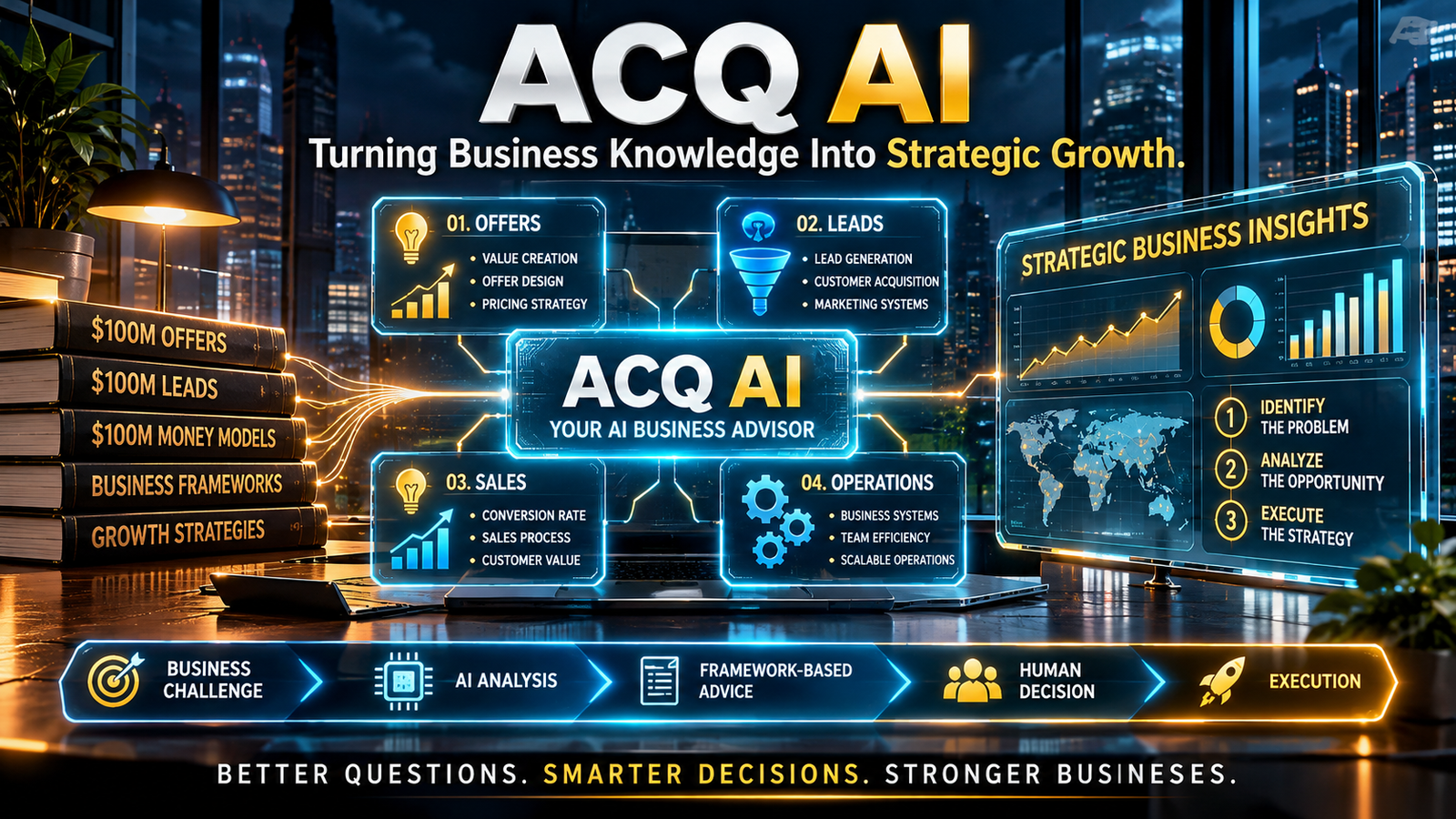
ACQ AI is an AI-powered business assistant associated with Acquisition.com and Alex Hormozi. It helps entrepreneurs apply business frameworks and strategies to challenges involving offers, lead generation, sales, pricing, and business growth.
What Is ACQ AI?
ACQ AI is an AI-powered business advisory platform associated with Acquisition.com, the investment and business education company led by Alex and Leila Hormozi.
Unlike general-purpose AI assistants, ACQ AI focuses on business growth and operational decision-making. Its purpose is to make Acquisition.com’s business knowledge more accessible through an interactive AI experience.
The platform draws on several recognizable business resources, including:
- $100M Offers
- $100M Leads
- $100M Money Models
- Alex Hormozi’s business frameworks and playbooks
- Consulting knowledge and practical business strategies
The official ACQ AI website describes the product as a personal AI business advisor. It highlights answers grounded in Hormozi’s frameworks and strategies associated with businesses that have scaled significantly.
Acquisition.com’s current ACQ Vantage offering also describes ACQ AI as being trained using Alex Hormozi’s books, frameworks, playbooks, and more than 50,000 hours of consulting material.
That figure is a company-provided description, not an independently audited measurement of model training data.
The distinction matters because ACQ AI is not simply another chatbot with a business-related interface. Its value proposition centers on applying a specific business philosophy to practical entrepreneurial challenges.
How Does ACQ AI Work?
ACQ AI combines conversational artificial intelligence with a specialized business knowledge foundation.
Users can describe a business challenge, provide relevant context, and request recommendations. The system generates responses intended to reflect Acquisition.com’s approach to business growth.
The general workflow looks like this:
1. Identify a Business Problem
The user starts with a specific challenge.
Examples include:
- Customer acquisition costs are increasing.
- Sales conversions have stopped growing.
- An offer is struggling to attract customers.
- The business has inconsistent revenue.
- The owner is involved in too many daily operations.
- Customer retention is declining.
A clearly defined problem gives the system a better starting point.
2. Provide Relevant Business Context
The quality of an AI recommendation depends heavily on the information provided.
A business owner might describe their:
- Industry and target audience
- Current products or services
- Pricing structure
- Monthly revenue
- Customer acquisition channels
- Sales conversion rates
- Operational challenges
Providing meaningful context makes recommendations more relevant than asking broad questions.
For example, asking how to increase revenue is less useful than explaining the current offer, customer profile, pricing, and sales process.
3. Generate Framework-Based Recommendations
ACQ AI produces responses using its business-oriented knowledge foundation.
These recommendations may help users evaluate pricing, improve offers, understand customer acquisition problems, and identify operational improvements.
The official product positioning emphasizes actionable advice rather than purely theoretical explanations.
However, users should remember that a framework-based answer is still an AI-generated recommendation. It does not guarantee that a particular strategy will work in every industry.
4. Evaluate and Implement the Advice
The final stage happens outside the chatbot.
Business owners need to compare recommendations against their financial position, available resources, customer behavior, and operational capabilities.
A useful recommendation becomes valuable only when it leads to measurable improvement.
For example, a pricing recommendation should be tested against conversion rates, gross margins, customer demand, and cash flow.
Key Features of ACQ AI
ACQ AI’s main selling point is its business-specific knowledge foundation. Its value comes from combining that knowledge with conversational access.
1. Alex Hormozi’s Business Frameworks
The platform emphasizes strategies associated with Alex Hormozi’s business books and educational resources.
These include principles related to:
- Creating attractive offers
- Generating qualified leads
- Improving sales processes
- Developing profitable business models
- Increasing customer value
- Building scalable operations
This makes ACQ AI particularly relevant to entrepreneurs already familiar with Hormozi’s approach.
2. Offer and Pricing Guidance
Pricing decisions can influence revenue, profit margins, and customer acquisition.
ACQ AI is positioned to help business owners examine their offers and pricing strategies.
Potential questions include:
- How can I make my offer more attractive?
- Which parts of my service create the most customer value?
- How should I communicate the benefits of my product?
- Why are prospects interested but not purchasing?
The official ACQ Vantage website also features a customer testimonial describing an offer and pricing rebuild.
The testimonial reports increased pricing and improved cash collection. However, this is a customer-reported result, not an independently verified performance benchmark.
3. Customer Acquisition Strategies
Customer acquisition is another important area within the Hormozi business framework.
Business owners can explore questions involving lead generation, marketing messages, sales funnels, and customer conversion.
For example, a service business might examine why its advertising generates inquiries but produces few paying customers.
The goal is to identify weaknesses in the acquisition process rather than simply generate more marketing content.
4. Business Growth and Scaling
Growing a company requires more than increasing sales.
Businesses also need stronger systems, effective management, predictable revenue, and operational capacity.
ACQ AI’s business-advisor positioning makes it relevant to questions about:
- Revenue growth
- Operational bottlenecks
- Business scalability
- Team responsibilities
- Process improvement
- Customer retention
These topics become increasingly important as a company moves beyond its early growth stage.
5. Access to Advanced Business Knowledge
One of the platform’s more interesting ideas is making accumulated consulting knowledge accessible through an AI interface.
Instead of searching through books, workshops, and educational materials individually, users can ask questions conversationally.
This can reduce the effort required to locate relevant business concepts.
However, the platform does not publicly establish that every recommendation comes directly from a specific consultation or that every answer includes a traceable source.
Users should therefore distinguish between knowledge-based guidance and independently verified business evidence.
Practical Use Cases: Where Can ACQ AI Help?
The usefulness of ACQ AI depends on the business problem being addressed.
Here are several practical situations where its approach may be relevant.
Small Business Owners
Small business owners frequently manage sales, marketing, customer service, and operations simultaneously.
ACQ AI may help them organize their thinking and examine problems involving pricing, lead generation, and customer retention.
For example, a local service company could use it to evaluate whether its pricing structure adequately reflects delivery costs and customer value.
Marketing Agencies
Marketing agencies often struggle with inconsistent lead generation and unclear service positioning.
An AI business advisor can help examine:
- Service packaging
- Pricing models
- Client acquisition
- Sales messaging
- Customer retention
- Differentiation
An agency could use these recommendations to review its existing service packages before introducing a new offer.
Online Businesses and Coaches
Online businesses depend heavily on their offers, sales funnels, customer relationships, and recurring revenue.
ACQ AI may help owners assess whether their products communicate enough value and whether their sales processes support sustainable growth.
Coaches can also explore service positioning, customer acquisition, and pricing decisions.
Established Companies
Growing companies face a different set of challenges.
Their problems often involve management structures, operational efficiency, team responsibilities, and inconsistent processes.
ACQ AI may provide an additional perspective when evaluating these issues.
However, complex financial, legal, employment, and regulatory decisions still require qualified professionals.
ACQ AI Pricing: What Does It Cost?
Pricing is an important consideration because ACQ AI is associated with Acquisition.com’s broader business membership ecosystem.
There is no single universally applicable standalone subscription price that accurately represents every current access arrangement.
The current ACQ Vantage public pricing page lists the following membership options:
| Membership | Published Price | ACQ AI Access |
|---|---|---|
| Standard | $1,000/month | Limited access |
| VIP | $3,000/month | ACQ AI Pro, unlimited access |
| Premium annual | $8,000/year | ACQ AI Pro |
| VIP annual | $36,000/year | ACQ AI Pro |
These prices are published membership prices, not confirmed standalone ACQ AI subscription prices.
The membership packages also include other benefits, such as community participation, workshops, playbooks, and varying levels of advisor access.
The Standard monthly package lists limited ACQ AI access, while VIP includes unlimited ACQ AI Pro access.
Annual membership options are also advertised with different benefits and access arrangements.
What Should Buyers Check Before Paying?
Before purchasing, confirm:
- Whether ACQ AI is included in the selected membership.
- Whether access is limited or includes ACQ AI Pro.
- Whether the advertised price is monthly or annual.
- Which workshops and playbooks are included.
- Whether advisor access is included.
- Whether cancellation and renewal conditions suit your business.
Membership pricing and benefits can change. Always verify the current checkout terms before committing.
ACQ AI Usage Limits and Technical Restrictions
A particularly important detail appears in Acquisition.com’s published AI Supplemental Terms, last updated June 2, 2026.
These terms specify usage limits that buyers should understand before relying on the platform for frequent business consultations.
| Usage Category | Published Limit |
|---|---|
| Daily soft prompt limit | 25 prompts |
| Daily hard prompt limit | 50 prompts |
| Hourly burst limit | 30 prompts |
| Monthly prompt limit | 414 prompts per 30-day billing period |
| New chat creation | 7 chats per 24 hours |
The terms also state that exceeding applicable limits may result in throttling, overage charges, or upgrade requirements at Acquisition.com’s discretion.
This is important because the phrase unlimited access in a membership comparison should not automatically be interpreted as unlimited technical usage without restrictions.
The AI terms establish that additional usage limitations can apply.
For businesses planning frequent consultations, these restrictions deserve attention before purchasing.
ACQ AI Privacy and Security: What Users Should Know
Business owners sometimes enter sensitive information into AI platforms.
That can include customer details, financial figures, sales reports, internal processes, and operational documents.
Consequently, privacy deserves careful consideration.
Acquisition.com’s AI Supplemental Terms explain several important conditions.
Input and Output Processing
The terms allow Acquisition.com to process user inputs and outputs for operating, maintaining, improving, and developing its AI features.
They also permit the use of these materials to train and improve AI models, subject to the conditions described in the agreement.
This is an important distinction for businesses handling confidential information.
Third-Party AI Providers
The terms explain that ACQ AI may use third-party AI providers.
User inputs may be transmitted to or processed by these providers. Their applicable third-party terms can govern their processing activities.
The document also states that Acquisition.com does not assume responsibility for the security and processing practices of those external providers.
Sensitive Information Restrictions
The AI terms specifically prohibit submitting certain sensitive information.
These restrictions include:
- Personal data
- Personal health information
- Material non-public information
- Confidential information and trade secrets without appropriate authorization
- Other sensitive or regulated data
Users should read the complete agreement before entering business information.
Is ACQ AI a Zero Data Retention Platform?
There is no sufficient basis in the published AI terms to describe ACQ AI as a Zero Data Retention platform.
The terms explicitly allow certain information to be used for operating and improving AI features.
Businesses should not assume that their information receives zero-retention treatment.
They should also avoid treating general security language or the use of established AI providers as proof of a specific security certification.
For companies with strict confidentiality requirements, reviewing the complete contractual and third-party data-processing arrangements is essential.
ACQ AI Benefits and Limitations
ACQ AI has a specialized purpose, which creates both advantages and trade-offs.
Main Benefits
Business-specific guidance: Its positioning is centered on entrepreneurial problems rather than general information retrieval.
Recognizable business frameworks: Its knowledge foundation includes Hormozi’s books, frameworks, and playbooks.
Conversational access: Users can describe challenges directly instead of manually searching through extensive educational materials.
Practical applications: Pricing, offers, sales, customer acquisition, and operations are relevant areas for business owners.
Membership ecosystem: Eligible ACQ Vantage members can access additional educational resources and community benefits.
Important Limitations
Specialized perspective: Its association with one company’s business philosophy may not suit every industry or management style.
No guaranteed results: Recommendations cannot guarantee higher revenue, improved margins, or business growth.
Usage restrictions: Published AI terms specify daily, hourly, and monthly prompt limits.
Privacy considerations: Inputs may be processed by third-party AI providers and used to improve AI features.
Membership cost: The current public membership prices represent a substantial investment for smaller businesses.
Limited technical transparency: Public-facing materials do not provide enough detail to independently assess the underlying model architecture, model routing, benchmark performance, or exact training methodology.
ACQ AI vs. Other AI Business Tools
ACQ AI operates in a specialized category of AI business assistance.
Its alternatives include general-purpose AI assistants and established business strategy resources.
These products are not identical competitors, but they can serve overlapping needs.
| Platform | Target User | Key Strength | Pricing Transparency | Core Limitation |
|---|---|---|---|---|
| ACQ AI | Established entrepreneurs | Hormozi-focused business guidance | Membership-based | Specialized perspective and access restrictions |
| ChatGPT | Businesses and general users | Broad analysis, writing, and research capabilities | Public plans | Requires users to provide suitable business frameworks and context |
| Claude | Founders and professional teams | Long-form analysis and document work | Public plans | Not specifically built around Hormozi’s business methodology |
| Google Gemini | Businesses and Google Workspace users | AI assistance within Google’s ecosystem | Public plans | General-purpose rather than specialized business coaching |
| Strategyzer | Entrepreneurs and innovation teams | Business model and value proposition frameworks | Product-dependent | Not a direct conversational AI equivalent |
ACQ AI vs. ChatGPT
ChatGPT provides general-purpose AI assistance across business, research, writing, analysis, and productivity.
ACQ AI takes a narrower approach by emphasizing Acquisition.com’s business frameworks.
ChatGPT may suit users who need flexibility across different tasks. ACQ AI may appeal to entrepreneurs who specifically want guidance based on Hormozi’s approach.
ACQ AI vs. Claude
Claude is another general-purpose AI assistant with strong document analysis and writing capabilities.
It can help founders evaluate business plans, review marketing materials, and analyze operational information.
However, it does not position itself as an official Alex Hormozi business advisor.
ACQ AI vs. Google Gemini
Gemini offers AI assistance across Google’s product ecosystem.
Businesses already using Google Workspace may find its integrations useful.
ACQ AI’s differentiation is its specialized business knowledge foundation rather than a broad productivity ecosystem.
Which Alternative Makes More Sense?
The answer depends on what a business actually needs.
- Choose ACQ AI when its specialized business frameworks are central to your workflow.
- Consider ChatGPT for broader business analysis and flexible AI assistance.
- Consider Claude for document-heavy research and detailed written analysis.
- Consider Gemini when Google Workspace integration is important.
- Consider Strategyzer when structured business model and value proposition tools are the priority.
Who Should Use ACQ AI?
ACQ AI is most relevant to people who already operate a business and need additional strategic guidance.
Good Fit
- Entrepreneurs managing established companies
- Business owners improving offers and pricing
- Founders addressing customer acquisition challenges
- Marketing agencies reviewing their business models
- Operators trying to identify operational bottlenecks
- Existing Acquisition.com members interested in its AI resources
Not an Ideal Fit
ACQ AI may be less suitable for:
- People looking for a free general-purpose chatbot
- Beginners who have not yet developed a business idea
- Businesses requiring strict zero-data-retention guarantees
- Companies seeking a complete enterprise AI infrastructure
- Teams needing independently validated financial or legal advice
- Organizations requiring extensive multi-user governance and administration
A business should evaluate its actual needs before investing in a specialized advisory product.
How to Get Better Results From ACQ AI
The quality of business advice depends on the quality of the problem description.
A vague question often produces generic recommendations.
A structured question provides more useful context.
Use Specific Business Questions
Instead of asking:
“How can I grow my business?”
Try:
“My agency generates approximately 40 qualified leads monthly, but only four become paying customers. Our average project value is $2,000. Help me identify possible weaknesses in our sales process.”
The second question provides a clearer business situation.
Explain Your Constraints
Include relevant information about:
- Budget
- Available staff
- Customer acquisition channels
- Operational capacity
- Existing pricing
- Business objectives
This helps frame recommendations around realistic conditions.
Request Prioritized Recommendations
Ask the system to distinguish between immediate improvements and longer-term initiatives.
For example, request three potential changes ranked by expected impact, implementation difficulty, and required resources.
Verify Every Important Recommendation
Do not implement a major financial or operational change simply because an AI assistant recommends it.
Compare suggestions with actual business data, customer feedback, and professional advice where necessary.
Measure the Outcome
Define measurable indicators before implementing a recommendation.
Useful indicators include:
- Customer acquisition cost
- Conversion rate
- Gross profit margin
- Average order value
- Customer lifetime value
- Customer retention
- Revenue per employee
These metrics help determine whether the recommendation produces meaningful results.
The Future of Specialized AI Business Advisors
ACQ AI represents an interesting direction in the development of AI-powered business services.
General-purpose AI models can answer questions across thousands of subjects. However, many professionals want assistance grounded in a specific discipline, methodology, or body of experience.
This creates an opportunity for specialized AI products.
Business advisors, consultants, educators, and professional organizations can make their accumulated knowledge accessible through conversational interfaces.
The potential value is not simply generating answers faster. It is helping users connect established frameworks with their own business circumstances.
However, specialized knowledge does not automatically produce superior decisions.
The quality of an AI business advisor still depends on its underlying models, information quality, context handling, product design, and ability to distinguish useful recommendations from unsupported assumptions.
For ACQ AI, long-term value will depend on how effectively it translates business knowledge into practical recommendations while maintaining transparency, reliability, and appropriate data controls.
Frequently Asked Questions
1. What is ACQ AI used for?
ACQ AI is an AI-powered business assistant associated with Acquisition.com. It helps entrepreneurs explore business challenges involving offer creation, lead generation, pricing, sales, operations, and business growth using Acquisition.com’s business frameworks.
2. Is ACQ AI free to use?
ACQ AI is not presented as a universally free standalone service. Access is associated with Acquisition.com offerings, including ACQ Vantage membership plans that provide different levels of AI access. Check the official website for current pricing and availability.
3. Is ACQ AI trained on Alex Hormozi’s books?
Acquisition.com describes ACQ AI as drawing on Alex Hormozi’s books, frameworks, and business playbooks. These include concepts associated with $100M Offers, $100M Leads, and $100M Money Models.
4. Is ACQ AI better than ChatGPT?
ACQ AI and ChatGPT serve different purposes. ACQ AI focuses on business guidance based on Acquisition.com’s frameworks, while ChatGPT offers broader capabilities for research, writing, analysis, brainstorming, and productivity. The better choice depends on your needs.
5. Can ACQ AI help small businesses grow?
ACQ AI can help small-business owners think through offers, customer acquisition, sales processes, pricing, and operational systems. Its recommendations still require human judgment, business-specific research, and practical execution.
6. Is ACQ AI safe for confidential business information?
Users should review Acquisition.com’s AI terms and privacy policies before submitting sensitive information. AI inputs may be processed by third-party providers, and the terms include restrictions concerning sensitive and confidential data. Avoid sharing passwords, customer records, trade secrets, or regulated information without appropriate authorization.
7. What makes ACQ AI different from other AI business tools?
Its main distinction is its focus on Acquisition.com’s business knowledge and entrepreneurial frameworks. Rather than serving as a general-purpose AI assistant, it is positioned around applying those frameworks to business decisions.
8. Who should use ACQ AI?
Entrepreneurs, founders, marketers, sales professionals, and business owners interested in Acquisition.com’s approach to offers, marketing, sales, and business growth may find ACQ AI useful.
Conclusion
ACQ AI is a specialized AI business advisor developed around Acquisition.com’s business education and Alex Hormozi’s frameworks.
Its primary appeal is straightforward: entrepreneurs can use conversational AI to explore questions involving offers, pricing, sales, customer acquisition, and business operations.
It may be particularly relevant to established business owners who already value Hormozi’s approach.
However, the membership cost, usage restrictions, data-processing conditions, and limited public technical transparency deserve attention.
Before purchasing, evaluate the included access level, actual usage limits, privacy terms, and potential return on investment.
Ultimately, ACQ AI should be treated as a business decision-support tool, not a replacement for experience, financial analysis, or professional judgment.