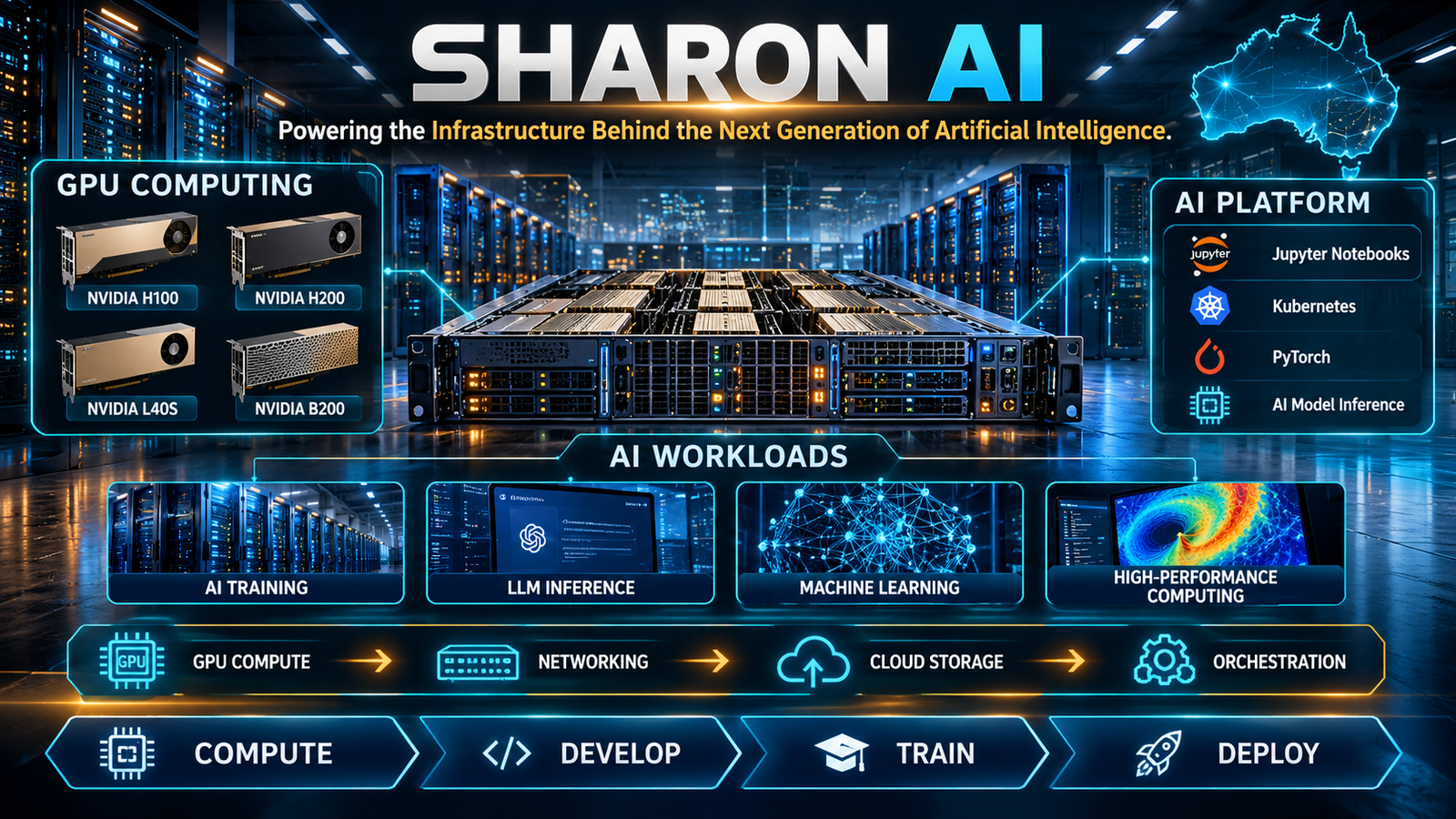
Sharon AI is an Australian neocloud provider specializing in GPU computing, AI infrastructure, and high-performance computing (HPC). Its services help organizations access the processing resources required for machine learning, generative AI, scientific research, and enterprise applications.
The company operates through an integrated infrastructure model. This combines GPU hardware, cloud computing, storage, networking, software orchestration, and technical services.
Unlike traditional cloud platforms that support a broad range of computing requirements, Sharon AI focuses heavily on accelerated computing. This makes its infrastructure particularly relevant to workloads that require substantial parallel processing.
Its main offerings include:
- GPU-as-a-Service (GPUaaS): Access to specialized graphics processing units for demanding computing workloads.
- AI Cloud: Cloud infrastructure for training, fine-tuning, and deploying AI models.
- AI Studio: A platform-as-a-service environment for AI and machine learning development.
- High-Performance Computing: Computing resources for scientific research, simulations, analytics, and other intensive workloads.
- Cloud Storage: Storage infrastructure for datasets, model files, and AI applications.
- Managed Infrastructure Services: Technical support and operational assistance for enterprise computing environments.
Sharon AI also operates in the emerging neocloud market. Neocloud providers specialize in accelerated computing rather than competing across the entire traditional cloud services market.
How Does Sharon AI Work?
Sharon AI combines physical computing infrastructure with software that allows customers to provision and manage resources.
The basic process involves selecting computing resources, configuring an environment, deploying workloads, and monitoring performance.
1. Selecting GPU Computing Resources
The first step is choosing the appropriate hardware for a particular workload.
AI training, model inference, and scientific simulations have different memory and processing requirements. Sharon AI offers access to multiple accelerator configurations, including NVIDIA GPU options.
For example, large language model training may require substantial GPU memory and high-speed communication between processors. Smaller inference workloads may operate efficiently on less expensive configurations.
2. Provisioning a Cloud Environment
After selecting resources, users can deploy their computing environments through supported infrastructure options.
These include:
- GPU-enabled virtual machines.
- Dedicated bare-metal servers.
- Kubernetes clusters.
- Container-based environments.
- Interactive Jupyter Notebook environments.
This flexibility allows technical teams to choose an environment that matches their software architecture and workload requirements.
3. Developing and Running AI Workloads
Once the environment is available, developers can install frameworks, access datasets, and execute machine learning workloads.
Sharon AI Studio supports development environments and frameworks such as PyTorch, TensorFlow, JAX, ONNX, and OpenCV.
These tools help developers build, test, fine-tune, and deploy AI applications without independently managing every component of the underlying infrastructure.
4. Managing and Monitoring Resources
Infrastructure management becomes increasingly important when several teams share expensive computing resources.
Sharon AI provides management capabilities for resource provisioning, monitoring, user administration, quotas, and workload operations.
Its documentation also describes tenant administration, access controls, project management, and audit-log functionality.
The practical advantage is centralized management rather than requiring every developer to administer separate infrastructure manually.
Key Features of Sharon AI
Sharon AI’s value comes from combining several infrastructure services within one AI-focused computing environment.
GPU-as-a-Service
GPU-as-a-Service allows organizations to rent access to specialized computing hardware instead of purchasing and maintaining physical servers.
This can reduce the initial infrastructure investment associated with AI development.
Sharon AI’s published hardware offerings include NVIDIA L40S, A40, H100, and H200 accelerators, alongside AMD MI300X configurations.
Actual availability depends on the deployment, hardware allocation, and service agreement.
AI Studio
Sharon AI Studio provides a managed environment for AI and machine learning development.
Its documented capabilities include:
- Jupyter Notebook-based development.
- Preconfigured machine learning frameworks.
- AI model deployment.
- Fine-tuning infrastructure.
- Inference optimization.
- Development and collaboration environments.
The platform targets developers and researchers who need more than basic GPU access.
It combines computing resources with software and operational support.
Virtual Machines and Bare-Metal Servers
Different AI workloads require different levels of infrastructure control.
Virtual machines offer flexible computing environments, while bare-metal servers provide direct access to dedicated physical hardware.
This distinction matters for organizations running specialized software, performance-sensitive workloads, or complex computing environments.
Kubernetes and Container Support
Containerization helps developers package applications with their dependencies.
Kubernetes provides tools for deploying, scaling, and managing containerized workloads.
Sharon AI’s documentation describes managed Kubernetes clusters, custom containers, and GPU-enabled environments.
These capabilities can help teams standardize application deployment across development and production environments.
AI Model Inference
Inference refers to the process of using a trained model to generate predictions or responses.
For example, when an application sends a request to a large language model, the computing resources process that request and produce an output.
Sharon AI documents inference deployment for popular LLMs, including hourly metering options.
This is relevant to businesses that need computing resources for AI-powered applications without necessarily training models from scratch.
High-Performance Storage and Networking
AI infrastructure needs more than powerful GPUs.
Large datasets must move efficiently between storage systems and computing resources. Network performance also affects distributed training, where multiple GPUs work together.
Sharon AI describes high-bandwidth networking, NVMe storage, S3-compatible object storage, and infrastructure designed for demanding AI workloads.
These components are important because storage and networking bottlenecks can reduce the effectiveness of expensive GPU hardware.
What Can You Use Sharon AI For?
Sharon AI supports several computing-intensive applications.
The most relevant use cases include the following.
Large Language Model Training
Training large language models requires substantial computing resources.
Organizations can use GPU infrastructure to process training datasets, optimize model parameters, and experiment with different architectures.
Sharon AI’s infrastructure is designed to support these types of AI workloads.
However, actual training performance depends on the GPU configuration, networking, storage, software optimization, and dataset size.
Generative AI Applications
Generative AI systems create content such as text, images, and other digital outputs.
Developers need computing resources to deploy models, process user requests, and maintain inference services.
A specialized GPU cloud can provide the infrastructure required to operate these applications.
Machine Learning and Fine-Tuning
Fine-tuning adapts an existing model to a particular task or dataset.
For example, a company might customize a language model for customer support or internal document analysis.
Sharon AI provides AI development infrastructure and fine-tuning capabilities that can support these workflows.
Scientific Research and High-Performance Computing
Research institutions often run computationally demanding simulations and analytical workloads.
Examples include:
- Scientific modeling.
- Data-intensive research.
- Complex simulations.
- Genomics analysis.
- Advanced statistical computing.
GPU acceleration can reduce processing time for workloads that support parallel computation.
Video Rendering and Visual Computing
High-performance GPUs are also useful for visual computing.
Potential applications include video processing, 3D rendering, visual effects, and other graphics-intensive tasks.
These workloads can benefit from dedicated computing resources without requiring organizations to maintain their own GPU server infrastructure.
Sharon AI Hardware and Technology
Hardware selection is one of the most important factors when evaluating a GPU cloud provider.
Different GPU generations offer different memory capacities, processing capabilities, and performance characteristics.
Sharon AI’s published infrastructure information identifies several accelerator families.
| GPU model | General capability | Potential applications |
|---|---|---|
| NVIDIA A40 | Professional GPU computing | Visualization, rendering, AI workloads |
| NVIDIA L40S | Accelerated visual computing | Generative AI, inference, rendering |
| NVIDIA H100 | High-performance AI acceleration | Model training, inference, HPC |
| NVIDIA H200 | High-memory AI computing | Large models, advanced inference |
| NVIDIA B200 | Blackwell architecture | Large-scale AI training and inference |
| NVIDIA B300 | Blackwell Ultra architecture | Advanced AI computing |
| AMD MI300X | High-memory accelerator | AI training and HPC |
Not every listed GPU should be interpreted as immediately available for every customer.
Some hardware references describe deployed infrastructure, while others relate to planned or expanding capacity.
Why GPU Memory Matters
GPU memory determines how much model data and other information can remain available during computation.
Large language models can require substantial memory, particularly when developers use larger model parameters or longer context lengths.
Higher-memory accelerators can help accommodate demanding workloads. However, memory capacity alone does not determine overall performance.
Networking, software optimization, batch size, model architecture, and data movement also influence results.
Sharon AI Pricing: What Should Customers Expect?
Sharon AI offers different infrastructure and platform services, so pricing depends on the resources and service configuration required.
The company documents usage-based GPU computing and hourly metering for certain inference workloads. It also offers a pricing calculator and direct commercial enquiries.
However, a single verified public price covering every GPU model and service configuration is not available from the information reviewed for this article.
Potential cost components include:
- GPU model and quantity.
- Number of computing hours.
- Virtual machine or bare-metal configuration.
- Storage requirements.
- Network usage.
- Additional platform services.
- Managed technical support.
- Contract duration and committed capacity.
On-Demand Versus Long-Term Contracts
On-demand computing is useful when workloads are unpredictable or experimental.
Customers pay for the resources they consume, subject to the applicable service terms.
Long-term infrastructure contracts work differently. They may involve commitments to reserve or purchase a defined amount of computing capacity.
Sharon AI has publicly discussed take-or-pay contracts as part of its infrastructure business model.
Under these arrangements, customers commit to specified capacity and payment obligations, even when actual utilization changes.
For businesses, the important question is not simply the hourly GPU price. It is the total cost of running the workload.
Before purchasing, customers should request a detailed estimate covering compute, storage, networking, minimum commitments, and any additional charges.
Sharon AI Privacy and Security
Security is particularly important when organizations run proprietary models, customer information, or confidential research workloads.
Sharon AI describes infrastructure security features such as encryption, access controls, isolated environments, and tenant-management capabilities.
Its public Trust Center also lists a SOC 2 Type I attestation and security-related documentation.
However, these details should be interpreted carefully.
SOC 2 Type I evaluates the design of relevant controls at a particular point in time. It is not equivalent to a SOC 2 Type II examination of control effectiveness over a period.
It also does not automatically establish Zero Data Retention.
Organizations should independently evaluate:
- Data retention periods.
- Data deletion procedures.
- Encryption in transit and at rest.
- Access management.
- Tenant isolation.
- Backup policies.
- Incident response procedures.
- Data center locations.
- Contractual privacy obligations.
For Australian organizations, data residency may also be important when working with regulated information or government workloads.
A cloud provider’s infrastructure location is only one part of data governance. Customers should also understand where backups, support access, and other data-processing activities take place.
Sharon AI vs. Other GPU Cloud Providers
Sharon AI operates in a competitive market that includes specialist neocloud providers and established hyperscalers.
The most relevant comparisons depend on hardware availability, pricing, geographic requirements, and technical support.
| Platform | Target user | Key strength | Pricing transparency | Main consideration |
|---|---|---|---|---|
| Sharon AI | Enterprises, researchers, AI developers | Australian AI-focused infrastructure | Configuration and commercial enquiries | Verify regional availability and contract terms |
| CoreWeave | AI companies and large enterprises | Specialized GPU cloud infrastructure | Published product-specific pricing varies | Compare capacity and contractual commitments |
| Lambda | AI developers and research teams | GPU cloud and AI computing | Public instance pricing available for selected services | Check regional availability |
| Nebius | AI developers and enterprises | AI infrastructure and cloud services | Product-specific pricing | Evaluate deployment locations |
| AWS | Businesses and developers | Broad cloud ecosystem and AI services | Public pricing calculators and service rates | Infrastructure choices can be complex |
| Google Cloud | Enterprises and AI development teams | Integrated cloud and AI ecosystem | Public service pricing | GPU availability depends on region and configuration |
| Microsoft Azure | Enterprise and developer teams | Enterprise cloud and AI services | Public pricing tools | Capacity and service restrictions vary |
Sharon AI vs. CoreWeave
CoreWeave is a specialist GPU cloud provider with an established position in accelerated computing.
Both companies target demanding AI workloads rather than focusing exclusively on ordinary web hosting.
Sharon AI’s differentiating angle is its Australian infrastructure footprint and sovereign AI positioning.
CoreWeave may be worth evaluating when global GPU capacity and its broader cloud ecosystem are priorities.
Sharon AI vs. AWS and Google Cloud
AWS and Google Cloud provide much broader cloud ecosystems.
They support databases, storage, networking, application hosting, AI services, and many other enterprise requirements.
Sharon AI focuses more narrowly on AI and high-performance computing infrastructure.
For an organization that needs a comprehensive cloud platform, hyperscalers may offer broader integration options. For a specialized GPU requirement, a neocloud may deserve consideration.
The correct choice depends on the workload rather than the provider’s marketing claims.
Latest Sharon AI Developments in 2026
Sharon AI has announced several important infrastructure and commercial developments during 2026.
These developments help explain why the company has become relevant to discussions about Australia’s AI computing capacity.
Expansion of AI Cloud Agreements
In August 2026, Sharon AI announced a five-year cloud service agreement with a reported total contract value of US$373 million.
The company stated that the agreement would involve AI infrastructure deployments in Australia, with expected revenue commencement in the first quarter of 2027.
The announcement also described a planned initial deployment involving 2,048 NVIDIA B300 GPUs.
These figures represent announced contractual commitments and planned deployments, not independently verified completed revenue.
Major Customer Deployment Milestone
On August 20, 2026, Sharon AI announced the successful delivery and customer acceptance of an initial deployment under a separate five-year infrastructure agreement.
The company reported an initial contract value of approximately US$950 million.
It expected revenue from that deployment to commence in stages during the third and fourth quarters of 2026.
Infrastructure and Technology Partnerships
Sharon AI also announced a strategic agreement with Rafay Systems in September 2026.
The agreement focuses on infrastructure orchestration and operations across its expanding AI Factory environments.
In addition, the company announced a collaboration with VAST Data involving DataEnclave, which focuses on bringing AI models to customer-controlled infrastructure.
These developments demonstrate the company’s emphasis on infrastructure, orchestration, storage, and enterprise deployment rather than consumer AI applications.
Public Company Status
Sharon AI Holdings Inc. trades on Nasdaq under the ticker symbol SHAZ.
This is relevant for readers researching the company from an investment perspective.
However, evaluating its shares requires separate financial analysis. Announced contracts and infrastructure expansion do not guarantee profitability, future revenue, or investment returns.
Who Should Use Sharon AI?
Sharon AI may be relevant to organizations that need specialized computing resources for demanding workloads.
Potential users include:
AI developers: Teams building and deploying machine learning applications that need GPU acceleration.
Research institutions: Organizations conducting scientific simulations, computational research, and advanced data analysis.
Enterprise technology teams: Businesses developing private AI applications or deploying large-scale models.
AI infrastructure operators: Companies that need dedicated GPU resources, storage, networking, and operational support.
Media and visual computing teams: Organizations working with rendering, video processing, and graphics-intensive applications.
However, individuals who simply want to use an AI chatbot or generate occasional images may not need this type of infrastructure.
A GPU cloud is primarily a development and computing environment, not a ready-made consumer AI application.
Limitations and Things to Consider Before Choosing Sharon AI
Sharon AI offers specialized infrastructure, but potential customers should evaluate several practical considerations.
1. Pricing Requires Workload-Specific Evaluation
GPU costs can vary significantly by hardware type, allocation, and contract structure.
Customers should obtain a complete estimate rather than comparing a single advertised GPU rate.
2. Regional Requirements Matter
Australian infrastructure can be valuable for organizations with local hosting or data-residency requirements.
However, international customers should examine latency, connectivity, support coverage, and the location of all relevant data-processing activities.
3. GPU Availability Must Be Confirmed
A provider may advertise several GPU generations without making every model immediately available.
Confirm the exact hardware, memory, interconnect, quantity, and delivery schedule before committing to a project.
4. Infrastructure Does Not Guarantee Model Performance
A powerful GPU does not automatically make an AI application accurate or efficient.
Model architecture, software, dataset quality, inference optimization, and workload configuration remain important.
5. Enterprise Contracts Need Careful Review
Large computing commitments can introduce financial and operational obligations.
Review minimum usage requirements, cancellation terms, service-level agreements, capacity guarantees, and support arrangements.
These details can have a significant impact on the long-term cost of an AI deployment.
Frequently Asked Questions
1. What is Sharon AI used for?
Sharon AI provides GPU cloud infrastructure, AI development environments, and high-performance computing services. Organizations can use its platform for AI training, model inference, machine learning, fine-tuning, scientific research, and other demanding computing workloads.
2. Is Sharon AI an AI chatbot?
No. Sharon AI is primarily an AI infrastructure and neocloud provider. Its services supply computing resources and development environments that businesses and developers can use to build and operate AI applications.
3. Does Sharon AI offer NVIDIA GPUs?
Yes. Sharon AI’s published infrastructure includes NVIDIA GPU models such as the A40, L40S, H100, and H200. Its announced infrastructure expansion also includes newer Blackwell-generation accelerators. Customers should confirm current availability and configuration before ordering.
4. How much does Sharon AI cost?
Sharon AI does not have one universal price for every service and GPU configuration. Costs depend on hardware, usage duration, storage, networking, and commercial arrangements. Customers should use the company’s pricing resources or request a workload-specific quotation.
5. Is Sharon AI suitable for enterprise AI projects?
It may be suitable for enterprises that need GPU computing, AI development environments, or Australian-hosted infrastructure. Before choosing it, organizations should assess performance requirements, availability, pricing, security controls, contractual obligations, and support arrangements.
Conclusion
Sharon AI represents a specialized approach to the growing demand for AI computing infrastructure.
Its platform combines GPU cloud services, AI development environments, high-performance computing, storage, and infrastructure management.
The company’s Australian infrastructure footprint and enterprise-focused strategy make it relevant to organizations evaluating alternatives to conventional cloud computing.
However, the right choice depends on more than hardware specifications or announced contract values. Customers should examine real-world GPU availability, workload performance, total operating costs, security documentation, and contractual flexibility.
For developers, researchers, and businesses building computationally intensive AI systems, Sharon AI is a platform worth evaluating alongside established GPU cloud providers.
For everyday consumers looking for an AI chatbot, it serves a different purpose entirely.