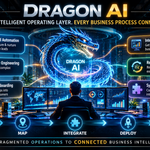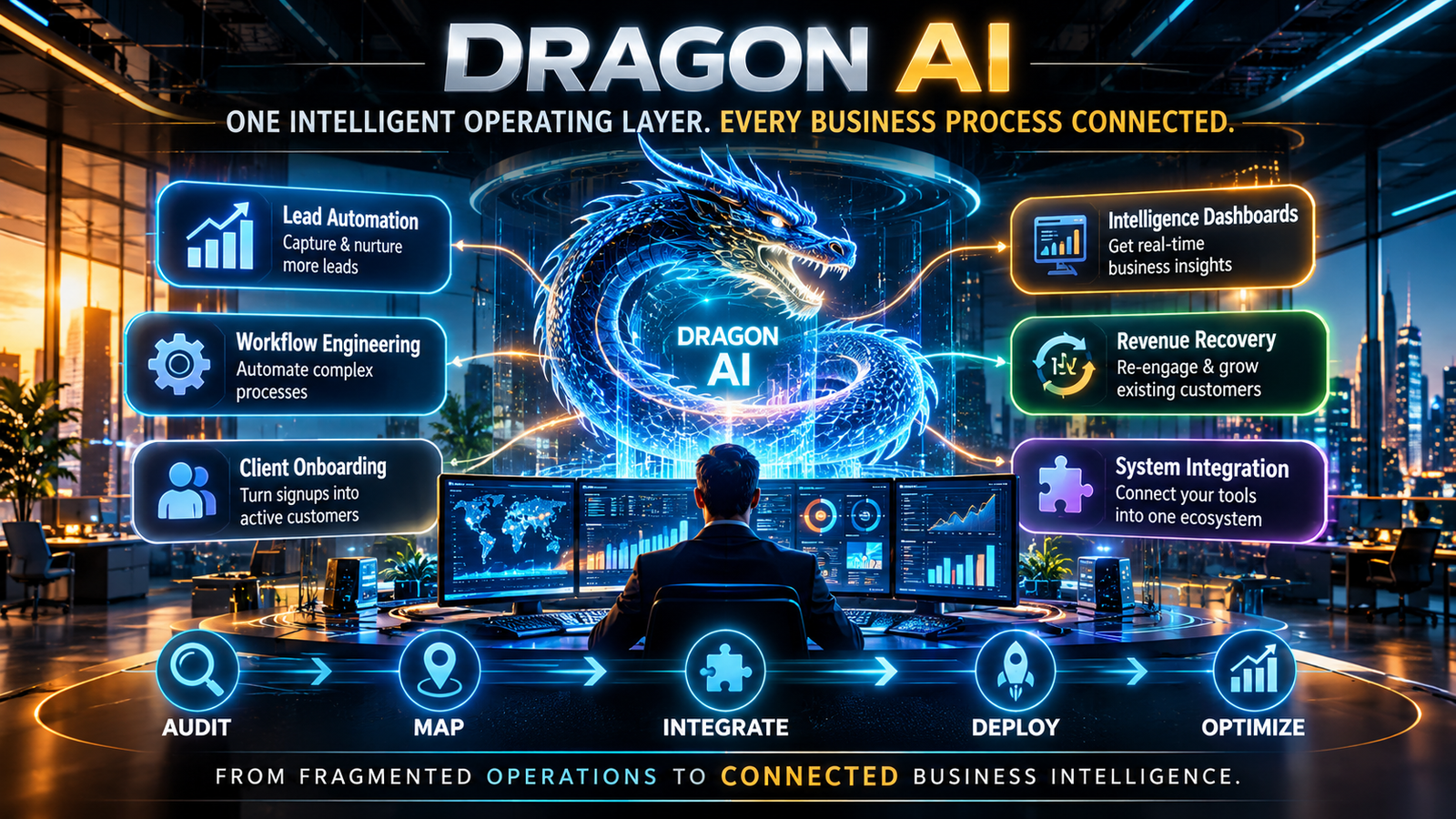
Dragon AI is a business automation platform designed to connect workflows, operational data, reporting dashboards, and revenue processes through a unified intelligent system. It aims to reduce repetitive work, improve business visibility, and help companies manage operations through connected automation rather than disconnected software.
Dragon AI at a Glance
- Primary purpose: Business automation and operational systems integration.
- Core offering: Connected workflows, lead management, dashboards, and reporting.
- Target audience: Growing businesses, operational teams, sales departments, and business owners.
- Deployment approach: Business audit, system mapping, integration, deployment, and ongoing optimization.
- Main advantage: Connecting separate business processes into a coordinated operating environment.
- Important consideration: Actual results depend on implementation quality, existing software, data accuracy, and business requirements.
What Is Dragon AI?
Business automation platform and intelligent systems infrastructure
Dragon AI Solutions presents Dragon AI as a unified operational layer for businesses. Its goal is to connect software, automate repetitive processes, and make important business information easier to access.
Many growing companies use separate applications for customer relationships, sales, accounting, marketing, project management, and reporting. Although each application serves a purpose, disconnected systems can create unnecessary work.
Employees may enter the same information multiple times. Managers may wait for reports. Sales teams may forget follow-ups because customer information sits across different platforms.
Dragon AI aims to address these problems through integrated business systems.
Rather than positioning itself as just another chatbot, the company focuses on building operational infrastructure around existing business processes.
Its website highlights six primary areas:
- Lead and pipeline automation.
- Workflow and process engineering.
- Client onboarding systems.
- Reporting and intelligence dashboards.
- Revenue recovery and customer retention.
- Systems integration and technology-stack audits. Intelligent Business Systems
This distinction matters when evaluating Dragon AI. It is primarily presented as a business systems and automation solution, not as an independent foundation model or general-purpose AI chatbot.
How Does Dragon AI Work?
Dragon AI describes a structured implementation process. It starts by examining business operations before designing and connecting automation systems.
The approach follows five stages.
Where Workflow Automation Actually Pays Back | Softpro India
softproindia.in
1. Intelligence Audit
The first stage examines how a company currently operates.
The audit identifies:
- Where customer inquiries originate.
- How employees process incoming leads.
- Which tasks require repetitive manual work.
- Where information becomes disconnected.
- Which processes create delays.
- Where reporting lacks visibility.
This assessment helps identify opportunities for automation.
For example, a sales department might receive inquiries through website forms, email, and social media. Without connected systems, employees may need to transfer customer information manually.
An operational audit can reveal where those handoffs should be improved.
2. System Mapping
After the initial assessment, Dragon AI describes creating an operational blueprint.
This blueprint outlines how different systems should communicate and what each automated process should accomplish.
A typical workflow might look like this:
Customer submits an inquiry
Lead information is captured
Lead is qualified and assigned
Automated follow-up begins
Sales dashboard records progress
This is an illustrative business workflow, not a claim that every customer receives an identical configuration.
3. Integration Strategy
The third stage connects the required applications and business processes.
The company says it aims to build around an organization’s existing technology stack instead of replacing everything.
That approach can reduce migration complexity.
However, successful integration depends on the available APIs, authentication methods, application permissions, data formats, and third-party platform restrictions.
Businesses should confirm which integrations are supported before approving a project.
4. Deployment
Dragon AI describes a deployment process that introduces connected systems in a controlled sequence.
Its published timeline outlines:
- Week 1: Intelligence audit.
- Week 2: System mapping.
- Weeks 3–4: Integration strategy.
- Weeks 5–8: Deployment.
- Ongoing: Optimization.
These are the company’s stated implementation stages, not a guaranteed delivery schedule for every project. Complex integrations may require additional time. Intelligent Business Systems
5. Continuous Optimization
Business processes change as companies grow.
New employees join, customer requirements evolve, and software providers update their products.
The final stage focuses on maintaining and improving automated workflows. This may involve adjusting triggers, reviewing process performance, and expanding integrations.
The important consideration is ongoing ownership. Companies should understand who maintains third-party connections and handles failures after deployment.
Key Features of Dragon AI
Dragon AI’s offering focuses on six connected business capabilities.
Lead and Pipeline Automation
Lead management is one of the central applications.
Businesses often lose potential customers because inquiries receive delayed responses or inconsistent follow-ups.
Dragon AI describes a system that can capture incoming leads, qualify them, assign scores, and organize follow-up activities.
Potential applications include:
- Automatic lead capture.
- Lead qualification.
- Sales pipeline organization.
- Follow-up sequences.
- Lead routing.
- Pipeline forecasting.
For businesses handling substantial inquiry volumes, structured lead automation can reduce administrative work.
However, automated lead scoring should be evaluated against actual conversion data. An incorrect scoring model can prioritize the wrong prospects.
Workflow and Process Engineering
This capability focuses on replacing repetitive manual handoffs with structured workflows.
Examples include:
- Internal approval requests.
- Employee notifications.
- Recurring operational tasks.
- Document processing.
- Departmental handoffs.
- Automated status updates.
The objective is to make processes more consistent and easier to monitor.
Good workflow engineering also requires exception handling. A system should know what happens when an approval is rejected, an application becomes unavailable, or required information is missing.
Client Onboarding Systems
Customer onboarding frequently involves several separate activities.
A business might need to collect documents, process payments, confirm agreements, assign employees, and send welcome messages.
Dragon AI describes connecting these activities into a coordinated onboarding process.
This can help businesses create a more consistent customer experience.
Its website specifically describes automating contracts, payments, intake, and welcome sequences. The company also advertises an onboarding process that can move from signature to kickoff in under 24 hours. This should be treated as a stated service capability rather than a universal delivery guarantee. Intelligent Business Systems
Reporting and Intelligence Dashboards
Disconnected reporting creates problems for managers.
Information may exist across CRM platforms, spreadsheets, financial applications, and project management software.
Dragon AI presents a unified dashboard concept that brings operational information into one environment.
Potential reporting areas include:
- Revenue performance.
- Sales pipeline activity.
- Customer retention.
- Workflow status.
- Operational performance.
- Business risks.
The real value depends on data quality and synchronization frequency.
A dashboard cannot provide reliable business intelligence if its underlying information is incomplete or outdated.
Revenue Recovery and Retention
Acquiring new customers is not the only way businesses generate revenue.
Existing customers, inactive leads, and previous inquiries can represent additional opportunities.
Dragon AI describes automation for identifying potential churn signals, reactivating dormant customers, and triggering relevant upselling activities.
For example, a subscription business could create a workflow that identifies customers approaching renewal and schedules appropriate follow-up.
However, identifying churn accurately requires meaningful customer data and clearly defined indicators. Automated messages should also respect communication preferences and applicable marketing regulations.
Systems Integration and Technology-Stack Audits
Technology-stack audits examine how applications interact and whether businesses are paying for unnecessary or overlapping tools.
Dragon AI says its integration work aims to connect existing applications into a more coordinated system.
This can help identify:
- Duplicate software subscriptions.
- Repeated data entry.
- Broken integrations.
- Unnecessary manual processes.
- Inconsistent customer records.
- Reporting gaps.
The goal is not necessarily to eliminate every application. It is to make the overall technology environment more useful and manageable.
Who Can Benefit From Dragon AI?
Dragon AI appears most relevant to organizations with multiple operational processes and disconnected applications.
| Business type | Potential application | Expected operational value |
|---|---|---|
| Agencies | Lead management and client onboarding | More consistent delivery |
| E-commerce businesses | Customer workflows and retention | Better process coordination |
| Professional services | Document and approval automation | Reduced administrative work |
| Sales organizations | Lead scoring and follow-ups | Improved pipeline visibility |
| Growing companies | Systems integration and reporting | Better operational control |
| Customer support teams | Ticket workflows and notifications | More organized support processes |
Small and Medium-Sized Businesses
Smaller companies often depend on spreadsheets and manual communication.
Connecting essential processes can reduce administrative complexity.
However, a smaller company with only a few employees may not need a comprehensive automation project. The investment should match the actual operational problem.
Growing Enterprises
Larger businesses frequently manage multiple departments and software platforms.
Their biggest challenge may be coordinating information between existing systems.
A unified operational architecture could help managers monitor performance and reduce duplicated work.
Sales and Marketing Teams
Sales departments can benefit from automated lead capture, routing, and follow-up.
Marketing teams may also use connected data to understand campaign performance and customer behavior.
These improvements require accurate attribution and reliable integrations.
Benefits of Dragon AI
The main potential benefits relate to operational efficiency rather than simply adding another AI tool.
Less repetitive work: Automated workflows can reduce manual data entry, notifications, and administrative handoffs.
Better visibility: Connected dashboards can make important operational information easier to review.
Improved customer journeys: Structured onboarding and follow-up processes can create more consistent experiences.
Reduced software fragmentation: Integrations can help separate applications work together.
More consistent operations: Documented workflows make processes easier to understand, monitor, and maintain.
Scalable infrastructure: Businesses can expand automation as their operational requirements change.
These are potential benefits of the described approach. They should not be interpreted as independently verified performance results.
Dragon AI Pricing: How Much Does It Cost?
One important consideration is pricing transparency.
Dragon AI’s publicly available website does not provide a clear, standardized pricing table with fixed packages or monthly subscription rates.
Instead, it encourages prospective customers to discuss their business requirements and request a tailored estimate. Intelligent Business Systems
This suggests that pricing may depend on project scope and implementation requirements.
Potential cost factors include:
- Number of workflows being developed.
- Complexity of existing software integrations.
- Number of departments involved.
- Custom dashboard requirements.
- Data migration and system configuration.
- Ongoing maintenance and optimization.
Before committing, businesses should request an itemized proposal.
| Pricing consideration | What to confirm |
|---|---|
| Initial implementation | One-time development costs |
| Integration | Whether third-party integration costs are included |
| Software subscriptions | Separate fees for external platforms |
| Maintenance | Ongoing support charges |
| Ownership | Rights to workflows and documentation |
| Expansion | Cost of adding new systems |
Important: Do not assume that the absence of an ongoing Dragon AI licensing fee means the entire technology stack is free to operate. Third-party software subscriptions, API usage, hosting, and infrastructure may still create recurring expenses.
Dragon AI Privacy and Security Considerations
Business automation often involves sensitive operational information.
Depending on the implementation, connected systems may process customer records, employee information, financial data, sales conversations, and internal documents.
That makes privacy and security important evaluation criteria.
Before deploying Dragon AI, businesses should request clear answers about the following areas.
Data Access and Permissions
Each integration should receive only the permissions required for its intended purpose.
For example, a lead-management workflow should not automatically receive unrestricted access to unrelated financial records.
Role-based permissions can help limit unnecessary data exposure.
Data Storage and Retention
Businesses should establish:
- Where customer information is stored.
- Which systems retain uploaded information.
- How long information remains available.
- How data deletion requests are handled.
- Whether third-party providers receive business information.
API Security
API integrations connect separate applications.
They should use appropriate authentication, encrypted communication, secure credential storage, and controlled access permissions.
Companies should also understand how API credentials are managed after project handoff.
Compliance and Security Documentation
Ask for relevant documentation before transferring sensitive information.
This may include:
- Privacy policy.
- Data processing agreement.
- Access-control documentation.
- Incident response procedures.
- Third-party processor information.
- Applicable security certifications.
I could not independently establish a specific SOC 2 certification, Zero Data Retention policy, or comprehensive security certification for Dragon AI from the reviewed public information.
These should remain verification questions, not assumed product capabilities.
Dragon AI vs. Other Business Automation Platforms
Dragon AI operates in a market that includes workflow automation software, CRM platforms, and custom AI development services.
However, these products do not necessarily offer identical services.
Some provide self-service automation builders. Others offer customer management software or custom development.
The following comparison helps explain the differences.
Alternative platforms are not confirmed direct competitors. Their inclusion provides a practical comparison of different approaches.
| Platform | Target user | Key strength | Pricing transparency | Main limitation |
|---|---|---|---|---|
| Dragon AI | Businesses needing connected operational systems | Customized business automation | Custom estimate | Public pricing and technical specifications are limited |
| Zapier | Individuals and businesses | Application-to-application automation | Public plans | Complex workflows may become expensive |
| Make | Automation builders and teams | Visual workflow design | Public plans | Requires workflow configuration skills |
| n8n | Developers and technical teams | Flexible workflow automation | Public plans and self-hosting options | Greater technical responsibility |
| HubSpot | Sales and marketing teams | Customer relationship management | Public plan information | Broader customization can increase costs |
Dragon AI vs. Zapier
Core editor
toddmoy.com
Zapier is a workflow automation platform that connects different applications through triggers and actions.
For example, a new form submission can create a CRM record and trigger an email notification.
Dragon AI describes a broader service model focused on business-specific systems, integrations, dashboards, and operational architecture.
The distinction is important.
Zapier is useful when a company wants to configure application connections independently. Dragon AI may be more relevant when the company wants help designing and implementing a wider operational system.
Dragon AI vs. Make
12 Melhores Alternativas ao Zapier para Todas as Necessidades de Fluxo de Trabalho
larksuite.com
Make provides a visual environment for building automated workflows.
Its interface allows users to connect applications and design multi-step processes.
Dragon AI, by contrast, presents itself as a customized implementation service rather than simply a self-service workflow builder.
Businesses should compare implementation costs, flexibility, technical ownership, and maintenance requirements.
Dragon AI vs. n8n
Automatisation & Workflows IA | Automatiser vos processus métier intelligemment
devflows.eu
n8n is particularly relevant for technical teams that need flexible workflow automation.
It offers options for cloud-based and self-hosted deployments.
Its technical flexibility can be attractive to developers who want greater control over their automation infrastructure.
Dragon AI may appeal to businesses that prefer a more guided approach to operational design and deployment.
The best option depends on internal technical resources and the complexity of the required system.
Dragon AI vs. HubSpot
HubSpot Reporting, Dashboards & Forecasting | Dear Lucy — Dear Lucy
dearlucy.co
HubSpot focuses on customer relationship management, marketing, sales, and customer service.
Dragon AI describes a broader operational integration approach that can include CRM-related processes alongside onboarding, reporting, and workflow engineering.
A business may use a CRM as its central customer database while integrating it into a wider automation environment.
These approaches can complement each other rather than compete directly.
Limitations and Things to Check Before Choosing Dragon AI
Dragon AI’s proposed approach addresses genuine operational problems. However, businesses should examine its limitations before making a purchasing decision.
1. Limited Public Technical Documentation
The website explains the services and implementation stages but does not provide a complete public technical specification.
Information about supported integrations, underlying AI models, APIs, hosting infrastructure, and architecture should be requested directly.
2. Custom Implementation Requires Planning
A customized automation project is not necessarily as simple as activating a subscription.
Businesses need to define their requirements, document workflows, review integrations, and test the finished system.
Poorly defined requirements can create additional development work.
3. Third-Party Dependencies
Automated systems often depend on external software providers.
Changes to API permissions, subscription plans, rate limits, or application features can interrupt workflows.
Businesses should establish monitoring and recovery procedures.
4. Automation Still Needs Human Oversight
Not every decision should be automated.
Financial approvals, sensitive customer communications, employment decisions, and unusual operational situations may require human review.
A reliable system should include escalation procedures rather than assuming every task can run independently.
5. Pricing Needs Project-Level Evaluation
Because publicly listed standardized pricing is unavailable, prospective customers cannot easily calculate the total cost from the website alone.
A detailed proposal is essential.
6. Performance Claims Need Independent Validation
Dragon AI’s website displays figures such as 3.2× pipeline velocity, 58% campaign ROI improvement, and 42% fewer manual hours.
These are company-presented figures. The reviewed public material does not provide enough independently verifiable methodology or underlying datasets to establish them as general performance guarantees. Intelligent Business Systems
Businesses should request case studies, baseline measurements, and references relevant to their industry.
Is Dragon AI a Genuine AI Model or an Automation Platform?
This is an important distinction because the keyword Dragon AI can lead users to different types of products.
Based on the Dragon AI Solutions website reviewed here, the offering is presented as a business automation and systems integration service.
It is not publicly documented as an independent large language model comparable to GPT, Claude, or Gemini.
Similarly, the available information does not establish that Dragon AI develops its own foundational machine learning models.
Its stated value proposition is connecting business operations through automation and intelligent systems.
This means users researching Dragon AI should distinguish between:
- AI models that generate text, images, or code.
- AI agents that perform tasks using connected tools.
- Workflow platforms that connect software applications.
- Business automation providers that design and implement complete operational systems.
Understanding this distinction prevents confusion when comparing products with similar names.
How to Evaluate Dragon AI Before Investing
Before signing an agreement, businesses should evaluate the proposed implementation using measurable criteria.
A practical assessment should include:
- Define the problem: Identify the specific process that needs improvement.
- Request a system blueprint: Understand exactly which applications will connect.
- Verify integrations: Confirm supported APIs and third-party dependencies.
- Review data security: Understand access permissions, retention, and data processing.
- Calculate total costs: Include implementation, subscriptions, hosting, and maintenance.
- Establish performance metrics: Measure processing time, error rates, conversion rates, and administrative hours.
- Confirm ownership: Obtain documentation, credentials, and workflow handoff terms.
- Test failure scenarios: Check what happens when integrations fail or information is incomplete.
A successful automation project should demonstrate measurable improvements rather than simply introduce more technology.
Frequently Asked Questions
1. What is Dragon AI used for?
Dragon AI is presented as a business automation and systems integration solution. It focuses on connecting workflows, managing leads, automating client onboarding, integrating software, and creating operational dashboards.
2. Does Dragon AI offer custom business automation?
Yes. Its website describes customized workflow engineering, system integrations, lead automation, client onboarding, and reporting solutions designed around business operations.
3. How much does Dragon AI cost?
Dragon AI does not publish a standardized pricing table on its reviewed website. Prospective customers need to request a tailored estimate based on their business requirements and implementation scope.
4. Is Dragon AI a chatbot or an AI language model?
Dragon AI Solutions is presented primarily as a business automation and systems integration provider. Its public website does not establish it as an independent foundation language model or general-purpose chatbot.
5. Is Dragon AI suitable for small businesses?
It may suit small businesses experiencing repetitive administrative work, disconnected software, and inefficient customer management. However, smaller companies should compare implementation costs against the actual operational savings they expect.
Conclusion
Dragon AI represents a business-focused approach to intelligent automation. Instead of concentrating on a single chatbot or isolated AI feature, it aims to connect different operational processes through customized systems.
Its main areas include lead management, workflow engineering, client onboarding, reporting dashboards, revenue recovery, and software integration.
The approach may appeal to growing businesses that struggle with fragmented applications and repetitive administrative tasks.
However, pricing transparency, technical documentation, integration compatibility, security arrangements, and independently verified performance results deserve careful attention.
Before choosing Dragon AI, request a detailed implementation blueprint and evaluate the expected return against the complete project cost.
Ultimately, successful business automation depends on more than AI technology. It requires reliable integrations, accurate data, thoughtful workflow design, and appropriate human oversight.