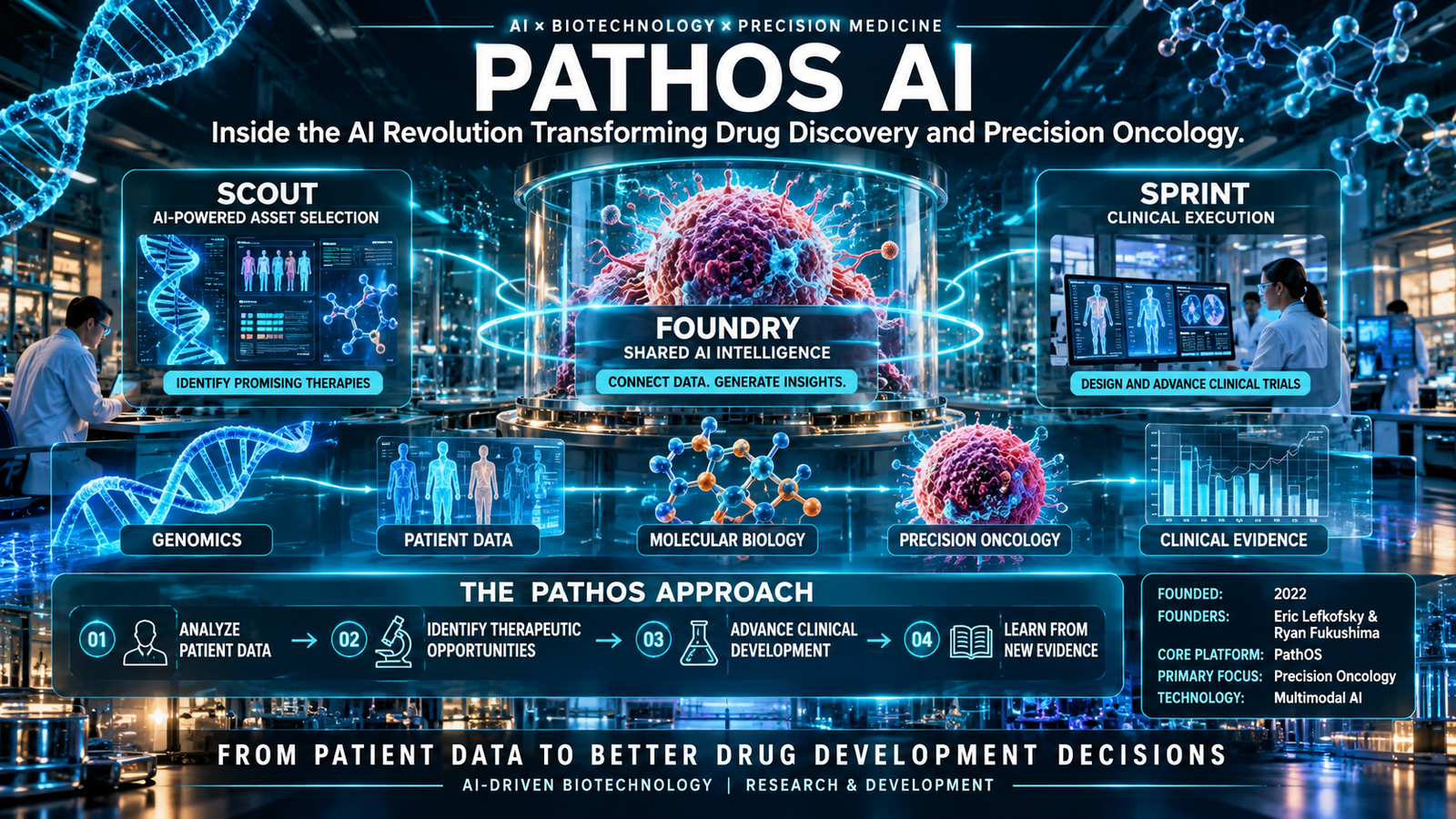
Pathos AI is a clinical-stage biotechnology company that uses artificial intelligence and large-scale patient data to improve cancer drug development, patient selection, and clinical trial decisions. Its PathOS platform connects three systems, Scout, Sprint, and Foundry, to identify promising therapies, guide clinical development, and learn from new scientific evidence.
At a Glance: Pathos AI
- Company: Pathos AI, Inc.
- Founded: 2022.
- Founders: Eric Lefkofsky and Ryan Fukushima.
- Headquarters: New York City, United States.
- Primary focus: AI-powered drug development, initially centered on precision oncology.
- Core technology: PathOS, consisting of Scout, Sprint, and Foundry.
- Data approach: Multimodal patient information, including clinical, genomic, imaging, and treatment-outcome data.
- Business model: Developing its own therapeutic pipeline and collaborating with pharmaceutical companies.
- Latest major funding: $237 million Series E announced October 23, 2026, at an approximately $3 billion post-money valuation. Pathos+2
What Is Pathos AI?
Pathos AI is an AI-native biotechnology company working to change how pharmaceutical companies discover, select, and develop medicines.
Traditional drug development often involves years of research, expensive clinical trials, and uncertain outcomes. One major challenge is identifying which patients are most likely to respond to a particular treatment.
Pathos approaches this problem through artificial intelligence, biological modeling, and large-scale patient datasets.
Instead of treating drug discovery as a collection of disconnected research activities, the company is developing an integrated system that connects scientific research with clinical development.
Its technology focuses on three interconnected activities:
- Identifying promising drug candidates and treatment opportunities.
- Selecting patient populations that may benefit from specific therapies.
- Improving clinical development decisions through continuous analysis of new evidence.
The company’s initial focus is oncology, particularly cancer treatments for patients who have limited options under existing standards of care.
An important distinction: Pathos AI is not a public-facing AI application. It is a biotechnology company using proprietary AI infrastructure to develop and advance therapeutic candidates.
Why Pathos AI Matters in Modern Biotechnology
Developing a successful medicine is difficult even when researchers understand the underlying disease.
A promising drug may fail because its clinical trial includes patients who are unlikely to respond. Another treatment may show meaningful benefits in a smaller biological subgroup that researchers initially overlooked.
These challenges create financial and scientific risks.
Pathos aims to address them by combining different categories of biological and clinical information.
For example, researchers can investigate relationships between:
- Genetic variations.
- Tumor characteristics.
- Medical imaging.
- Previous treatment responses.
- Clinical histories.
- Longitudinal patient outcomes.
Analyzing these information sources together can reveal patterns that individual datasets might miss.
However, identifying a promising pattern does not establish that a treatment works. Clinical studies must still demonstrate safety and efficacy.
That distinction is essential when evaluating any AI-driven drug development company.
How Does Pathos AI Work?
Pathos organizes its technology around the PathOS platform, which connects three major components: Scout, Sprint, and Foundry.
Our Platform | Pathos
The three components serve different purposes but operate as parts of one development system.
1. Scout: Identifying Promising Drug Opportunities
Scout is Pathos’s AI-enabled asset-selection engine.
Its purpose is to evaluate investigational therapies and identify opportunities where a particular treatment might benefit a specific patient population.
The system analyzes available evidence to help prioritize potential drug development programs.
Its intended activities include:
- Evaluating investigational drug candidates.
- Identifying potentially responsive patient subgroups.
- Examining biological and clinical evidence.
- Ranking development opportunities.
- Supporting decisions about which assets deserve further investment.
This approach addresses a fundamental pharmaceutical challenge: a treatment does not necessarily work equally well for every patient with the same diagnosis.
For example, two people with the same cancer type may have different molecular characteristics. A therapy might be more relevant to one subgroup than another.
Scout aims to help researchers identify these distinctions earlier.
Why it matters: Better patient stratification could help pharmaceutical developers design more focused clinical studies and avoid investing heavily in poorly matched treatment populations.
2. Sprint: Turning Research Into Clinical Progress
Sprint is the clinical-execution component of PathOS.
After Scout identifies a promising development opportunity, the program can move into a Sprint Pod.
Pathos describes these pods as small, focused teams that combine AI scientists, engineers, and clinical or translational experts.
Their responsibilities include:
- Designing biomarker-driven clinical trials.
- Evaluating clinical evidence.
- Supporting dose and development decisions.
- Monitoring progress toward clinical milestones.
- Making informed Go/No-Go decisions.
A Go/No-Go decision determines whether a development program should continue, change direction, or stop.
This matters because pharmaceutical companies cannot afford to advance every candidate indefinitely.
A treatment that produces weak evidence may require a different patient population, a revised study design, or discontinuation.
Sprint is designed to make those decisions more connected to available scientific evidence.
It does not eliminate clinical uncertainty or guarantee successful trials.
3. Foundry: The Shared AI Intelligence Layer
Foundry is the central AI infrastructure behind the PathOS platform.
It supports Scout and Sprint by analyzing information across development programs.
According to Pathos, Foundry combines an oncology foundation model with specialized AI capabilities and laboratory validation.
The company describes its approach as a continuous learning system.
In practical terms, this means information generated during one development program can potentially inform decisions in another.
Foundry is intended to work with multiple types of information, including:
- Clinical records.
- Genomic information.
- Medical imaging.
- Biological specimen data.
- Treatment outcomes.
- Clinical research evidence.
Pathos also describes using thousands of specialized AI agents to synthesize information and support development decisions. Pathos+1
The important distinction is that Foundry is not simply a chatbot answering medical questions.
It is designed as a scientific decision-support infrastructure connected to drug development.
What Makes Pathos AI Different?
The main difference is its attempt to connect AI-powered research with actual pharmaceutical development.
Many AI biotechnology companies concentrate on individual stages, such as identifying biological targets, designing molecules, or predicting drug properties.
Pathos places particular emphasis on connecting patient selection, clinical execution, and portfolio decisions.
Its approach has several distinguishing characteristics.
Multimodal Patient Data
Multimodal AI combines different types of information rather than relying on one data format.
In oncology, this can include genomic sequencing, pathology images, medical records, and treatment outcomes.
Combining these sources may help researchers identify relationships between tumor biology and treatment response.
Pathos states that it has access to more than 200 petabytes of multimodal oncology data linked to patient outcomes.
The company compares this volume with The Cancer Genome Atlas (TCGA), describing it as approximately 50 times larger.
These are company-reported figures. Data volume alone does not establish data quality, representativeness, or clinical usefulness. Pathos+1
Oncology Foundation Models
Foundation models are machine learning systems trained on extensive datasets to identify patterns and perform different related tasks.
In healthcare, specialized foundation models can analyze complex biological information.
Pathos identifies an oncology foundation model as the backbone of Foundry.
The company has described development of this model in partnership with Tempus and AstraZeneca.
However, detailed independent benchmarking, model architecture specifications, and publicly reproducible performance results are not available in the cited public descriptions.
This makes it important to distinguish the company’s technical positioning from independently demonstrated performance.
Lab-in-the-Loop Validation
AI predictions are only useful when they can be tested against biological evidence.
A lab-in-the-loop approach connects computational predictions with experiments performed in physical laboratories.
The process can work as follows:
- AI analyzes biological and clinical information.
- Researchers identify a promising scientific hypothesis.
- Laboratory experiments test that hypothesis.
- Experimental results provide additional evidence.
- Researchers use the findings to refine subsequent decisions.
This connection between computational research and laboratory testing is particularly important in biotechnology.
It helps prevent AI-generated predictions from being treated as established scientific discoveries.
AI-Assisted Clinical Development
Pathos also focuses on decisions made after a potential drug has entered development.
These include selecting appropriate patient groups, designing clinical studies, and evaluating whether a treatment should advance.
This creates a broader proposition than using AI exclusively for molecular discovery.
Pathos AI’s Main Applications
Pathos AI’s technology is primarily designed for biotechnology and pharmaceutical research.
Its potential applications include several important areas.
Precision Oncology
Precision oncology aims to match cancer treatments with the biological characteristics of individual patients or patient subgroups.
Pathos uses multimodal data analysis to investigate which therapies may be more relevant to particular cancer populations.
For example, researchers might examine whether a molecular biomarker is associated with a different response to treatment.
AI can help identify these relationships, although clinical validation remains necessary.
Patient Stratification
Patient stratification involves dividing a clinical population into groups based on relevant characteristics.
These characteristics may include:
- Genetic mutations.
- Biomarker expression.
- Disease progression.
- Previous treatment history.
- Molecular profiles.
Better patient selection could improve clinical trial design and help researchers investigate treatment effectiveness in more relevant populations.
Clinical Trial Design
Clinical trials require careful decisions about eligibility criteria, endpoints, patient populations, and treatment protocols.
AI can help researchers examine complex datasets when making these decisions.
Pathos’s Sprint engine is intended to support biomarker-driven trial design and development milestones.
The potential benefit is more informed decision-making, rather than automatically replacing clinical researchers.
Pharmaceutical Portfolio Management
Drug developers must decide which assets deserve additional research investment.
These decisions involve scientific evidence, development costs, commercial opportunities, and clinical risks.
Pathos aims to use Foundry and Scout to help prioritize these opportunities.
This is especially relevant when pharmaceutical companies manage multiple investigational treatments simultaneously.
Pathos AI’s Business Model
An important part of understanding Pathos AI is recognizing that it is both a technology company and a drug developer.
It is not simply selling access to an AI application.
Its business strategy combines two broad activities.
Developing Its Own Drug Pipeline
Pathos identifies and advances therapeutic assets through its AI-enabled development infrastructure.
The company can evaluate investigational therapies, acquire or license promising assets, and guide their clinical development.
This means its commercial success depends partly on the progress of its own therapeutic programs.
Pharmaceutical Partnerships
Pathos also collaborates with established pharmaceutical and biotechnology companies.
These relationships can involve licensing agreements, research collaborations, access to technology, and joint development activities.
This model gives Pathos opportunities to apply its AI infrastructure beyond its internally managed pipeline.
It also creates potential commercial value through collaboration rather than relying exclusively on future drug sales.
Pathos AI’s Latest Developments in 2026
Pathos has experienced significant developments during 2026.
The most important announcements concern its financing, therapeutic pipeline, and expansion into neurological research.
2026 COMPANY ANNOUNCEMENTS AND REPORTED DEVELOPMENTS
- August 2026: JSKN016 licensing agreementPathos announced an agreement with Alphamab Oncology concerning JSKN016, a TROP2/HER3 bispecific antibody-drug conjugate.The agreement covers development and commercialization rights outside mainland China, Hong Kong, Macau, and Taiwan. The announced financial terms include a $125 million upfront payment and potential milestone payments. Pathos
- October 23, 2026: $237 million Series EPathos announced a $237 million Series E financing round led by Bristol Myers Squibb, with an approximately $3 billion post-money valuation.The company said the funding would support its platform and oncology development pipeline. pathos.com+1
- October 23, 2026: Expansion into neurological researchPathos announced collaborations with Bristol Myers Squibb and Tempus AI focused on Alzheimer’s disease and other neurological conditions.The announcement included a five-year, $55 million agreement to license a de-identified neurological patient dataset from Tempus.Bristol Myers Squibb also received strategic access to Pathos’s Foundry platform under the announced arrangements. pathos.com+1
Why These Developments Matter
The 2026 announcements indicate that Pathos is pursuing a broader role in pharmaceutical research.
Its original emphasis was precision oncology. Its neurological research collaborations suggest an opportunity to apply similar data-driven approaches to other complex diseases.
The Series E financing also provides substantial capital for further platform development and clinical advancement.
However, funding, partnerships, and platform expansion should not be confused with proven clinical success.
The ultimate test remains whether Pathos can advance effective therapies through rigorous clinical evaluation.
Pathos AI Competitors and Alternatives
Pathos operates in a competitive AI biotechnology market.
However, not every AI drug discovery company offers the same technology or business model.
Some focus on designing new molecules. Others concentrate on biological research, automated laboratory experimentation, or clinical development.
The following companies provide useful comparisons.
Comparison based on publicly described company positioning, not a ranking of performance.
| Company / Platform | Primary Focus | Target Users | Main Strength | Pricing Transparency |
|---|---|---|---|---|
| Pathos AI / PathOS | Precision oncology and clinical development | Biopharma companies and research organizations | Patient data, AI selection, clinical execution | No public self-service pricing |
| Recursion Pharmaceuticals | AI-driven drug discovery and development | Pharmaceutical companies and researchers | Automated experimentation and biological modeling | No standard public platform pricing |
| Insilico Medicine | Generative AI drug discovery | Biotech and pharmaceutical companies | Biology, chemistry, and clinical development tools | Partnership-based commercial arrangements |
| Isomorphic Labs | Computational drug discovery | Pharmaceutical partners | AI-driven molecular and biological modeling | No standard public platform pricing |
| Formation Bio | Technology-enabled drug development | Biopharma and pharmaceutical partners | Technology-led clinical development | No standard public platform pricing |
Recursion+3
Pathos AI vs. Recursion
Recursion Pharmaceuticals has a prescription for high drug costs: AI and 25 petabytes of data – MarketWatch
Recursion Pharmaceuticals
Recursion combines machine learning, large-scale biological datasets, and automated laboratory experimentation.
Its platform connects biological discovery with therapeutic development. This creates overlap with Pathos, although their technical strategies and operational priorities differ.
Pathos places particular emphasis on oncology patient selection and clinical execution.
Recursion emphasizes an integrated discovery system connecting computational predictions with experimental biology. Recursion+1
Pathos AI vs. Insilico Medicine
ACS Central Science | Researchers from Insilico Medicine and Lilly publish foundational vision for fully autonomous “Prompt-to-Drug” pharmaceutical R&D
Insilico Medicine
Insilico Medicine develops generative AI technology for biology, chemistry, and drug development.
Its Pharma.AI platform supports the discovery and development of potential drug candidates.
The distinction is primarily strategic.
Insilico is strongly associated with AI-assisted target identification and molecular design. Pathos emphasizes multimodal patient evidence, therapeutic asset selection, and clinical development.
Pathos AI vs. Isomorphic Labs
News – Isomorphic Labs
Isomorphic Labs
Isomorphic Labs applies advanced computational methods to biological and molecular problems.
Its approach is particularly relevant to AI-powered drug design and understanding molecular interactions.
Pathos’s differentiation is its emphasis on patient-level clinical evidence and the development of therapeutic assets.
Which is the closest alternative? Recursion is a useful comparison for integrated AI-driven drug discovery, while Insilico Medicine is relevant for generative drug development. Neither is an exact replacement for Pathos’s operating model.
Benefits of Pathos AI
Pathos’s approach addresses several challenges in pharmaceutical development.
1. More Informed Drug Selection
AI can analyze large collections of biological and clinical evidence to identify promising therapeutic opportunities.
This may help researchers prioritize candidates with stronger supporting evidence.
2. Better Patient Matching
Identifying the right patient population is essential in precision medicine.
Pathos aims to use multimodal information to identify subgroups that may respond differently to specific treatments.
3. Connected Research and Clinical Development
Its Scout, Sprint, and Foundry architecture connects asset selection, clinical execution, and shared intelligence.
This can reduce fragmentation between different stages of development.
4. Continuous Scientific Learning
A connected platform can incorporate new findings from clinical programs and laboratory experiments.
In principle, this could improve future decisions across multiple development programs.
5. Pharmaceutical Collaboration Opportunities
Pathos’s partnerships create opportunities to work with established pharmaceutical organizations.
These relationships may help expand access to scientific expertise, datasets, and development resources.
Limitations and Challenges of Pathos AI
Despite its potential, Pathos AI faces challenges that are important for investors, researchers, and pharmaceutical partners.
Clinical Validation Is Still Essential
AI predictions do not prove that a drug is safe or effective.
A promising model output must be evaluated through appropriate laboratory studies and clinical trials.
Data Quality Can Affect Predictions
Large datasets are not automatically reliable datasets.
Incomplete patient records, inconsistent measurements, population bias, and missing clinical information can influence model performance.
Limited Public Technical Transparency
Pathos describes its platform and its major components publicly.
However, important technical details remain undisclosed or insufficiently documented for independent evaluation.
These include detailed model specifications, reproducible benchmarks, and comprehensive technical validation results.
Drug Development Remains Expensive
AI may help improve research decisions, but pharmaceutical development still requires substantial financial resources.
Clinical trials, regulatory submissions, laboratory validation, and manufacturing remain complex activities.
No Guarantee of Regulatory Approval
An AI-selected therapy must still meet applicable regulatory requirements.
The FDA and other regulators evaluate evidence of safety, efficacy, and manufacturing quality. AI involvement does not remove these requirements.
Pathos AI Pricing: Is It Free?
Pathos AI does not appear to offer a conventional public subscription product.
There is no publicly listed consumer pricing structure comparable to ChatGPT, Midjourney, or other self-service AI applications.
Its business model is oriented toward pharmaceutical development, licensing, and strategic collaborations.
This distinction matters because searching for a Pathos AI free trial or monthly subscription may create confusion.
For pharmaceutical organizations interested in its technology, commercial arrangements would need to be discussed directly with the company.
| Pricing question | Public information |
|---|---|
| Free consumer plan | Not publicly listed |
| Monthly subscription | Not publicly listed |
| Public API pricing | Not publicly listed |
| Enterprise licensing | Requires direct commercial discussion |
| Pharmaceutical partnerships | Negotiated agreements |
There is also no publicly documented self-service developer API or SDK in the company’s platform materials.
Pathos AI Privacy and Data Security
Healthcare data requires particularly careful handling.
Patient information can contain sensitive details about medical histories, diagnoses, treatments, and genetic characteristics.
Pathos describes using multimodal patient data and de-identified datasets in its research infrastructure.
Its October 2026 neurological collaboration announcement specifically references a de-identified dataset supplied through Tempus. Pathos+1
However, de-identification alone does not answer every privacy question.
Organizations evaluating the platform should request information about:
- Patient consent and lawful data use.
- Data provenance and licensing.
- De-identification standards.
- Access controls and audit logging.
- Data retention and deletion procedures.
- Third-party data processing.
- Cross-border data transfers.
- Applicable healthcare privacy requirements.
It is also important not to assume that a company has SOC 2 certification or Zero Data Retention simply because it uses enterprise-grade technology.
Those claims require separate verification.
Who Should Use or Evaluate Pathos AI?
Pathos is primarily relevant to organizations working in pharmaceutical research and development.
Fighting the war at Ohio State | Ohio State Health & Discovery
Biotechnology Companies
Organizations developing oncology therapies may find its patient-selection and clinical-development approach relevant.
bioaccess® | Clinical Research in Latin America
Pharmaceutical Companies
Drug developers managing multiple investigational assets may evaluate its AI-assisted portfolio and clinical decision-making capabilities.
Healix Technologies — Healthcare Research, Innovation & AI Diagnostics
Clinical and Translational Researchers
Research teams investigating biomarkers, treatment response, and patient subgroups may find the underlying approach relevant.
Thomas Rusca – XENIS AG | LinkedIn
Biotech Investors and Industry Analysts
Investors can examine its platform, clinical pipeline, licensing strategy, partnerships, and capital requirements.
Who Is Pathos AI Not Designed For?
Pathos is not positioned as a general-purpose productivity assistant.
It is not intended to replace:
- Everyday AI chatbots.
- AI writing applications.
- Image-generation tools.
- Consumer medical advice applications.
- Personal healthcare diagnosis services.
Patients should not interpret the company’s research technology as an individual treatment recommendation.
How to Evaluate Pathos AI Before a Partnership
Organizations considering a relationship with Pathos should look beyond platform descriptions and funding announcements.
A practical evaluation should cover five areas.
1. Scientific validation: Request evidence showing how AI-generated recommendations are evaluated against laboratory and clinical findings.
2. Model performance: Ask about independent validation, dataset representativeness, reproducibility, and performance across different patient populations.
3. Clinical outcomes: Examine whether platform-assisted decisions have translated into measurable improvements in clinical development.
4. Commercial terms: Understand licensing rights, data access, ownership of discoveries, intellectual property, and financial obligations.
5. Data governance: Review privacy controls, data provenance, contractual responsibilities, and security documentation.
These questions help separate an interesting technology proposition from a commercially and scientifically validated solution.
Frequently Asked Questions
1. What is Pathos AI used for?
Pathos AI uses artificial intelligence and multimodal patient data to support drug discovery, precision oncology, patient stratification, and clinical development. Its PathOS platform connects Scout, Sprint, and Foundry to support therapeutic selection and clinical decision-making.
2. Is Pathos AI a chatbot or an AI assistant?
No. Pathos AI is a biotechnology company, not a consumer chatbot. Its AI technology is designed to support pharmaceutical research, drug development, and clinical decision-making.
3. What is the PathOS platform?
PathOS is Pathos AI’s integrated drug development platform. It consists of Scout for asset selection, Sprint for clinical execution, and Foundry as the shared AI intelligence layer.
4. Is Pathos AI free to use?
Pathos does not publicly advertise a conventional free consumer plan or monthly subscription. Its business model focuses on therapeutic development and pharmaceutical collaborations rather than general-purpose consumer software.
5. Who founded Pathos AI?
Pathos AI was founded in 2022 by Eric Lefkofsky and Ryan Fukushima. The company is headquartered in New York City and focuses on AI-enabled biotechnology and drug development.
Conclusion
Pathos AI represents an interesting approach to combining artificial intelligence with pharmaceutical research.
Its PathOS platform connects three important activities: identifying promising therapeutic assets, guiding clinical development, and learning from multimodal scientific evidence.
Its emphasis on precision oncology makes it particularly relevant to biotechnology companies and pharmaceutical researchers.
The company’s 2026 financing and strategic collaborations also demonstrate growing commercial interest in its technology.
However, investment, partnerships, and impressive data volumes are not substitutes for clinical evidence.
The most important questions concern the platform’s independently validated performance, its ability to improve development decisions, and whether its therapeutic programs ultimately demonstrate meaningful patient benefits.
For organizations evaluating AI-driven biotechnology, Pathos deserves attention as a drug development company rather than another general-purpose AI tool.