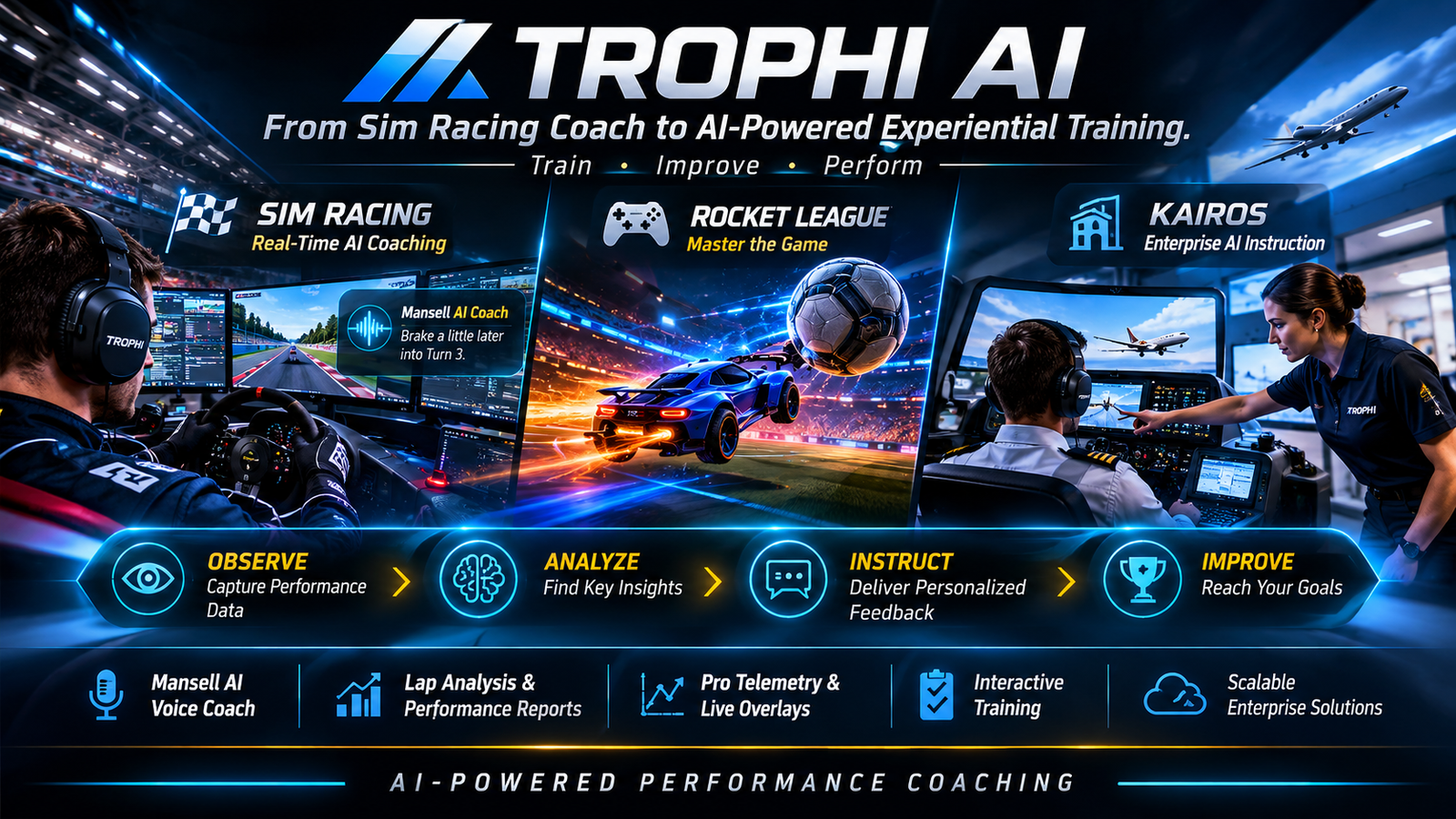
Trophi AI is an AI-powered coaching platform for sim racing, Rocket League, and enterprise training. It uses performance data and AI feedback to help users analyze mistakes, improve skills, and train smarter.
Trophi AI at a Glance
- What it is: An AI coaching and experiential training technology company.
- Original specialty: Real-time coaching for sim racing.
- Gaming products: Sim racing coaching and Rocket League training.
- Enterprise platform: Kairos, an AI instruction platform for practical training and operations.
- Key technology: Performance monitoring, contextual feedback, AI-assisted instruction, and session analysis.
- Pricing: Free and paid Rocket League plans, annual sim racing subscriptions, and custom enterprise pricing for Kairos.
What Is Trophi AI?
Trophi AI is an artificial intelligence company that develops coaching technology for practical skill development. Its software observes performance, identifies mistakes, and delivers personalized instructions to help users improve.
Unlike a conventional AI chatbot, Trophi.ai focuses on what people actually do rather than simply answering questions. Its technology connects performance data with coaching recommendations, making feedback relevant to real activities.
The company originally developed its technology around sim racing. Racing simulators provide measurable information about braking, acceleration, steering, vehicle speed, and driving consistency. This creates an environment where AI can analyze performance and provide specific coaching.
Trophi.ai’s approach draws on the expertise of Scott Mansell, a former racing driver and founder of Driver61. CEO Mike Winter and Mansell helped develop the company’s vision of making expert instruction available to more learners.
The company is headquartered in St. John’s, Newfoundland and Labrador, Canada.
Its technology has since expanded beyond racing. Trophi.ai now offers Rocket League coaching and Kairos, an enterprise platform designed to help organizations build and deliver AI-guided experiential training.
An important distinction is that Trophi.ai is the company, while Kairos is its broader AI instruction platform. Its consumer coaching products and enterprise technology serve different audiences.
How Does Trophi AI Work?
Trophi.ai follows a performance-based coaching model. It observes an activity, interprets relevant information, and provides guidance that users can apply.
The process involves three main stages.
1. Collecting Performance Data
The software gathers information from supported activities.
In sim racing, relevant data can include:
- Braking pressure and timing
- Throttle application
- Vehicle speed
- Steering inputs
- Gear selection
- Cornering behavior
- Lap and sector times
In Rocket League, the platform analyzes gameplay information, including player movement, positioning, boost usage, and important match events.
Kairos extends this approach to more complex training environments. Depending on the implementation, it can work with simulator telemetry, voice, video, and other performance signals.
2. Analyzing Performance With AI
After collecting information, the system evaluates performance against relevant coaching objectives or standards.
For example, a sim racer might repeatedly lose time because they brake too early before a corner. AI-assisted analysis can identify this pattern and highlight the opportunity to improve.
In an enterprise training environment, the system can evaluate learner actions against standards established by subject-matter experts.
The goal is to identify meaningful mistakes rather than overwhelm learners with every available data point.
3. Delivering Personalized Feedback
The final stage involves turning observations into useful instructions.
Depending on the product, feedback can include:
- Real-time voice coaching
- Lap analysis reports
- Telemetry comparisons
- Gameplay summaries
- Interactive training lessons
- Performance recommendations
- Training-session debriefs
This creates a continuous improvement cycle:
Practice → Analyze → Receive Feedback → Apply Corrections → Practice Again
The advantage is that learning becomes connected to actual performance instead of relying entirely on theoretical explanations.
Main Features of Trophi AI
Trophi.ai provides different capabilities across sim racing, Rocket League, and enterprise training.
1. Mansell AI Voice Coach
One of Trophi.ai’s most recognizable features is Mansell, its AI voice coach.
The feature delivers spoken coaching during supported sim racing sessions. Instead of waiting until a race finishes, drivers can receive guidance while driving.
Its coaching capabilities include:
- Real-time voice instructions
- Corner-by-corner feedback
- Brake Point Assist
- Pace Notes
- Real-Time Skill Analysis
This approach is particularly useful for beginners who struggle to interpret complicated telemetry graphs.
Drivers can concentrate on the racing experience while receiving relevant instructions through their headset.
2. Lap Analysis and Performance Reports
Lap analysis helps drivers understand where they lose time.
Instead of focusing exclusively on the final lap time, users can examine individual sections and compare their performance.
The analysis can help identify problems involving braking, corner entry, apex speed, and acceleration.
This is useful when a driver repeatedly struggles with the same corner or cannot understand why their lap times remain inconsistent.
3. Pro Telemetry and Live Overlays
Telemetry provides measurable information about vehicle behavior and driver inputs.
Trophi.ai offers tools for examining:
- Brake pressure
- Throttle input
- Vehicle speed
- Gear selection
- Steering behavior
These indicators help drivers understand what happens during different stages of a lap.
The distinction between telemetry and coaching is important. Telemetry shows what happened, while coaching attempts to explain what the driver should change.
4. Rocket League AI Coaching
Trophi.ai has also expanded its coaching technology into Rocket League.
This product applies performance-based AI training to a competitive game where mechanics, positioning, and decision-making influence results.
Its published features include:
- Mansell AI Voice Coach
- Mechanic training
- Interactive mini-games
- Step-by-step lessons
- Match analysis
- Important gameplay moments playback
- Performance statistics and trends
- Workshop maps
The platform provides training for different skill levels.
According to its official website, its analysis supports players from Bronze through Grand Champion. Much of its training content targets players between Gold and Champion.
Its free plan provides starter mechanic training, match playback, post-match analysis, and workshop maps. Premium adds access to the complete training library.
5. Kairos: Enterprise AI Instruction Platform
Kairos represents a significant expansion of Trophi.ai’s technology.
It is designed for organizations that need to deliver practical training at scale without depending entirely on individual human instructors.
The platform allows subject-matter experts to build training experiences using their own knowledge, standards, and instructional requirements.
Kairos Foundry
Foundry helps experts create structured training experiences.
Its capabilities include:
- Developing lesson objectives
- Creating interactive lessons
- Building training scenarios
- Generating part-task simulators
- Defining coaching criteria
- Establishing evaluation standards
Kairos Instruct
Instruct focuses on delivering guidance during practical activities.
Its capabilities include:
- Real-time instruction
- Performance monitoring
- Contextual feedback
- Learner evaluation
- Post-session debriefs
Kairos Insights
The platform also supports reviewing training sessions and identifying recurring problems.
Instructors can examine what happened during a session, understand the reasoning behind coaching interventions, and improve training material.
Kairos identifies several potential application areas:
- Commercial aviation
- Defence
- Drone operations
- Autonomous systems
- Marine operations
- Industrial environments
The platform describes cloud, on-premises, hybrid, and disconnected deployment possibilities. Organizations should confirm the availability and configuration of these options during technical evaluation.
Trophi AI Products: Understanding the Differences
The Trophi.ai ecosystem serves several markets, so it is important to understand what each product offers.
| Product | Target audience | Main purpose |
|---|---|---|
| Sim Racing | Racing enthusiasts | Improve driving technique and lap times |
| Rocket League | Competitive gamers | Improve mechanics and gameplay decisions |
| Kairos | Enterprises and training organizations | Build and deliver AI-guided practical training |
A sim racer generally needs telemetry analysis and driving feedback.
An aviation training organization needs controlled instruction, simulator integration, practical evaluation, and instructor oversight.
These are different requirements, even though both products use AI-assisted coaching.
Trophi AI Pricing: How Much Does It Cost?
Trophi.ai offers different pricing structures depending on the product.
Its sim racing subscriptions use annual billing options, while Rocket League provides a free entry-level plan and a paid subscription.
Kairos follows an enterprise sales model.
The following prices reflect the published USD annual offers and pricing information checked in November 2026. Promotions and checkout totals may change.
Sim Racing Pricing
| Plan | Monthly equivalent | Annual charge |
|---|---|---|
| Premium | $7.50 | $89.99 |
| Premium + Setups | $16.66 | $199.99 |
| Team | $20.83 | $249.99 |
| Professional | $58.33 | $699.99 |
Premium includes AI voice coaching, lap analysis, telemetry, live overlays, and supported game access.
Premium + Setups adds Grid & Go data packs, including professional iRacing setups, telemetry data, and reference laps.
Team includes three Premium licenses, making it suitable for friends and small racing groups.
Professional includes Premium + Setups features, monthly one-to-one coaching through Driver61, and weekly group coaching opportunities.
Premium offers a seven-day free trial. The company also advertises a 30-day money-back guarantee through its stated refund process.
One important detail is that the displayed monthly equivalents represent annual subscription pricing. They should not be confused with confirmed monthly billing options.
Rocket League Pricing
Rocket League has a separate subscription structure.
| Plan | Price | Main offering |
|---|---|---|
| Basic | Free | Starter training and match analysis |
| Premium | $6/month equivalent | Full training library and additional features |
The Premium subscription is billed annually at $72 and includes a seven-day free trial.
The Basic plan includes:
- Starter mechanic training
- Mansell AI Voice Coach
- Match playback
- Unlimited post-match analysis
- AI summaries
- Gameplay statistics
- Workshop maps
Premium adds access to the complete library of more than 80 AI mechanic lessons, mini-games, and professional training packs.
Kairos Enterprise Pricing
Kairos does not publish a standard subscription price on its main product page.
Organizations interested in adopting the platform must contact Trophi.ai for commercial information.
Enterprise pricing may depend on:
- Number of learners
- Training environments
- Simulator integrations
- Deployment requirements
- Custom training development
- Implementation and support requirements
Businesses should request a detailed proposal before comparing Kairos with other enterprise training platforms.
Official pricing pages:
- Sim Racing: https://www.trophi.ai/sim-racing/pricing/
- Rocket League: https://www.trophi.ai/pricing-rocket-league
- Kairos: https://www.trophi.ai/kairos/
Benefits of Using Trophi AI
Trophi.ai offers several potential advantages for people who want structured, performance-focused learning.
More Actionable Feedback
Traditional tutorials explain techniques, but they cannot automatically identify mistakes in every user’s performance.
Trophi.ai attempts to address this problem by connecting coaching recommendations with actual activity data.
Personalized Learning
Users can receive recommendations based on their own performance instead of following identical instructions regardless of their skill level.
This can make practice more relevant and focused.
Faster Identification of Mistakes
Analyzing telemetry or reviewing entire gameplay sessions manually can take time.
AI-assisted analysis helps highlight areas that deserve attention.
More Consistent Practice
An AI coach can provide repeatable guidance across multiple sessions.
This is useful when a human instructor is unavailable for every practice attempt.
Scalable Enterprise Training
Kairos extends the same principle beyond gaming.
Organizations can potentially make expert knowledge available to more learners without requiring an instructor to supervise every repetition individually.
However, actual training outcomes depend on the quality of the underlying standards, performance data, integrations, and human oversight.
Limitations and Things to Consider
Despite its potential, Trophi.ai is not automatically suitable for everyone.
Understanding its limitations is essential before purchasing a subscription or adopting the enterprise platform.
1. Platform Compatibility
The consumer applications are currently PC-focused.
The sim racing pricing page identifies iRacing Road, Assetto Corsa Competizione, Le Mans Ultimate, and supported F1 titles.
The exact F1 versions listed can vary between product pages. Therefore, drivers should verify their game version before subscribing.
Trophi.ai also explains that telemetry from supported F1 console games can be imported into the application running on a PC. This does not mean the complete application runs natively on PlayStation or Xbox.
Rocket League also requires a PC-based application.
2. AI Recommendations Need Practical Validation
AI-generated coaching is not automatically correct in every situation.
Driving performance depends on vehicle setup, tire conditions, track temperature, traffic, and driving style.
A recommendation that works in one scenario may not produce the same result in another.
Users should evaluate recommendations through repeated practice rather than blindly following every instruction.
3. Subscription Costs
The annual billing structure may not suit users who only want occasional coaching.
Even when the monthly equivalent looks affordable, the initial annual payment is an important consideration.
The Rocket League free plan provides a lower-risk starting point, but sim racing has a different subscription structure.
4. Enterprise Implementation Complexity
Kairos addresses more complicated training requirements.
Organizations may need to evaluate simulator compatibility, data integration, deployment architecture, instructional standards, and operational support.
These requirements can make enterprise implementation more involved than installing a consumer application.
5. Privacy and Data Governance
Performance coaching may involve telemetry, gameplay records, voice interactions, and training-session information.
Organizations should understand how these records are collected, processed, stored, and accessed.
The public product descriptions are not enough to establish specific security certifications or data-retention guarantees.
Enterprise buyers should request documentation covering:
- Data collection and processing
- Retention and deletion policies
- Access controls
- Encryption practices
- Third-party service providers
- Data residency
- On-premises deployment
- Zero Data Retention availability, if required
Do not assume that an available deployment option or general security statement automatically establishes SOC 2 certification or Zero Data Retention.
Trophi AI vs. Competitors: Which Tools Are Worth Comparing?
Trophi.ai operates in multiple markets, so its alternatives depend on the intended use.
For sim racing, relevant comparisons include telemetry analysis, AI driving coaches, reference laps, and professional coaching platforms.
Sim Racing Competitor Comparison
| Platform | Target user | Key strength | Pricing transparency | Main limitation |
|---|---|---|---|---|
| Trophi.ai | Sim racers | Real-time AI voice coaching | Published subscription plans | PC-focused application |
| Coach Dave Delta | Intermediate and advanced drivers | AI insights, professional setups, and telemetry | Published monthly and annual pricing | Broader feature set may be unnecessary for basic coaching |
| Virtual Racing School | Competitive sim racers | Reference laps, telemetry, and structured coaching | Free and paid plans | Requires more driver involvement in interpreting performance data |
1. Coach Dave Delta
Coach Dave Delta combines AI coaching with professional setups, telemetry, reference laps, and video analysis.
Its Auto Insights feature examines individual corner phases, including braking, entry, apex, and exit.
It helps drivers understand where they lose time and what adjustments could improve their performance.
The platform also offers a broader toolkit for drivers who want setups and data analysis alongside AI coaching.
Choose it when: You want professional setups, detailed corner analysis, and a broader sim racing toolkit.
Official website: https://coachdaveacademy.com/delta/
2. Virtual Racing School
Virtual Racing School is another relevant option, particularly for iRacing competitors.
Its coaching ecosystem focuses on reference data, telemetry comparisons, and structured driver development.
Drivers can study faster laps and understand how their driving differs from experienced competitors.
Its pricing includes a free Casual plan, a Dedicated plan, and a Competitive plan.
Choose it when: Your priority is detailed telemetry analysis, reference data, and structured competitive improvement.
Official website: https://virtualracingschool.com/
Which Competitor Should You Choose?
There is no universal winner.
The right choice depends on how you prefer to learn.
- Choose Trophi.ai for real-time voice coaching and guided practice.
- Choose Coach Dave Delta for professional setups and detailed performance analysis.
- Consider Virtual Racing School for reference-driven learning and telemetry comparisons.
For Rocket League, evaluate Trophi.ai against dedicated mechanic-training tools and coaching workflows used by competitive players.
For Kairos, consumer sim racing applications are not meaningful enterprise alternatives. Organizations should compare it with simulation-based training platforms according to their specific operational requirements.
How Trophi AI Uses Artificial Intelligence
One of the most interesting aspects of Trophi.ai is its focus on performance intelligence rather than general-purpose text generation.
Understanding this distinction helps explain its technical value.
Performance Data and Machine Learning
Machine learning systems can identify patterns in large amounts of structured information.
In sim racing, telemetry provides measurable signals that describe driver behavior.
For example, an AI coaching system can examine:
- How early a driver brakes.
- How quickly throttle input increases.
- Whether steering corrections are excessive.
- How cornering speed changes.
- Where time is lost relative to a reference lap.
These signals provide a foundation for more specific feedback.
Real-Time AI Inference
Inference is the process through which an AI system produces an output after receiving input data.
For a real-time coaching system, timing matters.
A recommendation that arrives after a driving decision may be less useful than feedback delivered while the driver can still respond.
Kairos also emphasizes real-time instruction, where the system observes an activity and intervenes when relevant.
Its platform describes continuously processing telemetry, voice, and video signals. Its published technical material also identifies telemetry processing of up to 60 Hz.
These are company-described capabilities, not independently verified benchmarks across every deployment.
Context-Aware Instruction
Generic advice is often insufficient for practical training.
Consider two drivers approaching the same corner. One brakes too early, while the other enters too quickly.
Both need different corrections.
A useful coaching system must interpret the situation before suggesting an action.
Kairos takes this principle further by allowing organizations to define standards, scenarios, and expert judgment that guide the instruction.
Why This Is Different From a General AI Chatbot
A general-purpose chatbot responds primarily to prompts and conversational context.
Performance coaching requires information about what someone actually did.
The underlying system therefore needs access to relevant activity data, an understanding of performance standards, and a way to translate observations into useful instructions.
Trophi.ai’s value proposition is not simply that it uses AI. It connects AI assistance to practical performance.
However, the company does not publicly disclose enough technical detail to establish its complete model architecture, training datasets, or the exact division of work between machine-learning models and other software components.
It would be inaccurate to claim that Trophi.ai relies on a particular LLM, RAG architecture, or proprietary foundation model without further documentation.
Latest Trophi AI Developments in 2026
Trophi.ai’s recent development shows a broader move from consumer coaching toward enterprise AI instruction.
Several developments are particularly relevant.
March 2026: Federal Development Funding
On March 3, 2026, Trophi.ai announced a $950,000 repayable contribution from the Government of Canada through the Atlantic Canada Opportunities Agency.
The funding was intended to support marketing and product development.
The announcement described the company’s AI coaching work across gaming and simulation.
This is a company-announced funding development, not evidence of a specific product performance improvement.
May 2026: AI Compute Access Fund
On May 12, 2026, Trophi.ai announced that it had been selected as one of 44 Canadian companies receiving support through the AI Compute Access Fund.
The company described the funding as support for compute-intensive AI and machine-learning workloads.
Its announcement also discussed extending coaching technology from sim racing into Rocket League.
This development highlights an important infrastructure consideration: real-time AI coaching can require substantial processing resources, especially when systems must interpret continuous performance data.
November 2026: Kairos and Enterprise Expansion
The company’s current positioning places Kairos at the center of its broader AI instruction strategy.
Rather than limiting its technology to gaming, Trophi.ai is targeting industries where practical skills, real-time decisions, and experienced human judgment are important.
Aviation, defence, drone operations, and industrial environments are among its stated application areas.
This is a meaningful strategic expansion. However, organizations should distinguish between the company’s stated target markets and independently documented commercial deployments.
Who Should Use Trophi AI?
Trophi.ai is not designed for one universal audience.
Its suitability depends on the user’s activities and goals.
| User type | Potential suitability | Reason |
|---|---|---|
| Beginner sim racers | High | Structured driving feedback |
| Experienced sim racers | High | Telemetry and detailed analysis |
| Rocket League beginners | High | Mechanic lessons and guided training |
| Competitive Rocket League players | Moderate to high | Gameplay analysis and targeted practice |
| Esports teams | Potentially high | Shared coaching and performance development |
| Aviation training organizations | Enterprise evaluation | AI-guided experiential instruction |
| Industrial training teams | Enterprise evaluation | Scenario-based and performance-focused training |
| Casual gamers | Depends | Subscription may not justify occasional use |
Who May Benefit Most?
Sim racers who practice regularly and want to understand their driving mistakes may find the coaching workflow particularly useful.
Rocket League players who struggle with mechanics or consistent gameplay can explore the structured training options.
Enterprise training managers should evaluate Kairos when instructor availability, repeatable training, and expert knowledge retention are important concerns.
However, casual users who play occasionally may not benefit enough to justify a recurring subscription.
Common Mistakes to Avoid When Evaluating Trophi AI
Before choosing a subscription or enterprise solution, avoid these common mistakes.
- Confusing the products: Sim racing, Rocket League, and Kairos serve different markets.
- Ignoring annual billing: Compare the actual amount charged rather than the displayed monthly equivalent.
- Assuming every game is supported: Verify the exact title, version, and supported content.
- Treating AI feedback as unquestionable: Recommendations should be evaluated against actual results.
- Confusing company claims with independent results: Published user counts and performance improvements require appropriate context.
- Ignoring data governance: Enterprise customers should request detailed documentation about privacy, retention, and deployment.
- Comparing unrelated alternatives: A telemetry application is not necessarily a replacement for an enterprise training platform.
These checks can prevent unnecessary spending and help buyers identify the capabilities they actually need.
Frequently Asked Questions
1. What is Trophi AI used for?
Trophi AI is used for AI-powered coaching and practical skill development. Its products help sim racers and Rocket League players analyze performance, receive personalized feedback, and improve through structured training. Its Kairos platform extends AI instruction into enterprise training environments.
2. Is Trophi AI free to use?
Trophi.ai offers a free Basic plan for Rocket League, including starter training and match analysis. Its sim racing product offers a seven-day Premium trial. Paid subscriptions provide additional features, and Kairos uses an enterprise sales model.
3. Does Trophi AI work with iRacing?
Yes. Trophi.ai supports iRacing Road and offers AI voice coaching, telemetry, lap analysis, and performance feedback. Drivers should check the current compatibility documentation for supported cars and tracks.
4. What is Kairos by Trophi AI?
Kairos is Trophi.ai’s enterprise AI instruction platform. It allows organizations to build practical training experiences, provide real-time coaching, evaluate learner performance, and review training sessions. Its target industries include aviation, defence, drones, and industrial operations.
5. Is Trophi AI worth paying for?
Trophi.ai may be worthwhile for people who regularly practice sim racing or Rocket League and want personalized performance feedback. However, its value depends on game compatibility, coaching quality, subscription costs, and individual training habits. Enterprise buyers should separately evaluate Kairos against their operational and security requirements.
Conclusion
Trophi.ai represents an interesting application of artificial intelligence because it connects coaching with measurable performance.
Its sim racing product focuses on driving technique, telemetry, and real-time voice feedback. Its Rocket League offering applies similar ideas to competitive gaming.
Meanwhile, Kairos takes the company’s approach into enterprise training, where expert knowledge and practical instruction need to reach more learners.
The most important consideration is choosing the right product for the intended use.
Sim racers should evaluate compatibility, coaching quality, and annual subscription costs. Rocket League players should examine the free training options before upgrading. Enterprise organizations should request technical, privacy, deployment, and commercial documentation before adoption.
Ultimately, Trophi.ai is worth exploring for users who want AI assistance grounded in real performance rather than generic instructions. Its long-term potential will depend on measurable learning outcomes, technical reliability, and its ability to deliver consistent coaching across different environments.