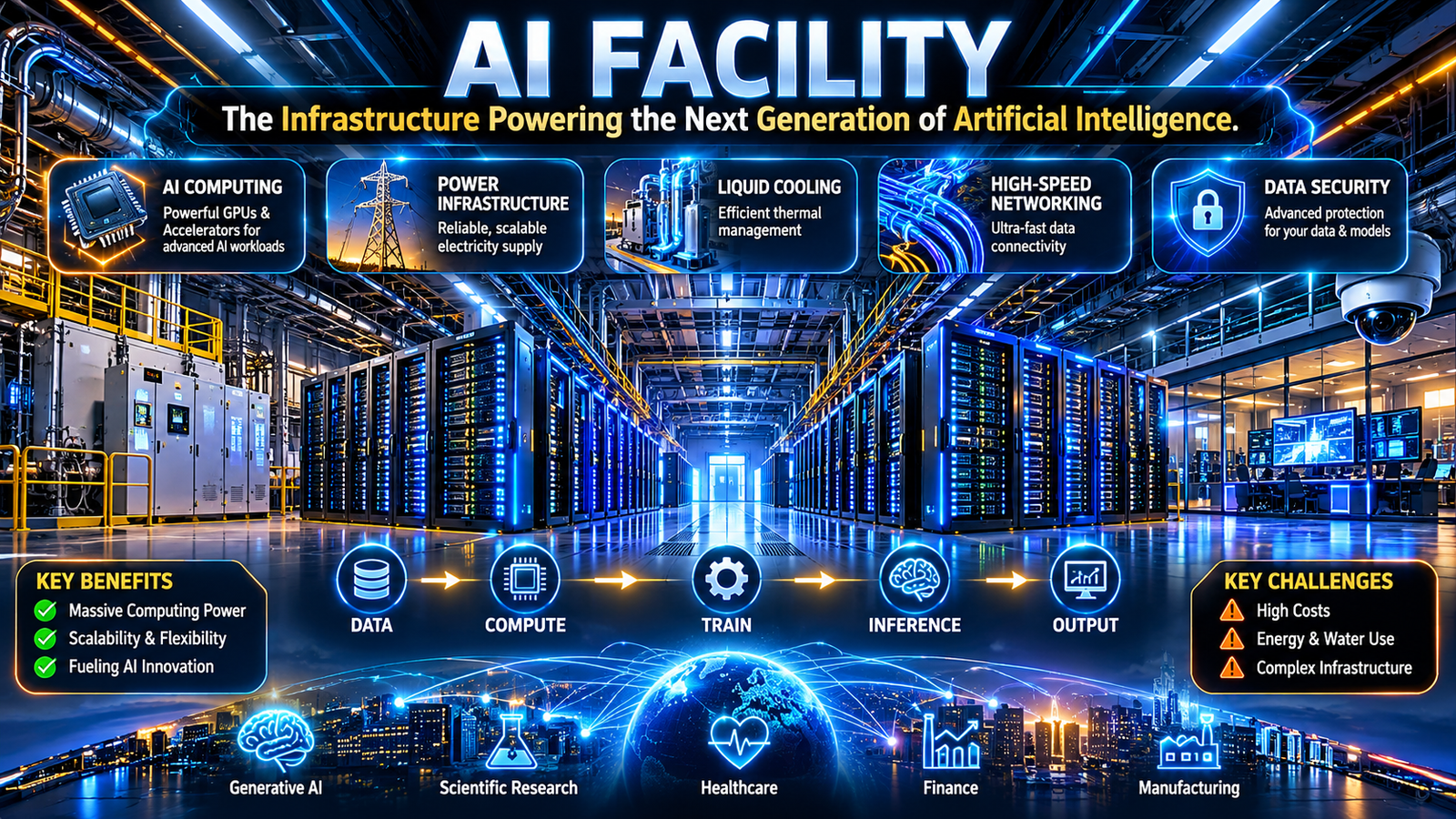
An AI facility is a specialized physical environment that provides the computing hardware, electricity, cooling, networking, and security needed to develop and operate artificial intelligence systems. It supports workloads such as machine learning, generative AI, model training, and inference through infrastructure designed for high computing performance, reliability, and scalability.
At a Glance
- Definition: An AI facility provides the physical infrastructure required to operate artificial intelligence workloads.
- Core infrastructure: GPUs, servers, storage, high-speed networking, electrical systems, and advanced cooling.
- Main applications: AI model training, generative AI, scientific research, enterprise automation, and inference.
- Major requirement: Reliable electricity and effective thermal management.
- Key advantages: Scalable computing, centralized infrastructure, performance, and operational control.
- Main challenges: Construction costs, energy consumption, water use, cybersecurity, and infrastructure availability.
What Is an AI Facility?
An AI facility is a purpose-built computing environment that provides the physical resources needed to run artificial intelligence workloads. It combines specialized processors, high-performance servers, data storage, networking, electricity, cooling, and operational systems.
Unlike a conventional office or general-purpose server room, an AI facility must support computationally demanding applications. These include training large language models, generating images, processing complex datasets, and running AI-powered business applications.
The term can describe several types of infrastructure:
- AI data centers: Large facilities housing thousands of processors and servers for AI workloads.
- AI research facilities: Environments where researchers develop, test, and evaluate machine learning models.
- Enterprise AI facilities: Private infrastructure operated by organizations that need greater control over AI systems and data.
- AI computing campuses: Large-scale developments combining multiple data centers, power infrastructure, cooling systems, and supporting facilities.
- Edge AI facilities: Smaller computing environments located closer to users, devices, or industrial operations.
These facilities can be owned by technology companies, research institutions, cloud providers, governments, or specialized infrastructure operators.
AI Facility vs. Traditional Data Center
Both environments provide computing resources. However, their infrastructure priorities can differ considerably.
| Infrastructure | Traditional data center | AI facility |
|---|---|---|
| Processing hardware | Primarily CPUs, with some accelerators | High-performance GPUs and specialized accelerators |
| Workloads | Websites, databases, cloud applications | Model training, inference, and AI development |
| Power requirements | Vary by application and rack density | Often higher for concentrated AI computing |
| Cooling | Commonly air-based | Air and liquid cooling, depending on density |
| Networking | General enterprise and cloud networking | High-bandwidth, low-latency cluster networking |
| Storage | General-purpose enterprise storage | High-throughput storage for large datasets |
| Scalability | Server and storage expansion | Coordinated expansion of compute, power, cooling, and networking |
These are general distinctions, not absolute rules. Traditional facilities can run AI workloads, while AI facilities can also support conventional computing.
The important difference is how the infrastructure is designed around the demands of AI.
How Does an AI Facility Work?
An AI facility transforms electricity, computing hardware, software, and data into usable AI capabilities.
Its operation involves several connected stages. Each stage depends on the reliability and performance of the others.
Jensen Huang Declares AGI Has Arrived as Inference Compute Reshapes the Scaling Law
AI Data Center Power Distribution from Grid to GPU
Liquid Cooling | FläktGroup
10
1. Data Collection and Storage
AI systems need data for training, fine-tuning, and inference.
An AI facility may connect to databases, cloud storage, enterprise applications, research repositories, and external data sources.
Storage infrastructure must support the volume and speed of data movement required by the workload.
For example, training a large language model involves repeatedly accessing extensive datasets. Slow storage can leave expensive processors waiting for information.
2. AI Processing and Computation
The computing layer performs the actual calculations.
Modern AI facilities commonly use:
- GPUs: Process many mathematical operations simultaneously.
- CPUs: Handle general computing, coordination, and system operations.
- AI accelerators: Specialized processors designed for machine learning workloads.
- High-performance memory: Provides fast access to model parameters and working data.
- Storage systems: Retain datasets, model checkpoints, and application information.
Companies may deploy NVIDIA GPUs, AMD accelerators, or specialized chips developed for particular AI workloads.
The hardware selection depends on model size, performance requirements, software compatibility, and operating costs.
3. Model Training and Inference
AI facilities generally support two important computing activities.
Model training involves processing data to teach a machine learning model how to recognize patterns and produce useful outputs.
Training large models can require thousands of accelerators working together.
Inference happens after a model has been trained. It uses the model to generate predictions, answer questions, classify information, or produce content.
For example, when someone asks an AI assistant a question, inference infrastructure processes the request and generates a response.
Training and inference have different resource requirements. Training often emphasizes large, tightly connected computing clusters. Inference places greater importance on response time, workload distribution, and serving costs.
4. Cooling and Thermal Management
AI processors generate substantial heat during intensive operations.
Without appropriate cooling, excessive temperatures can reduce performance, trigger protective shutdowns, and damage equipment.
Facilities therefore use combinations of:
- Air-conditioning systems.
- Hot-aisle and cold-aisle containment.
- Direct-to-chip liquid cooling.
- Cooling distribution units (CDUs).
- Heat exchangers and dry coolers.
- Temperature and humidity monitoring.
The cooling architecture depends on processor density, climate, available water, and facility design.
5. Networking and Output Delivery
AI systems frequently distribute workloads across multiple servers.
High-speed networking allows processors to exchange information, access shared storage, and coordinate calculations.
Once processing finishes, applications deliver results through APIs, enterprise software, websites, or other connected services.
This entire process requires continuous coordination between hardware, software, networking, and facility operations.
Key Infrastructure Components of an AI Facility
The physical infrastructure determines how much computing capacity a facility can support and how reliably it can operate.
High-Performance Computing Hardware
The computing layer is the central component of an AI facility.
It includes GPU servers, accelerator systems, CPUs, memory, and specialized networking equipment.
For demanding workloads, hardware must support distributed computing. Multiple accelerators work together rather than operating as independent machines.
The choice of hardware also affects software compatibility, procurement costs, power consumption, and future upgrade options.
Electrical Power Infrastructure
AI computing requires a dependable electricity supply.
A large AI facility may need dedicated electrical infrastructure to support its computing equipment and mechanical systems.
Important components include:
- Utility grid connections.
- Electrical substations.
- Transformers and switchgear.
- Uninterruptible power supplies (UPS).
- Backup generators.
- Battery energy storage systems.
- Power distribution units.
Power availability should be evaluated before construction begins.
A building may have enough physical space for additional servers but lack the electrical capacity to operate them.
Advanced Cooling Systems
Cooling is another major design requirement.
Traditional air cooling can remain suitable for lower-density equipment. However, concentrated AI workloads may require liquid-based thermal management.
Direct-to-chip cooling circulates liquid through cold plates attached to heat-generating components.
This transfers heat away from processors more effectively than relying entirely on room air.
Liquid cooling also introduces additional engineering requirements, including:
- Coolant distribution.
- Leak detection.
- Fluid monitoring.
- Pump redundancy.
- Maintenance access.
- Emergency isolation systems.
The objective is not simply to keep equipment cool. It is to maintain stable performance while managing energy and water consumption.
High-Speed Networking
AI training clusters require rapid communication between processors.
Networking infrastructure can include high-speed Ethernet, InfiniBand, fiber-optic connections, and specialized switching equipment.
Poor network performance can create bottlenecks even when processors have substantial computing capacity.
Network design should account for bandwidth, latency, congestion, redundancy, and compatibility with the computing architecture.
Physical Security and Monitoring
AI facilities contain expensive equipment and potentially sensitive information.
Their security architecture should cover both physical and digital threats.
Common controls include:
- Restricted access areas.
- Identity verification.
- Surveillance systems.
- Network segmentation.
- Encryption.
- Security monitoring.
- Backup and recovery procedures.
- Incident response planning.
Security requirements should reflect the sensitivity of the data and the organization’s operating model.
Main Applications and Use Cases of AI Facilities
AI facilities support applications across multiple industries. Their capabilities depend on available computing resources, software, datasets, and organizational requirements.
「10年分の研究を2日で」を超えた——Co-ScientistがいよいよNatureに正式掲載|pulserman
装备制造企业一遇到平台后续扩展空间不清就救火,信息化负责人该怎样判断服务商是否真正懂行业-金蝶软件
Award funds research to advance AI for medical record efficiency » Health Outcomes & Biomedical Informatics » College of Medicine » University of Florida
11
Generative AI and Large Language Models
Generative AI is one of the most demanding applications of modern computing infrastructure.
AI facilities support the development and operation of systems that generate text, images, audio, video, and software code.
Large language models also require substantial computing resources for training, fine-tuning, and inference.
Scientific Research and Development
Research organizations use high-performance computing infrastructure to analyze complex datasets and perform computational experiments.
Applications include:
- Climate modeling.
- Weather forecasting.
- Molecular research.
- Drug discovery.
- Genomics.
- Materials science.
- Physics simulations.
AI can accelerate parts of these workflows by identifying patterns and assisting with complex calculations.
Healthcare and Medical Technology
AI infrastructure can support medical imaging analysis, clinical research, drug development, and healthcare administration.
Hospitals and research institutions may use specialized environments to process sensitive medical information.
However, deploying AI in healthcare requires appropriate privacy controls, validation, human oversight, and regulatory compliance.
Financial Services
Financial institutions use AI for fraud detection, risk modeling, customer support, document processing, and financial analysis.
An AI facility can provide the computing resources required to process large datasets and operate these applications.
Manufacturing and Industrial Automation
Manufacturers use AI to improve production processes and identify equipment problems.
Common applications include:
- Predictive maintenance.
- Visual quality inspection.
- Industrial robotics.
- Supply chain forecasting.
- Production optimization.
- Digital twins.
AI infrastructure can support centralized model development while smaller edge systems handle time-sensitive operations near manufacturing equipment.
Benefits of an AI Facility
A properly designed AI facility provides several operational and strategic advantages.
Greater Computing Capacity
Specialized infrastructure allows organizations to run demanding workloads that exceed the practical capabilities of ordinary business computers.
Multiple accelerators can work together to process large datasets and complex models.
Better Control Over Infrastructure
Organizations operating private facilities can make decisions about hardware, network architecture, storage, and access controls.
This can be particularly useful when handling sensitive business information or specialized workloads.
However, private ownership also creates responsibility for maintenance, security, and infrastructure upgrades.
Scalability for Growing AI Workloads
Modular infrastructure allows operators to expand computing capacity as demand increases.
They can add servers, cooling equipment, storage, and power systems in planned stages.
Expansion still depends on available electricity, physical space, equipment supply, and cooling capacity.
Improved Workload Performance
AI-specific hardware and high-speed networking can improve performance for appropriately designed workloads.
The benefits depend on software optimization, model architecture, data quality, and resource allocation.
Simply installing more GPUs does not guarantee better results.
Support for AI Innovation
Research teams and businesses can experiment with new models, applications, and computing approaches.
A suitable facility can support development, testing, deployment, and continuous model improvement.
Challenges and Limitations of Building an AI Facility
Despite their potential, AI facilities involve significant technical, financial, and environmental challenges.
1. High Construction and Operating Costs
Developing an AI facility requires substantial investment.
Costs may include land, building construction, electricity infrastructure, cooling systems, networking, security, and computing hardware.
The technology fit-out can be especially expensive.
JLL’s January 2026 outlook estimated average global data center construction costs at approximately $11.3 million per megawatt for 2026. This estimate covers shell and core construction, not the complete AI technology fit-out. JLL Research
This distinction matters when calculating the actual investment required.
2. Electricity Availability
Power availability has become a major constraint on data center development.
AI facilities need dependable electricity, and large projects can require substantial utility upgrades.
In some markets, grid connection delays can affect construction schedules and operating plans.
Developers may investigate on-site generation, battery storage, renewable energy agreements, or phased capacity deployment.
However, each option introduces additional costs and engineering considerations.
3. Water Consumption and Environmental Impact
Cooling and electricity generation can both contribute to water consumption.
The environmental impact depends on cooling technology, local climate, electricity sources, and operating practices.
The International Energy Agency’s October 2026 analysis highlights the relationship between data center growth, electricity demand, emissions, and water stress. It also identifies trade-offs between water-efficient and energy-efficient cooling approaches. IEA+1
Operators should evaluate total resource consumption rather than considering cooling efficiency in isolation.
4. Cybersecurity Risks
AI facilities can become attractive targets because they contain valuable computing infrastructure, proprietary models, and sensitive datasets.
Security planning should address:
- Unauthorized physical access.
- Compromised server infrastructure.
- Data theft.
- Network attacks.
- Software supply-chain vulnerabilities.
- Misconfigured storage and access permissions.
NIST published an initial public draft of SP 800-239 in July 2026, examining security threats and gaps in AI data center environments. It provides a useful reference for understanding the specialized security requirements of these systems. NIST Computer Security Resource Center
5. Rapid Technology Changes
AI hardware evolves quickly.
A facility designed around one generation of processors may need modifications to accommodate newer equipment.
Changes in rack density, cooling requirements, networking, and power distribution can create expensive upgrade requirements.
Flexible architecture and modular expansion can reduce some of these risks, although they cannot eliminate technological uncertainty.
AI Facility Providers, Platforms, and Competitors
The AI facility market does not have one universal competitor category. It includes cloud infrastructure providers, colocation operators, specialized AI infrastructure companies, and hardware manufacturers.
These businesses serve different customers. Some provide access to computing capacity, while others develop or operate the physical facilities.
Major AI Infrastructure Providers
| Platform / Provider | Target user | Key strength | Pricing transparency | Core limitation |
|---|---|---|---|---|
| Amazon Web Services (AWS) | Developers and enterprises | Cloud computing and AI infrastructure | Public service pricing, usage-dependent | Costs depend on configuration and consumption |
| Microsoft Azure | Businesses and enterprise AI teams | Cloud infrastructure and AI services | Public service pricing, usage-dependent | Service availability varies by region |
| Google Cloud | Developers and research teams | AI infrastructure and machine learning services | Public service pricing, usage-dependent | Costs vary by hardware and workload |
| Equinix | Enterprises and infrastructure operators | Colocation and interconnection | Generally quote-based | Requires separate planning for computing hardware |
| Digital Realty | Enterprises and large infrastructure users | Data center capacity and connectivity | Generally quote-based | Not a complete AI software or model platform |
These providers should not be treated as interchangeable.
Cloud platforms provide access to computing resources without requiring customers to construct their own buildings. Colocation companies provide physical data center space and supporting infrastructure. Customers may then deploy their own hardware.
Cloud AI Infrastructure vs. Private AI Facilities
The choice between cloud infrastructure and private ownership depends on workload requirements.
| Consideration | Cloud AI infrastructure | Private AI facility |
|---|---|---|
| Initial investment | Usually lower | Usually substantial |
| Infrastructure ownership | Provider-managed | Organization-managed |
| Hardware customization | Depends on provider | Greater architectural control |
| Expansion | Based on available cloud capacity | Requires physical expansion |
| Maintenance | Primarily provider responsibility | Internal or contracted responsibility |
| Data governance | Depends on service configuration and agreements | Direct control over physical environment |
| Operational complexity | Lower facility-management burden | Higher infrastructure responsibility |
There is also a middle option: colocation.
Organizations can rent space, power, and cooling from a data center operator while maintaining control over their own computing hardware.
How to Evaluate an AI Facility Provider
Before choosing a provider, evaluate the following:
- Compute availability: Confirm the availability of suitable GPUs and accelerators.
- Power capacity: Check whether the provider can support your expected workload.
- Cooling architecture: Understand the available cooling technology and supported rack densities.
- Network performance: Evaluate bandwidth, latency, and connectivity.
- Geographic availability: Consider data residency, regulatory requirements, and user proximity.
- Pricing structure: Review hardware charges, electricity, storage, networking, and support costs.
- Security controls: Examine access management, encryption, audit processes, and incident response.
- Expansion options: Determine whether additional capacity can be deployed without major disruption.
A provider’s advertised computing performance is only one part of the evaluation. Infrastructure availability and long-term operating costs matter just as much.
AI Facility Costs: What Determines the Investment?
There is no universal price for building an AI facility.
A small enterprise computing environment and a hyperscale AI campus have very different infrastructure requirements.
The total investment generally includes two major categories.
Construction and Facility Infrastructure
These expenses cover the physical environment:
- Land acquisition and site preparation.
- Building construction.
- Electrical connections and substations.
- Cooling and heat-rejection systems.
- Backup power.
- Fire protection.
- Physical security.
- Networking pathways.
The cost depends on location, facility size, construction standards, and available utilities.
AI Hardware and Technology Fit-Out
The technology fit-out includes:
- GPU servers and accelerators.
- CPUs and memory.
- High-performance storage.
- Network switches and fiber.
- Rack systems.
- Cooling distribution equipment.
- Software and management platforms.
Hardware selection can significantly change the overall investment.
Ongoing Operating Expenses
Construction is only the beginning.
Operators must budget for electricity, cooling, maintenance, network connectivity, hardware replacement, security, insurance, and staffing.
A realistic financial assessment should calculate total cost of ownership (TCO), not just the initial construction budget.
It should also account for hardware depreciation and expected utilization.
An expensive GPU cluster operating below capacity may deliver poor financial returns, even when its technical specifications are impressive.
Latest AI Facility Developments in 2026
AI infrastructure is moving toward higher computing density, integrated cooling, and more coordinated energy management.
Several developments are particularly important.
1. Integrated Power and Cooling Design
One major development is the shift toward designing electrical and mechanical infrastructure together.
ASHRAE, the Pacific Northwest National Laboratory (PNNL), and the National Electrical Manufacturers Association (NEMA) released an AI Data Center Energy Performance Framework in June 2026.
The framework covers planning, design, commissioning, energy efficiency, water management, resilience, and modernization. It provides guidance rather than replacing mandatory building codes or technical standards. ASHRAE+1
This approach reflects an important engineering principle: power delivery and cooling cannot be optimized independently in high-density AI environments.
2. Direct-to-Chip Liquid Cooling
Liquid cooling is becoming increasingly important as AI processors generate more heat within concentrated computing systems.
Direct-to-chip cooling transfers heat from processors through liquid-cooled cold plates.
It can support higher-density deployments and reduce dependence on conventional room-level air cooling.
However, system design must address coolant distribution, leak detection, maintenance, and equipment compatibility. AI Data Center Energy Performance Framework+1
3. Higher-Voltage Power Architectures
Higher-voltage power distribution is receiving attention as AI rack power requirements increase.
Architectures such as 800 VDC are being evaluated for high-density computing environments.
Higher voltage can reduce current for a given power level, potentially reducing conductor requirements and distribution losses.
However, implementation requires compatible equipment, protection systems, and careful engineering. It should not be considered a universal requirement for every AI facility. AI Data Center Energy Performance Framework
4. AI Inference Is Changing Facility Requirements
Early infrastructure expansion focused heavily on large training clusters.
However, inference is becoming increasingly important as organizations deploy AI applications to real users.
Inference facilities may prioritize geographic distribution, low latency, workload flexibility, and cost-efficient hardware.
This creates opportunities for regional data centers and smaller deployments closer to customers. TechTarget+1
5. Greater Attention to Energy and Water Efficiency
AI facility development increasingly involves questions about electricity supply, environmental impact, and community resources.
The IEA’s October 2026 report examines how governments and operators can integrate data centers into electricity systems while addressing affordability, reliability, and sustainability.
Its findings reinforce the importance of transparent energy planning and efficient resource management. IEA+1
Who Should Build or Use an AI Facility?
An AI facility is not necessary for every organization using artificial intelligence.
Its suitability depends on computing demand, data sensitivity, financial resources, and infrastructure requirements.
| Organization | Potential benefit | Recommended approach |
|---|---|---|
| AI research laboratories | Large-scale model experimentation | Dedicated or specialized computing infrastructure |
| Technology companies | Model development and AI product deployment | Cloud, colocation, or private infrastructure |
| Large enterprises | Greater infrastructure and data governance control | Private or hybrid AI environment |
| Universities | Scientific computing and research | Shared institutional AI computing facility |
| Healthcare organizations | Research and sensitive data processing | Compliant private or managed infrastructure |
| Small businesses | Access to AI applications | Cloud-based AI services |
For smaller organizations, renting computing capacity is generally more practical than constructing a dedicated facility.
Building physical infrastructure makes more sense when workloads are sufficiently large, predictable, and financially justified.
Technical Considerations Before Developing an AI Facility
Planning an AI facility requires coordination between infrastructure engineers, software teams, security specialists, and financial decision-makers.
Several technical considerations deserve particular attention.
Workload Assessment
Start by identifying the actual workloads.
Model training, fine-tuning, inference, and scientific computing have different resource requirements.
Estimate:
- Expected GPU or accelerator requirements.
- Memory capacity.
- Storage throughput.
- Network bandwidth.
- Average and peak power consumption.
- Expected utilization.
- Future expansion requirements.
Avoid purchasing hardware based only on advertised specifications.
Scalability and Modular Architecture
Modular design can simplify expansion.
Facilities can add computing racks, electrical systems, and cooling modules in stages.
However, modular construction only works effectively when the underlying electrical, mechanical, and networking interfaces are properly coordinated.
Reliability and Redundancy
AI facilities should plan for equipment failures and service interruptions.
Important considerations include redundant power paths, backup cooling, network resilience, monitoring, and disaster recovery.
Operators should also test their backup systems rather than relying exclusively on design specifications.
Security and Data Governance
Organizations should establish clear policies covering data access, retention, encryption, and third-party infrastructure.
For cloud deployments, examine contractual data handling terms and available retention controls.
For private environments, define responsibility for physical access, system administration, monitoring, and incident response.
Importantly, a SOC 2 report does not automatically establish Zero Data Retention. These are different security and data-handling considerations.
Frequently Asked Questions
1. What is the main purpose of an AI facility?
The main purpose of an AI facility is to provide the computing infrastructure required to develop, train, deploy, and operate artificial intelligence systems. It combines specialized processors, storage, networking, electricity, cooling, and security systems to support demanding AI workloads.
2. Is an AI facility the same as an AI data center?
The terms are closely related. An AI data center is a physical facility designed to support AI computing, while AI facility is a broader descriptive term that can also include research environments, enterprise computing sites, and specialized AI campuses.
3. How much electricity does an AI facility consume?
Electricity consumption varies significantly according to facility size, computing hardware, workload utilization, and cooling requirements. A small AI computing environment may consume considerably less electricity than a hyperscale AI data center. Operators should evaluate expected IT load and total facility energy consumption before deployment.
4. Why do AI facilities need liquid cooling?
High-performance AI processors generate substantial heat, especially when many accelerators operate together. Liquid cooling transfers heat away from processors more efficiently in suitable high-density configurations. It also requires additional infrastructure for coolant circulation, leak detection, and maintenance.
5. Can a small business operate its own AI facility?
Yes. A small business can operate a private AI server room or a compact computing environment if it has suitable hardware, power, cooling, and technical support. However, cloud AI services or rented GPU infrastructure are often more practical when computing requirements are limited or unpredictable.
Conclusion
An AI facility provides the physical foundation for modern artificial intelligence. It brings together computing hardware, electricity, cooling, networking, storage, and security to support demanding AI workloads.
Its value depends on the organization’s computing requirements and long-term infrastructure strategy.
Large technology companies, research institutions, and enterprises with substantial AI workloads may benefit from dedicated infrastructure. Smaller organizations can often achieve their goals through cloud platforms or colocation services.
Before investing, evaluate electricity availability, cooling requirements, hardware costs, security, scalability, and environmental impact.
Ultimately, a successful AI facility is not simply a building filled with powerful processors. It is an integrated infrastructure system designed to deliver reliable, efficient, and scalable computing.