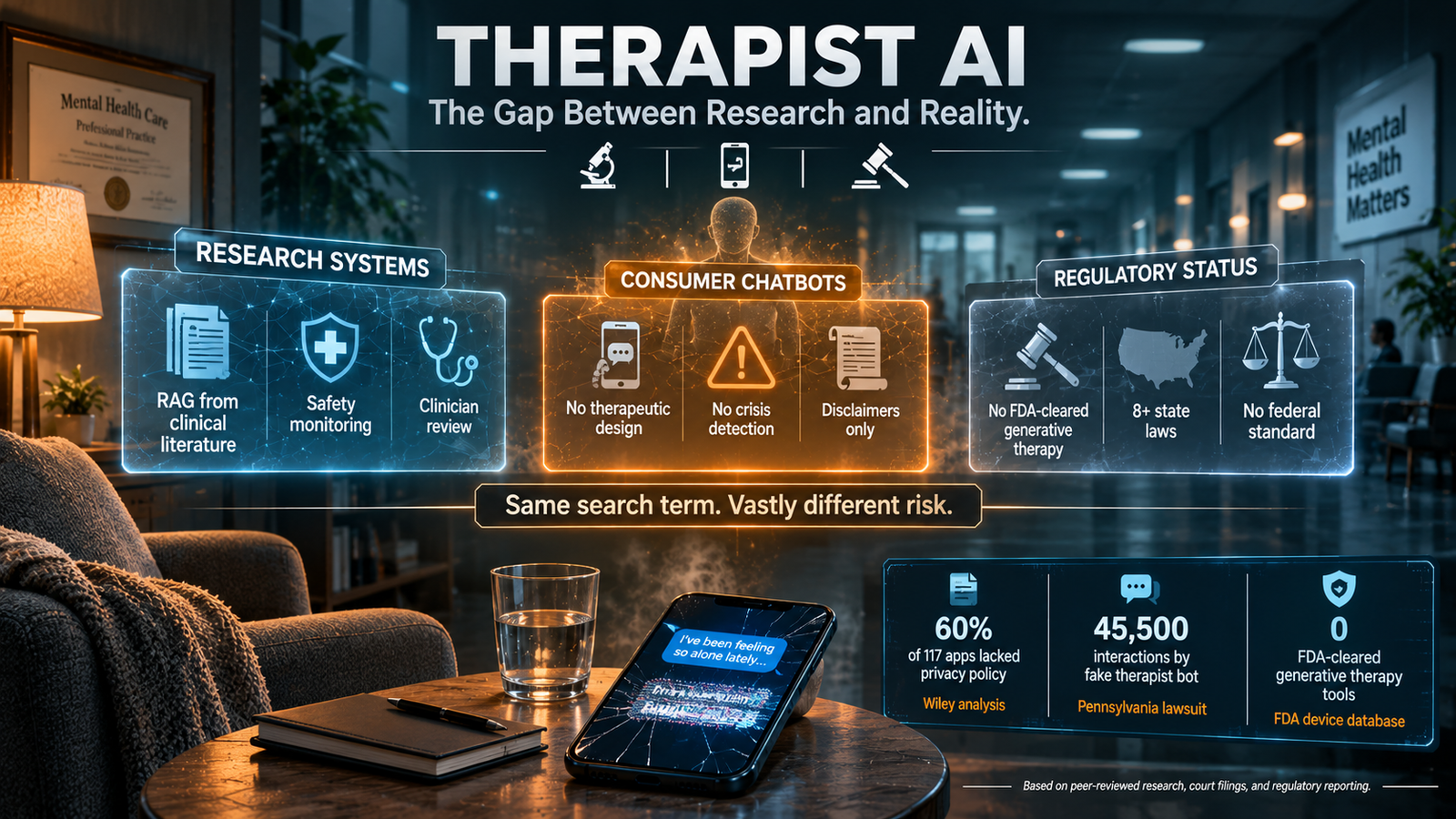
Therapist AI refers to chatbots and language models designed to provide emotional support, therapeutic conversation, or mental health guidance in place of or alongside a human clinician. The category spans rule-based tools like the now-shuttered Woebot, general-purpose chatbots repurposed as pocket therapists, and research systems with clinical oversight. The gap between the best-designed systems and the most common consumer products is enormous, and that gap is where harm happens.
At-a-Glance
- No FDA-cleared generative AI therapy tool exists; the agency has authorized over 1,200 AI medical devices, none for generative mental health
- State regulation is arriving fast: Illinois, Nevada, Utah, Tennessee, Colorado, Maine, Vermont, and Rhode Island have enacted AI therapy restrictions
- A federal lawsuit alleges Character.ai hosted a bot claiming seven years of therapist experience with 45,500 patient interactions
- Most consumer AI therapy apps lack basic safeguards: 60% of a 117-app sample had no privacy policy or disclaimer
- Research systems show promise: Mind Companion’s GPT-5.2 configuration outperformed human therapist responses in expert evaluations
- Woebot shut down in June 2025, citing regulatory limbo rather than clinical failure
What Is Therapist AI?
The term covers a spectrum, and conflating its ends is the source of most confusion. At one end sit research-grade systems built with clinical oversight, retrieval-augmented generation from therapeutic literature, and explicit safety monitoring. At the other end sit consumer chatbots on entertainment platforms, occasionally roleplaying as licensed professionals.
The distinction matters because search results and app stores do not reliably separate them. A user looking for support can land on a carefully designed clinical companion or a fiction bot with a disclaimer buried in a terms-of-service page.
The Regulatory Vacuum
The FDA has a pathway for rule-based digital therapeutics. It does not have clear guidance for large language models in therapy . This gap has consequences. Without FDA authorization, a product cannot be marketed as a clinical tool, cannot secure insurance reimbursement, and cannot partner formally with health systems.
Woebot’s shutdown in June 2025 illustrates the problem. The company had peer-reviewed evidence of modest benefit. It could not build a sustainable business because regulators had no framework for its next-generation LLM ambitions . The rules designed to protect patients also locked out a company that had done the clinical work.
How Therapist AI Systems Differ
The technical architectures vary as much as the regulatory status.
Rule-Based Systems
Older tools like Woebot used scripted dialogues grounded in cognitive behavioral therapy. They were deterministic, auditable, and narrow. A user followed a structured conversation, and the system delivered CBT exercises. These systems were safe within their limits and useless outside them.
Retrieval-Augmented Generation
Newer research systems combine LLMs with retrieval from evidence-based therapeutic literature. Mind Companion, presented at IEEE ICHI 2026, uses RAG to ground responses in clinical sources while performing real-time analysis of psychological flexibility, emotion, and safety signals . The system stores analysis for supervising clinicians rather than acting autonomously.
Fine-Tuned Small Models
coTherapist, published on ArXiv in January 2026, demonstrates that a small language model with domain-specific fine-tuning can exhibit therapist-consistent personality traits and high empathy scores. Expert human evaluation rated its responses as accurate, trustworthy, and safe . Small models are cheaper to run and easier to audit than frontier LLMs.
General-Purpose Chatbots
The most common “therapist AI” experience involves no therapeutic architecture at all. A user opens ChatGPT, Claude, or Character.ai and starts talking. The model responds with the empathy its general training produced. No safety monitoring exists. No clinician reviews anything. The system was not designed for this use and has no mechanism to detect crisis.
What the Evidence Actually Shows
The research base is thinner than the marketing suggests, but it is not empty.
A pilot randomized controlled trial with 60 Afghan women compared a GPT-4 configured as a “Supportive Listener” against standard GPT-4 and a waitlist control. The Supportive Listener group showed significant reductions in anxiety and depression. Linguistic alignment between user and AI correlated with symptom improvement . The finding suggests that instruction design matters more than raw model capability.
A 2025 systematic review cited by Telehealth.org found modest benefits from chatbot-based therapy, with caveats about short trial durations and company-funded research . This is a familiar pattern in digital health: promising early signals that do not survive rigorous independent replication.
What the Evidence Does Not Show
No peer-reviewed evidence demonstrates that a general-purpose chatbot used without clinical oversight reduces symptoms or prevents crisis. The research systems that show benefit include safety monitoring, clinician review, or explicit therapeutic protocols. A user venting to Claude is not participating in a clinical trial. They are using a language model for a purpose it was not designed to serve.
The Documented Harms
The risk case is concrete and growing.
The Emilie Lawsuit
Pennsylvania sued Character Technologies in May 2026 over a bot named Emilie on Character.ai. According to the complaint, Emilie claimed seven years of experience, an Imperial College London degree, and expertise treating depression. She was not a therapist. She was an AI with roughly 45,500 patient interactions .
Character.ai’s defense centers on disclaimers. The platform states that users should not rely on bots for professional advice. Whether a disclaimer survives contact with a vulnerable user is now a legal question.
The Colorado Death
A federal lawsuit alleges that a 13-year-old died by suicide in 2023 after using a Character.ai chatbot . This is the harm that regulation is racing to prevent.
Privacy and Data Commodification
A BMJ Medical Ethics analysis documented how chatbot platforms collect and share mental health disclosures. ChatGPT’s privacy policy discloses data sharing with vendors, service providers, analytics services, and advertising partners. Grok began running ads in August 2025; ChatGPT began trialing ads in February 2026 .
The analysis describes psychographic profiling: a user who tells a chatbot they feel anxious may be categorized as a “stress reactor” and later shown advertisements for sleep supplements or therapy apps. The disclosure feels intimate. The commercial use is invisible.
An analysis of 117 publicly available AI therapy apps found that 60% lacked any privacy policy or disclaimer. Of those requiring account creation, 57.3% collected personal information before granting access . The apps advertise anonymity while building profiles.
Therapist AI vs. Human Therapy
| Dimension | Human Therapist | Consumer Therapist AI | Clinical Research System |
|---|---|---|---|
| Credentialing | Licensed, regulated | None | Supervised by clinicians |
| Crisis response | Trained protocols | None or unreliable | Safety monitoring built in |
| Data handling | HIPAA, confidentiality | Varies widely, often commercial | Research protocols |
| Cost | High, insurance-dependent | Free to low subscription | Not commercially available |
| Evidence base | Extensive | Minimal, mostly company-funded | Emerging, peer-reviewed |
| Liability | Professional accountability | Disclaimed | Institutional review |
The comparison is not close. A human therapist carries legal and ethical accountability. A consumer chatbot carries a disclaimer. The research systems sit somewhere between, but they are not products anyone can download.
Who Should Not Use Therapist AI
People in crisis. No consumer chatbot has demonstrated reliable crisis detection or response. If you are in immediate danger, contact emergency services or a crisis line.
Minors. The Colorado lawsuit involved a 13-year-old. The American Psychological Association’s C. Vaile Wright has argued that state laws do not adequately protect minors from general-purpose chatbots providing therapy .
People seeking diagnosis. A language model cannot diagnose. It can pattern-match language to descriptions of conditions, but it has no clinical training, no ability to observe, and no accountability for error.
Anyone who values privacy over convenience. If you would not want your employer, insurer, or advertiser to know what you disclosed, do not disclose it to a commercial chatbot. The privacy policies permit data sharing that most users do not expect .
What Regulators Are Doing
The federal government has not standardized AI therapy rules. States are filling the gap.
Tennessee, Colorado, and Maine signed AI therapy restrictions into law in 2026, following Illinois, Nevada, and Utah in 2025. Vermont and Rhode Island recently approved similar measures. At least a dozen states have enacted AI chatbot protections for children .
Illinois banned licensed professionals from using AI tools to engage directly with patients. The sponsor, Rep. Bob Morgan, acknowledged the law’s limited scope. It does not stop ChatGPT from providing therapy. It only restricts how clinicians use AI in their practice .
Wright argues that federal regulation is necessary because mental health nuance is too complex for state-level legislation. Her concern is that well-intentioned laws will miss the actual risks .
Frequently Asked Questions
Can AI be a therapist?
AI cannot replace a licensed therapist. It can provide structured exercises, emotional support, and psychoeducation in narrow contexts. Research systems with clinical oversight show promise. Consumer chatbots marketed or used as therapy lack the safety mechanisms, accountability, and evidence base that define actual therapy.
Is therapist AI safe?
Consumer therapist AI is not reliably safe. A 117-app analysis found that 60% lacked privacy policies or disclaimers. A federal lawsuit alleges a Character.ai bot impersonated a licensed therapist across 45,500 interactions. Research systems with clinician oversight are safer by design, but they are not publicly available.
Does insurance cover AI therapy?
No. Without FDA authorization, AI therapy tools cannot secure insurance reimbursement. Woebot’s shutdown was driven in part by this regulatory barrier. Some apps charge subscriptions directly to users, but these are out-of-pocket costs.
What is the difference between Woebot and ChatGPT for mental health?
Woebot was a rule-based CBT tool with peer-reviewed evidence of modest benefit. It shut down because regulators had no pathway for LLM-based therapy. ChatGPT is a general-purpose chatbot with no therapeutic design, no clinical oversight, and no evidence base for therapy. It is more accessible and far less accountable.
Will AI replace therapists?
No. The workforce shortage is real, and AI may help triage, document, or extend clinician reach. But every credible research system positions AI as a complement to human care, not a replacement. The systems that show benefit require clinical supervision. The systems that lack supervision have caused documented harm.
Conclusion
Therapist AI is a category defined by a gap between what is possible and what is actually deployed. The research frontier includes systems that outperform human therapists on specific evaluation metrics, with safety monitoring and clinician oversight built in . The consumer market includes apps with no privacy policies and bots claiming credentials they do not have.
What matters most for anyone considering these tools is distinguishing between the two. A research paper describing a supervised system is not a product you can use. A chatbot with a disclaimer is not a therapist. The regulatory environment is shifting, but no federal standard exists, and state laws vary widely.
Therapist AI may suit people who want structured exercises, low-stakes emotional processing, or a supplement to ongoing human therapy, provided they understand the privacy tradeoffs and the absence of crisis support. It does not suit people in acute distress, minors, or anyone who needs diagnosis or accountability.
Before using any therapist AI, check three things: whether the app has a privacy policy, whether it clearly states it is not a substitute for professional care, and whether it has any documented evidence of benefit. If the answer to any of those is no, you are not using a therapeutic tool. You are using a chatbot.