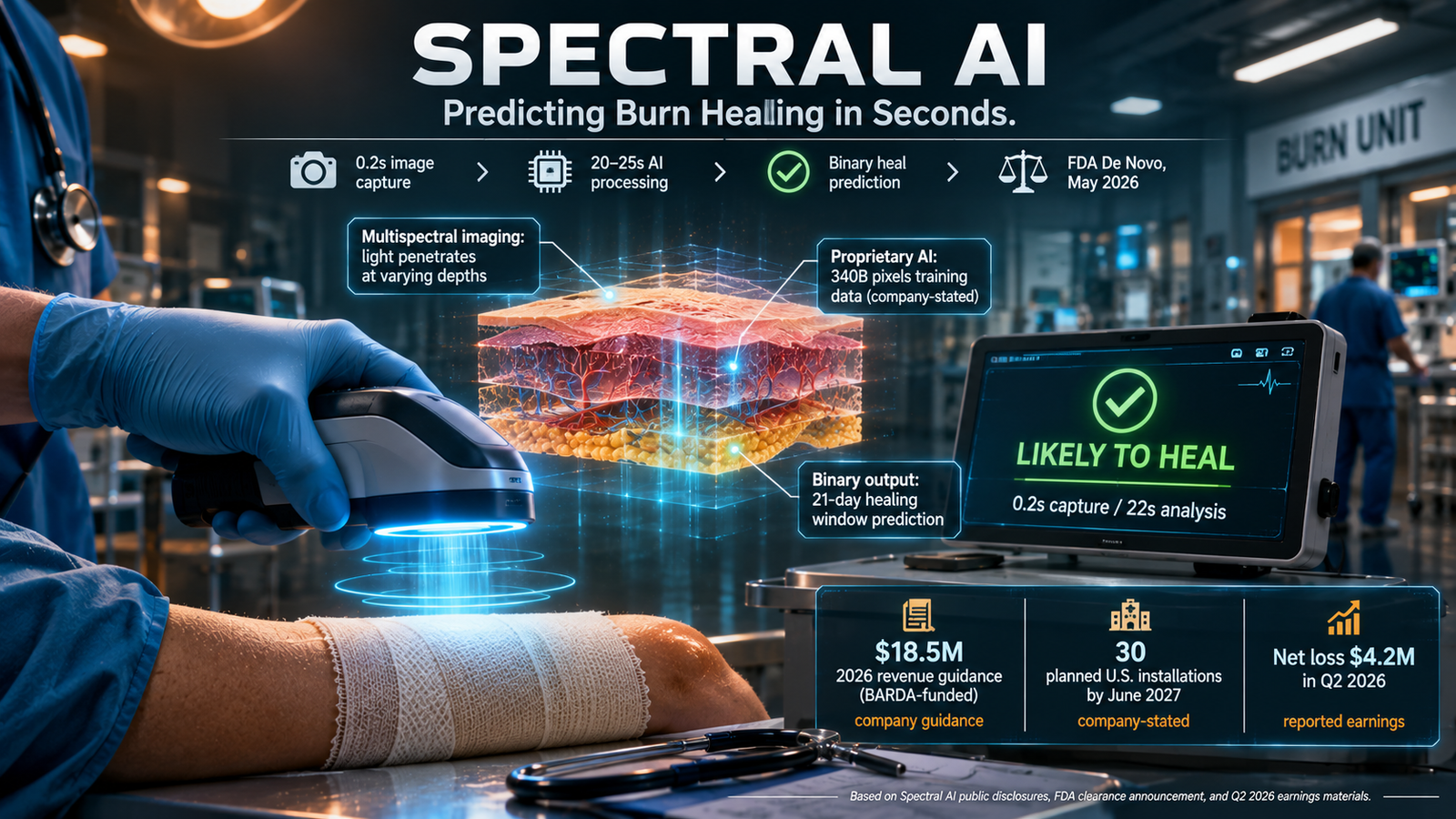
Spectral AI is a Dallas-based medical diagnostics company whose DeepView System combines multispectral imaging with a proprietary AI algorithm to predict whether a burn wound will heal without surgical intervention. The system received FDA De Novo Classification in May 2026, authorizing commercial distribution in the United States for burn care, and it produces a binary healing prediction in roughly 20 to 25 seconds after a 0.2-second image capture .
At-a-Glance
- What it is: A predictive medical device for burn wound assessment, not a general AI platform
- Core technology: Multispectral imaging plus proprietary AI trained on 340 billion pixels of burn data
- Speed: 0.2-second image acquisition, 20–25 seconds to AI classification output
- Regulatory status: FDA De Novo Classification granted May 2026; UKCA authorization since February 2024
- Business model: Capital equipment sales or leases plus recurring software and service revenue on minimum three-year terms
- Key constraint: Commercial rollout is staged through June 2027, with hospital procurement and AI review committees slowing deployment
What Is Spectral AI?
Spectral AI occupies a specific and narrow lane in medical artificial intelligence. It does not build chatbots, imaging analysis for radiology, or drug discovery models. It builds one thing: a device that tells clinicians whether a burn wound is likely to heal on its own or needs surgery.
The company is publicly traded on Nasdaq under the ticker MDAI. It went public through a SPAC merger in September 2023, combining with Rosecliff Acquisition Corp I . Its headquarters are in Dallas, Texas, and its primary product is the DeepView System.
The clinical problem DeepView addresses is real. Burn assessment currently relies on clinical judgment, which varies by experience. A surgeon must decide whether to operate or wait, and that decision affects healing time, infection risk, and scarring. DeepView offers an objective data point to support that judgment, not replace it.
DeepView vs. Conventional Burn Assessment
How DeepView Works
The workflow is designed for bedside use. A clinician points the multispectral camera at the wound. Image acquisition takes 0.2 seconds. The system then processes the image and runs its proprietary AI model, which returns a classification in roughly 20 to 25 seconds .
The output is binary. DeepView indicates whether areas within the burn wound are unlikely to heal within 21 days and may require significant medical intervention . It does not provide a treatment recommendation. It provides a data point that the clinician integrates with their own assessment.
The Imaging Layer
Multispectral imaging captures information beyond what the human eye can see. Different wavelengths penetrate tissue to varying depths, and the resulting data can reveal subsurface characteristics that correlate with healing potential. This is not a photograph. It is a structured dataset that the AI model was trained to interpret.
The AI Layer
Spectral AI describes its algorithm as proprietary. The company does not publish model architecture, parameter counts, or inference infrastructure details. What it does disclose is the training data scale: over 340 billion pixels of burn wound image data, described as clinically validated . This figure is company-stated and has not been independently audited.
The system was trained and tested against this database to produce its binary classification. The De Novo pathway, reserved for novel devices without a predicate, required the company to demonstrate safety and effectiveness to the FDA. That clearance is a verified regulatory fact, though the underlying model performance metrics are not public.
FDA Clearance and Commercial Launch
The FDA granted De Novo Classification for DeepView in May 2026 . This authorization permits commercial distribution in the United States for burn care across burn centers, trauma centers, and emergency departments .
The stock fell approximately 12 percent on the day the clearance was announced . This reaction suggests that investors had already priced in the approval or that the market expected additional commercial traction alongside the regulatory milestone. The clearance itself was not a surprise; Spectral AI had submitted its De Novo application in June 2025 .
The BARDA Relationship
Spectral AI’s development has been substantially funded through government contracts. Its primary revenue source in 2026 is the BARDA Project BioShield contract, which supports continued development of the DeepView System . The company reiterated 2026 revenue guidance of approximately $18.5 million, which does not include material contributions from DeepView sales .
The first 30 U.S. installations are expected to receive substantial BARDA support under the CLIN2 component of the contract . This means early commercial placements are subsidized by government funding, which reduces the sales friction but also means the commercial model has not yet been tested at full price.
Staged Rollout
Management plans to deploy up to 30 DeepView systems at U.S. burn centers, trauma centers, and emergency departments through June 30, 2027 . The company has two commercial personnel as of its Q2 2026 earnings call and has budgeted for at least two additional hires .
The rollout faces practical friction. Hospital procurement, cybersecurity reviews, and AI committee approvals can slow deployment, management acknowledged . These are standard hurdles for any medical device, but they are particularly relevant for an AI-powered system that requires clinical workflow integration.
Pricing and Revenue Model
Spectral AI does not publish list pricing for DeepView. The revenue model, however, has been described in earnings calls. It includes system capital purchases or leases, followed by recurring software and service revenue under minimum three-year terms .
This is a standard model for medical capital equipment. The upfront device sale or lease is followed by ongoing software licensing, maintenance, and support. The three-year minimum term provides some revenue visibility once installations are complete.
| Plan Element | Structure | Transparency |
|---|---|---|
| Device acquisition | Capital purchase or lease | Not publicly disclosed |
| Software and service | Recurring, minimum three-year term | Not publicly disclosed |
| Early U.S. placements | Subsidized by BARDA CLIN2 | Government contract terms apply |
| International sales | Planned after UKCA update | Not yet active |
The absence of public pricing is not unusual for medical devices sold through hospital procurement. But it means buyers cannot compare DeepView costs against alternatives without engaging Spectral AI directly.
Clinical Evidence and Limitations
The De Novo clearance establishes that the FDA reviewed the device’s safety and effectiveness data and found them sufficient for authorization. That is a verified fact. What the clearance does not provide is a public, peer-reviewed benchmark that independent researchers can scrutinize.
Company-Stated Claims
Spectral AI states that DeepView provides an “objective and immediate assessment” of healing potential . The system’s output is described as supporting “earlier and more informed treatment decisions” . These are company claims about intended benefit, not independently verified outcome improvements.
The 340 billion pixel training database is also company-stated . No third party has audited its composition, diversity, or clinical validation methodology.
Clinical Study Pipeline
The company is running a label expansion study for burns involving the head, hands, and feet. The first Site Initiation Visit was completed at Pinderfields Hospital in the UK in October 2026 . The study will enroll adult and pediatric patients, image them within 72 hours of injury, and assess healing outcomes through 21 days. The DeepView System will be used in a blinded, observational capacity and will not direct patient care in this study .
A separate 12-center U.S. triage and treatment outcome study is planned for the fourth quarter of 2026 . These studies may generate the peer-reviewed evidence that is currently absent from the public record.
What DeepView Does Not Do
DeepView does not treat burns. It does not recommend specific surgical procedures. It does not replace clinical judgment. The binary output is a single data point, and the FDA clearance is specifically for burn indication, not for other wound types. Spectral AI has stated ambitions to expand into broader wound care, but those applications are not cleared.
Competitors and Alternatives
The AI-enabled wound analysis market includes several established players, though most focus on chronic wounds rather than acute burns.
| Company | Focus | Key Strength | Pricing Transparency | Core Limitation |
|---|---|---|---|---|
| Spectral AI | Burn healing prediction | FDA De Novo, multispectral + AI, 340B pixel database | Not public | Burn indication only, early commercial stage |
| Swift Medical | Chronic wound management | FDA 510(k) for Swift Ray 1, 34M image training set | Not public | Not focused on acute burn triage |
| MolecuLight | Bacterial fluorescence imaging | FDA MDDT qualification for wound measurement | Not public | Different clinical application |
| eKare | Wound measurement and documentation | Established clinical footprint | Not public | Not predictive of healing potential |
| Kent Imaging | Tissue oxygenation imaging | Non-contact assessment | Not public | Not AI-driven classification |
Spectral AI’s differentiation is its specific focus on burn healing prediction with a binary output. Swift Medical and MolecuLight operate in adjacent but distinct clinical spaces. The competitive threat is less from direct rivals than from the possibility that large medical device companies build or acquire similar capabilities.
Who Spectral AI Serves
Primary users:
- Burn centers and trauma centers seeking objective assessment tools
- Emergency departments without immediate access to burn specialists
- Clinical researchers studying wound healing prediction
Not a fit for:
- General practitioners or outpatient clinics without burn caseloads
- Patients seeking direct consumer access (DeepView is a clinician-facing device)
- Organizations seeking AI tools for wound types other than burns
Technical and Governance Considerations
Model Transparency
Spectral AI does not disclose its model architecture, training methodology, or performance metrics beyond what the FDA reviewed for clearance. This is common for medical device companies, where proprietary algorithms are protected intellectual property. But it limits independent evaluation.
Data Privacy
The DeepView System captures medical images of patients. Spectral AI has not published detailed data retention or sharing policies in the materials reviewed for this article. Healthcare providers evaluating the device should conduct their own privacy and HIPAA compliance review, as they would for any medical imaging system.
Cybersecurity
Hospital cybersecurity reviews are cited by management as a deployment hurdle . This reflects the reality that any network-connected medical device requires security assessment. Spectral AI has not published security certifications or audit results.
Frequently Asked Questions
What does Spectral AI actually do?
Spectral AI builds the DeepView System, a medical device that uses multispectral imaging and AI to predict whether a burn wound will heal without surgery. It received FDA De Novo Classification in May 2026 and is beginning a staged U.S. commercial rollout. The company is also developing label expansions for burns on the head, hands, and feet.
Is Spectral AI FDA approved?
The DeepView System received FDA De Novo Classification in May 2026 . De Novo is a regulatory pathway for novel devices without a predicate. It authorizes commercial distribution for the burn indication. It is not the same as a 510(k) clearance, which requires an existing predicate device.
How much does Spectral AI cost?
Spectral AI does not publish pricing. The revenue model includes capital purchase or lease of the device plus recurring software and service fees on minimum three-year terms . Early U.S. placements are supported by BARDA funding, which may reduce costs for the first 30 installations.
How accurate is DeepView?
The FDA reviewed the device’s safety and effectiveness data and granted De Novo clearance, which establishes a regulatory determination of safety and effectiveness. However, Spectral AI has not published peer-reviewed performance metrics that independent researchers can evaluate. The company’s clinical studies are ongoing.
Is Spectral AI profitable?
No. Spectral AI reported a net loss of $4.2 million in Q2 2026, with adjusted EBITDA of negative $3.5 million . Its 2026 revenue guidance of approximately $18.5 million comes primarily from BARDA contract development work, not DeepView sales . The company is transitioning from government-funded development to commercial operations.
Conclusion
Spectral AI is a focused medical AI company with a cleared product, a government-funded runway, and a staged commercial plan. The DeepView System addresses a real clinical problem: burn assessment is subjective, and access to specialist expertise is uneven. A rapid, objective data point could help clinicians make better decisions, particularly in emergency departments without burn specialists on site.
What matters most is distinguishing between regulatory clearance and clinical proof. The FDA De Novo classification is a verified milestone. The claim that DeepView improves outcomes is a company statement that awaits independent validation through the ongoing studies. The 340 billion pixel training database is company-stated and unaudited. The pricing is not public.
Spectral AI suits burn centers and trauma centers with the volume and infrastructure to integrate a new diagnostic device. It does not suit general clinics, outpatient practices, or anyone seeking a consumer-facing wound assessment tool. Before committing, clinical buyers should request the FDA summary of safety and effectiveness, evaluate the device against their existing workflow, and review the company’s data handling practices through their own compliance channels. The commercial rollout through 2027 will reveal whether the technology delivers on its regulatory promise.