An AI restaurant is a food service operation that uses artificial intelligence and robotics to automate cooking, ordering, or assembly tasks, either fully or in collaboration with human staff. The category spans fully automated concepts like CaliExpress by Flippy to collaborative systems like Chipotle’s Autocado and Sweetgreen’s Infinite Kitchen. The technology is real, but the economics and operational fit vary enormously by format.
At-a-Glance
- Two models: Fully automated showpieces (CaliExpress) and collaborative tools (Chipotle, Sweetgreen)
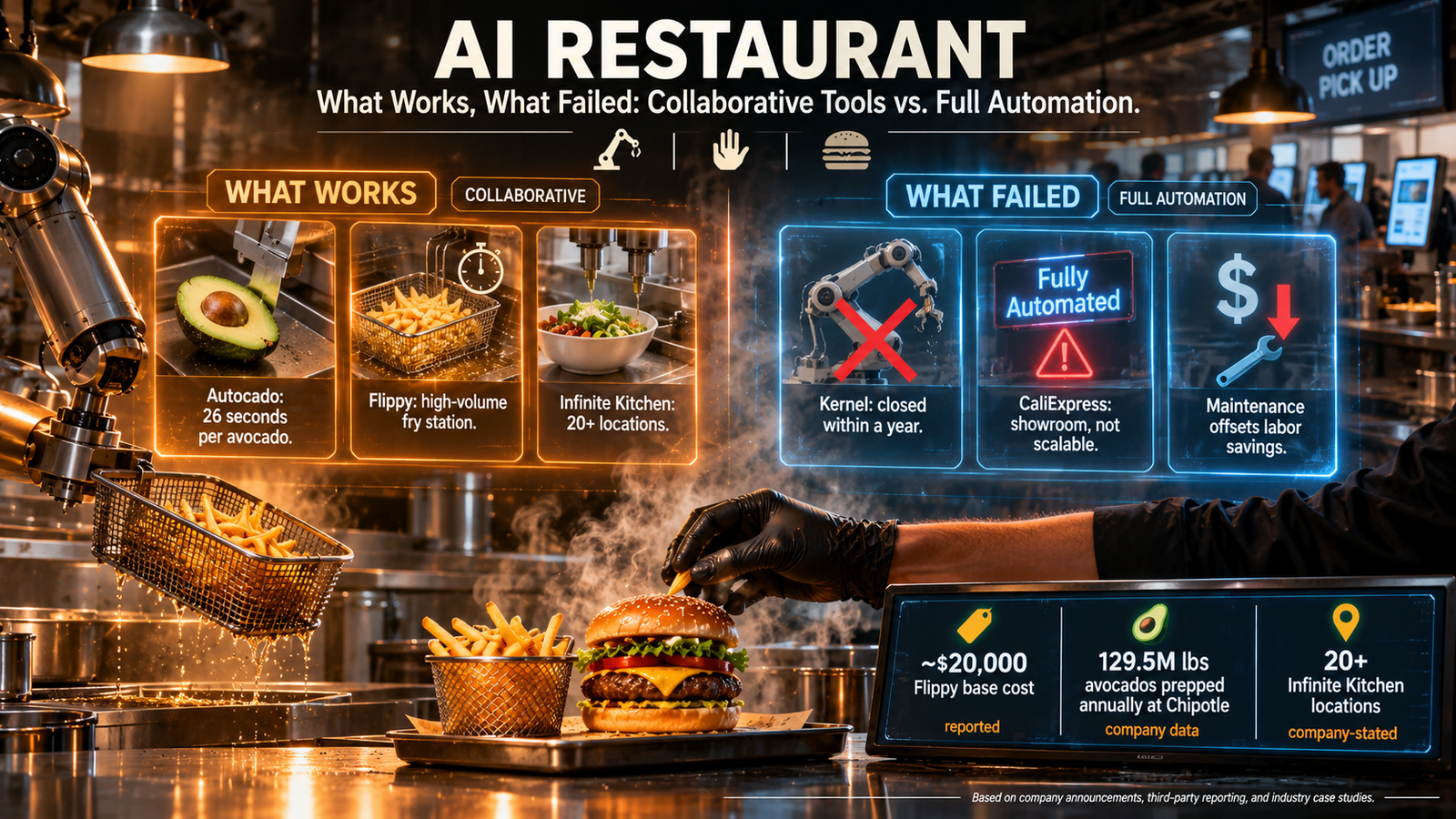
- Real deployments: Chipotle’s Autocado preps avocados in 26 seconds; Sweetgreen has 20+ Infinite Kitchens
- Real costs: A Flippy setup runs roughly $20,000 plus $10,000 installation and $3,500 monthly
- Real failures: Chipotle founder’s Kernel closed its robot concept within a year
- The pattern: Robots succeed when they do one tedious task well, not when they replace the whole kitchen
- Key limitation: Labor savings are often offset by maintenance, training, and integration costs
What Is an AI Restaurant?
The term covers a wide spectrum. At one end sit fully automated restaurants where robots handle most cooking and ordering. At the other sit conventional restaurants that use AI for narrow, repetitive tasks like avocado processing or bowl assembly.
The distinction matters because the outcomes differ dramatically. Fully automated concepts generate headlines and viral videos. Collaborative automation generates operational value.
The Fully Automated Model
CaliExpress by Flippy in Pasadena, California, represents the fully automated end. The restaurant uses Miso Robotics’ Flippy for frying and a grill robot from Cucina for burger patties. Ordering runs through PopID biometric kiosks. A robot food runner called Tuffy delivers to tables .
The menu is deliberately narrow: burgers, cheeseburgers, lettuce wraps, fries, and drinks . This constraint is not incidental. Full automation requires predictable, repeatable tasks. A broad menu breaks the model.
The Collaborative Model
Chipotle’s approach sits at the opposite end. The company deployed Autocado, a cobot that cuts, cores, and peels avocados in about 26 seconds, at a Huntington Beach location in 2024 . Human crew members still hand-mash the fruit to make guacamole. The robot handles the tedious, injury-prone prep work. Humans handle the part that requires judgment.
Chipotle also tested an Augmented Makeline built with Hyphen. The system assembles bowls and salads while crew members focus on other tasks . Both technologies went through Chipotle’s stage-gate process before broader rollout.
How These Systems Actually Work
Flippy and Grill Robots
Flippy is a robotic arm designed for fry station work. It knows when to drop fries into oil, how long to cook them, and when to lift the basket and shake it . The grill robot at CaliExpress grinds beef in real time after an order is placed, forms a patty, and cooks it .
The technical complexity is lower than it appears. These are structured environments with fixed inputs and outputs. The robot does not need to taste or adjust. It follows a timer and a motion path.
Autocado
Autocado addresses a specific pain point. Chipotle uses roughly 5.18 million cases of avocados annually, equivalent to 129.5 million pounds . Hand-cutting that volume is time-consuming and produces injuries. The machine recognizes variability in fruit size and adjusts itself automatically . It processes up to 25 pounds at a time .
The human still mashes the avocado. Chipotle has not automated the guacamole recipe itself, only the prep. This is a deliberate choice. The company’s brand depends on the perception of fresh, hand-mashed guac.
Infinite Kitchen
Sweetgreen’s Infinite Kitchen uses a hopper-based system to assemble bowls. The technology came from Spyce, an MIT spinout Sweetgreen acquired for about $70 million in 2021 . Sweetgreen later sold the Spyce robotics business to Wonder for $186.4 million while retaining a license to continue deploying Infinite Kitchens .
The system is designed for throughput and accuracy, not spectacle. Sweetgreen positions it as a way to free workers for customer service . The company has faced sales declines and is using automation as part of a broader turnaround effort, not as a standalone solution .
The Economics: What These Systems Actually Cost
Pricing is rarely disclosed, but some data points exist.
The Flippy numbers suggest a payback calculation based on labor hours. A fry cook working multiple shifts costs more than $3,500 monthly in most U.S. markets when factoring wages, benefits, and turnover. But the robot still requires human oversight, maintenance, and a trained operator nearby.
The Sweetgreen numbers tell a different story. Acquiring and developing automation is capital-intensive. Selling the robotics unit while licensing it back suggests Sweetgreen concluded it did not need to own the technology to benefit from it .
What Works and What Fails
Success Pattern: Narrow, Tedious, High-Volume Tasks
Autocado works because avocado prep is repetitive, injury-prone, and high-volume. Flippy works in high-throughput environments where fries are ordered constantly. Infinite Kitchen works when bowl assembly is standardized and volume is predictable.
The common thread is task specificity. These systems do not try to be a chef. They try to be a very good prep cook.
Failure Pattern: Full Automation as a Spectacle
Kernel, the restaurant concept from Chipotle founder Steve Ells, opened in New York with a large robotic arm handling oven work. It closed within a year and pivoted to a conventional sandwich shop . The reasons cited included maintenance challenges, training burdens, and the difficulty of bolting sensitive robotics to century-old floors .
Ells himself acknowledged that the concept may have felt too cold. The robot became the story, not the food. When the novelty faded, the operational overhead remained.
CaliExpress operates more as a showroom than a scalable restaurant model. It functions as a “pseudo-museum” for Flippy technology, hosting school tours and displaying retired robotic arms . That is a legitimate marketing strategy for Miso Robotics. It is not a template for chain restaurant economics.
Who Should Consider AI Restaurant Automation
Potential fit:
- High-volume quick-service locations with narrow, standardized menus
- Chains struggling with specific prep bottlenecks like avocado processing or fry station turnover
- Operators with capital to invest and patience for integration challenges
- Brands using automation as part of a broader operational efficiency strategy
Poor fit:
- Full-service restaurants with variable menus
- Low-volume locations where labor savings do not offset monthly costs
- Operators expecting immediate ROI without workflow redesign
- Businesses using automation primarily for marketing attention
Common Mistakes and Misconceptions
Assuming “fully automated” means no staff. CaliExpress still requires humans to assemble burgers, add toppings, and handle exceptions . The robot cooks the patty. A person builds the burger.
Ignoring maintenance and training costs. Kernel’s failure highlighted how much effort goes into keeping sensitive robotics operational in a commercial kitchen . These are not plug-and-play appliances.
Confusing press coverage with business viability. Viral videos of robot arms flipping burgers generate attention. They do not prove unit economics. Sweetgreen’s Infinite Kitchen rollout is measured in dozens of locations, not thousands.
Believing AI solves labor shortages automatically. Automation shifts labor needs; it does not eliminate them. Someone must operate, clean, troubleshoot, and maintain the equipment. The skill profile changes, but the headcount does not always drop.
Frequently Asked Questions
What is the world’s first AI restaurant?
CaliExpress by Flippy in Pasadena, California, has been described as the first fully automated AI-powered restaurant. It uses robotic grill and fry stations, biometric ordering kiosks, and a robot food runner. The menu is limited to burgers, fries, and drinks. It operates partly as a showroom for Miso Robotics technology .
Are AI restaurants replacing human workers?
The evidence suggests augmentation more than replacement. Chipotle’s Autocado handles avocado prep while humans mash guacamole . Sweetgreen says Infinite Kitchen frees workers for customer service . Fully automated concepts still require humans for assembly and oversight. The labor model shifts rather than disappears.
How much does a restaurant robot cost?
Reported figures suggest a Flippy system costs roughly $20,000 plus $10,000 for installation, with monthly operating costs around $3,500 . These numbers come from a single deployment and may not reflect current pricing. Larger systems like Sweetgreen’s Infinite Kitchen involve multi-million-dollar development and acquisition costs.
Why did Chipotle’s founder’s robot restaurant close?
Kernel, Steve Ells’ robot-powered concept, closed within a year for several reasons. Installing and maintaining sensitive robotics in older buildings proved difficult. Staff training and safety requirements added complexity. The prominent robotic arm also created a cold, industrial atmosphere that may have alienated customers . The concept pivoted to a conventional sandwich shop.
Is AI automation profitable for restaurants?
It depends on the task and volume. Narrow automation in high-volume settings can deliver labor savings. Broad automation often carries maintenance and integration costs that offset those savings. Sweetgreen sold its robotics unit while licensing it back, suggesting the company concluded that owning the technology was not the most efficient path .
Conclusion
AI restaurant technology has moved past the demo phase. Real deployments exist, real costs are documented, and real failures have occurred. The pattern is clear enough to draw practical lessons.
What matters most is task specificity. Robots succeed when they handle one tedious, repeatable, high-volume job. They struggle when they become the centerpiece of the dining experience. Autocado works because nobody wants to cut avocados for hours. Kernel failed because the robot became the reason to visit, and that reason was not strong enough.
AI restaurants suit high-volume quick-service operators with narrow menus and capital to invest. They do not suit full-service restaurants, low-volume locations, or operators seeking marketing spectacle without operational commitment.
Before adopting any automation, operators should evaluate the specific bottleneck, the true total cost including maintenance and training, and whether the technology solves a real problem or merely attracts attention. The restaurants that get this right will not look like robot museums. They will look like normal restaurants where a few unpleasant tasks quietly got easier.