Quizard AI is a mobile homework helper app that scans questions and math problems from photos, then delivers AI-generated answers with explanations. It targets students at all levels with a freemium model, but its token-based paywall and unusually weak privacy disclosures make it a tool worth scrutinizing before use. The app is distinct from Quizard.io, a separate study workspace for university lectures, and the two should not be confused.
At-a-Glance
- What it is: A homework scanner app from Quizard AI, Inc., available on iOS and Android
- Core function: Photo-based question solving with AI explanations, plus multiple-choice and short-answer help
- Pricing model: Freemium with token purchases and subscriptions, roughly $6.99 to $79.99 depending on tier and region
- Key strength: Fast photo-to-answer workflow for math and general homework questions
- Key weakness: Google Play listing states data is not encrypted and cannot be deleted
- Major confusion: Quizard AI (homework app) and Quizard.io (lecture study workspace) are unrelated products
What Is Quizard AI?
Quizard AI is a mobile application published by Quizard AI, Inc., a Delaware-registered company. The app positions itself as a homework and study aid for students from high school through college, and even adults refreshing their knowledge .
The core interaction is simple. A student photographs a homework question, typically a math problem or a multiple-choice item. The app’s AI processes the image and returns an answer, ideally with an explanation of the steps involved. The app also supports short-answer problems and claims to help with quiz and exam preparation.
This is a different product from Quizard.io. The latter is a study workspace designed for university courses, with features like slide mapping, spaced repetition, and Anki export . The two share a name and a general education focus, but they are separate companies with separate business models. Search results for “quizard ai” are dominated by the homework app, which is why this article focuses on it.
The Company Behind the App
Quizard AI, Inc. is registered at a Dover, Delaware address. The developer contact listed on app stores is support@quizard.ai and contact@quizard.ai . The company maintains a presence on TikTok and Instagram under the handle @quizard.ai . No public information was found regarding funding, team size, or the underlying AI models the app uses.
How Quizard AI Works
The workflow follows a familiar pattern for AI homework scanners.
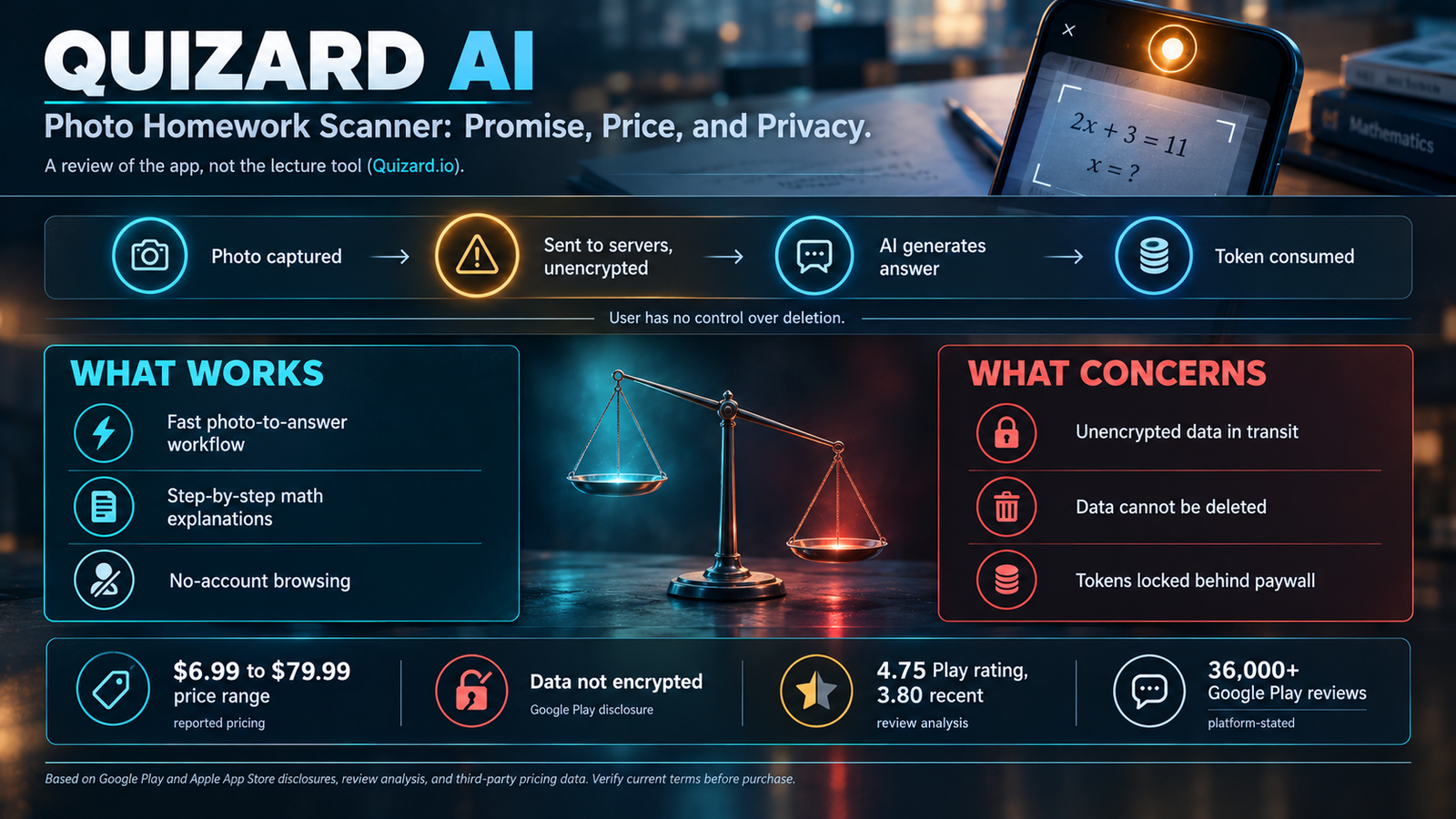
Step 1: Capture the question. Users photograph a problem using their phone’s camera. The app accepts printed text, handwritten math, and multiple-choice formats.
Step 2: AI processing. The image is sent to Quizard’s servers, where an AI model interprets the question and generates a response. The app does not disclose which model or provider powers this processing.
Step 3: Receive the answer. The app displays a solution, sometimes with step-by-step explanations. For math problems, the explanation may walk through the calculation.
Step 4: Ask follow-ups. Users can ask additional questions about the problem, though multiple reviews indicate follow-up questions are restricted unless the user upgrades to a paid tier .
The Token System
Quizard AI limits free usage through a token mechanism. Users receive a small number of tokens, and each question consumes tokens. When tokens run out, users must either purchase more or subscribe to a paid plan. One Google Play reviewer described the experience bluntly: “There’s no refresh of the tokens so when you’re out, you’re out, nothing else just Pay or Delete the app” .
This token system is the primary source of user frustration. A review summary from Chrome-Stats notes that “token-based access and paid subscriptions needed for full features” is a recurring complaint, alongside “occasional AI reliability or accuracy concerns” .
Pricing: What You Actually Pay
Quizard AI’s pricing is difficult to pin down because it varies by region, platform, and subscription duration. Sensor Tower data for the US App Store shows in-app purchases ranging from $6.99 to $79.99 . The Apple App Store listing for the UAE shows weekly unlimited plans at AED 19.99 and AED 29.99, monthly Pro at AED 59.99 and AED 79.99, and yearly Pro tiers ranging from AED 99.99 to AED 249.99 .
| Plan Type | Approximate US Price Range | Notes |
|---|---|---|
| Weekly unlimited | $6.99 to $9.99 | Short-term access, likely auto-renewing |
| Monthly Pro | $17.99 to $19.99 | Standard subscription tier |
| Yearly Pro | $29.99 to $79.99 | Wide range suggests multiple tiers or testing |
| 6-month Pro | $39.99 | Mid-length option |
The wide price range for yearly plans is unusual. It suggests the company is testing different price points or offering different feature bundles under similar names. Users should verify the exact terms before confirming any purchase.
One Google Play reviewer reported spending $40 on the app and receiving no answered questions, stating that “the program does not understand any questions scanned in, even after multiple times” . This is a single review, not a verified pattern, but it illustrates the risk of paying for a subscription before testing whether the scanner works reliably for your specific subject matter.
Hidden Costs and Usage Limits
The token system functions as a hidden cost multiplier. Even paid subscribers may encounter limits. The same reviewer who spent $40 noted that the app still failed to answer questions. Another reviewer complained, “I am not able to ask more follow up questions unless I upgrade to pro” .
The app’s claim of being “free to use” is technically true but misleading in practice. Free usage is limited to a small token allowance, and meaningful use requires payment.
Privacy and Data Handling: The Most Serious Concern
The Google Play listing for Quizard AI contains a data safety disclosure that should give any user pause.
Data is not encrypted. The listing states plainly: “Data isn’t encrypted” . This means information transmitted between the user’s device and Quizard’s servers may be vulnerable to interception.
Data cannot be deleted. The listing also states: “Data can’t be deleted” . Users have no mechanism to request removal of their data after using the app.
Data collected. The app declares collection of “Device or other IDs” and states “No data shared with third parties” . However, the Apple App Store listing includes a section titled “Data Used to Track You,” indicating that some data may be used for cross-app tracking . The discrepancy between platforms is itself worth noting.
These disclosures are provided by the developer, as required by Google Play policy. They represent the company’s own statements about its practices. The admission that data cannot be deleted is particularly significant. It means that homework questions, which may include personal information, academic work, or images captured by the camera, remain on Quizard’s systems indefinitely with no user recourse.
The app’s privacy policy, linked from the Google Play listing, is hosted on a Notion page. This is an unusual choice for a formal privacy document and does not inspire confidence in the company’s data governance practices.
What Quizard AI Does Well
Despite the privacy concerns and aggressive monetization, the app has genuine utility for some users. Its Google Play rating sits at 4.75 based on over 36,000 reviews, though recent ratings average lower at 3.80 . The disparity suggests that initial impressions are positive but satisfaction declines with continued use.
Photo-based math solving works, when it works. Users consistently praise the app’s ability to scan and solve math problems. One reviewer noted it “helps users understand topics and serves as a solid study aid” . Another said it is “good for checking work” .
Explanations can be helpful. When the AI correctly interprets a question, the step-by-step explanations provide educational value beyond just the answer.
Convenience. For students without access to a tutor, a photo scanner that produces instant explanations fills a real gap.
Limitations and Red Flags
Accuracy Is Inconsistent
AI homework solvers are known to produce incorrect answers, especially for advanced topics. A review from AIToolHub notes that “AI explanations can occasionally be wrong, especially for advanced topics” . For students relying on the app to learn, an incorrect explanation is worse than no explanation.
The Rating Pressure Problem
Multiple review summaries note that the app “pressures users to give 5-star reviews to unlock more usage” . This practice, while not unique to Quizard, artificially inflates ratings and misleads new users. A 4.75 rating built partly on coerced reviews is not a reliable signal of quality.
Follow-Up Questions Locked Behind Paywall
The inability to ask follow-up questions without upgrading undermines the educational value. Understanding a problem often requires clarification. A tool that answers once and then demands payment for further explanation is designed for extraction, not learning.
No Clarity on Underlying Models
Quizard does not disclose which AI models or providers power its answers. This opacity makes it impossible to assess accuracy claims, data handling at the model layer, or whether the app is a wrapper around a third-party API. Users are trusting an unknown system with images of their academic work.
Quizard AI vs. Alternatives
For math specifically, Photomath and Symbolab offer more focused tools with longer track records. For general homework help, ChatGPT’s free tier handles many of the same questions with better privacy practices and no token system. Quizard’s advantage is the integrated photo-to-answer workflow, but that advantage does not outweigh its data handling problems for most users.
Who Should Avoid Quizard AI
Students with privacy concerns. The admission that data is not encrypted and cannot be deleted should disqualify this app for anyone who values control over their personal information.
Anyone on a budget. The token system is designed to convert free users into paying subscribers. The free tier is too limited to be useful for regular homework help.
Students working on advanced material. User reviews suggest the app struggles with complex questions. If your coursework is beyond introductory level, expect more failures than successes.
People who need reliable explanations. An AI that gives wrong answers with confident explanations is actively harmful for learning.
Frequently Asked Questions
Is Quizard AI free?
Quizard AI offers a free tier with limited tokens. Meaningful use requires purchasing tokens or a subscription. Prices range from roughly $6.99 for weekly access to $79.99 for yearly plans, depending on region and platform . The app’s “free to use” claim is technically true but practically misleading.
Is Quizard AI safe to use?
The Google Play listing states that data is not encrypted and cannot be deleted . These are serious privacy concerns. Users should assume that any image or question submitted to the app may be retained indefinitely with no recourse for removal.
What is the difference between Quizard AI and Quizard.io?
Quizard AI is a mobile homework scanner app from Quizard AI, Inc. Quizard.io is a separate study workspace for university lectures with features like slide mapping and spaced repetition . They are unrelated products that happen to share a name.
Why does Quizard AI ask for a 5-star review?
Multiple review analyses note that the app pressures users to rate it 5 stars in exchange for more usage . This practice inflates the app’s rating and should be considered when evaluating its overall score.
Does Quizard AI work for all subjects?
The app claims to cover a wide range of subjects, but user reviews suggest it performs best on math problems. Accuracy for other subjects is inconsistent, and advanced material may produce unreliable results .
Conclusion
Quizard AI is a homework scanner app that solves math and general questions from photos. It has a working core function and a user base that finds it helpful for checking work and understanding basic problems.
What matters most, however, is not whether the scanner works. It is the terms under which it works. The app’s own data disclosure states that information is not encrypted and cannot be deleted. Its token system is designed to extract payment before users can evaluate whether the tool suits their needs. Its rating is partly built on pressure tactics. These are not incidental flaws; they are features of the business model.
Quizard AI may suit a student who needs a quick answer to a basic math problem and does not care about data retention. It does not suit anyone who expects privacy protections, predictable costs, or reliable performance on advanced material. Before downloading, users should ask whether the convenience of a photo scanner is worth handing over academic work to a company that says it cannot delete your data.