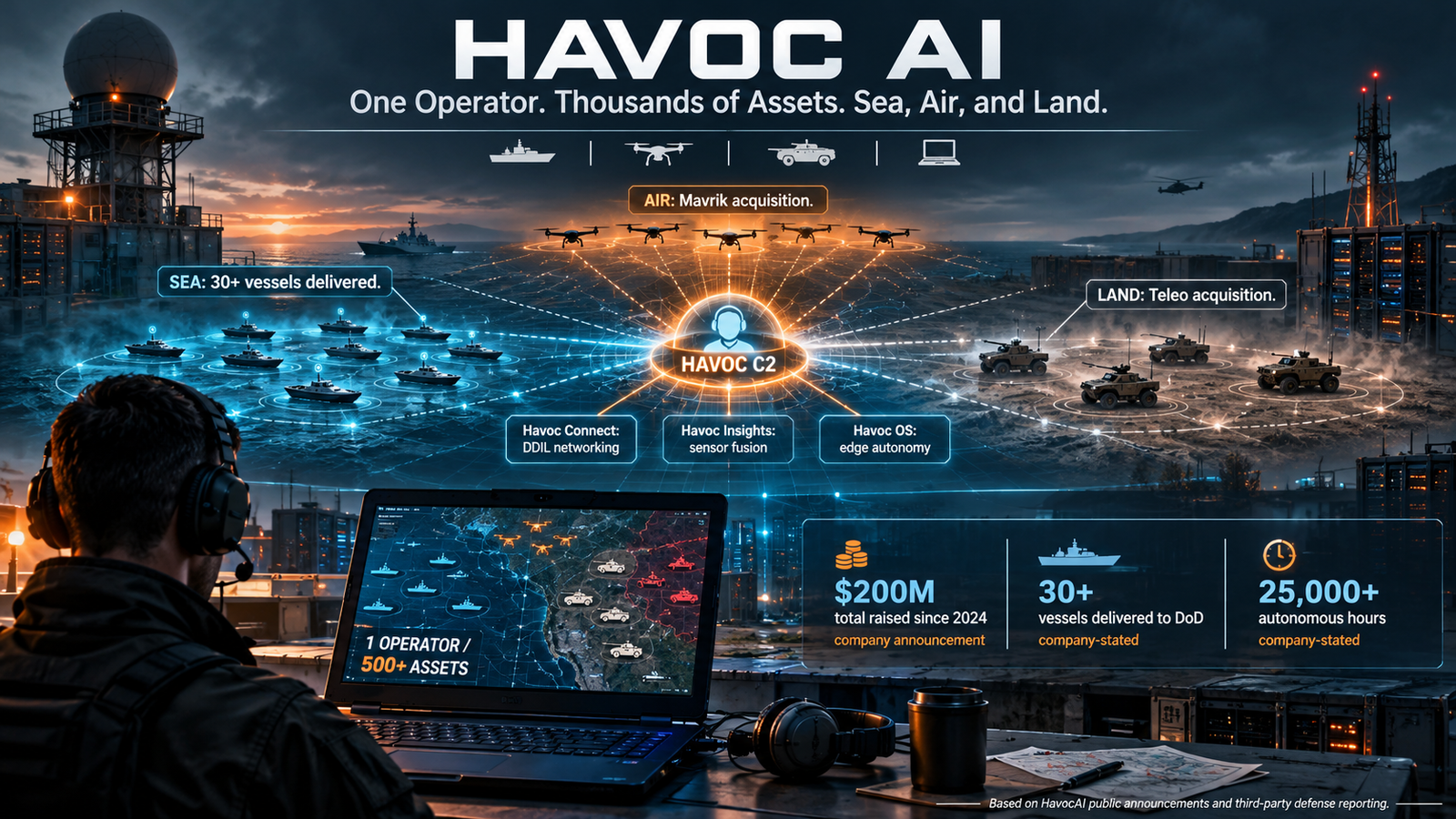
Havoc AI is a Rhode Island-based defense technology company building collaborative autonomy software that lets a single operator command thousands of uncrewed vehicles across sea, air, and land. Founded in 2024, the company has raised roughly $200 million, delivered over 30 autonomous surface vessels to the U.S. military, and acquired two companies to expand beyond maritime operations. Its core thesis is that autonomy is a software problem, not a hardware one, and the software must work when communications fail.
At-a-Glance
- What it is: A defense software company selling collaborative autonomy stacks, not consumer AI
- Founded: 2024, Providence, Rhode Island; CEO Paul Lwin
- Funding: $100M Series A in May 2026, bringing total raised to ~$200M
- Core product: Software that lets one operator supervise thousands of heterogeneous autonomous assets
- Traction: 25,000+ autonomous testing hours, 200B+ data points collected, 30+ vessels delivered to DoD
- Key risk: No public pricing, no independently verified performance benchmarks, and heavy dependence on U.S. military contracts
What Is Havoc AI?
Havoc AI is not a chatbot, a content generator, or a general-purpose AI platform. It is a defense contractor building the software layer that coordinates autonomous military systems. The company’s pitch is direct: the hardware for drones, boats, and ground vehicles already exists. What is missing is the ability for thousands of those assets to work together in coordinated, resilient ways .
The company was founded in 2024 and is headquartered in East Providence, Rhode Island, with additional offices in Austin and San Diego . CEO Paul Lwin frames the mission around a specific operational reality: future conflicts will occur in contested, distributed, and communications-degraded environments, and autonomy must function there, not just in controlled demos .
The Software-Defined Hardware Thesis
Havoc describes its approach as “software-defined hardware.” The autonomy stack is modular and platform-agnostic. It can be plugged into vessels, aircraft, and ground vehicles from different manufacturers. The company claims its software runs across more than 100 air, surface, and ground platforms .
This matters for procurement. Military branches do not want to buy a single proprietary vehicle. They want a coordination layer that works across mixed fleets. Havoc positions itself as that layer.
How Havoc AI Works
The operational model centers on one-to-many control. A single human operator defines mission intent, and the software translates that intent into tasking for large numbers of autonomous assets .
The Four Software Components
Havoc’s stack breaks into four named products :
Havoc C2 is the command-and-control interface. It lets operators define objectives and direct assets across distributed systems without proportional increases in manpower.
Havoc Insights is the analytics layer. It fuses real-time data from vehicles, sensors, and system services to surface trends, anomalies, and mission-level decision support.
Havoc Connect is the networking layer. It creates a peer-to-peer overlay network so systems can exchange commands and telemetry even when connectivity is intermittent or degraded.
Havoc OS runs on the edge. It enables heterogeneous platforms to execute collaborative missions and adapt to changing conditions without relying on continuous cloud connectivity.
The DDIL Environment
DDIL stands for Denied, Degraded, Intermittent, or Limited. It describes the communications conditions Havoc’s software is designed to survive . This is not a marketing flourish. It reflects the operational reality of contested electromagnetic environments, where GPS and radio links may be jammed or unavailable.
The Rampage vessel demonstration at the Navy League’s Sea-Air-Space conference illustrated the concept in practice. Three uncrewed boats circled port waters, alternating formations and speeds, controlled by a single operator on land using a laptop . The operator load was low enough that Havoc trained Army finance soldiers to use the system in about 20 minutes, according to Chief Strategy Officer Ben Cipperley .
The Hardware: Rampage and Beyond
While Havoc emphasizes software, it also builds and sells the vessels that carry its autonomy stack.
Rampage
The Rampage is a 14-foot autonomous surface vessel with a fully electric engine and a payload capacity of up to 300 pounds . It is beach-launchable, self-righting, and designed for persistent maritime operations at scale. The Robotics Registry lists a unit price of approximately $100,000 . The U.S. Navy purchased a dozen Rampages after the 2024 Silent Swarm experimentation event .
Havoc claims it can assemble 10 Rampage vessels in a single day . This production cadence matters for military buyers who need attritable, replaceable systems rather than bespoke platforms.
Larger Vessels in Testing
Havoc is developing larger autonomous surface vessels, including the 38-foot Seahound, 42-foot Kaikoa, and 100-foot Atlas . These are in testing phases as of late 2025. Specifications remain vendor-claimed.
Funding and Acquisitions
Havoc’s $100 million Series A closed in May 2026. New investors included CCM Capital Markets, Clear Street, Cobalt Capital, Boardman Bay Capital Management, SAIC, and JA Green. Existing backers included Lockheed Martin Ventures, B Capital, Scout VC, and Outlander VC . Former Congressman Devin Nunes joined the board as chair .
The company has made two strategic acquisitions to expand beyond maritime autonomy:
These acquisitions support the “all-domain” claim in Havoc’s branding. Without them, the company would be a maritime autonomy vendor. With them, it can pitch a unified coordination layer across sea, air, and land.
Havoc AI vs. Defense Autonomy Competitors
| Company | Focus | Key Strength | Public Pricing | Core Limitation |
|---|---|---|---|---|
| Havoc AI | Collaborative autonomy software + ASVs | One-to-many control, DDIL resilience, prime partnerships | Not disclosed | No independent benchmarks, early-stage |
| Saildrone | Autonomous ocean data | Proven long-endurance maritime data collection | Not disclosed | Data-focused, not tactical autonomy |
| Shield AI | AI pilot for aircraft | Autonomous flight in contested environments | Not disclosed | Air domain only |
| Anduril | Defense autonomy + hardware | Lattice OS, broad platform portfolio | Not disclosed | Larger, less specialized in swarm coordination |
Havoc’s differentiation is its explicit focus on collaborative autonomy at scale. Competitors build autonomy for individual platforms or specific domains. Havoc builds the coordination layer. Whether that layer is as mature as the company claims remains difficult to verify from public sources.
Who Havoc AI Serves
Primary customers:
- U.S. Department of Defense and military branches
- Defense primes seeking autonomy integration (Leidos, Lockheed Martin, SAIC)
- Shipbuilders and manufacturers supporting autonomous vessel production (PacMar, Senesco)
Not a fit for:
- Commercial enterprises seeking off-the-shelf AI tools
- Individual users or researchers
- Organizations outside the U.S. defense ecosystem (export controls likely apply)
Limitations and Considerations
No Public Pricing or Contracts
Havoc does not publish pricing for its software or vessels beyond the ~$100,000 Rampage estimate from third-party sources . Defense procurement is negotiated through contracts, not public rate cards. Buyers cannot self-evaluate costs without engaging the company.
Vendor-Claimed Metrics
The company’s performance figures, including 25,000+ autonomous hours and 200 billion data points collected, come from Havoc’s own announcements . They have not been independently audited or published in peer-reviewed form. This does not mean they are false, but procurement teams should request verification.
Limited Transparency on Software Architecture
Havoc describes what its software does, not how it works. There is no public documentation on the underlying models, inference architecture, latency characteristics, or security certifications. The Clarity Score analysis of Havoc’s website noted that the site reads like a product catalog without conveying the operator’s actual circumstances . This is a marketing gap, but it also reflects limited public technical disclosure.
Dependence on U.S. Military Contracts
Havoc’s business is built on defense spending. Shifts in procurement priorities, budget cycles, or strategic focus could affect the company’s trajectory. This is a standard risk for defense startups, not unique to Havoc, but it matters for anyone evaluating long-term partnerships.
The “Havoc AI” Name Collision
Search results for “Havoc AI” include unrelated products, including a Roblox exploit script chatbot on MiniApps and an AWS deployment tool called ./HAVOC . The defense company at havocai.com is the entity most relevant to serious search intent, but users should be aware of the naming confusion.
Frequently Asked Questions
What does Havoc AI actually do?
Havoc AI builds software that lets a single operator command large numbers of autonomous military vehicles across sea, air, and land. The software handles mission tasking, sensor data fusion, and resilient networking in degraded communications environments. The company also builds the Rampage autonomous surface vessel as a platform for its autonomy stack.
Is Havoc AI a public company?
No. Havoc AI is a private venture-backed startup. It raised a $100 million Series A in May 2026, bringing total funding to roughly $200 million since its 2024 founding . There is no public stock ticker.
How much does Havoc AI cost?
Havoc does not publish pricing. The Rampage vessel is estimated at approximately $100,000 per unit by third-party sources . Software licensing, integration services, and larger vessels are negotiated through defense contracts. Commercial customers should expect custom quotes.
Who invests in Havoc AI?
Investors include Lockheed Martin Ventures, B Capital, Scout VC, Outlander VC, UP.Partners, SAIC, Cobalt Capital, and Vanderbilt University’s endowment . The presence of Lockheed Martin and SAIC, both defense primes, signals industry confidence in Havoc’s technology.
What is the Rampage vessel?
The Rampage is a 14-foot autonomous surface vessel built by Havoc. It has a fully electric engine, carries up to 300 pounds of payload, and is designed for persistent maritime operations. The U.S. Navy purchased a dozen units after a 2024 experimentation event .
Conclusion
Havoc AI is a defense technology company with a specific and coherent thesis: the future of military autonomy depends on software that coordinates thousands of assets, not just individual platforms that move on their own. The company has raised substantial capital, secured major defense partnerships, and demonstrated its technology in operational settings.
What matters most for anyone evaluating Havoc is distinguishing between verified traction and marketing claims. The funding rounds are real. The Navy purchases are real. The acquisitions of Mavrik and Teleo are real. The performance metrics, however, are company-stated and unaudited. The software architecture is not publicly documented. The pricing is not disclosed.
Havoc suits defense procurement teams seeking collaborative autonomy solutions and primes looking for integration partners. It does not suit commercial buyers, individual users, or organizations that need transparent pricing and published technical specifications before engagement. Before committing to a partnership, buyers should request independent validation of performance claims, detailed security documentation, and clear contract terms that address long-term support and platform evolution.