Path AI is a Boston-based digital pathology company whose AISight platform combines FDA-cleared image management with AI-powered diagnostic tools for labs and pharmaceutical research. Roche Diagnostics acquired Path AI for $1.05 billion in May 2026, cementing its position as a core piece of enterprise pathology infrastructure. The company’s revenue is driven primarily by pharma clinical trial services rather than hospital diagnostic software, a distinction that explains both its valuation and its limitations.
At-a-Glance
- What it is: An AI-powered pathology platform, not a consumer tool or general medical AI
- Acquisition: Roche Diagnostics acquired Path AI for $1.05B in May 2026
- Core product: AISight Dx, FDA-cleared for primary diagnosis with a Predetermined Change Control Plan
- Key clearance: PathAssist Derm received FDA Breakthrough Device Designation in March 2026
- Revenue mix: Over 60% from pharmaceutical clients; estimated $100M–$250M revenue in 2025
- Notable deployments: Labcorp nationwide, MedStar Health across 40+ pathologists
What Is Path AI?
Path AI is a digital pathology software company headquartered in Boston. It builds the infrastructure that lets pathology labs move from glass slides under microscopes to digital whole-slide images managed, analyzed, and shared through cloud software.
The company’s core product is AISight, an image management system (IMS) that serves as the software backbone for digital pathology workflows. Labs use AISight to view slides, manage cases, collaborate on difficult diagnoses, and integrate AI algorithms that analyze tissue images .
- Path AI is not a hardware company. It does not make scanners or microscopes. It is not a clinical diagnostic lab. It sells software and services to labs, hospitals, and pharmaceutical companies that need to digitize pathology operations and extract quantitative data from tissue samples.
Path AI vs. Other Pathology AI Vendors
Path AI’s differentiation is its combination of an open IMS platform with deep pharmaceutical research services. Paige and Ibex build algorithms that plug into IMS platforms. Proscia competes directly on IMS but does not have Path AI’s pharma services footprint.
How AISight Works
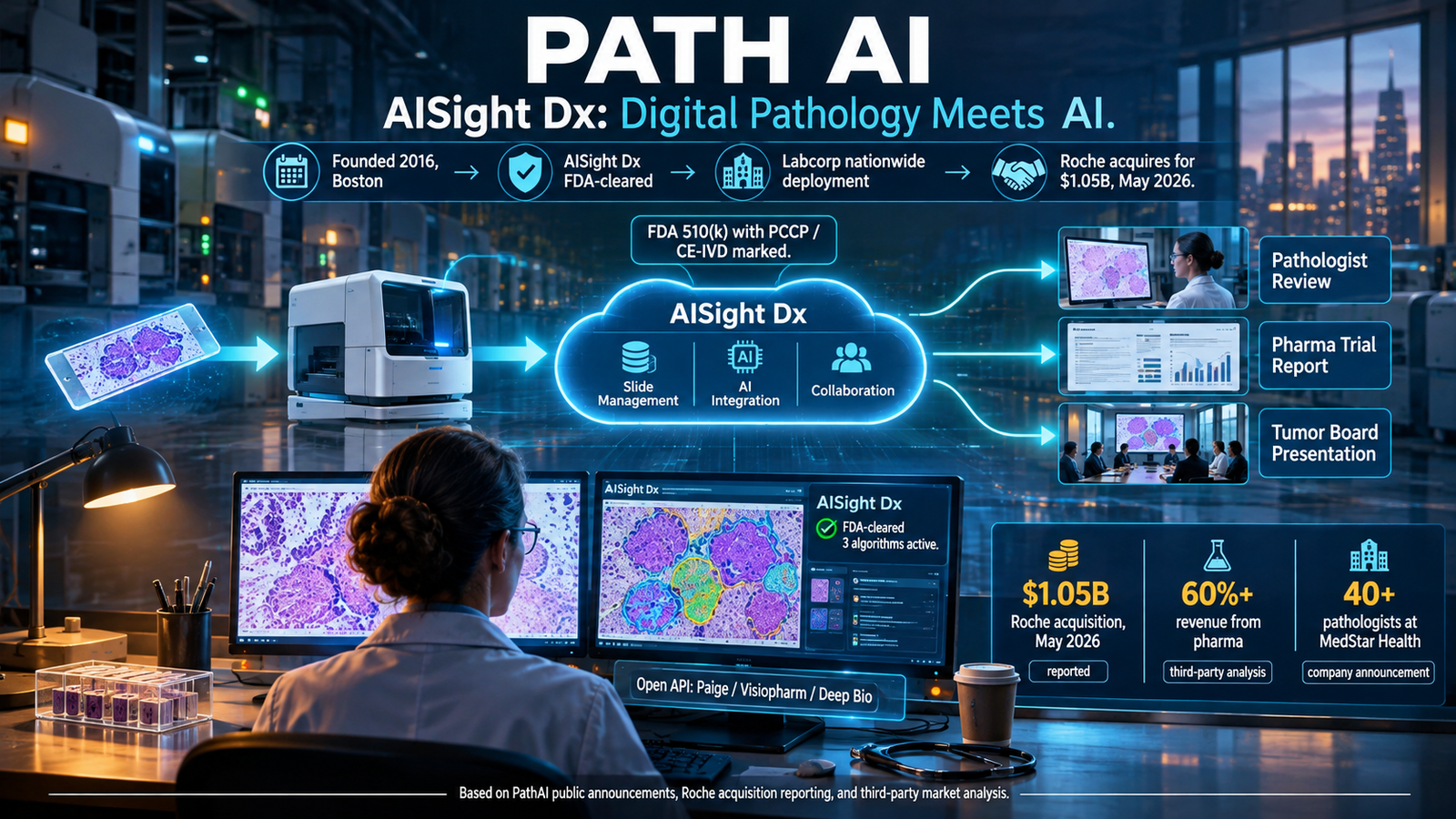
AISight Dx is a cloud-native platform. It handles slide management, viewing, collaboration, and AI integration in a single environment.
The Core Workflow
Labs scan glass slides into digital whole-slide images. Those images enter AISight, where pathologists review them on monitors instead of microscopes. The platform manages case assignment, secondary reviews, annotation, and reporting .
The v2.17 release added presentation queues for tumor boards, a structured consult workflow, and voice-enabled reporting through a partnership with Voicebrook . These features matter for operational efficiency. A pathologist preparing for a tumor board can build a curated slide queue in advance rather than assembling materials manually.
The Open Integration Model
AISight is designed as an open platform. Through an API framework called AISight Link, third-party AI algorithms from companies like Paige, Visiopharm, Deep Bio, and Mindpeak can run inside the same workflow . Pathologists do not need to export files or switch between viewers.
This matters for hospital procurement. KLAS research found that buyers consistently demand AI integration directly into the IMS workflow rather than separate systems . AISight’s open architecture addresses that requirement.
The Predetermined Change Control Plan
AISight Dx received FDA 510(k) clearance with an authorized Predetermined Change Control Plan (PCCP) . This is a regulatory mechanism that allows the company to update certain software elements without filing a new 510(k) for each change. It reduces regulatory friction for iterative improvements, though the scope of permitted changes is defined by the FDA.
FDA Clearances and Clinical Reach
Path AI has accumulated a series of regulatory milestones that establish its clinical credibility.
AISight Dx is FDA-cleared for primary diagnosis in the US and CE-IVD marked for primary diagnosis in the EEA, UK, and Switzerland . This means pathologists can use it as their primary viewing platform for diagnostic reads, not just research or secondary review.
PathAssist Derm received FDA Breakthrough Device Designation in March 2026 . This designation accelerates review for devices that address unmet clinical needs. PathAssist Derm analyzes whole-slide images of skin lesions to aid pathologists in dermatopathology review. It is currently For Research Use Only, not for diagnostic procedures.
AIM-MASH AI Assist received qualification from both the FDA and EMA as a Drug Development Tool . This is a regulatory qualification that allows the tool to be used in MASH clinical trials as a standardized endpoint assessment.
Enterprise Deployments
The commercial traction is real and verifiable. Labcorp is deploying AISight Dx across its national network of anatomic pathology labs and hospital collaborations . MedStar Health signed a multi-year partnership to deploy AISight Dx and AI algorithms across a network supporting over 40 pathologists . These are named customers with public announcements, not anonymized case studies.
The Roche Acquisition and What It Means
In May 2026, Roche Diagnostics acquired Path AI for $1.05 billion . The deal is the largest acquisition in digital pathology to date.
Why Roche Bought Path AI
The strategic logic centers on the pharmaceutical side. Path AI’s revenue is dominated by pharma clients, including Roche, GSK, and BMS. Over 60% of revenue comes from drug developers who use Path AI’s AI tools to standardize pathology endpoints in clinical trials .
Roche’s diagnostics division already sells scanners and reagents. Adding Path AI gives Roche a software layer that connects tissue diagnostics to drug development. A pharma company running a clinical trial can use Path AI’s algorithms to measure treatment response in tissue samples, generating data that supports regulatory submissions.
The Independence Question
The acquisition creates a structural tension. Path AI’s platform integrates AI algorithms from third-party vendors, including Paige and Visiopharm. Those vendors compete with Roche in some markets. Whether they will continue integrating with a platform owned by a Roche subsidiary is an open question .
Path AI’s pharma clients include companies that compete with Roche. Those clients may hesitate to run sensitive clinical trial data through a platform owned by a competitor. This concern does not invalidate the acquisition, but it creates a competitive opening for independent pathology AI vendors.
Pricing and Revenue Transparency
Path AI does not publish software pricing. This is standard for enterprise medical software sold through procurement negotiations. The company’s revenue structure, however, has been reported by third-party analysis.
Revenue Composition
Third-party estimates put Path AI’s 2025 revenue at approximately $100 million to $250 million, with growth of 30% to 40% . Over 60% comes from pharmaceutical clients. The remainder comes from hospital software licensing, SaaS services, laboratory testing, and algorithm licensing.
This revenue mix explains the company’s trajectory. Hospital diagnostic software is a slower, lower-margin business than pharma clinical trial services. Path AI prioritized the higher-value pharma segment, which is why it attracted a $1.05 billion acquisition price while other pathology AI companies remain smaller.
What Buyers Should Expect
Labs evaluating AISight should expect enterprise contract terms. There is no self-serve pricing, no free tier, and no public rate card. The cost includes platform licensing plus potential fees for AI algorithms, whether Path AI’s own or third-party integrations. Voice-enabled reporting through Voicebrook may carry separate licensing .
Limitations and Considerations
Pharma-Centric Priorities
Path AI’s revenue dependence on pharma clients shapes its product priorities. Features that matter for clinical trial endpoints may receive more investment than features that matter for routine hospital diagnostics. Labs seeking a vendor focused exclusively on their clinical workflow needs should evaluate whether Path AI’s roadmap aligns with their priorities.
Post-Acquisition Uncertainty
The Roche acquisition introduces uncertainty about Path AI’s platform neutrality. Third-party AI vendors may reconsider integration. Pharma clients may reconsider data sharing. These are not confirmed disruptions, but they are plausible consequences of the ownership change.
Algorithm Scope
Path AI’s own diagnostic algorithms are expanding but remain narrower than its platform capabilities. PathAssist Derm is Breakthrough Device Designated but not yet cleared for diagnostic use . The company’s strength is the platform, not a comprehensive suite of proprietary diagnostic AI.
Headcount and Stability
Path AI has undergone staff reductions. Third-party tracking shows headcount at approximately 284 as of July 2026, down from earlier peaks . Korean-language reporting describes “large-scale workforce reductions” and “business restructuring” prior to the acquisition . These reports should be treated as third-party analysis rather than verified fact, but they suggest the company faced commercial pressure before Roche stepped in.
Path AI vs. Competitors After the Acquisition
The competitive landscape shifts with Path AI under Roche ownership. Independent IMS vendors like Proscia may benefit from pharma and lab concerns about Roche neutrality. Algorithm vendors like Paige and Ibex face a choice about whether to continue integrating with AISight or prioritize other platforms.
Who Path AI Serves
Primary users:
- Pharmaceutical companies running clinical trials with tissue-based endpoints
- Large hospital systems and reference labs digitizing pathology workflows
- Pathology labs seeking an open IMS platform with third-party AI integration
Not a fit for:
- Small clinics without digital pathology infrastructure
- Labs seeking a closed, single-vendor algorithm solution
- Organizations uncomfortable with Roche ownership of their pathology platform
Frequently Asked Questions
What does Path AI actually do?
Path AI builds AISight, a digital pathology platform that lets labs view, manage, and analyze whole-slide images. It also provides AI algorithms and clinical trial services to pharmaceutical companies. The platform is FDA-cleared for primary diagnosis and deployed at Labcorp and MedStar Health.
Is Path AI owned by Roche?
Yes. Roche Diagnostics acquired Path AI for $1.05 billion in May 2026 . Path AI operates as a Roche subsidiary. The acquisition makes Roche a major player in digital pathology software alongside its existing scanner and reagent businesses.
How much does Path AI cost?
Path AI does not publish pricing. Enterprise contracts are negotiated directly with the company. Costs include platform licensing and may include fees for AI algorithms and third-party integrations. Labs should request quotes through Path AI’s sales team.
What is AISight Dx cleared for?
AISight Dx is FDA-cleared for primary diagnosis in the US and CE-IVD marked for primary diagnosis in the EEA, UK, and Switzerland . It is an image management system, not a diagnostic algorithm. It received clearance with a Predetermined Change Control Plan that allows certain software updates without new filings.
What happened to Path AI’s workforce?
Third-party tracking shows Path AI headcount at approximately 284 as of July 2026, down from earlier peaks . Korean-language reporting describes restructuring and workforce reductions prior to the Roche acquisition . Path AI has not published detailed statements about layoffs in the materials reviewed for this article.
Conclusion
Path AI became the most valuable company in digital pathology by building the software layer that connects tissue images to AI analysis and pharma research. Its AISight platform is FDA-cleared, deployed at major labs, and open to third-party algorithms. The Roche acquisition validates the business model and provides resources for expansion.
- What matters most for anyone evaluating Path AI is understanding what it is and what it is not. It is an enterprise platform for digitizing pathology workflows, not a consumer diagnostic tool. It is a pharma-focused business, not a hospital-first software vendor. It is now a Roche subsidiary, which brings stability but also raises questions about platform neutrality.
Path AI suits large labs, hospital systems, and pharmaceutical companies with the volume and infrastructure to justify enterprise software procurement. It does not suit small practices, standalone clinics, or organizations that need transparent pricing before engagement. Buyers should evaluate the post-acquisition roadmap, third-party algorithm availability, and data governance terms before committing to a multi-year contract.