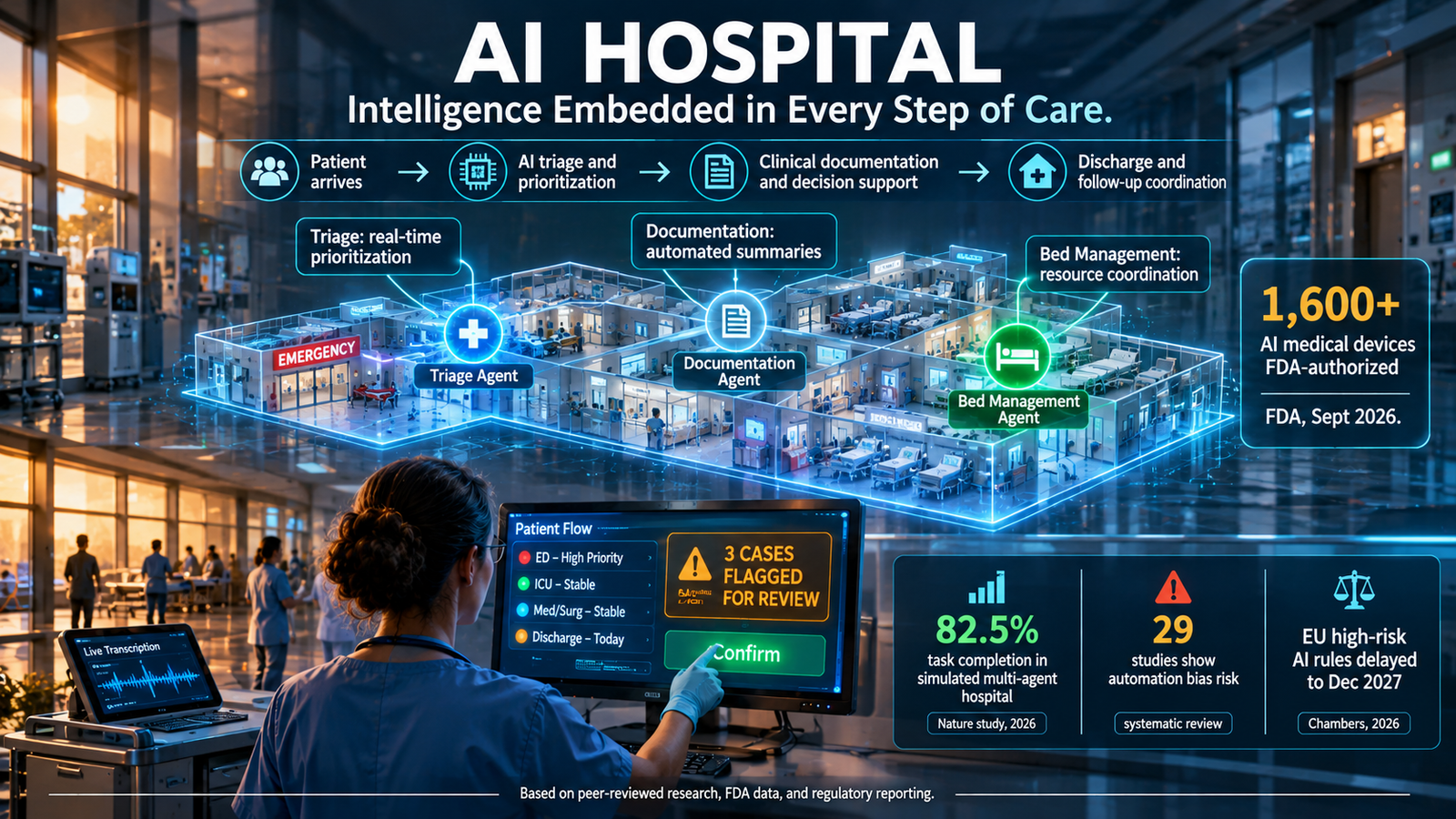
An AI hospital is a healthcare model where artificial intelligence is embedded into the hospital’s operational and clinical systems, not added as a separate tool. These systems use AI agents to handle triage, documentation, scheduling, and diagnostic support in real time, linking offline medical expertise with continuous digital coordination. The model is moving from pilot projects into real deployments, though evidence on outcomes, safety, and cost remains uneven.
At-a-Glance
- Core idea: AI as infrastructure, not a feature bolted onto existing systems
- Real deployments: China opened its first AI hospital in Boao in March 2026
- Clinical evidence: Research agents like MIRA matched or exceeded physician diagnostic accuracy in simulated cases
- FDA scope: Over 1,600 AI-enabled medical devices authorized as of September 2026
- Key risk: Automation bias and deskilling, documented across 29 peer-reviewed studies
- Regulatory gap: EU high-risk AI rules delayed to December 2027; US taking a deregulatory posture
What Is an AI Hospital?
The term gets used loosely, so precision matters. An AI hospital is not a hospital that uses a chatbot on its website. It is a healthcare system where AI is embedded into the operational layer, coordinating patient flow, clinical documentation, and resource allocation as part of the hospital’s core function.
China offered the first formal definition in March 2026, when a consensus document released at the Zhongguancun Forum described an AI hospital as a model where AI links offline medical expertise with online services to deliver proactive, continuous care . The same month, the country opened its first AI hospital in Boao, Hainan Province.
The distinction between “AI in a hospital” and an “AI hospital” matters. Most hospitals now use some form of AI, whether in imaging analysis or scheduling software. An AI hospital reorganizes workflows around AI coordination rather than treating AI as a departmental add-on.
The Agentic Layer
Much of the current work centers on AI agents, software systems that can take actions within a workflow rather than just answer questions. A 2026 study in Nature described a multi-agent framework with four collaborative agents handling patient registration, triage and physician allocation, clinical documentation, and bed management . In a simulated environment, the system achieved an 82.5% task completion rate and 87.5% coordination efficiency .
These are simulation results, not clinical outcomes. They suggest the architecture is feasible. They do not prove it works in a real hospital with real patients and real edge cases.
How AI Hospital Systems Work
The technical architecture varies, but several common components appear across deployments.
Triage and Patient Flow
AI systems can analyze incoming patient data and prioritize cases before a clinician sees them. At Rambam Health Care Campus in Israel, an AI system called Shaked operates in adult and pediatric emergency departments, analyzing patient histories, lab results, and symptoms in real time . In one documented case, it flagged a young woman’s recent dental procedure, steering the team away from a stroke protocol toward a correct diagnosis of gum inflammation .
In pediatric care, Shaked identified an injury pattern consistent with possible child abuse in a four-month-old, prompting a report to authorities . It also caught severe hypokalemia in a 13-year-old whose symptoms initially appeared to be simple muscle pain .
These are individual case reports from the hospital. They illustrate capability, not population-level effectiveness.
Clinical Documentation and Decision Support
Documentation consumes a large share of clinician time. AI systems that transcribe and summarize encounters are among the most widely deployed hospital AI tools. Singapore General Hospital developed NoteBuddy, which transcribes and summarizes doctor-patient conversations in real time . The hospital reports that robotic process automation and related tools returned more than 84,000 hours to staff .
More ambitious systems go beyond documentation. The MIRA agent, developed by researchers at TU Dresden and University Hospital Dresden, operates inside electronic health records in a simulated environment. It orders tests, interprets results, and prepares treatment decisions . In retrospective simulations using over 500 real patient cases, MIRA achieved higher diagnostic accuracy than physician comparison groups in some areas .
MIRA’s lead researcher described the system as similar to an airplane autopilot: it supports and relieves professionals, but responsibility remains with the physician . The system has not been deployed in live clinical care.
Resource and Bed Management
Agent-based systems can coordinate bed allocation and interdepartmental logistics. The Nature study’s Bed Allocation Agent handled adaptive resource management in simulation, contributing to the 96.4% workflow stability rate reported . This is the least visible but potentially highest-value application: hospitals lose significant capacity to inefficient bed turnover and discharge coordination.
Real-World Deployments
The gap between research and deployment is narrowing, but unevenly.
China’s Boao hospital is the most ambitious operational deployment. It was designed to connect patients with specialty drugs and devices available in the Lecheng pilot zone, using AI to match indications and track outcomes . The hospital operates on a three-step model: local consultation, treatment in Lecheng, and home follow-up .
Whether this model improves outcomes or simply improves access to a specific regulatory zone’s offerings is an open question. No peer-reviewed evaluation has been published.
Benefits and Limitations
What AI Hospitals Promise
Reduced documentation burden. Transcription and summarization tools address a measurable pain point. Clinicians spend substantial time on EHR documentation, and even partial automation frees time for care .
Faster triage and prioritization. Systems that flag deteriorating patients or unusual presentations can reduce delays. Rambam’s case reports suggest this works in specific instances .
Better resource utilization. Bed management and scheduling are optimization problems well suited to algorithmic approaches. Simulation data supports feasibility .
Continuous monitoring. AI systems do not tire or lose attention. They can track patient status continuously rather than at discrete intervals.
What Remains Unproven or Risky
Outcome evidence is thin. Most published work uses simulation or retrospective data. Prospective, multi-site studies tracing AI recommendations to patient outcomes are rare . The field lacks the evidence base to claim that AI hospitals improve care at scale.
Automation bias is documented. A systematic review of 29 peer-reviewed studies found consistent evidence that clinicians over-rely on AI outputs when they are presented as authoritative . When AI is wrong, humans may fail to catch it. The review recommends structured human-in-the-loop oversight, not just optional review .
Deskilling is a real concern. The same review found evidence of cognitive offloading, where clinicians’ independent reasoning degrades with prolonged AI reliance . A system that makes clinicians faster but less capable is a long-term risk, not a benefit.
Integration is hard. Most AI tools are not built for existing EHR workflows. Reviews consistently identify fragmented data standards and limited interoperability as major barriers . A model that performs well in isolation may fail when deployed in a hospital’s actual data environment.
Regulatory and Liability Landscape
FDA Oversight
The FDA does not regulate AI as a category. It regulates medical devices, including AI-enabled devices, through premarket pathways like 510(k), De Novo, and premarket approval . As of September 2026, the agency had authorized over 1,600 AI-enabled medical devices .
These range from imaging algorithms to insulin dosing software. The FDA has also introduced Predetermined Change Control Plans, which allow developers to update AI models within approved bounds without new submissions . This is important for AI devices, which may need frequent retraining as data distributions shift.
EU Delay and US Deregulation
The EU’s high-risk AI requirements, originally scheduled for August 2026, were deferred to December 2027 for stand-alone systems and August 2028 for AI embedded in regulated products . The obligations were not softened, only postponed. The delay reflects the difficulty regulators face in keeping pace with the technology.
In the United States, the current administration has pursued a deregulatory AI policy, narrowing FDA oversight of lower-risk digital health tools and relying more on post-market surveillance . This approach may accelerate deployment but places more responsibility on hospitals and clinicians to evaluate tools independently.
Liability Expansion
EU member states must transpose the new Product Liability Directive by December 2026, extending strict liability to software and AI systems . This means developers and vendors, not just clinicians and hospitals, can be held liable for harm. The population of potential defendants is expanding as AI systems become more autonomous.
Who AI Hospitals Serve and Who They Don’t
Likely beneficiaries:
- High-volume hospitals with documentation bottlenecks and capacity constraints
- Emergency departments that need faster triage and prioritization
- Systems with existing digital infrastructure and data governance maturity
Poor fit or premature:
- Small hospitals without the technical staff to integrate and monitor AI systems
- Facilities with fragmented or low-quality data, where model outputs will be unreliable
- Organizations seeking fully autonomous clinical decision-making, which no cleared system provides
Common Mistakes and Misconceptions
Treating “AI hospital” as a product you can buy. It is an operational model, not a SKU. Hospitals assemble it from multiple vendors, internal development, and workflow redesign.
Assuming FDA clearance means clinical superiority. Clearance means the device met safety and effectiveness standards for its intended use. It does not mean the device outperforms clinicians or improves outcomes in every setting .
Ignoring the human infrastructure. AI systems require oversight, training, and workflow redesign. The evidence on automation bias suggests that without structured review processes, AI can degrade rather than improve decision quality .
Confusing pilot results with deployed performance. A model validated on retrospective data may perform differently in a live environment with different patient populations, data quality, and clinician behavior.
Frequently Asked Questions
What is an AI hospital?
An AI hospital is a healthcare model where AI is embedded into clinical and operational systems, coordinating patient flow, documentation, and decision support as part of the hospital’s core function. China formalized this definition in March 2026 when it opened its first AI hospital in Boao . It differs from a hospital that simply uses AI tools in isolated departments.
Are AI hospitals real or still experimental?
Both. Operational deployments exist, including China’s Boao hospital and Rambam’s Shaked system in Israel. But most clinical AI research remains simulation-based or retrospective. The MIRA agent, for example, has demonstrated strong results in simulated EHR environments but has not been deployed in live care . The gap between operational deployment and proven outcome improvement is significant.
Does the FDA regulate AI hospitals?
The FDA regulates AI-enabled medical devices, not hospitals or AI systems as a category. It has authorized over 1,600 AI-enabled devices as of September 2026 . Hospitals themselves are regulated through different mechanisms, and the integration of multiple AI tools into a clinical workflow falls outside the FDA’s device-by-device review.
What are the biggest risks of AI hospitals?
Automation bias and deskilling are the most documented risks. A systematic review of 29 studies found consistent evidence that clinicians over-rely on AI outputs and that prolonged reliance can degrade independent reasoning . Data fragmentation, integration failures, and unproven outcome claims are also significant concerns.
Will AI replace doctors in hospitals?
No cleared AI system operates autonomously in clinical care. The systems described here support, prioritize, and document. MIRA’s developers describe it as an autopilot, not a replacement for the pilot . Rambam’s director general stated explicitly that AI will strengthen decision-making, not replace physicians . The evidence on deskilling suggests the risk is not replacement but gradual erosion of independent clinical judgment if oversight is weak .
Conclusion
The AI hospital is a coherent concept with real deployments and genuine technical foundations. It is also a field where marketing runs ahead of evidence. Agent-based systems can coordinate workflows in simulation. AI tools can transcribe, triage, and flag. But the published record does not yet demonstrate that these systems improve patient outcomes at scale, and the risks of automation bias and deskilling are documented, not hypothetical.
What matters most is the human infrastructure around the technology. A hospital that deploys AI without structured oversight, clinician training, and clear accountability is not an AI hospital. It is a hospital with unmanaged automation. The difference is governance, not algorithms.
AI hospitals may suit high-volume systems with the technical capacity to integrate, monitor, and override AI tools. They do not suit facilities seeking a turnkey solution or organizations that cannot invest in the oversight the evidence demands. Before adopting any AI hospital model, decision-makers should ask for prospective outcome data, not vendor demonstrations. They should define who is accountable when the system is wrong. And they should measure whether clinicians are becoming more capable with AI, or merely faster without it.