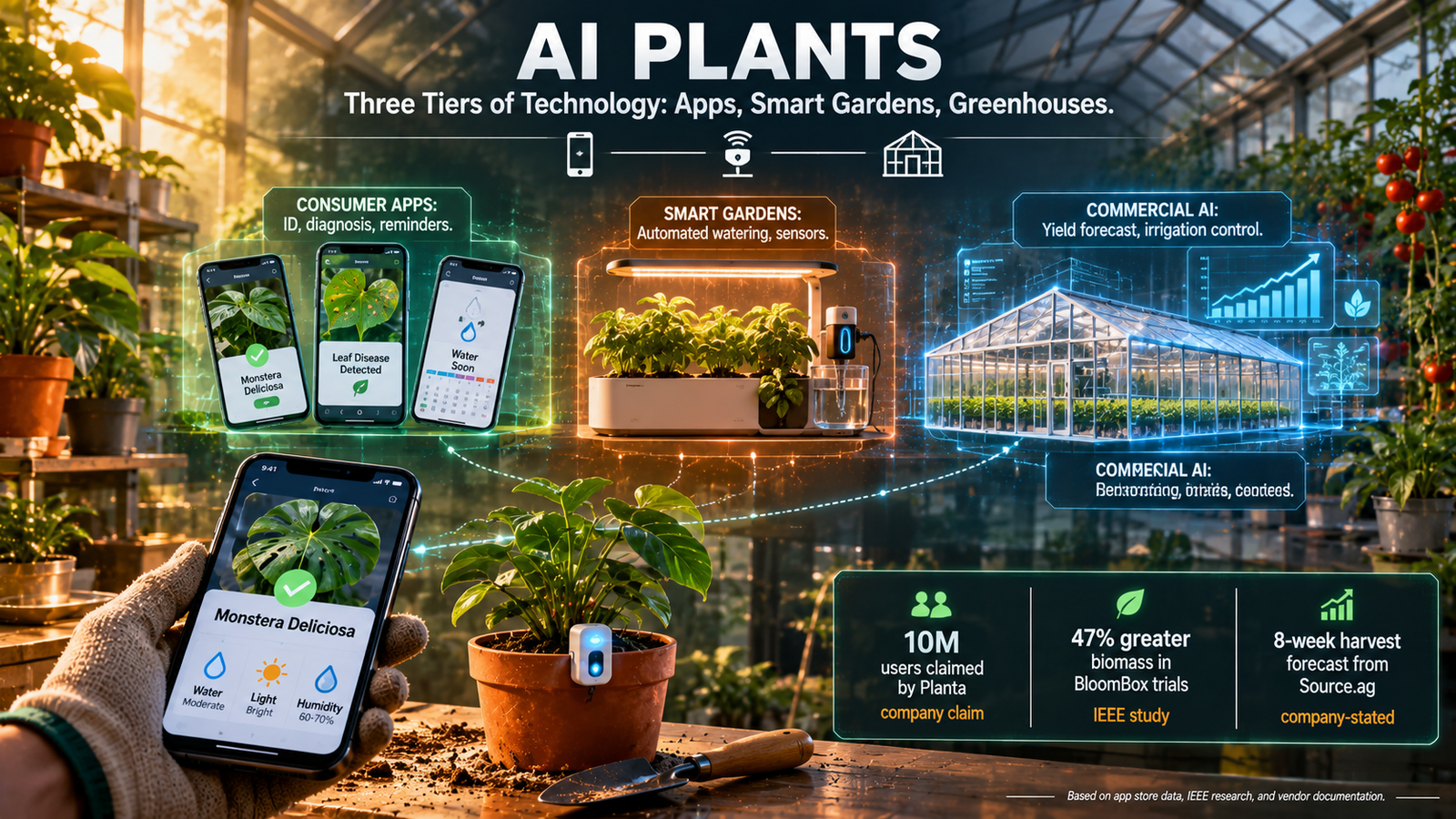
AI plants refers to artificial intelligence tools applied to plant care, identification, and cultivation, spanning consumer apps that diagnose sick houseplants and commercial systems that automate greenhouse operations. The category includes photo-based identification apps like Planta and WhatPlant, IoT-enabled smart gardens like BloomBox, and enterprise platforms like Source.ag that forecast harvests for commercial growers. Each tier solves a different problem, and the technology’s usefulness depends heavily on which problem you actually have.
At-a-Glance
- Consumer apps dominate search: Planta has 1M–5M installs and targets houseplant hobbyists
- Identification is table stakes: Most apps now bundle plant ID, disease diagnosis, and care reminders
- Accuracy varies: User reviews report misidentification and contradictory diagnoses on some apps
- Smart gardens exist: BloomBox research showed 47% greater biomass versus manual care in controlled trials
- Commercial AI is different: Source.ag forecasts greenhouse yields up to eight weeks ahead
- Critical caveat: Apps explicitly warn that diagnoses are informational, not professional advice
What Are AI Plants?
The phrase covers three distinct technology tiers, and conflating them leads to confusion. Understanding which tier matters for your use case is the first step.
Tier one: Consumer identification apps. These are smartphone apps that use computer vision to identify plants from photos, diagnose diseases, and send care reminders. Planta, WhatPlant, and PlantAI are representative examples . The core technology is image classification, often running on cloud infrastructure.
Tier two: Smart garden hardware. These are IoT systems that combine sensors, actuators, and AI models to automate watering, lighting, and climate control. BloomBox and EcoGrow are research prototypes, not consumer products . Gardena sells commercial smart watering systems with app control, though its AI claims are limited .
Tier three: Commercial horticulture AI. These are enterprise platforms for greenhouse growers. Source.ag, integrated with Priva’s climate computers, provides harvest forecasting, irrigation control, and cultivation management for commercial operations . This is B2B software, not a consumer app.
AI Plants Tiers Compared
| Tier | Example | Target User | Core Function | Price Model |
|---|---|---|---|---|
| Consumer app | Planta, WhatPlant | Houseplant hobbyists | ID, diagnosis, reminders | Freemium subscription |
| Smart garden | BloomBox (research), Gardena | Home gardeners | Automated watering, sensors | Hardware + app |
| Commercial AI | Source.ag | Greenhouse growers | Yield forecasting, irrigation | Enterprise contract |
How Consumer AI Plant Apps Work
The workflow is consistent across apps. You snap a photo of a plant. The app sends the image to a cloud model, which returns a species identification, a health assessment, and care instructions .
Planta’s app store ranking suggests strong adoption. It held the sixth position on Pakistan’s top grossing House & Home chart and generated an estimated $60,000 in monthly revenue . The app claims 10 million users and 40 million plants tracked. These are company-stated figures.
WhatPlant and PlantAI offer similar feature sets. Identification, disease diagnosis, an AI chatbot for questions, care guides, and reminders . The differentiation is mostly in interface design and the quality of the underlying model.
The Accuracy Problem
Plant AI’s terms of service contain a direct admission: “We do not guarantee 100% accuracy in plant identification” and “Disease diagnosis is a suggestion based on visual symptoms and should not replace professional agricultural or horticultural advice” .
User reviews confirm the gap between marketing and reality. One PlantAI reviewer described the app misidentifying a sick tulip as bamboo, then insisting the wilting plant was “blooming beautifully” . This is an anecdote, not a systematic evaluation, but it illustrates the limitation of visual-only diagnosis.
The technology works best for common houseplants with distinctive features. It struggles with stressed plants, unusual cultivars, and species that look similar to each other.
Smart Gardens and Research Prototypes
The consumer smart garden market is smaller and less mature than the app market. Gardena’s smart system offers automated watering and app control, but its AI features are limited to lawnmower navigation rather than plant-level intelligence .
Academic research points toward what is technically possible. BloomBox, presented at an IEEE conference in 2026, combined a Raspberry Pi with environmental sensors and LSTM neural networks for predictive control. In 45-day trials with Holy Basil, the autonomous system achieved 47% greater biomass and 52% increased leaf area compared to manual watering . The system also reduced energy use by 34% relative to simpler threshold-based automation.
These results are promising but preliminary. The trial used a single plant species in a controlled setup. Scaling to diverse houseplants with different needs is a harder problem.
EcoGrow took a different approach, integrating Gemini 1.5 as a large language model to identify plants from user photos and generate tailored care recommendations . This is an early-stage research project, not a product you can buy.
Commercial AI for Greenhouse Growers
The enterprise tier operates on different economics and solves different problems. Source.ag, a partner in Priva’s open platform, provides modules for commercial greenhouse operations .
Harvest Forecast uses AI to predict yields up to eight weeks in advance, adapting to changing greenhouse conditions. The value proposition is operational: growers and sales teams can plan deliveries and avoid penalties for missed commitments.
Irrigation Control integrates with Priva’s Precision Irrigation Measurement system. It collects sensor data on drain water and slab weight, calculates optimal irrigation strategies, and executes them automatically through Priva’s climate computers .
Cultivation Management supports pre-season planning and mid-season strategy adjustments through simulation.
This tier is not for hobbyists. The buyers are commercial growers managing hectares of controlled-environment agriculture. The AI here is optimization software, not a chatbot.
The Scientific Frontier
Academic research on AI and plants extends well beyond consumer apps. A 2026 review in ScienceDirect described how machine learning and deep learning are transforming plant science from descriptive biology to predictive, design-oriented research .
The applications include high-throughput phenotyping, where CNN-based pipelines segment leaves and extract traits like disease lesion area at scale. Genomic prediction models link genotype to phenotype. IoT and digital twins enable real-time growth monitoring.
A particularly striking development came from the Chinese Academy of Sciences, where researchers used AlphaFold 3 and BindCraft to design synthetic plant immune receptors. Of 391 designed receptors, 71 successfully recognized target pathogens and triggered immune responses . This is generative AI applied to crop protection, not plant care.
These advances will eventually filter into commercial products. For now, they remain research.
Limitations and Common Mistakes
Assuming identification equals diagnosis. An app that correctly names your plant may still misdiagnose its health problem. Visual symptoms overlap across many conditions. Plant AI’s own terms acknowledge this limitation .
Trusting free tiers for serious use. Most apps gate disease diagnosis and unlimited identification behind subscriptions. The free versions are trials, not tools .
Confusing correlation with causation. BloomBox showed impressive biomass gains in a controlled trial with one species. That does not mean a consumer smart garden will produce similar results across diverse houseplants .
Ignoring the data gap. Academic reviews note that AI models trained in data-rich regions may not transfer well to different crops, soils, and practices . Consumer apps face the same problem at smaller scale: a model trained on common houseplants may fail on rare species.
Expecting commercial-grade forecasting from consumer tools. Source.ag’s harvest prediction is built for greenhouse operations with sensors, climate computers, and historical data. A phone app cannot replicate that .
Who Should Use AI Plants Tools
Consumer apps suit:
- Beginner houseplant owners who need identification and basic care guidance
- People who inherit plants and do not know what they are
- Hobbyists who want reminders and light meter tools
Smart garden hardware suits:
- Home gardeners willing to invest in automation for a small number of plants
- People with consistent plant types and predictable schedules
- Early adopters comfortable with prototype-level reliability
Commercial AI suits:
- Greenhouse operations with existing climate control infrastructure
- Growers who need yield forecasting for sales planning
- Operations with sensor data and staff to act on recommendations
None of these suit:
- Anyone seeking guaranteed plant health outcomes
- Professional growers without digital infrastructure
- People who want a replacement for horticultural knowledge rather than a supplement
Frequently Asked Questions
Are AI plant identifier apps accurate?
Accuracy varies by plant and image quality. Apps work best on common species with distinctive features and healthy foliage. Plant AI’s terms explicitly state they do not guarantee 100% accuracy and that diagnoses are informational only . User reviews report occasional misidentifications, particularly with stressed or unusual plants .
What is the best AI plant app?
There is no single best app. Planta has the largest user base and revenue, suggesting strong market fit . WhatPlant bundles disease diagnosis and AI chat . PlantAI offers similar features with mixed user reviews . The right choice depends on whether you prioritize identification, diagnosis, or care reminders.
Can AI actually automate plant care?
In controlled research settings, yes. BloomBox demonstrated autonomous care with 47% greater biomass than manual watering for one plant species . Consumer products like Gardena automate watering but rely on schedules rather than plant-level AI . Full automation for diverse houseplants remains a research problem.
Do commercial greenhouses use AI?
Yes. Source.ag provides AI-driven harvest forecasting and irrigation control for commercial greenhouse growers, integrated with Priva’s climate computers . This is enterprise software for operations with sensors and historical data, not a consumer tool.
Is AI plant identification safe for foraging?
No. Plant AI’s terms explicitly warn: “You should not consume any plant based solely on the identification provided by this App. Some plants are highly toxic to humans and pets” . Foraging requires expert human verification, not an app.
Conclusion
AI plants is a phrase that promises more than any single tool delivers. Consumer apps offer convenient identification and care reminders, but they are supplements to horticultural knowledge, not replacements. Smart garden hardware automates watering and monitoring, but the most impressive results come from research prototypes, not products on store shelves. Commercial AI platforms genuinely transform greenhouse operations, but they require infrastructure and data that most growers do not have.
What matters most is matching the tool to the problem. If you cannot identify a houseplant, an app will help. If you want to automate watering for a small garden, a smart system may work. If you manage a commercial greenhouse, enterprise AI can improve forecasting and resource efficiency.
Before choosing any AI plant tool, evaluate the accuracy claims against the terms of service, not just the marketing. Check whether the free tier includes the features you actually need. And recognize that plant care, like most domains where AI is applied, still depends on human judgment. The best tools improve that judgment. They do not replace it.