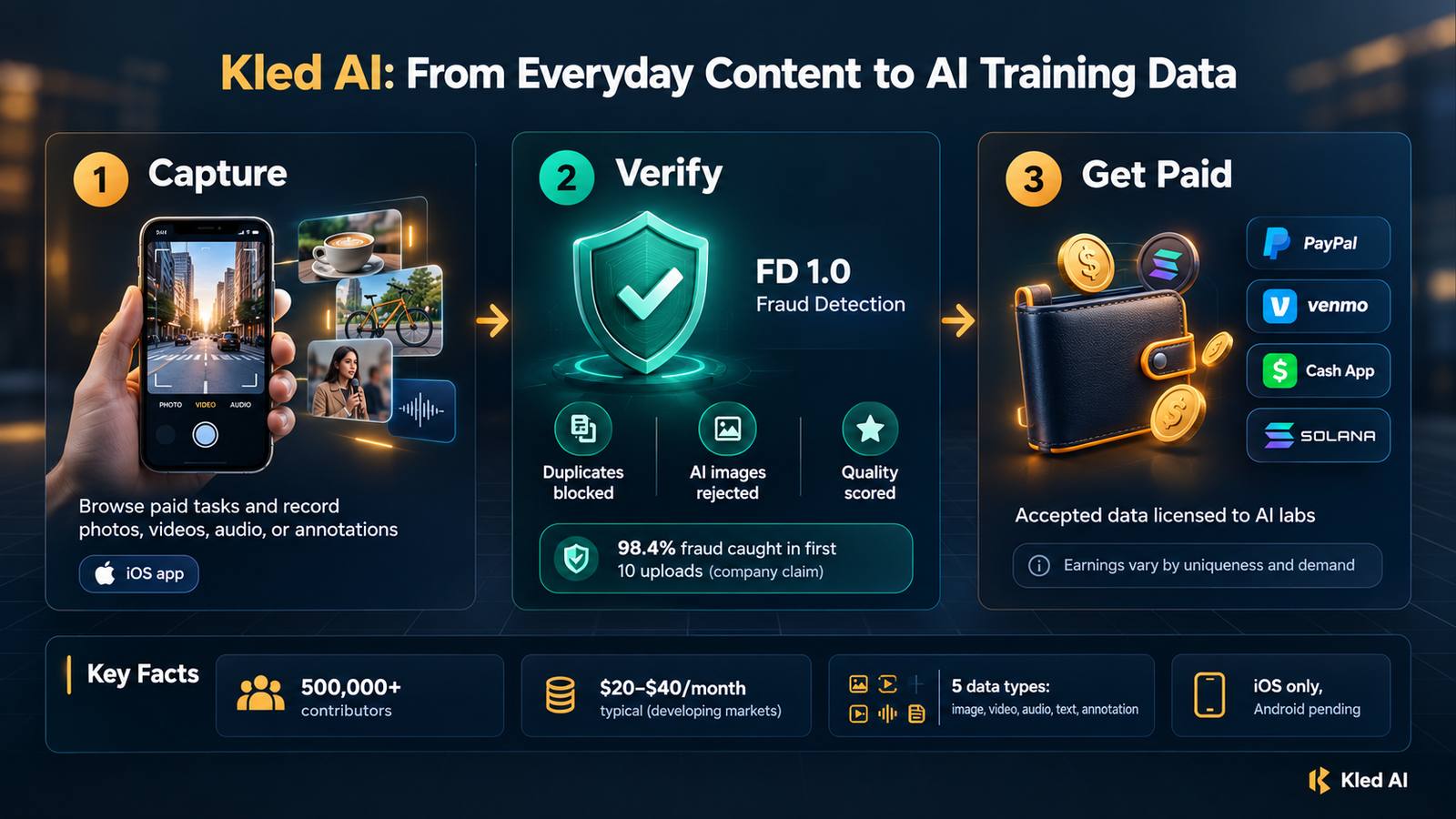
Kled AI is a mobile app that pays everyday users for uploading photos, videos, audio, and completed tasks that are licensed to AI labs for model training. Founded by Avi Patel, the platform has grown to over 500,000 contributors and positions itself as an opt-in alternative to companies scraping user data without compensation. Users earn based on content uniqueness, quality, and current buyer demand rather than raw file counts.
At-a-Glance
- What it is: A consumer data marketplace app, not an AI assistant or model
- Founded by: Avi Patel, a 22-year-old entrepreneur based in San Francisco
- Core model: Users complete data tasks, Kled licenses accepted submissions to AI companies
- Contributor base: 500,000+ opt-in contributors across the US, Southeast Asia, and Europe
- Platform: iOS only as of late 2026; Android version in development
- Key limitation: Earnings vary wildly and depend on content demand, not effort alone
What Is Kled AI?
Kled AI occupies a growing niche in the AI economy: paying individuals for real-world data that trains machine learning models. The company operates a mobile application where users browse paid tasks, capture requested content, submit it for review, and receive payment through PayPal, Venmo, or a Solana wallet .
The product is not a chatbot, not an image generator, and not a writing assistant. It is a two-sided marketplace. AI labs need diverse, rights-cleared training data. Everyday people have camera phones and daily routines. Kled connects the two and takes a cut.
Founder Avi Patel has framed this as a corrective to how tech companies historically handled user data. “Most companies scrape user data for free,” he told Business Insider. “We’re trying to flip that” . Whether Kled fully delivers on that framing is a question users should evaluate carefully.
Kled AI vs. Traditional Data Brokers
| Dimension | Traditional Data Broker | Kled AI |
|---|---|---|
| Data source | Passive collection, often without direct consent | Opt-in tasks with explicit submission |
| User compensation | Usually none | Direct payment per accepted submission |
| Data type | Browsing history, demographics, purchases | Photos, videos, audio, labeled tasks |
| Control | User has little visibility | User chooses which tasks to complete |
How Kled AI Works
The workflow is straightforward by design. Kled wants contributors to understand what is expected before they hit record.
Step 1: Browse the task feed. Kled V3 replaced the old upload button with a personalized discovery feed. Tasks appear ranked by relevance to each contributor, with pay shown upfront .
Step 2: Read the instructions. Each task includes examples of accepted and rejected submissions. Clarity matters because rejected submissions earn nothing.
Step 3: Capture the content. Tasks span five modalities: image, video, audio, text, and annotation. Examples include filming yourself completing everyday activities, capturing objects from multiple angles, or recording native language speech .
Step 4: Submit for review. Every upload passes through Kled FD 1.0, the platform’s fraud detection model. Kled claims this system identifies and removes 98.4% of bad actors within their first 10 uploads .
Step 5: Get paid. Accepted submissions credit to the user’s balance. Payouts go through PayPal, Venmo, Cash App, or Solana .
The Fraud Detection Layer
Kled’s FD 1.0 model is central to its quality control. The company says it detects duplicate uploads, AI-generated images, content scraped from the internet, edited files, and behavioral fraud . This matters for contributors because fraud detection failures dilute the value of the dataset and reduce payouts for legitimate users.
The 98.4% figure is a company claim from internal evaluations. Kled has not published independent benchmarks or third-party audits of FD 1.0.
How Much Can You Actually Earn?
This is the question most people searching for Kled AI want answered. The honest answer is: it depends heavily on where you live, what you upload, and whether you treat it as casual or serious work.
Company-Released Figures
Kled has published several earnings claims across its marketing materials and press interviews. These figures should be treated as company statements, not independently verified averages.
The Business Insider figures align with the platform’s developing-market popularity. In the Philippines and Malaysia, $20 to $40 per month represents meaningful supplemental income . In the United States, that same amount is negligible for most users.
How Kled Calculates Payouts
Kled’s help center is unusually candid about its payment logic. Earnings reflect content value for AI training, not file count or size . The platform explicitly warns about diminishing returns: ten unique, diverse photos can earn more than 500 near-identical ones.
The factors that increase per-file value include uniqueness, diversity of subjects and contexts, relevance to current buyer demand, technical quality, and authenticity . Kled also states that rates are dynamic. The same type of content may be worth more or less depending on how much similar data already exists in the dataset.
This means contributors cannot predict earnings before uploading. There is no published rate card. The task feed shows pay upfront for structured tasks, but general uploads do not come with guaranteed rates.
Key Features and Recent Updates
Kled V3 (September 2026)
The most recent major release rebuilt the home screen around task discovery rather than passive uploads. Kled says the feed learns where each contributor performs best and personalizes task recommendations accordingly . The company also claims labs can now deploy new datasets to 500,000 contributors within 72 hours using 108 configurable task templates.
Kled V2 (December 2025)
V2 introduced Special Tasks, domain-specific data requests from enterprises with boosted rewards. Examples include uploading coursework, capturing infrastructure issues like potholes, and recording short activity videos . Kled said it had over $10 million in active enterprise contracts at the time.
Passive Earning Integrations
Kled V2 introduced connections to Google Drive and Dropbox, allowing data to sync automatically and generate payouts . The company has signaled plans to expand integrations to platforms like Netflix and Spotify, though these are not live as of this writing.
Limitations and Risks
iOS Only
The Kled app is currently available only on the Apple App Store for iPhone. An Android version is described as “on its way” but has no confirmed release date . This excludes a large portion of users in Kled’s core markets.
Account Suspensions and Support Gaps
At least one App Store reviewer reported their account being suspended without explanation after a small payout . Kled’s response to that review stated that suspensions follow specific Terms of Service violations and directed users to a support email . The company says support@kled.ai is its only monitored channel. Users should keep this in mind: there is no phone support and no live chat.
Privacy and Data Rights
Kled states that accepted contributions are “licensed for AI training with your consent” . The consent language matters. Users are granting Kled a license to their content, not just uploading it. What that license permits in practice is governed by Kled’s terms, which users should read before contributing sensitive material.
Kled says it complies with HIPAA and GDPR and that ML systems anonymize sensitive information . These are company claims. No independent audit or certification is cited on the public-facing materials reviewed for this article.
The Solana Token Complication
Kled AI has an associated cryptocurrency token, $KLED, traded on Solana . This creates a potential confusion point. The token is not the same as the app’s payout system, though Solana is listed as a cash-out option. Users interested in the app should understand they are participating in a data marketplace, not an investment product. Token prices are volatile and unrelated to contributor earnings.
Content Quality Demands
Kled only accepts photos from newer iPhones in some contexts . The platform’s own guidance says standard smartphone cameras are adequate, but quality matters and rejected submissions earn nothing . Contributors who upload casually without reading task instructions will likely earn very little.
Who Should Consider Kled AI
Possible fit:
- Users in developing markets where $20 to $40 monthly is meaningful supplemental income
- People who already capture diverse daily content and can meet task specifications
- iPhone owners comfortable with gig-style work and variable pay
- Users interested in the data economy and willing to accept licensing terms for their content
Poor fit:
- Android users (no app available)
- Anyone expecting predictable, hourly-style earnings
- Users uncomfortable with licensing personal photos or videos to AI companies
- People seeking a full-time income without significant effort and content volume
Frequently Asked Questions
How much can you realistically make on Kled AI?
Kled’s own interview figures suggest $20 to $40 monthly for casual users in developing markets, with top users reaching $2,000 or more . Earnings depend on content uniqueness, demand, and how many accepted tasks you complete. There is no guaranteed rate, and many uploads may be rejected.
Is Kled AI free to use?
Yes. The app is free to download, and Kled pays users rather than charging them . The company earns revenue by licensing accepted data to AI labs and enterprises.
What happens to my data after I upload it?
Kled states that accepted contributions are licensed for AI training with your consent . The company says it anonymizes sensitive information and complies with privacy regulations, but these are company claims without independent verification. Users should read Kled’s terms before uploading sensitive content.
Can I use Kled AI on Android?
Not currently. Kled is iOS-only as of late 2026. The company says an Android version is in development but has not announced a release date .
Why was my Kled account suspended?
Kled says suspensions result from Terms of Service violations including multiple accounts, duplicate uploads, AI-generated content, or payout manipulation . The company directs suspended users to support@kled.ai. There is no appeal process described publicly beyond that email.
Conclusion
Kled AI is a data marketplace app that pays users for real-world content used to train artificial intelligence. It has scaled quickly, attracted venture funding, and built a genuine contributor network across Southeast Asia, Europe, and the United States. For some users in developing markets, it provides meaningful supplemental income. For most casual users elsewhere, the earnings are likely modest and unpredictable.
What matters most is understanding the trade. You are not just uploading photos; you are licensing content for AI training. Kled controls acceptance, pricing, and account status. Payouts depend on demand factors you cannot see. The app is iOS-only. Support is email-only. And the company’s quality and privacy claims are self-reported.
Kled may suit iPhone users who want to experiment with gig-style data work and who are comfortable with variable pay. It does not suit Android users, anyone seeking stable income, or people unwilling to license personal media to an AI data broker. Before signing up, read the terms, start with small submissions, and treat your first payouts as a test rather than a promise.