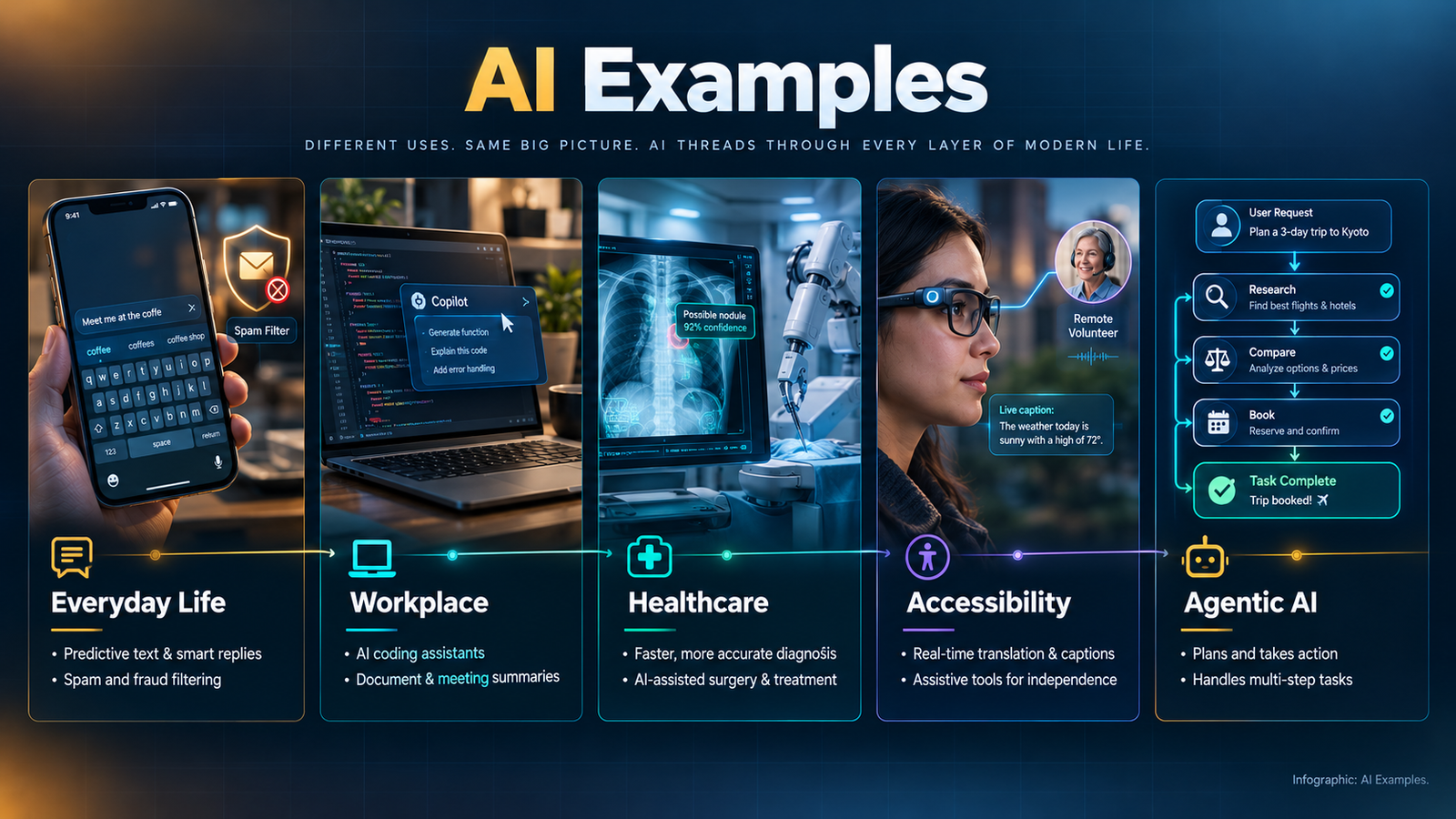
AI examples span everyday conveniences like spam filtering and predictive text, professional tools like GitHub Copilot and Microsoft Copilot, and high-stakes applications such as medical imaging analysis and fraud detection. These systems are already embedded in banking, healthcare, software development, and accessibility tools, often without users realizing AI is involved. Understanding concrete examples helps separate practical deployments from marketing hype.
At-a-Glance
- Everyday AI: Email spam filters, smartphone keyboards, and banking fraud alerts operate largely invisibly
- Workplace AI: Copilots and coding assistants are deployed at scale, with CIBC rolling out agentic AI to 50,000+ employees
- Healthcare AI: Diagnostic imaging algorithms can outperform human panels in specific tasks, though oversight remains essential
- Accessibility AI: Smart glasses paired with volunteer networks restore independence for visually impaired users
- Agentic AI: The shift from chat assistants to task-completing agents marks the most significant recent development
- Key caveat: Many examples rely on third-party models or APIs, and vendor transparency varies widely
What Counts as a Real AI Example?
The phrase “AI examples” covers an enormous range. A spam filter and an autonomous coding agent are both AI, but they operate on completely different principles and carry different risks.
This guide focuses on documented, verifiable deployments rather than speculative use cases. Each example includes what the system actually does, who uses it, and what limitations apply. The goal is practical clarity, not hype.
A Note on Verification
Some examples come from company press releases and should be treated as company claims. Others are documented in peer-reviewed research or government inventories. Where evidence is limited to vendor statements, that is noted.
Everyday AI You Already Use
Email Spam Filtering
Most email providers use machine learning to route unwanted messages to spam folders. Google reports that fewer than 0.1% of spam messages bypass its AI-powered filters . Given that roughly 77% of global email traffic is spam, this is one of the highest-volume AI applications in existence.
The system learns from user behavior. When you mark a message as spam or move it to your inbox, you provide training signal for the next classification round.
Smartphone Predictive Text and Assistants
Your phone’s keyboard predicts the next word based on your typing history. Voice assistants like Siri and Google Assistant parse spoken commands using natural language processing. These systems run partly on-device and partly in the cloud, depending on the task.
Critics note that always-listening assistants create surveillance opportunities, even when designed with good intentions . Users should review privacy settings for voice activation features.
Banking Fraud Detection
Banks use AI to monitor transactions for signs of fraud. MoMo, a Vietnamese fintech, reports that its AI models analyze behavior, device, network, and transaction context within 100 to 300 milliseconds. The system detects nearly 29,000 unusual transactions daily and proactively alerts over 10,000 users .
SAS Institute survey data indicates that over two-thirds of banks use AI chatbots, and nearly 63% use AI for fraud detection . These are company and industry survey figures, not independently audited results.
AI Examples in the Workplace
Microsoft Copilot and Google Gemini in Productivity Suites
Microsoft Copilot integrates into Word, Excel, PowerPoint, Outlook, and Teams. It handles content creation, summarization, and decision support through natural language prompts . Google Gemini performs similar functions across Google Workspace and APIs, combining text, images, audio, and code .
These tools are widely deployed, but their value depends heavily on how organizations configure data access and retention. Copilot’s enterprise version, for example, inherits Microsoft 365 permissions, which can either improve or complicate governance.
GitHub Copilot for Software Development
GitHub Copilot assists developers by generating context-aware code suggestions, offering conversational support, and handling autonomous workflows like debugging and testing . It is one of the most widely adopted AI coding tools, though output quality varies by language and codebase complexity.
A known limitation: Copilot sometimes suggests insecure or outdated code patterns. Developers must review suggestions rather than accepting them blindly.
CIBC AI 2.0: Agentic AI at Bank Scale
CIBC deployed its proprietary agentic AI workspace, CAI 2.0, to over 50,000 employees . The platform allows team members to delegate complex, multi-step tasks to AI agents. For example, while a banker is in a client meeting, the AI can gather research from multiple sources, organize findings, and prepare a presentation draft.
The system builds on CIBC AI, a chat-based assistant that 20,000 team members use daily . The shift from chat to agentic workflows represents a meaningful architectural change: agents plan and execute rather than simply respond.
Leidos and ServiceNow: Autonomous IT Ticket Resolution
Leidos, a defense and technology contractor, is deploying ServiceNow’s AI platform across its 50,000-person workforce. The projected outcome: up to 60% autonomous resolution of IT support tickets, with approximately 80,000 tickets eliminated annually .
The deployment runs across FedRAMP environments, indicating government-grade compliance requirements . The projected savings of $3 million annually are company estimates, not verified results.
AI Examples in Healthcare and Accessibility
Medical Imaging Analysis
AI algorithms assist radiologists in detecting conditions from X-rays, CT scans, and MRIs. One study found that an AI algorithm called DLAD outperformed 17 of 18 doctors in detecting potential lung cancer on chest X-rays . Hospitals in Vietnam have integrated AI into diagnostic imaging for early detection of lung cancer, liver damage, and cardiovascular disease .
However, critics warn against treating AI diagnostics as a “black box.” Clinicians need to understand how the system reaches conclusions to trust and verify its output . AI is a second reader, not a replacement for medical judgment.
Robotic Surgery with AI Assistance
Vinmec Healthcare System in Vietnam performed the country’s first two-way remote robotic surgeries in August 2026. Surgeons at one hospital controlled robotic arms at another facility nearly 2,000 kilometers away. Two patients recovered well, and Vietnam became the second Southeast Asian country to master the Toumai robotic surgery system .
This is a documented clinical outcome, not a company projection. The surgeries demonstrate AI-assisted teleoperation, though the primary control remains human.
Smart Glasses for the Visually Impaired
Ian Torrie, a 52-year-old man in Lincolnshire, lost most of his sight after a stroke. He uses Meta smart glasses paired with the Be My Eyes app to connect with remote volunteers who see through the glasses’ camera and provide live assistance .
Volunteers help with tasks like cooking, finding misplaced items, and checking whether shoes match. Torrie describes the technology as “life-changing” . The Lincoln and Lindsey Blind Society reports that 30 of its service users currently use the glasses, with many describing a “new lease of life” .
The example also illustrates a tension: smart glasses have been banned in some public spaces due to privacy concerns about secret recording. Torrie says he worries about confrontation but continues using them .
AI Examples in Marketing and Content Creation
Grammarly and Jasper AI
Grammarly provides AI-powered writing assistance across platforms, generating, rewriting, and summarizing text while adapting to individual style and tone. Jasper AI targets marketing teams with brand-consistent content creation, real-time collaboration, and multimodal campaign support .
Both tools illustrate a common pattern: AI handles first drafts and repetitive edits, while humans apply judgment and final approval. The risk is over-reliance, where writers lose the ability to evaluate output quality critically.
Synthesia for Video Production
Synthesia enables scalable AI-driven video creation with realistic avatars and multilingual voiceovers . Organizations use it for training videos, product demos, and internal communications. The avatars are synthetic, not real people, which raises questions about disclosure and trust. Viewers generally know they are watching an AI presenter in corporate contexts, but that assumption may not hold in all settings.
Adobe Firefly
Adobe Firefly powers image generation and editing within Creative Cloud. It generates and modifies visual assets through natural language prompts . Adobe has positioned Firefly as commercially safe, trained on licensed content, though independent verification of training data claims is difficult.
AI Examples in Agentic Workflows
The most significant recent shift is from chat-based assistants to agents that plan and execute multi-step tasks. CIBC’s CAI 2.0 and Leidos’ ServiceNow deployment are two enterprise examples .
A research paper published in IEEE Xplore describes an AutoGen-driven agent framework using Google Gemini 1.5 Pro and five MCP tools. The system achieved a 96.4% task completion rate across 950 test queries with an average response time of 1.8 seconds . The paper claims superior performance to LangChain+GPT-4, CrewAI, BabyAGI, and AutoGPT, though these are benchmark results from a single study, not independent validation.
Agentic systems introduce new risks. An agent that can send emails, modify spreadsheets, and call external APIs requires robust permission controls. Enterprises deploying these systems should verify audit logging, human-in-the-loop checkpoints, and failure recovery mechanisms.
Common Mistakes When Evaluating AI Examples
Mistaking demos for deployments. A polished video of an AI agent completing a task does not mean the system works reliably at scale. Look for production metrics, not launch announcements.
Ignoring the wrapper problem. Many AI products are thin interfaces over third-party APIs. If the underlying model provider changes terms or pricing, the wrapper product may change or disappear.
Assuming “AI-powered” means sophisticated. Marketing labels do not indicate technical depth. A rule-based chatbot and a fine-tuned LLM may both be called “AI.”
Overlooking data retention. Tools that process your documents or emails may store that data for training or review. Read the privacy policy before feeding sensitive information to any AI system.
Treating company metrics as facts. Projected savings and productivity gains come from vendor calculations. They are useful starting points for evaluation, not proof of outcomes.
Frequently Asked Questions
What are some common AI examples people use every day?
Email spam filters, smartphone predictive text, voice assistants, and banking fraud alerts are among the most common daily AI applications. Most operate invisibly, classifying and routing data without explicit user commands. Google reports that fewer than 0.1% of spam bypasses its filters .
What is an example of agentic AI in business?
CIBC’s CAI 2.0 allows employees to delegate multi-step tasks to AI agents that plan and execute research, document preparation, and risk coordination. The platform is deployed to over 50,000 team members . Leidos is deploying ServiceNow’s AI platform with a target of 60% autonomous IT ticket resolution .
How is AI used in healthcare today?
AI assists with medical imaging analysis, robotic surgery teleoperation, and diagnostic support. One study found an AI algorithm outperformed 17 of 18 doctors in detecting lung cancer on chest X-rays . Vietnamese hospitals have integrated AI into imaging for cancer and cardiovascular diagnosis . AI is a support tool, not a replacement for clinical judgment.
What is a real example of AI helping people with disabilities?
Meta smart glasses paired with the Be My Eyes app connect visually impaired users to remote volunteers who see through the camera and provide live assistance. Users report increased independence for tasks like cooking and navigating public spaces . The technology also raises privacy concerns in shared environments.
Are AI examples in marketing reliable?
Tools like Grammarly, Jasper AI, and Adobe Firefly are real products used by marketing teams. However, output quality varies, and human review remains essential. Claims about brand consistency and creative quality are vendor assertions, not independently verified benchmarks .
Conclusion
AI examples are everywhere, but not all are equal. Spam filters and predictive text are mature, low-risk applications embedded in daily life. Copilots and coding assistants deliver documented productivity gains with caveats about verification. Agentic platforms and healthcare diagnostics carry higher stakes and require stronger governance.
What matters most is distinguishing between verified deployments, company projections, and marketing claims. The CIBC and Leidos rollouts are real, but their metrics come from press releases. The IEEE agent framework benchmark is peer-reviewed but not independently replicated. The medical imaging study is compelling but focused on a single task.
AI suits organizations and individuals who understand the limitations of each tool. It is not a blanket solution, and “AI-powered” is not a quality guarantee. Before adopting any AI example as a model for your own use, evaluate the evidence behind it, the data practices involved, and whether the vendor discloses which models actually power the system.