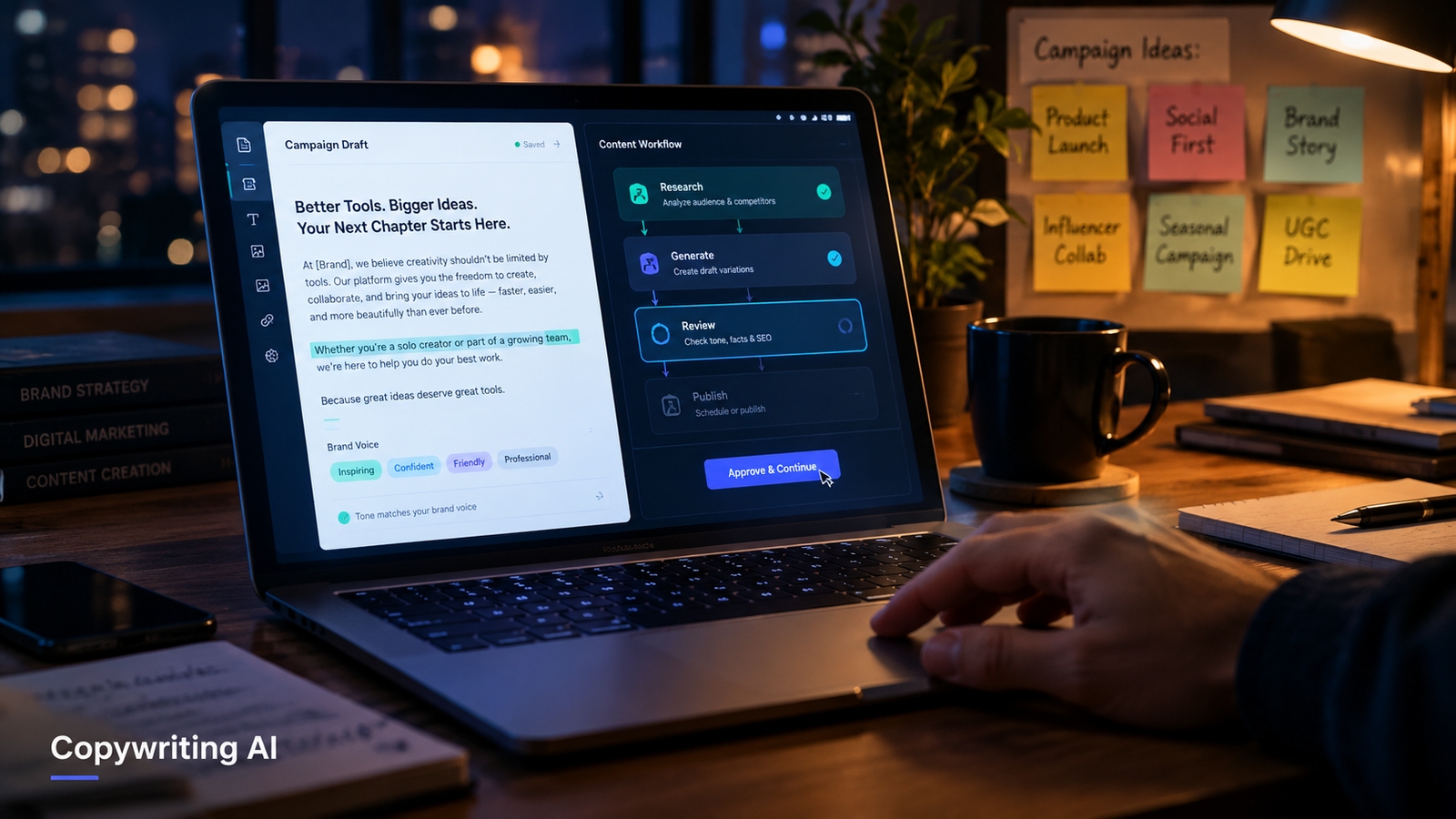
Copywriting AI refers to generative tools that produce marketing copy, ad variations, emails, and long-form content from prompts or templates. The category has split into two distinct product types: brand-governed content platforms like Jasper, and workflow automation engines like Copy.ai. Choosing between them requires understanding pricing structures, usage limits, and the growing overlap with general-purpose models like ChatGPT and Claude.
At-a-Glance
- Category split: Brand-control platforms vs. workflow automation tools, not interchangeable writing assistants
- Jasper pricing: Pro starts at $59 per seat per month billed annually; Business is quote-only
- Copy.ai pricing: Chat plan at $24 per month billed annually for five seats; Enterprise is demo-gated
- Anyword pricing: Starter at $39 per month billed annually with prediction credits as the real constraint
- Key hidden limit: Prediction credits and workflow credit consumption vary by complexity, not just volume
- Core threat: General models at $20 per month now handle most single-piece writing tasks
What Is Copywriting AI?
Copywriting AI is a subset of generative AI focused on persuasion-oriented writing. It covers ad copy, landing pages, email sequences, product descriptions, social posts, and sales pages. The output is designed to drive action, not just inform.
The market has matured significantly since the first wave of GPT-3 wrappers. Two distinct product philosophies now dominate the premium tier.
Brand-governed platforms prioritize consistency. They train on your existing content, enforce voice rules, and produce drafts that require less editing for tone. Jasper is the clearest example.
Workflow engines prioritize automation. They chain research, generation, and review into multi-step pipelines that run with minimal human intervention. Copy.ai has moved decisively in this direction .
A third category, budget template tools, competes on price and speed. These products target freelancers and small teams who need quick output without brand governance or workflow complexity.
Copywriting AI vs. General-Purpose Models
| Dimension | Copywriting AI Platforms | General Models (ChatGPT, Claude) |
|---|---|---|
| Brand consistency | Trained voice profiles, knowledge assets | Requires manual prompting each time |
| Workflow automation | Built-in multi-step pipelines | Not native, requires external orchestration |
| Template library | 80+ marketing-specific formats | No structured templates |
| Pricing | $24 to $59+ per month | ~$20 per month |
| Best for | Teams with volume and consistency needs | Individuals, ad-hoc tasks |
How the Major Platforms Compare
The competitive landscape has consolidated around a few recognizable names. Each serves a different primary buyer.
Jasper: Brand Control at a Premium
Jasper positions itself around enterprise brand governance. The Pro tier at $59 per seat per month billed annually includes the Canvas platform and Essential Agents. Smart Customization caps at 2 Brand Voices, 5 Knowledge assets, and 3 Audiences .
Those caps bind quickly for agencies or multi-brand teams. Unlimited Brand Voices and SSO sit on the quote-only Business tier. There is no published price between Pro and Business, which creates a budgeting gap for growing teams.
Jasper publishes a first-party MCP server at mcp.jasper.ai. This allows teams already using Claude, ChatGPT, or Cursor to access Jasper brand knowledge without switching interfaces . For organizations with established AI assistant workflows, this reduces adoption friction.
On security, Jasper lists SOC 2, GDPR, and no model training on customer data . The company uses a multi-model engine routing to OpenAI, Anthropic, Google, Cohere, and its own custom models . This model-agnostic approach reduces vendor lock-in at the model layer, though the platform itself remains proprietary.
Copy.ai: Workflow Over Writing
Copy.ai has pivoted away from pure copywriting. It now positions as a go-to-market workflow platform, and was acquired by Fullcast in October 2025 . The product remains available under the Copy.ai name with self-serve checkout, but the direction is clear: pipelines, not paragraphs.
The Chat plan costs $24 per month billed annually and covers five seats with unlimited generation. Once a team exceeds five seats, there is no published price. Enterprise pricing is demo-gated and includes API access, bulk workflow runs, and unlimited customizable workflows .
This creates a procurement cliff. A team outgrowing Chat moves from a card payment to a sales conversation with no public budget anchor. Workflow credit consumption also varies by complexity, so research-heavy workflows cost more per run than simple generation .
Copy.ai publishes named enterprise customers including Siemens, Autodesk, ServiceNow, and Salesforce . That is unusually strong production evidence. The platform also states it does not train its models on customer data .
Anyword: Prediction as the Product
Anyword differentiates on performance prediction, not generation volume. Its Predictive Performance Scores are trained on real conversion data, scoring copy before publication .
The Starter plan costs $39 per month billed annually. The binding constraint is prediction credits, not word count. Starter includes 100 predictions per month on annual billing, versus 50 on month-to-month. Data-Driven includes 175 versus 100 . Teams running tests across multiple paid channels will exhaust predictions faster than expected.
Anyword suits performance marketers who need to prioritize which copy variants to test. It does not suit teams seeking brand governance across many writers or multi-step workflow automation.
Pricing Traps and Hidden Limits
Premium copywriting AI pricing rarely reflects actual usage costs. Several patterns recur across platforms.
Seat caps with no published next tier. Jasper charges per seat on Pro, then jumps to quote-only Business. Copy.ai covers five seats, then jumps to demo-only Enterprise. Teams between these tiers face sales conversations without budget anchors.
Credit or prediction limits tied to billing terms. Anyword doubles prediction allowances on annual billing versus monthly . This penalizes teams that prefer flexibility.
Workflow credit variability. Copy.ai’s workflow runs consume credits based on complexity. A research-heavy workflow costs more than a simple generation task, but the platform does not provide a public estimator .
No free trial on some tiers. Copy.ai offers a 5-day money-back guarantee on first purchase, not a free trial . Jasper offers a 7-day free trial on Pro .
Template lock-in. Budget tools like SwiftCopy offer unlimited use cases on paid plans from $5.99 per month . The tradeoff is shallow customization and no brand training.
Privacy and Data Handling
Security claims in the copywriting AI space require careful reading. The distinction between “we do not train on your data” and “we do not retain your data” matters.
Jasper states it does not train on customer data and retains data for the duration of the agreement. Deletion occurs upon written request or contract termination, subject to legal obligations . The company lists SOC 2 and GDPR compliance. Jasper uses third-party sub-processors including OpenAI, Anthropic, Google, and Cohere .
Copy.ai states it does not train its models on customer data . SOC 2 Type II is named only in the metadata of its security page, with the report gated behind a contact form. The attestation type and scope cannot be confirmed without surrendering contact details .
Neither vendor publishes a certificate, auditor name, or report period on a public page. This is not evidence of non-compliance. It is a limitation on what buyers can verify from marketing materials alone.
A 2026 ACL study on consumer generative AI writing assistants found a measurable trade-off between privacy protection and moderation robustness. Stylization can suppress signals used for profiling, but the same transformations can reduce misinformation detection accuracy . This research concerns platform-level stylization, not specifically copywriting tools, but the finding is relevant to any organization relying on AI-generated text at scale.
Who Should Use Copywriting AI
Brand-governed platforms like Jasper suit:
- Marketing teams with multiple writers producing consistent output
- Organizations with defined brand voices and editorial review processes
- Teams already using AI assistants that want MCP integration
Workflow engines like Copy.ai suit:
- Go-to-market teams chaining research, generation, and CRM enrichment
- Operations teams building repeatable content pipelines
- Organizations comfortable with demo-gated enterprise pricing
Prediction tools like Anyword suit:
- Performance marketers prioritizing conversion optimization over volume
- Teams that A/B test copy across paid channels
Budget template tools suit:
- Freelancers and solo founders producing short-form copy
- Users who need speed and low cost over brand consistency
None of these platforms suit:
- Individuals whose entire writing output is a few social posts per week
- Teams unwilling to manage credit limits or seat caps
- Organizations that cannot accept demo-gated enterprise pricing
Common Mistakes
Assuming “AI copywriter” means one product category. Jasper and Copy.ai now serve different buyers. Confusing them leads to purchasing the wrong tool for your workflow.
Ignoring the general model alternative. Claude and ChatGPT at approximately $20 per month handle most single-piece writing tasks with a well-crafted prompt . Premium platforms justify their cost through brand consistency, workflow automation, or prediction scoring, not raw writing quality.
Underestimating prediction or credit limits. Anyword’s prediction credits and Copy.ai’s workflow credits are the real usage constraints. Teams focused on word count or seat count miss the actual cost driver.
Overlooking export and integration restrictions. Some features sit behind higher tiers. Copy.ai’s API access is Enterprise-only. Jasper’s SSO and unlimited Brand Voices are Business-only.
Treating SOC 2 as a data retention guarantee. SOC 2 certification addresses security controls, not data retention policies. A vendor can be SOC 2 compliant and still retain data for extended periods. Verify retention terms separately.
Frequently Asked Questions
What is the best copywriting AI tool in 2026?
There is no single best tool. Jasper suits enterprise teams needing brand voice governance across multiple writers. Copy.ai suits teams building automated go-to-market workflows. Anyword suits performance marketers who want predictive scoring before publishing. Budget tools like SwiftCopy suit freelancers who need fast, low-cost output.
How much does copywriting AI cost?
Prices range from $5.99 per month for basic template tools to $59 or more per seat per month for enterprise platforms. Jasper Pro costs $59 per seat per month billed annually. Copy.ai Chat costs $24 per month billed annually for five seats. Anyword Starter costs $39 per month billed annually. Enterprise tiers are quote-only or demo-gated.
Is copywriting AI better than ChatGPT?
It depends on the task. For single pieces of copy with a well-written prompt, ChatGPT or Claude at $20 per month produces comparable output. Copywriting AI platforms justify their premium through brand voice training, template libraries, workflow automation, and team collaboration features that general models do not provide natively.
Does copywriting AI train on my content?
Policies vary. Jasper states it does not train on customer data and uses multiple third-party model providers. Copy.ai also states it does not train on customer data. Budget tools often have less transparent policies. Always verify the specific vendor’s current terms before uploading proprietary content.
Can copywriting AI replace human writers?
No. These tools accelerate drafting and variation generation. They do not replace strategic thinking, audience research, editorial judgment, or the ability to recognize when copy is factually wrong or off-brand. Teams that treat AI output as final drafts without review risk publishing errors and generic messaging.
Conclusion
Copywriting AI in 2026 is not a single product category. It is a collection of tools serving different needs: brand governance, workflow automation, performance prediction, and budget template generation. The names that dominated early coverage, Jasper and Copy.ai, have diverged so significantly that comparing them directly is no longer useful .
What matters most is matching the tool to the workflow. Teams with multiple writers and strict brand standards should evaluate Jasper’s voice training and seat economics. Teams building automated pipelines should examine Copy.ai’s workflow capabilities and enterprise pricing path. Performance marketers should assess Anyword’s prediction credits against their testing volume.
The limitations are consistent across the category. Credit and prediction limits create unpredictable costs. Seat caps force sales conversations. General-purpose models at lower prices handle basic writing tasks adequately. SOC 2 claims require verification beyond marketing pages.
Before choosing a copywriting AI platform, calculate your actual monthly output volume, identify your binding constraint (seats, credits, predictions, or words), request security documentation directly, and test whether a general model with a strong prompt can meet your needs first. The premium tools are useful when their specific strengths match your specific workflow. They are expensive when they do not.