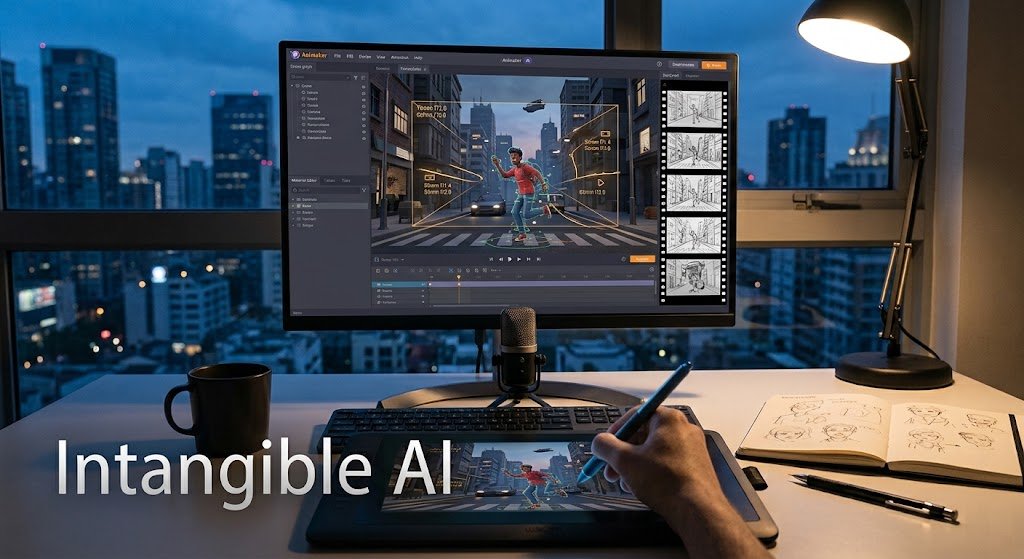
Intangible AI is a browser-based 3D studio that combines spatial intelligence with generative AI to give creators precise control over AI-generated images and video. Instead of describing scenes with text prompts, users build 3D environments, position cameras, and direct shots on a virtual set before rendering. This approach targets professional workflows in film, advertising, events, and games, where prompt-and-hope generation produces unpredictable results.
At-a-Glance
- What it is: A web-based AI 3D studio for scene composition and video generation
- Core innovation: Spatial intelligence that grounds AI models in structured 3D environments
- Founded: 2024, San Francisco; backed by Andreessen Horowitz and Crosslink Capital
- Pricing: Free tier with 150 credits; Explorer at $35/month; Business at $65/month
- Key limitation: Renders ultimately depend on third-party AI models like Kling
- Best for: Film previsualization, ad pitches, event mockups, and game prototyping
What Is Intangible AI?
Intangible AI occupies a specific gap in the creative AI market. Current text-to-video tools like Runway and Luma produce impressive visuals, but they remain fundamentally unpredictable. You describe a scene, hope the AI interprets it correctly, and often get something unusable for professional work.
Intangible takes a different path. It starts with a 3D environment rather than a text prompt. Users drag and drop objects from a library of over 5,000 assets, position cameras, and set lighting before any AI rendering begins . The generative models then interpret this structured 3D scene, producing images and video that match the intended composition.
The company was founded in early 2024 by Charles Migos, a former Apple and Unity design leader with over 180 patents, and Bharat Vasan, a repeat technology founder . The team includes veterans from Pixar, ILM, Electronic Arts, and NASA . This pedigree shows in the product’s focus on professional creative workflows rather than casual experimentation.
Intangible AI vs. Prompt-Based Generators
| Dimension | Text-to-Video Tools | Intangible AI |
|---|---|---|
| Input method | Text prompts | 3D scene construction with camera control |
| Control level | Low, unpredictable | High, deterministic layout |
| Output consistency | Varies between generations | Scene geometry preserved across renders |
| Primary users | Casual creators, experimenters | Professional film, ad, and game teams |
| Learning curve | Low entry, high frustration | Moderate setup, predictable results |
How Intangible AI Works
The workflow follows traditional 3D production logic, simplified for non-specialists.
Step 1: Build or import a scene. Users start with a blank environment or a preset template. They add buildings, characters, and props from the asset library using drag-and-drop controls .
Step 2: Position cameras and direct shots. Multiple cameras can be placed throughout the scene. Users define movement paths with waypoints and control exactly how each shot unfolds .
Step 3: Adjust lighting and atmosphere. Panels allow creators to set time of day, weather, fog, and visual styles ranging from photorealism to film noir .
Step 4: Render with AI. Once the scene is staged, Intangible’s rendering engine interprets the 3D layout and generates photorealistic images or video. The system currently uses Kling, a Chinese AI video generator, to transform composed scenes into final footage .
Step 5: Iterate and export. Users can switch between edit and visualization modes, making changes to any element and re-rendering without losing the scene structure.
The Spatial Intelligence Advantage
Intangible’s core technical claim centers on spatial intelligence. This concept, popularized by computer vision expert Fei-Fei Li, describes AI’s ability to perceive and interact with three-dimensional space .
Traditional video models interpret language. When you write “a red car on a snowy road,” every model and every person imagines something different. That ambiguity creates chaos in professional production.
Intangible eliminates this interpretation gap. The 3D scene provides exact geometry, object positions, and camera angles. The AI model receives structured spatial data rather than ambiguous text. This produces more coherent results and better continuity between frames .
Pricing and Credits
Intangible operates on a subscription model with credit-based usage. Annual billing offers up to 30% savings .
Top-up credit packs are available: $10 for 1,000 credits, $25 for 2,500, and $50 for 5,000 . Monthly plan credits expire at the end of each billing period. Bulk credit packs do not expire .
Hidden Cost Considerations
Video generation consumes credits rapidly. A 2K video with audio is the single most expensive action in the product . The platform provides no live cost preview at render time; the credit counter at the top-right of the workspace is the only real-time indicator .
The Free tier is a trial environment, not a production tool. Watermarked exports and the inability to import 3D assets make it unsuitable for client work . The jump from Explorer to Business triples the price for four times the credits and team features.
Main Use Cases
Film and Video Previsualization
Directors can sketch entire sequences in days rather than weeks. Production designers who worked on Star Wars and Shrek have used Intangible in beta . The platform allows rapid iteration on scene composition before expensive production begins.
Advertising and Campaign Pitches
Agencies can generate campaign visuals with complete camera control and art direction . The ability to show clients multiple angles of the same concept in real time accelerates the approval process.
Event and Experience Design
Event producers can mock up full venue experiences before building anything physical . Clients see the layout, lighting, and flow without expensive renderings.
Game and Level Prototyping
Game designers can prototype levels and environments instantly, testing spatial layouts and camera angles without full 3D software .
Architecture and Real Estate
Pre-construction investor renders can be generated from massing models, though Intangible’s fidelity to reference photographs varies by model .
Limitations and Considerations
Third-Party Model Dependency
Intangible ultimately relies on Kling for video rendering . This creates dependency on an external provider’s pricing, availability, and content policies. The platform does not offer native 3D-to-video generation.
Performance Sluggishness
Early reviews noted interface performance issues, particularly during initial sessions . Browser-based 3D rendering is computationally demanding.
Rendering Inconsistencies
Testing revealed historical accuracy issues with themed scenes . The AI may misinterpret or distort elements that fall outside its training distribution.
Credit Uncertainty
Costs vary by model, resolution, and action type. The absence of live cost previews means users cannot predict expenses before clicking Generate .
No Direct Cell Editing via Chat
The AI Composer can build environments from prompts, but direct manipulation of generated outputs requires manual adjustment.
Intangible AI vs. Competitors
Runway and Luma represent the text-to-video alternative. They excel at visual quality but lack spatial precision. Spline offers browser-based 3D design but does not integrate generative AI rendering in the same workflow. Intangible’s niche is the intersection of 3D control and AI generation.
Technical Considerations
Model Routing and Rendering
Intangible routes rendering tasks to third-party AI models. The platform’s knowledge graph and LLM stack manage scene interpretation and prompt construction internally . Users do not interact directly with the underlying models.
Credit Determinism
Every generation action costs a deterministic number of credits . Direct Render, which renders the 3D scene without AI intervention, is free. Anything touching a generation API costs credits.
Data Handling
Intangible’s help documentation does not prominently detail data retention policies or training data usage. Organizations with strict governance requirements should verify these practices directly with the vendor.
Who Should Use Intangible AI
Best fit:
- Film and television production teams needing rapid previsualization
- Advertising agencies pitching campaign concepts to clients
- Event producers mocking up spatial experiences
- Game studios prototyping levels and environments
- Creative professionals who think visually rather than textually
Poor fit:
- Users seeking a simple text-to-image generator
- Teams without budget for credit-based scaling
- Organizations needing guaranteed cost predictability
- Final-output production where AI artifacts are unacceptable
Frequently Asked Questions
Is Intangible AI free to use?
The Free tier provides 150 one-time credits, enough for roughly 25 images . It limits users to one project and watermarked exports. Paid plans start at $35 monthly for the Explorer tier .
How does Intangible AI compare to Runway?
Runway generates video from text or image prompts with high visual quality but unpredictable composition. Intangible builds 3D scenes with precise camera control before AI rendering. Runway suits experimental and short-form content; Intangible targets professional previsualization where spatial accuracy matters .
What AI model does Intangible use for video generation?
Intangible currently uses Kling, a Chinese AI video generator, for transforming 3D scenes into video . The platform manages model routing internally, and users do not interact directly with Kling.
Can I export 3D scenes from Intangible?
Yes. 3D scene export is available on Explorer and higher tiers . Free tier users cannot export 3D scenes or import their own 3D assets.
Does Intangible AI train on my creative work?
Intangible’s public documentation does not clearly state its training data policies. Users with proprietary or sensitive creative assets should contact Intangible directly to understand data handling and retention practices.
Conclusion
Intangible AI addresses a genuine problem in creative AI: the gap between what you imagine and what prompt-based tools produce. Its 3D scene construction approach provides spatial precision that text prompts cannot match. For professional teams in film, advertising, and games, this control matters more than raw generation speed.
What matters most is understanding the tradeoffs. Intangible is not a shortcut to finished production assets. It is a previsualization and concepting tool that accelerates decision-making before expensive work begins. The credit system requires careful budgeting. The third-party rendering dependency creates external risks. The Free tier is a demo, not a production environment.
Intangible suits creative professionals who already think in spatial terms and need to communicate those visions quickly. It does not suit casual users, teams without budget discipline, or organizations that need guaranteed output quality without iteration. Before committing, evaluate your actual previsualization volume, your team’s comfort with 3D interfaces, and whether the credit economics match your project pipeline.