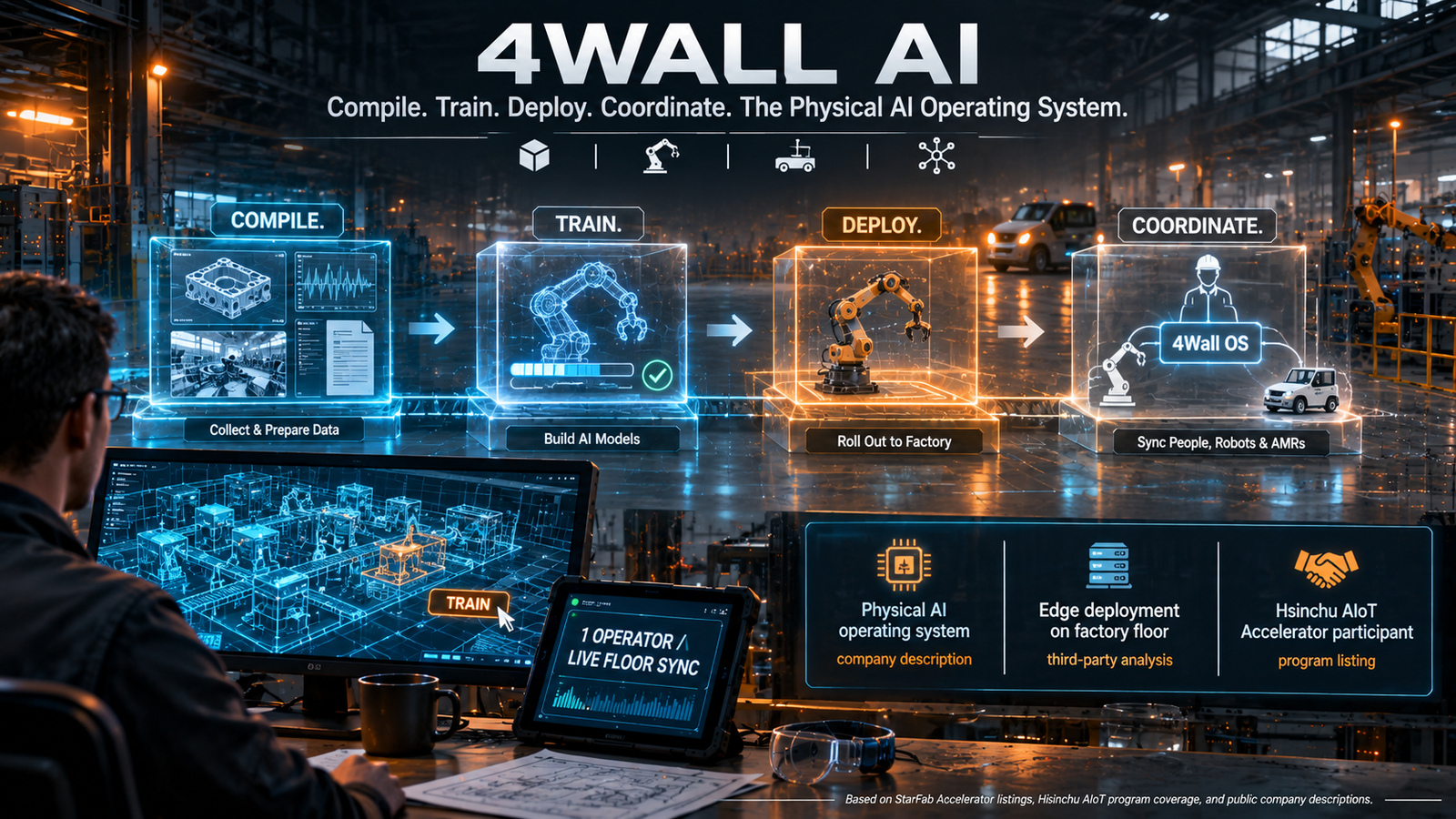
4Wall AI is a Taiwanese startup building a Physical AI operating system that compiles CAD files, sensor data, machine feeds, and natural language into simulation-ready industrial environments. Robots and AI agents train, validate navigation and tasks inside these digital worlds before deployment, then coordinate with people, equipment, and autonomous vehicles on the real factory floor. The company targets manufacturing and warehouse operators seeking to move toward autonomous operations without replacing existing machinery.
At-a-Glance
- What it is: A Physical AI operating system for industrial sites, not a consumer AI tool
- Core function: Compiles fragmented factory data into simulation-ready worlds for robot training
- Key capability: Pre-deployment validation plus real-time coordination on the factory floor
- Target market: Manufacturing and warehouse operators pursuing autonomous operations
- Ecosystem: Participated in Hsinchu AIoT Accelerator with corporate mentor Anke Technology
- Transparency gap: No public pricing, model specifications, or independent benchmarks available
What Is 4Wall AI?
4Wall AI occupies a distinct category in the industrial AI landscape. It is not a robot manufacturer, not a warehouse management system, and not a general-purpose AI platform. It is an operating system layer that sits between a factory’s existing data sources and the autonomous systems that will eventually run on the floor.
The company’s core proposition is straightforward. Factories already contain enormous amounts of data: CAD drawings of layouts, PLC signals from machines, HMI readouts, camera feeds, sensor telemetry, even paper work orders. This data is fragmented across systems that do not talk to each other. 4Wall AI compiles these disparate sources into a unified, simulation-ready model of the industrial environment .
That model serves two purposes. First, it lets robots and AI agents train and validate their perception, navigation, and task execution before they ever touch the physical floor. Second, once deployed, the same model coordinates people, equipment, and autonomous vehicles in real time, monitoring operations and replanning when conditions change.
The Name and the Metaphor
The “fourth wall” in theater refers to the invisible boundary between performers and the audience. Breaking it means acknowledging the viewer directly. For an industrial AI company, the metaphor is less about performance and more about dissolving the boundary between the digital model and the physical floor. The simulation is not a separate world; it is a working copy of the real one.
Physical AI, Explained Simply
Physical AI describes AI systems that operate in the physical world rather than purely in software. A chatbot is digital AI. A robot navigating a warehouse aisle is physical AI. The distinction matters because physical AI has harder constraints: latency matters, sensor noise is real, and mistakes have consequences. 4Wall AI’s bet is that the hardest part of physical AI is not the robot hardware but the environment model that lets the robot understand where it is and what to do.
How 4Wall AI Works
The workflow follows a compile-train-deploy-coordinate sequence.
Step 1: Data Ingestion
4Wall AI connects to the data sources already present in a factory. This includes CAD files for layout and equipment, imagery from cameras, sensor data from machines, PLC and HMI signals, and even paper work orders that need digitization . The system also accepts natural language input, which suggests operators can describe tasks or constraints conversationally rather than through rigid programming.
Step 2: World Compilation
The ingested data is compiled into a simulation-ready industrial world. This is not a simple 3D visualization. It is a structured environment that AI agents can reason about: where obstacles are, what equipment exists, how materials flow, what constraints apply. The goal is a model accurate enough that a robot trained inside it can transfer its skills to the real floor without extensive recalibration.
Step 3: Pre-Deployment Training and Validation
Before a robot or autonomous vehicle touches the physical site, it trains and validates its perception, navigation, and task execution inside the compiled world . This reduces the risk and cost of on-site testing. A robot that fails in simulation costs nothing but compute time. A robot that fails on a live factory floor costs downtime.
Step 4: On-Floor Coordination
Once deployed, the system coordinates people, equipment, and autonomous vehicles in real time. It monitors operations, executes tasks, and replans when conditions change . This is the operating system layer: it sits above individual machines and below the factory’s management systems, orchestrating the physical work.
Step 5: Continuous Monitoring
The system does not stop learning after deployment. It continues to monitor equipment and production status, supporting utilization analysis, production scheduling adjustments, and product manufacturing history creation . This creates a feedback loop between the simulation model and the live floor.
Key Capabilities
Heterogeneous Data Integration
The most tangible differentiator is the ability to pull together data from machines that were never designed to talk to each other. PLCs, HMIs, meters, cameras, and paper records all become inputs to a single model. This matters because most factories cannot rip out existing equipment. 4Wall AI’s approach is additive, not replacement-oriented.
Simulation-Ready Output
Not all simulation is equal. A visual walkthrough is not the same as a training environment where an AI agent can learn. 4Wall AI emphasizes that its output is “simulation-ready,” meaning agents can actively train and validate inside it, not just view it.
Real-Time Replanning
Factory floors are dynamic. A machine goes down, a delivery arrives early, a worker takes an unscheduled break. The system’s ability to replan in real time, rather than following a static schedule, is what makes it an operating system rather than a planning tool.
Edge Deployment
4Wall AI deploys its AI locally on the factory floor rather than relying entirely on cloud inference . This matters for latency-sensitive coordination tasks and for factories with unreliable connectivity. It also addresses data sovereignty concerns, since sensitive production data does not need to leave the site for basic operations.
Who 4Wall AI Serves
Primary fit:
- Manufacturing plants with mixed-vintage equipment and fragmented data
- Warehouse operators pursuing partial or gradual automation
- Industrial sites that cannot replace existing machinery but want autonomous capabilities
- Factories in Taiwan or Asia-Pacific with access to the local startup ecosystem
Poor fit:
- Greenfield factories designed from scratch with unified data infrastructure
- Operations seeking a ready-to-deploy robot or turnkey automation hardware
- Businesses outside industrial manufacturing and logistics
- Organizations requiring publicly documented pricing and technical specifications before engagement
Limitations and Transparency Gaps
No Public Pricing
4Wall AI does not publish pricing for its operating system, integration services, or deployment support. Industrial software procurement typically involves custom scoping, but the absence of any public guidance makes early-stage evaluation difficult.
No Technical Documentation
The company does not publicly disclose which foundation models power its AI agents, how its simulation engine works under the hood, or what hardware requirements apply. This is common for early-stage industrial startups, but it limits independent assessment.
No Independent Benchmarks
Performance claims about simulation accuracy, training transfer rates, or coordination latency have not been independently verified. Potential buyers should request case-level evidence during procurement discussions.
Early-Stage Ecosystem Position
4Wall AI’s visible traction comes primarily from its participation in the Hsinchu AIoT Accelerator, where it was paired with corporate mentor Anke Technology . This is a promising signal for a young company but does not constitute large-scale production validation. The company’s H-1B filing data shows a small team with roles in software engineering and data science, consistent with an early-stage startup .
Name Collision Confusion
Search results for “4Wall AI” include unrelated entities, most notably 4Wall Entertainment, a major entertainment technology company that provides LED and virtual production services for film and live events . There is also a separate “4thwall AI” platform focused on film production tools and a beta.4wall.ai site described as an AI character chat platform . The industrial operating system company at starfabx.com is the entity most relevant to serious industrial AI search intent, but users should be aware of the naming overlap.
The Industrial Context
4Wall AI’s positioning reflects a broader shift in industrial automation. The first wave of factory robots were fixed, caged, and programmed for repetitive tasks. The second wave involved mobile robots that could navigate warehouses but required extensive site mapping. The current wave, which 4Wall AI is betting on, involves AI agents that can understand a factory as a structured environment, train in simulation, and coordinate dynamically.
This approach shares conceptual ground with digital twin technology and reinforcement learning for robotics. The difference is packaging. 4Wall AI sells an operating system, not a simulation tool or a training framework. Whether that packaging resonates with factory operators who are accustomed to buying machines rather than software layers remains to be seen.
Frequently Asked Questions
What does 4Wall AI actually do?
4Wall AI builds a Physical AI operating system for factories and warehouses. It compiles CAD files, sensor data, machine signals, and other factory data into simulation-ready worlds where robots and AI agents train before deployment. Once deployed, the system coordinates people, equipment, and autonomous vehicles in real time on the physical floor.
Is 4Wall AI the same as 4Wall Entertainment?
No. 4Wall AI is an industrial AI startup building factory operating systems. 4Wall Entertainment is a separate, established company that provides LED screens, virtual production, and event technology for film, television, and live events . The similar names cause search confusion.
How much does 4Wall AI cost?
4Wall AI does not publish pricing. Industrial operating system deployments typically involve custom scoping, integration services, and ongoing support. Potential customers should contact the company directly for quotes.
What makes 4Wall AI different from a digital twin?
A digital twin is typically a visualization or monitoring tool. 4Wall AI emphasizes that its compiled worlds are simulation-ready, meaning AI agents can actively train inside them, not just view them. The system also handles real-time coordination on the factory floor, which goes beyond most digital twin use cases.
Where is 4Wall AI based?
4Wall AI is a Taiwanese startup. It participated in the Hsinchu AIoT Accelerator program, where it was matched with corporate mentor Anke Technology . The company also has a U.S. entity, 4WALL AI INC, headquartered in New York, according to H-1B filing data .
Conclusion
4Wall AI is an early-stage industrial AI company with a coherent technical thesis: the path to autonomous factories runs through better environment models, not just better robots. Its operating system compiles fragmented factory data into simulation-ready worlds, trains agents inside those worlds, and then coordinates physical operations on the live floor.
What matters most for potential buyers is distinguishing between the promise and the proof. The concept is sound and aligns with where industrial automation is heading. The data integration approach addresses a real pain point. The edge deployment strategy makes sense for latency and privacy. But public evidence of large-scale deployment is limited. Pricing is undisclosed. Technical architecture is not documented.
4Wall AI suits industrial operators with mixed-vintage equipment, fragmented data, and a willingness to engage in custom procurement. It does not suit buyers seeking off-the-shelf automation, transparent published pricing, or independently verified performance benchmarks. Before committing, evaluate whether the company’s simulation accuracy claims hold up in your specific factory environment, and whether the operating system layer integrates with your existing management and safety systems.