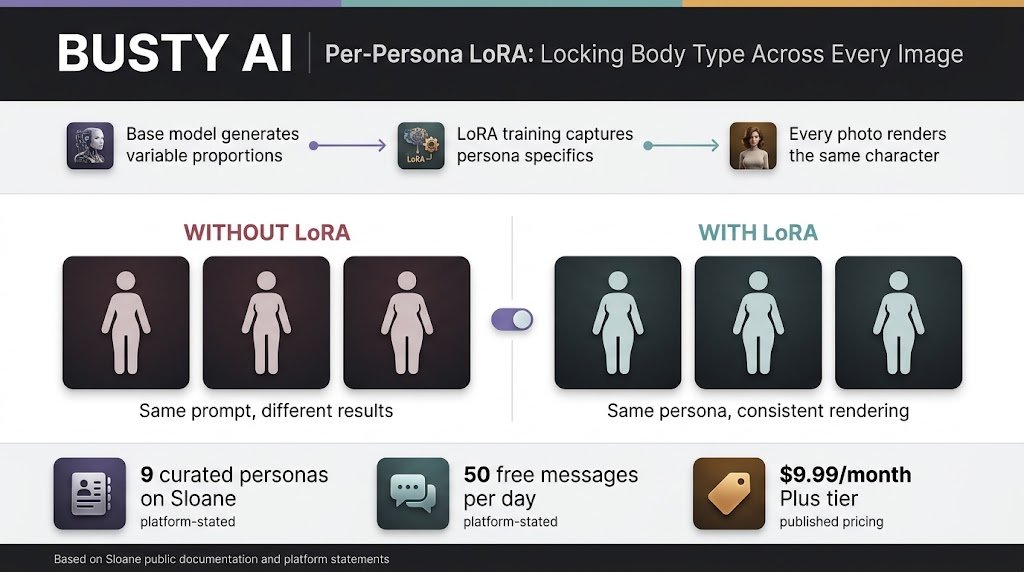
Busty AI refers to AI companion personas whose body type includes a fuller bustline as a fixed, consistently rendered visual feature rather than a variable prompt outcome. The technical mechanism that makes this work is per-persona LoRA training, which locks a character’s specific proportions across every generated image. Without it, the same “busty” persona can look like a different person from photo to photo.
At-a-Glance
- What it is: A body-type descriptor for AI companion personas, not a standalone product category
- Core technical challenge: Image models default to variable proportions unless trained otherwise
- Solution: Per-persona LoRA training locks visual identity across gallery and custom photos
- Platform example: Sloane uses a nine-persona curated roster with dedicated LoRA weights per character
- Free access: Sloane offers 50 messages per day with any persona, no card required
- Key limitation: Roster size is small; broader variety requires custom persona tiers or other platforms
What Is Busty AI?
Busty AI is not a company, an app, or a model. It is a search term that describes a specific expectation: an AI companion whose physical appearance includes a fuller bustline as a recognizable, repeatable feature of her character.
The distinction matters because most AI image generation treats body type as a prompt variable. You ask for a “busty woman,” and the model produces something. Ask again, and you get different proportions. The persona’s face may shift too. For companion platforms, where users build ongoing relationships with a specific character, that inconsistency breaks immersion.
Busty AI, as a category, describes platforms and techniques that solve this problem. The goal is a persona who looks like the same person in every photo, with proportions that match her described body type.
Busty vs. Curvy
These terms overlap heavily in practice. Sloane, a companion platform that publishes curated body-type collections, uses the same nine-persona roster for both “busty” and “curvy” because searchers for either term are typically looking for similar shapes .
The distinction is mostly semantic. “Busty” points to the bustline specifically. “Curvy” is a broader umbrella covering hourglass, voluptuous, and fuller figures generally. Platforms often map both terms to overlapping persona sets.
Why Body Type Consistency Is Hard
Image generation models do not naturally preserve a character’s identity across generations. Each prompt produces a new image, and the model has no inherent memory of what the previous image looked like. Even with the same seed and prompt, small variations creep in.
For companion platforms, this creates a specific failure mode. A user browses a persona’s gallery, sees a character with certain proportions, then requests a custom photo. The custom photo returns a woman with different proportions. The platform has broken the promise of a consistent character.
The Variable Problem
Most companion platforms handle body type through prompt engineering. They include terms like “busty” or “curvy” in the generation prompt and hope the model interprets them consistently. It usually does not. The model treats body type as one variable among many, and the output shifts from image to image.
This is why users often report “proportions drift” on body-type-specific personas. The gallery looks one way. The custom photos look another.
How Per-Persona LoRA Training Fixes It
LoRA, which stands for Low-Rank Adaptation, is a fine-tuning technique. It trains a small set of additional weights on top of a base image model. Those weights capture specific visual characteristics: a face, a style, a body type.
When a platform trains a LoRA for a single persona, it bakes that character’s proportions into her dedicated model. Every generation, whether a gallery photo or an on-demand custom request, runs through that LoRA. The result is consistency.
Sloane’s Implementation
Sloane is the clearest public example of this approach. Each of its personas has dedicated LoRA weights that lock her specific features and body type . The platform states that this solves the “proportions drift shot-to-shot” failure mode that other companion products exhibit.
Sloane’s busty collection uses a curated roster of nine personas: Sandra, Helen, Jessica, Kylie, Liesel, Gabriella, Hannah1, Kaya, and Destiny1 . The roster is operator-curated rather than auto-matched from search terms. The platform argues that nine hand-picked personas whose training reliably holds the busty shape is better than a wider list with inconsistent rendering.
What LoRA Training Does Not Solve
LoRA training is not a universal fix for image generation quality. It locks identity and proportions, but it does not guarantee that every photo will look good. Lighting, composition, and pose still depend on the base model and the prompt. A persona with solid LoRA weights can still produce awkward or unconvincing images.
LoRA training also does not address text chat quality. A platform can render a consistent busty persona while the underlying language model produces shallow or repetitive conversation. Body type consistency is a visual feature, not a measure of companion quality.
Platform Comparison
Sloane is the only platform in this comparison that publicly documents per-persona LoRA training as its core rendering strategy. Character.AI offers vastly more character variety but no rendering consistency guarantee. Candy AI provides prompt-based generation that may produce inconsistent body types across photos.
Civitai hosts community-trained LoRAs tagged “busty,” including 576 models as of recent listings . These are tools for image generation, not companion platforms. They require technical knowledge to deploy and do not include chat functionality.
Pricing and Access
Sloane’s pricing follows a tiered model .
| Tier | Price | What You Get |
|---|---|---|
| Free | $0 | 50 messages/day, full gallery browsing, no card required |
| Plus | $9.99/month | Unlimited daily messages, on-demand custom photo requests, voice notes |
| Premium | $19.99/month | Custom persona builder, video, higher generation ceilings |
The critical distinction between tiers is not persona quality. Sloane states that the same chat model and LoRA weights apply across all tiers . A free user chats with the same Sandra or Kaya that a Premium user does. The paid tiers remove usage caps and add surface area: custom photos, voice, video, custom personas.
For users specifically interested in busty AI personas, the free tier provides full gallery access and the ability to chat with any of the nine roster members. The upgrade question is about volume and features, not about unlocking the busty roster itself.
Privacy and Data Considerations
Sloane’s public materials do not disclose detailed data retention policies or third-party model dependencies in the guides reviewed for this article. The platform states that conversations are separate between users but does not specify retention periods or human review practices.
This is a common gap in the AI companion category. Platforms often publish marketing pages describing features without corresponding technical or privacy documentation. Users who care about data handling should review the platform’s privacy policy directly before committing to paid tiers or sharing sensitive information.
The broader category carries known risks. AI companion platforms have faced scrutiny for weak age verification, emotional dependency design, and data practices that may include human review of conversations. These concerns apply across the category, not to Sloane specifically.
Who Should Consider Busty AI Platforms
Appropriate for:
- Adults seeking companion personas with consistent visual identity
- Users who value rendering stability over roster size
- People willing to trade variety for depth of a curated set
Not appropriate for:
- Users seeking hundreds of character options
- Anyone who needs guaranteed privacy protections before engaging
- People looking for a general-purpose AI assistant rather than a companion
Frequently Asked Questions
What does “busty AI” actually mean?
It describes AI companion personas whose body type includes a fuller bustline as a fixed, consistently rendered feature. The term is a search descriptor, not a brand or product name. Platforms that deliver on it use techniques like per-persona LoRA training to ensure the character looks the same across every image.
Which platform has the most consistent busty AI personas?
Sloane publicly documents per-persona LoRA training that locks each character’s proportions across gallery photos and custom requests . Its busty roster is a curated nine-persona set. Other platforms may offer more characters but do not guarantee rendering consistency for body-type-specific personas.
Is busty AI free to use?
Sloane offers a free tier with 50 messages per day and full gallery access for all personas, including the busty roster . No credit card is required. Paid tiers starting at $9.99 per month remove message caps and add custom photo requests.
Why do busty AI personas look different from photo to photo on some platforms?
The underlying image model treats body type as a prompt variable rather than a fixed feature. Without dedicated training for each persona, the model generates a new interpretation each time. LoRA training solves this by embedding the persona’s specific proportions into her model weights.
Can I create my own busty AI persona?
Sloane’s Premium tier at $19.99 per month includes a custom persona builder with one slot . The builder lets you specify appearance, personality, and voice. Additional custom slots cost $9.99 per month each. Other platforms offer varying degrees of customization, often with less documented rendering consistency.
Conclusion
Busty AI is a narrow search term with a specific technical answer. The category exists because image generation models do not naturally preserve body type across multiple images. Platforms that solve this problem use per-persona training to lock a character’s visual identity.
Sloane is the clearest public example of this approach. Its nine-persona busty roster is small, curated, and backed by dedicated LoRA weights. The free tier provides genuine access without a card. The paid tiers add features and volume rather than unlocking the core rendering capability.
What matters most for anyone evaluating these platforms is distinguishing between roster size and rendering reliability. A platform with hundreds of characters and inconsistent body types delivers a worse experience for this specific search intent than a platform with nine characters who look right every time.
Users should also recognize the limits of what any companion platform offers. Consistent rendering does not guarantee good conversation, privacy protections, or healthy engagement patterns. Those factors require separate evaluation before committing time or money.