AI dectection refers to the practice of using software tools to determine whether text was generated by artificial intelligence or written by a human. Independent benchmarks show these tools are unreliable, with false positive rates ranging from 15% to over 60% depending on the tool and the writing population. The evidence suggests detection alone should never be used as grounds for accusation or penalty.
At-a-Glance
- What it is: Software that analyzes text patterns to estimate whether AI wrote it
- Core problem: High false positive rates mean innocent writers get flagged
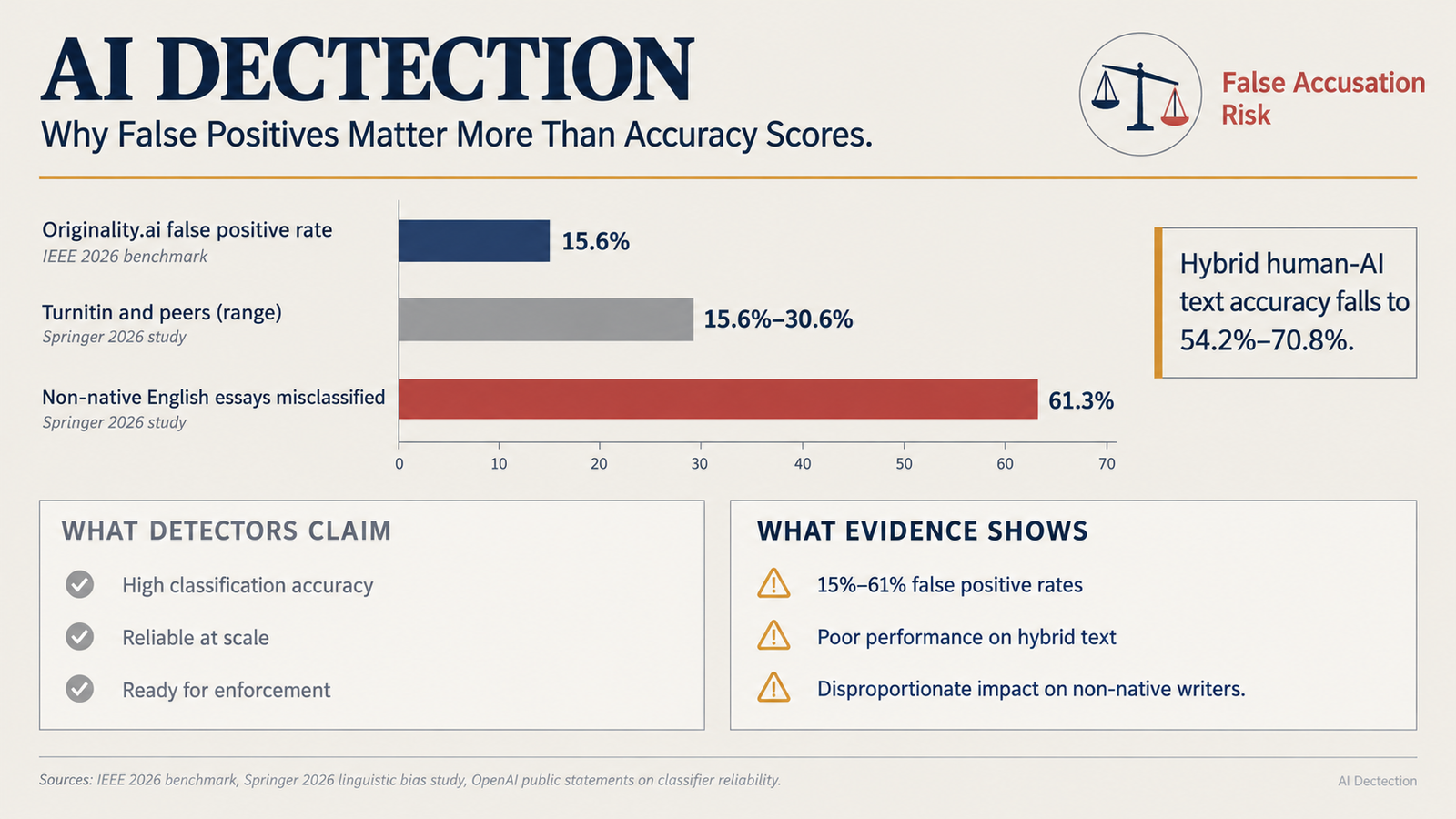
- Worst case: One study found 61.3% of non-native English essays were misclassified as AI
- Best performer: A 2026 IEEE benchmark found Originality.ai at 84.4% accuracy, with ZeroGPT lowest at 69.4%
- Hybrid texts: All tools performed poorly on mixed human-AI writing, with accuracy dropping to 54.2% to 70.8%
- Alternative approach: OpenAI added text watermarking in 2026, but it only catches 80% of 200-word passages and fails after light editing
What Is AI Dectection?
AI dectection is the process of using software to classify a piece of text as either human-written or AI-generated. The tools range from academic-integrity suites like Turnitin to standalone services like GPTZero and Originality.ai. They analyze linguistic patterns such as perplexity, burstiness, and token predictability to produce a probability score.
The search term “ai dectection” appears frequently alongside queries about academic honesty, student essays, and content marketing. The dominant intent is informational and commercial investigation: people want to know whether these tools work and which ones they can trust. The honest answer, based on published research, is that they work poorly enough that trusting them is dangerous.
Why the Spelling Matters
The misspelling “dectection” is common in search data. It appears in student forums, Reddit threads, and social posts where users ask about detector results. A well-optimized article should address the topic without mocking the spelling, and should use the correct term “detection” in body content while acknowledging the search variant naturally.
How AI Detectors Work
Most detectors rely on statistical signals left by language models during generation.
Perplexity and Burstiness
Large language models generate text one token at a time. They tend to choose high-probability tokens, producing text that is more predictable than human writing. Perplexity measures this predictability. Lower perplexity suggests AI authorship.
Burstiness measures variation in sentence length and structure. Human writing tends to be more varied. AI writing tends to be more uniform. Detectors combine these signals with other features to produce a score.
Token Repetition Analysis
Newer approaches examine token repetition patterns. A 2026 ICML paper introduced Telescope Perplexity, which measures how often a model repeats tokens in ways humans rarely do. The researchers argue that LLMs develop a “vestigial heuristic” against token repetition during training, and this bias leaves a detectable signature . This is promising research, but it has not yet produced a consumer tool that outperforms existing commercial detectors in real-world settings.
Watermarking
OpenAI introduced text watermarking in 2026 using a system called textGrain. The system influences word choice using pseudorandom values derived from a secret key, leaving a statistical signal that a detector can identify .
The limitations are significant. OpenAI’s own testing found the watermark was caught in only 80% of 200-word passages. Detection rates were lower for topics with rigid vocabulary, like mathematics. Changing 10% of words in a 400-word passage reduced detection to 66%. Replacing 25% of words dropped it to 17% .
The watermark detector is only available to researchers and experts who apply for access. It is not a public verification tool.
The Accuracy Problem
The published evidence on detector accuracy is consistent: these tools are not reliable enough for high-stakes decisions.
Benchmark Results
A 2026 IEEE study tested five widely used detectors against 180 academic writing samples. The findings were sobering :
| Detector | Overall Accuracy | False Positive Rate |
|---|---|---|
| Originality.ai | 84.4% | 15.6% |
| Turnitin AI Detection | Not reported as top performer | Within 15.6%–30.6% range |
| Copyleaks | Not reported as top performer | Within 15.6%–30.6% range |
| GPTZero | Not reported as top performer | Within 15.6%–30.6% range |
| ZeroGPT | 69.4% | 30.6% |
The false positive rates matter most. A 15.6% false positive rate means roughly one in six human-written texts gets flagged as AI. At 30.6%, nearly one in three does.
The Hybrid Text Blind Spot
The same study found that all tools performed far worse on hybrid texts, where humans and AI collaborated. Accuracy on hybrid texts dropped to between 54.2% and 70.8% . Since hybrid writing is increasingly common in professional and academic settings, this is a significant limitation.
Non-Native English Writers
The most troubling finding comes from a controlled benchmark using TOEFL essays. Across seven detectors, authentic essays written by non-native English speakers were misclassified at a mean false positive rate of 61.3%. Native-speaker essays were recognized far more reliably .
The reason is structural. Non-native writers often rely on well-attested vocabulary and conventional phrasing. These strategies reduce risk of error. But they also produce text that detectors associate with AI. The paper notes that restricted vocabulary, formulaic phrases, and uniform rhythm are legitimate features of second-language writing, yet they elevate flag risk .
OpenAI’s Own Admission
OpenAI has publicly stated that its research into detectors “didn’t show them to be reliable enough.” The company found that its own detector labeled Shakespeare and the Declaration of Independence as AI-generated. It also noted disproportionate impact on English-language learners and students with formulaic writing styles .
OpenAI discontinued its AI classifier in July 2023 due to low accuracy .
AI Dectection vs. AI Humanizers
A parallel market has emerged: tools that rewrite AI-generated text to evade detection. These “humanizers” restructure sentences, vary rhythm, and adjust perplexity to make text appear human-written.
The existence of this market undermines the entire detection premise. If a student can run AI text through a humanizer and submit it, the detector’s signal is meaningless. A 2026 Springer study found that humanized papers performed poorly under detection, with some tools dropping to near-zero accuracy on humanized content .
The arms race between detection and evasion has no stable endpoint. Every improvement in detection produces a corresponding humanizer update. The fundamental problem, that human and AI writing overlap statistically, cannot be solved by adding more features.
Who Should Use AI Detectors
Detection tools have limited legitimate uses. They are not suitable for accusations.
Reasonable uses:
- Screening large volumes of content for obvious AI generation patterns
- Research into linguistic differences between human and machine writing
- Supplementary signals alongside human judgment, never as sole evidence
Unreasonable uses:
- Accusing a student of cheating based on a detector score
- Rejecting a job applicant’s writing sample
- Penalizing a writer without disclosure and appeal rights
- Making editorial decisions without human review
Common Mistakes and Misconceptions
Assuming a high score proves AI use. Detectors produce probabilities, not proof. A 95% AI score means the tool’s model estimates 95% likelihood based on patterns. It does not mean the text was generated by AI. Human writing can match those patterns.
Believing false positives are rare. Published rates range from 15% to over 60% depending on the population. For non-native English writers, the risk is severe.
Trusting vendor accuracy claims. Vendors publish accuracy figures from their own testing. Independent benchmarks show lower performance. A 2026 dentistry study found Turnitin’s sensitivity at 27% for detecting AI-generated texts, meaning it missed nearly three-quarters of AI content in that sample .
Ignoring the hybrid problem. Most real-world writing involves some AI assistance, whether brainstorming, editing, or outlining. Detectors are least reliable precisely where the question matters most.
Forgetting that ChatGPT cannot self-detect. Asking ChatGPT whether it wrote a text produces random, fabricated answers. OpenAI explicitly states this .
What Institutions Should Do Instead
The evidence points toward process-based approaches rather than detection-based enforcement.
Disclose AI use explicitly. Create clear policies requiring students and employees to state how AI was used. A disclosed hybrid process is verifiable. An undisclosed one is not.
Assess process, not just product. Require drafts, outlines, and revision histories. These artifacts reveal writing development in ways a final product cannot.
Use detection as a conversation starter, never a verdict. If a detector flags a paper, discuss the writing process with the author. Do not issue penalties based on a score.
Protect vulnerable writers. Non-native English speakers, neurodivergent writers, and those with formulaic styles face disproportionate risk. Any policy using detectors must account for this.
Invest in writing support, not surveillance. The resources spent on detection software could fund writing centers, tutoring, and instruction on ethical AI use.
Frequently Asked Questions
Do AI detectors actually work?
They work better than chance on purely AI-generated text and purely human text, but they fail on the cases that matter most. False positive rates range from 15% to over 60%. Hybrid texts, which are increasingly common, are detected poorly by all tools. OpenAI has stated its own detector was not reliable enough for high-stakes decisions.
Why do AI detectors flag human writing?
Detectors look for patterns associated with machine generation: low perplexity, uniform sentence structure, restricted vocabulary. Many human writers produce text with these features. Non-native English speakers, formulaic academic writers, and people using translation tools are at highest risk.
What is the false positive rate for AI detectors?
Published rates vary by tool and population. A 2026 IEEE benchmark found rates between 15.6% and 30.6% for academic writing . A separate study found 61.3% of non-native English essays were misclassified as AI . The risk is not evenly distributed.
Can I get in trouble if a detector flags my writing?
Policies vary by institution. Some universities and employers have penalized people based on detector scores alone. However, given the documented unreliability, many institutions are revising policies to require human review and appeal processes. If you are flagged, request the specific evidence and an opportunity to discuss your writing process.
Is there a way to prove I wrote something myself?
There is no reliable technical proof. Version history from word processors or Google Docs can show writing development over time. Drafts and notes help. Watermarking only works for AI-generated text that has not been edited. For human writing, the best protection is transparent process documentation.
Conclusion
AI dectection is a field built on a reasonable premise: that machine text and human text have distinguishable patterns. The published evidence shows those patterns overlap too much for reliable classification, especially in high-stakes settings.
The tools vary widely in accuracy. Even the best performer in independent benchmarks missed roughly one in six human-written texts. Non-native English writers face misclassification rates above 60%. Hybrid texts, which represent most real-world writing, are detected poorly by every tool tested.
What matters most is the consequence of error. A false positive on a student essay can affect a grade, a scholarship, or a career. The asymmetry between the cost of a missed detection and the cost of a false accusation is severe. Institutions should weigh that asymmetry before deploying these tools.
AI detection may suit low-stakes screening and research. It does not suit accusations, penalties, or automated enforcement. Before choosing a detector, evaluate its independent false positive rate, its performance on the populations you serve, and whether you have a human review process that treats a flag as a question rather than a verdict.