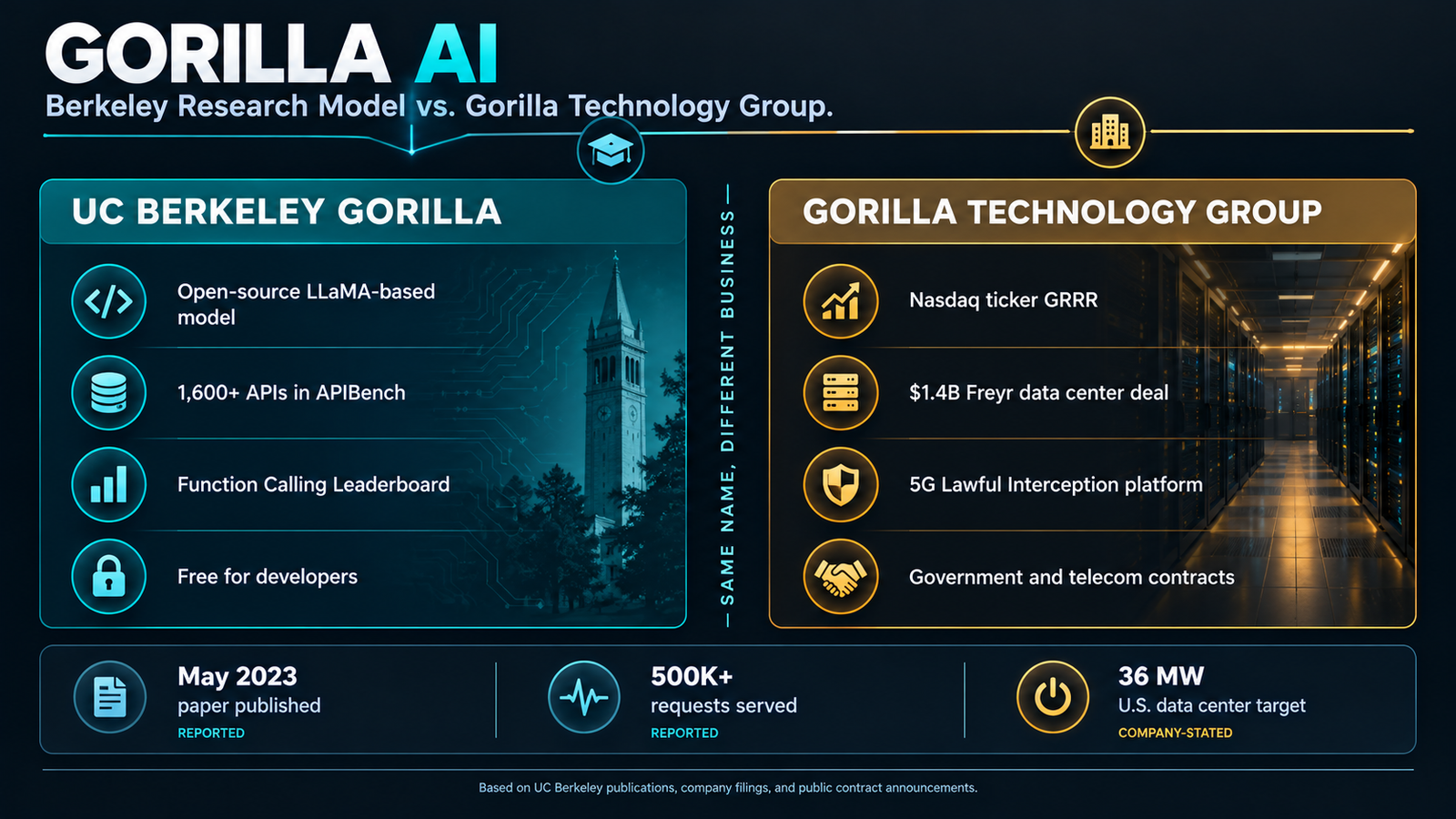
Gorilla AI refers to two distinct entities: an open-source research project from UC Berkeley that trains language models to invoke APIs accurately, and Gorilla Technology Group, a Nasdaq-listed company building AI data centers and sovereign intelligence platforms. The Berkeley project produced the Gorilla model and the Berkeley Function Calling Leaderboard, while Gorilla Technology focuses on GPU-as-a-Service, government security contracts, and AI infrastructure expansion across Asia and the Middle East. Confusing the two is the most common mistake searchers make.
At-a-Glance
- Two entities share the name: UC Berkeley’s Gorilla LLM project and Gorilla Technology Group (NASDAQ: GRRR)
- Berkeley Gorilla: A fine-tuned LLaMA model that outperformed GPT-4 on API call generation in 2023
- Gorilla Technology: A London-headquartered AI infrastructure and security intelligence provider
- Key Berkeley asset: APIBench dataset with 1,600+ APIs and the Berkeley Function Calling Leaderboard
- Key Gorilla Technology asset: 5G Lawful Interception platform and AI data center deployments in APAC
- Critical distinction: Berkeley’s Gorilla is open-source research; Gorilla Technology is a commercial contractor with government clients
What Is Gorilla AI?
The search term “Gorilla AI” splits into two unrelated projects. Understanding which one you need determines everything that follows.
Gorilla from UC Berkeley
The first Gorilla is a research initiative from UC Berkeley’s Sky Computing Lab. Researchers Shishir Patil, Tianjun Zhang, Xin Wang, and Joseph Gonzalez published “Gorilla: Large Language Model Connected with Massive APIs” in May 2023 . The core insight was simple but important: large language models struggle to call APIs correctly, often inventing parameters or hallucinating function names.
Gorilla addressed this by fine-tuning a LLaMA-based model on API documentation. The result was a system that could generate syntactically and semantically correct API calls for over 1,600 services . When combined with a document retriever, Gorilla adapted to API changes at test time without retraining.
The project expanded beyond the original model. It now includes:
- Gorilla OpenFunctions-V2: A drop-in function-calling model supporting parallel execution and multiple programming languages
- Berkeley Function Calling Leaderboard (BFCL): A community benchmark for evaluating function-calling capabilities across models
- Gorilla Execution Engine (GoEx): A runtime that executes LLM-generated actions with safety validation
- Gorilla CLI: A command-line tool that translates natural language into shell commands
The Berkeley project reports roughly 500,000 served requests since launch . Its models and datasets are available on Hugging Face and GitHub.
Gorilla Technology Group
The second Gorilla is a commercial entity. Gorilla Technology Group Inc. trades on Nasdaq under the ticker GRRR. It describes itself as a global solution provider in Security Intelligence, Network Intelligence, Business Intelligence, and IoT technology . The company is headquartered in London and has historically focused on smart city, video surveillance, and government security deployments.
In 2025 and 2026, Gorilla Technology pivoted aggressively toward AI infrastructure. It signed a $1.4 billion contract with Freyr Singapore to build AI data centers across Southeast Asia . It secured government intelligence platform wins in APAC for AI-based IPDR analytics and 5G Lawful Interception . And it announced plans to enter the U.S. market with a 36 MW data center acquisition and a 100+ MW expansion target .
The two Gorillas share a name and a rough association with artificial intelligence. They share nothing else.
How Berkeley’s Gorilla Works
The Berkeley model targets a specific failure mode in LLMs: incorrect tool use. When a user asks an AI to “get the weather in Tokyo,” a standard model might invent a function called get_weather() that does not exist. Gorilla learns to match natural language requests to actual API endpoints.
Retriever-Aware Training
The training approach, called Retriever Aware Training (RAT), teaches the model to work alongside a document retriever. At inference time, the retriever fetches relevant API documentation, and the model generates a call using that context . This design means Gorilla can adapt when APIs change without full retraining.
APIBench and Evaluation
To measure performance, the team built APIBench, a dataset covering HuggingFace, TorchHub, and TensorHub APIs . The benchmark tests whether models produce valid, executable API calls. Gorilla’s results showed that a fine-tuned open model could surpass GPT-4 on this narrow task, a finding that challenged assumptions about proprietary model superiority.
The Function Calling Leaderboard
The Berkeley Function Calling Leaderboard (BFCL) has become a reference point for evaluating function-calling across models. It includes single-turn, multi-turn, and multi-step evaluations, plus cost and latency metrics . The leaderboard is community-driven and covers both open-source and proprietary models.
How Gorilla Technology Operates
Gorilla Technology is a contractor, not a research lab. Its business model involves winning government and enterprise contracts for AI-powered security, surveillance, and infrastructure.
Core Offerings
AI Data Centers and GPU-as-a-Service. Gorilla develops and operates AI-ready data centers with high-density compute, cooling infrastructure, and physical security . It offers flexible models including Gorilla-branded capacity, dedicated customer environments, and GPU-as-a-Service.
Security and Intelligence Platforms. The company has deployed 5G Lawful Interception systems for national investigative agencies in Asia . It also won a contract for AI-based IPDR analytics, enabling authorities to reconstruct network traffic and identify anomalies across petabytes of metadata .
Smart City and Video Intelligence. Gorilla provides AI-powered video surveillance, facial recognition, license plate recognition, and edge computing for public safety and transportation .
Notable Contracts and Deals
Key Differences at a Glance
| Dimension | Berkeley Gorilla | Gorilla Technology Group |
|---|---|---|
| Type | Open-source research project | Nasdaq-listed commercial contractor |
| Primary output | Fine-tuned LLMs, benchmarks, datasets | AI data centers, security platforms, GPU services |
| Target user | Developers, AI researchers | Governments, telecoms, enterprises |
| Pricing | Free, open-source (model weights and code) | Contract-based, undisclosed pricing |
| Licensing | Open weights, research-friendly | Proprietary, commercial |
| Geography | Berkeley, California | London HQ; operations across APAC, Middle East, U.S. |
| Key asset | APIBench, BFCL, Gorilla models | 5G LI platform, data center portfolio |
Common Mistakes and Misconceptions
Searching for “Gorilla AI pricing” and expecting a consumer product. Berkeley’s Gorilla is free and open-source. Gorilla Technology does not publish pricing; its deals are negotiated contracts.
Assuming the Berkeley model is still state-of-the-art. Gorilla’s original 2023 claim of surpassing GPT-4 on API calls was significant at the time . The function-calling landscape has evolved considerably since then, and the BFCL now tracks many models that perform comparably or better on related tasks.
Confusing Gorilla Technology’s contracts with product availability. The Freyr deal and government wins are contract awards, not product launches. You cannot sign up for Gorilla Technology’s 5G Lawful Interception platform as an individual.
Believing “Gorilla AI” is a single company. The search results intermix both entities. This ambiguity is the defining SEO challenge for the term.
Who Should Care About Each Gorilla
Berkeley Gorilla is relevant for:
- Developers building tool-calling agents who need reliable API invocation
- Researchers benchmarking function-calling performance across models
- Teams exploring open-source alternatives to proprietary function-calling APIs
- Anyone studying how retrieval-augmented training reduces hallucination
Gorilla Technology is relevant for:
- Government agencies procuring sovereign AI and security intelligence systems
- Telecom operators needing lawful interception or network analytics infrastructure
- Enterprises seeking GPU-as-a-Service capacity in APAC or the Middle East
- Investors tracking AI infrastructure plays in emerging markets
Technical and Privacy Considerations
Berkeley’s Gorilla models are open-weight and can be run locally or on cloud infrastructure. This means users control data flow. The GoEx execution engine adds safety validation for LLM-generated actions, including undo capabilities and sandboxed execution . However, users deploying Gorilla models remain responsible for API credentials and access control.
Gorilla Technology operates in sensitive government security contexts. Its 5G Lawful Interception platform uses a zero-trust architecture with AES-256 encryption and chain-of-custody logging . These are company-stated claims, not independently audited certifications. The company does not publish SOC 2 reports, FedRAMP status, or Zero Data Retention guarantees on its public website. Buyers in regulated environments should request this documentation through procurement channels.
Frequently Asked Questions
Is Gorilla AI a free tool?
There are two answers. Berkeley’s Gorilla models are open-source and free to download, run, and modify. Gorilla Technology Group’s services are commercial contracts for governments and enterprises, with no public pricing or self-serve access.
What is the Berkeley Function Calling Leaderboard?
The BFCL is a benchmark from UC Berkeley that evaluates how well language models generate correct function calls. It covers single-turn, multi-turn, and multi-step scenarios, and includes cost and latency data. It is maintained as a community resource for comparing models on tool-use tasks .
Did Gorilla really beat GPT-4?
The original 2023 paper reported that Gorilla, a fine-tuned LLaMA model, surpassed GPT-4 on API call generation accuracy . This was a narrow, task-specific benchmark, not a general capability comparison. The finding demonstrated that specialized fine-tuning could outperform larger general models on constrained problems.
What does Gorilla Technology Group actually sell?
Gorilla Technology sells AI infrastructure and security intelligence systems. Its products include AI data centers with GPU-as-a-Service, 5G Lawful Interception platforms, AI-powered video analytics, and sovereign intelligence platforms for government agencies . It is a contractor, not a software product company.
Can I use Gorilla AI for my own project?
If you mean Berkeley’s Gorilla, yes. The models, datasets, and evaluation code are available on GitHub and Hugging Face under open licenses . If you mean Gorilla Technology, no. Its services are delivered through negotiated contracts with institutional clients.
Conclusion
Gorilla AI is a search term with two legitimate answers. Berkeley’s Gorilla is a research contribution to the function-calling problem: an open model, a benchmark, and a set of tools that help developers build more reliable AI agents. Gorilla Technology is a commercial infrastructure play, selling AI compute and security systems to governments and telecoms in Asia and beyond.
What matters most is knowing which one you need. Developers and researchers should start with the Berkeley GitHub repository and BFCL leaderboard. Procurement officers and infrastructure buyers should evaluate Gorilla Technology’s contract history and data center footprint. Neither entity is a consumer product, and neither publishes straightforward pricing.
Before committing to either, verify the current state. Berkeley’s model performance may no longer lead the field, and Gorilla Technology’s contract wins are not the same as operational revenue. The name collision will persist, so treat every “Gorilla AI” claim with the question: which Gorilla?