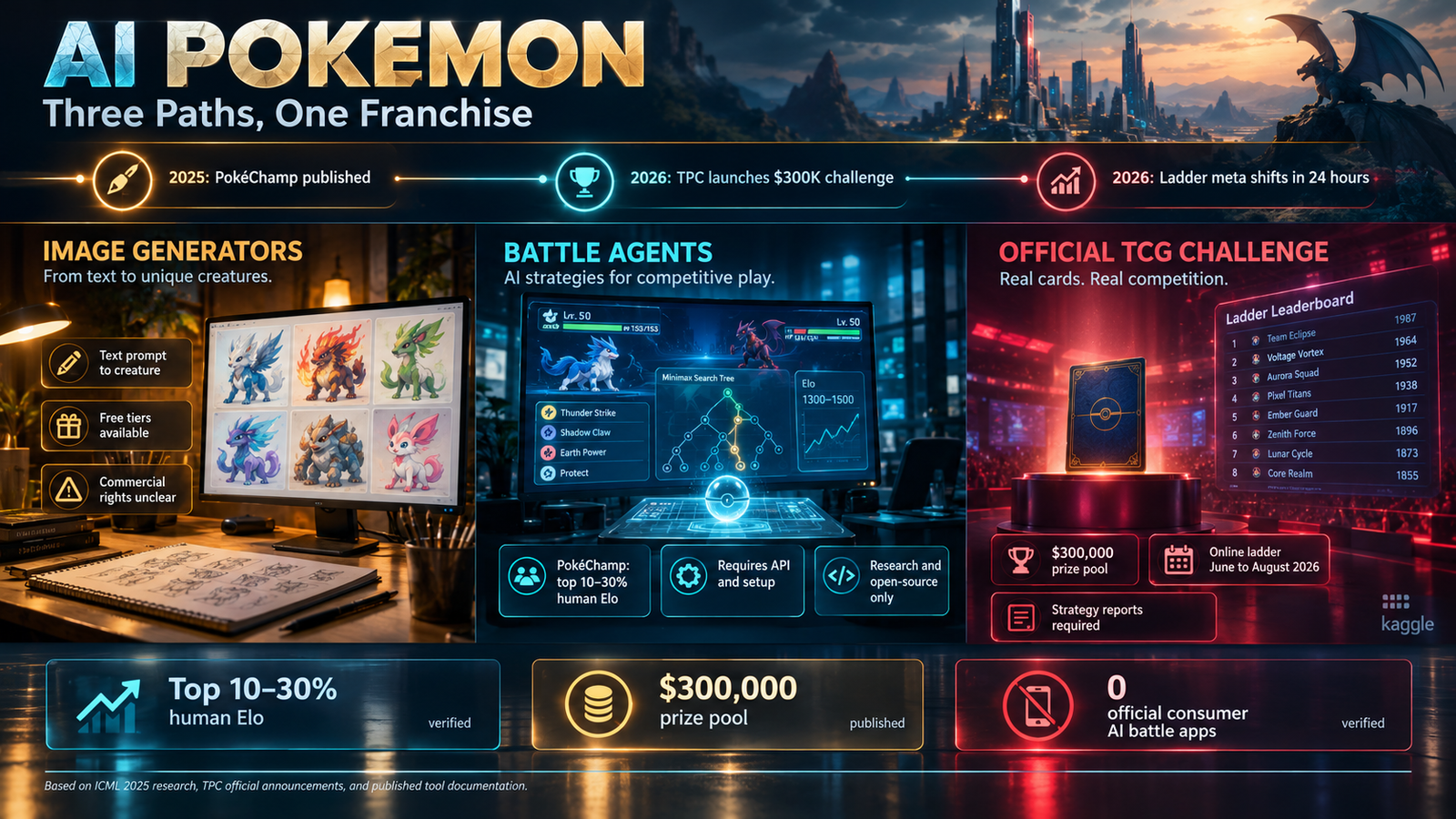
AI Pokemon refers to artificial intelligence tools and systems built around the Pokemon franchise, spanning image generators that create original creature designs, competitive battle agents that play Pokemon Showdown, and an official Pokemon Company card game AI tournament. The field has matured well beyond fan-made novelty tools, with academic research achieving top-tier human rankings and a $300,000 official competition now underway. Understanding which type of AI Pokemon tool you actually need is the first step.
At-a-Glance
- Three distinct categories: Image generators for fan art, battle agents for competitive play, and official tournament infrastructure
- Research milestone: PokéChamp, an LLM-powered agent, reaches projected Elo of 1300–1500 on Pokemon Showdown, placing it in the top 10–30% of human players
- Official event: The Pokemon Company and Kaggle launched a $300,000 PTCG AI battle challenge in June 2026, running through October
- Free generators exist: Perchance offers unlimited generation without an account; MyEdit and PhotoDirector offer more control with account requirements
- Key limitation: Generator outputs vary in style fidelity, and commercial licensing is rarely guaranteed
- Open-source access: Hugging Face hosts trained Pokemon GAN weights for developers building custom tools
What Is AI Pokemon?
The term “AI Pokemon” covers a wider range of tools than most searchers realize. Someone looking for a fun way to design a custom creature has very different needs from a developer training a competitive battling agent.
Three distinct categories dominate the landscape.
AI Pokemon generators are image tools that produce original creatures in the Pokemon art style. Users describe a type, appearance, and mood, and the tool returns concept art . These are creative toys, not official products.
AI Pokemon battle agents are software programs that play competitive Pokemon. They range from hobbyist GitHub projects to peer-reviewed academic research. The best current systems use large language models to evaluate game states and select moves .
Official AI Pokemon initiatives are events and infrastructure run by The Pokemon Company itself. The most significant is the 2026 PTCG AI Battle Challenge, a global competition with real prize money .
Why the Category Matters Beyond Fandom
Pokemon has become a benchmark problem for AI research. The game combines partial observability, stochastic outcomes, and deep strategic complexity. Unlike chess or Go, players cannot see their opponent’s hand or deck composition. Coin flips and card draw order introduce randomness that pure search algorithms struggle to handle .
This makes Pokemon a useful testbed for AI systems that must make decisions with incomplete information. PokéChamp’s authors explicitly frame their work as a template for “general multi-agent problems” beyond gaming .
AI Pokemon Generators: What They Actually Do
Image generators are the most accessible AI Pokemon tools. They require no technical knowledge and produce immediate visual results.
How They Work
Most generators use diffusion models fine-tuned on Pokemon artwork. Users provide a text prompt describing the creature’s type, color, features, and pose. The model generates one or more images matching that description .
Quality varies significantly. Dedicated tools trained specifically on Pokemon art produce more franchise-consistent results than general-purpose image generators. Some platforms offer style presets like “2D sprite,” “3D render,” or “oil painting” .
Generator Comparison
| Tool | Free Tier | Account Required | Style Options | Key Limitation |
|---|---|---|---|---|
| Perchance | Unlimited, 6 images per generation | No | 2D, 3D, oil painting | No editing tools |
| MyEdit | Yes, with account | Yes | Multiple presets | Prompt limited to 800 characters |
| PhotoDirector | Yes, with watermark | Yes (mobile app) | Multiple, plus AI replacement | Watermark on free tier |
| Japeal Fusion | Yes | No | Fusion of existing Pokemon only | Not original generation |
| Artguru | Yes | Varies | Pokemon-specific | Limited control depth |
Perchance stands out for its no-account, no-limit model. The tradeoff is zero post-generation editing. If the output is close but not quite right, you regenerate and hope for better .
MyEdit offers more control through longer prompts and style selection, but requires creating an account. PhotoDirector adds mobile convenience and AI-powered object replacement, though the free version watermarks outputs .
The Commercial Use Problem
Almost no generator clearly grants commercial rights to outputs. The standard advice applies: check the terms of service before using generated Pokemon-style art in a game, stream, or product. Most tools position themselves for personal, non-commercial use .
There is also the underlying intellectual property question. Pokemon designs are protected. A generator that produces a creature closely resembling Pikachu creates legal exposure regardless of what the tool’s terms say.
AI Pokemon Battle Agents: The Research Frontier
Battle agents represent the technical cutting edge of AI Pokemon. These are systems that play the game competitively, not just generate pictures of creatures.
PokéChamp: The Current Benchmark
PokéChamp, published at ICML 2025, is the most rigorously evaluated Pokemon battle agent to date. It uses a large language model to guide a minimax search algorithm, replacing three traditional modules: action sampling, opponent modeling, and value estimation .
The results are notable. Powered by GPT-4o, PokéChamp achieved a 76% win rate against the best existing LLM-based bot and 84% against the strongest rule-based bot. Its projected Elo of 1300–1500 places it among the top 10–30% of human players on Pokemon Showdown .
Even more interesting is the open-source result. Using an 8-billion-parameter Llama 3.1 model instead of GPT-4o, PokéChamp still beat the previous best LLM bot by 64% . This suggests the approach does not require frontier-scale models to be effective.
Technical Machine: The Hobbyist Alternative
Technical Machine is an open-source Pokemon AI on GitHub with partial support for all generations, though generations 1–4 are most complete . It handles team building, team prediction, and battling through a configurable search depth system.
The project is technically accessible but not consumer-friendly. Users must build the software, configure server settings, and run it from the command line. It is a tool for developers, not a finished product.
What Battle Agents Are Not
No AI Pokemon battle agent is available as a consumer app or service. You cannot download PokéChamp and play against it on your Switch. These are research artifacts and open-source projects. The gap between academic achievement and consumer product remains wide.
The Official Pokemon TCG AI Challenge
The Pokemon Company’s entry into AI competition changes the landscape. In June 2026, TPC and Kaggle launched a global PTCG AI battle challenge with a $300,000 total prize pool .
Competition Structure
The event runs in two phases. The online simulation phase runs from June through August 2026. Teams upload up to five AI agents per day to a virtual ladder system, where automated matches determine rankings. A live playoff round follows in October .
Crucially, ladder rank alone does not guarantee advancement. Teams must also submit strategy reports. TPC explicitly stated it does not want the competition to become a pure compute contest. Depth of analysis and originality of approach carry weight alongside raw win rate .
Early Meta Observations
Within two days of launch, the ladder revealed interesting dynamics. A beginner-friendly deck built around “Iono’s Bellibolt” occupied three of the top ten spots. The deck’s simple, clear win condition made it easy for early-stage AI agents to pilot effectively .
A more sophisticated deck centered on “Garganacl” briefly held the top spot by exploiting a damage immunity against ex Pokemon, which most meta decks rely on. Human players would simply switch attackers. Early AI agents kept attacking into immunity for zero damage. Within a day, the meta adapted and Garganacl fell out of the top ten .
This rapid environmental shift mirrors human TCG metagame evolution, but compressed into hours. It demonstrates both the promise and current limitations of AI decision-making in stochastic card games.
What Participants Need
TPC provides the simulator environment and a database of 2,000 standard-format cards. Competitors do not need to encode card stats or abilities. They focus entirely on decision logic: hand evaluation, line-of-play planning, and adaptation to unknown opponent strategies .
Who Should Use Which Type of AI Pokemon Tool
Casual fans and content creators should start with Perchance for free, no-account generation. Upgrade to MyEdit or PhotoDirector if you need specific styles or editing capability.
Developers interested in game AI should study PokéChamp’s methodology and explore Technical Machine as a practical starting point. The Hugging Face Pokemon GAN repository offers trained weights for sprite generation if image synthesis is the goal .
Competitive players and researchers should follow the official TPC Kaggle competition. Even if not competing, the early meta observations offer insight into how AI handles partial information and stochastic outcomes.
Anyone seeking a consumer AI Pokemon game should temper expectations. No polished, officially licensed AI battle experience exists for general audiences.
Technical Considerations and Limitations
Generator consistency. Producing the same Pokemon in multiple poses or scenes is difficult. Image-to-image features help, but perfect consistency requires manual editing or specialized workflows .
Battle agent accessibility. Research-grade agents like PokéChamp require API access to LLMs, which carries inference costs. Running GPT-4o for every move evaluation adds up quickly. The Llama 3.1 result suggests cheaper alternatives are viable, but setup complexity remains .
Licensing ambiguity. Generated images occupy a legal gray area. The tools do not claim ownership of Pokemon IP, and they do not grant rights they do not possess. Users bear responsibility for how they use outputs.
Data and privacy. Generator platforms collect prompts and generated images. Whether they use this data for training or retain it after account deletion varies by provider. None of the tools reviewed here publish detailed data retention policies on their marketing pages.
Frequently Asked Questions
Can I generate my own Pokemon for free?
Yes. Perchance offers unlimited free generation with no account required, producing six images per prompt in 2D, 3D, or oil painting styles. MyEdit and PhotoDirector also offer free tiers, though MyEdit requires an account and PhotoDirector adds watermarks to free outputs .
What is the best AI Pokemon battler?
PokéChamp is the most rigorously evaluated battle agent, achieving a projected Elo of 1300–1500 on Pokemon Showdown, which places it in the top 10–30% of human players. It is a research project, not a consumer product. Technical Machine is an open-source alternative for developers .
Is there an official Pokemon AI competition?
Yes. The Pokemon Company and Kaggle launched a PTCG AI battle challenge in June 2026 with a $300,000 prize pool. The online ladder phase runs through August, with a live playoff in October. Teams submit AI agents that compete in automated card game matches .
Can I use AI-generated Pokemon in my game or project?
Commercial usage rights depend entirely on the specific tool’s terms of service, which vary widely. Most generators position themselves for personal use. The underlying Pokemon IP is protected regardless of what the tool’s terms say. Verify licensing before any commercial deployment .
How does PokéChamp work without training on Pokemon data?
PokéChamp uses a large language model to guide a minimax search algorithm. The LLM handles action sampling, opponent modeling, and position evaluation. It leverages general knowledge stored in the model rather than Pokemon-specific training. This approach works with both GPT-4o and open-source Llama 3.1 .
Conclusion
AI Pokemon is not one thing. It is a cluster of tools serving different audiences with different needs. Image generators offer instant creative satisfaction for fans. Battle agents push the boundaries of decision-making under uncertainty. The official TPC competition brings legitimacy and resources to a field that previously lived in GitHub repositories and academic papers.
What matters most for anyone exploring this space is matching the tool to the task. A fan wanting a custom creature should not struggle with Technical Machine’s build instructions. A developer interested in game AI should not expect Perchance to offer strategic depth.
The limitations are real. Generators produce variable quality and offer no commercial clarity. Battle agents remain inaccessible to non-technical users. Official competitions are spectator events for most people.
Before investing time or money, ask a simple question: are you creating art, building software, or watching the frontier expand? The answer determines which AI Pokemon tools deserve your attention.