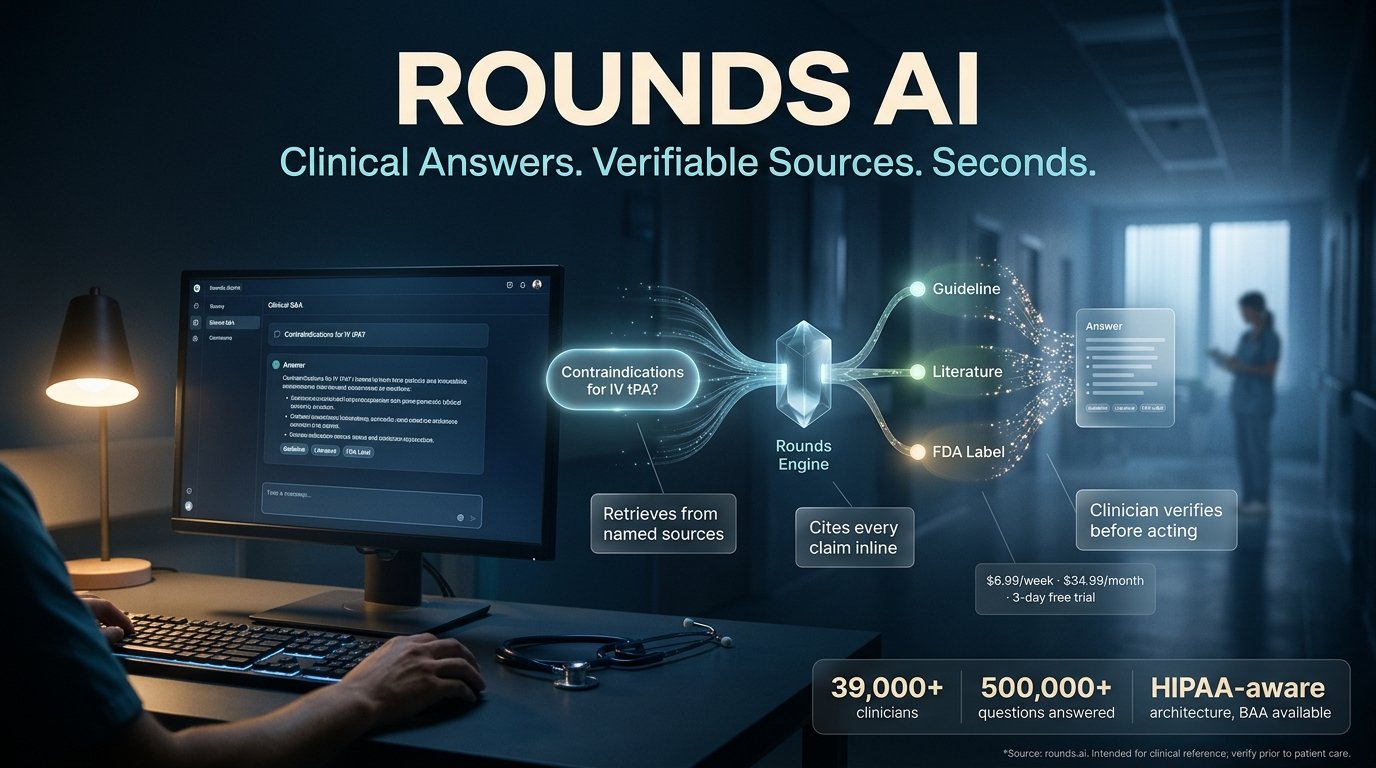
Rounds AI is a clinical decision-support tool that answers medical questions in plain language and grounds every response in named guidelines, peer-reviewed literature, and FDA prescribing information. It is built for clinicians, residents, and medical students who need a verifiable answer at the bedside rather than a generic chatbot response. The platform reports 39,000+ clinicians and over 500,000 questions answered, with pricing starting at $6.99 per week or $34.99 per month .
At-a-Glance
- What it is: A citation-first clinical Q&A tool, not a general AI assistant
- Core promise: Every answer links to verifiable sources the clinician can open
- Pricing: $6.99/week, $34.99/month, or custom Enterprise; 3-day free trial on web plans
- Access: Web browser and iOS app under one account
- Privacy posture: HIPAA-aware architecture; BAA available for enterprise teams
- Key limitation: Not a diagnostic tool; answers require independent verification before clinical action
What Is Rounds AI?
Rounds AI occupies a specific lane in medical AI. It is not an EHR-integrated agent, a scribe, or a diagnostic imaging tool. It is a question-and-answer engine designed around a single contract: every clinical answer must cite the evidence it draws from.
The product targets the moment a clinician has a question during a patient encounter. What is the contraindication for a drug? Which guideline applies to this condition? What does the FDA label say about dosing in renal impairment? Rounds answers in seconds and attaches the sources .
The name creates confusion. Multiple unrelated companies use “Rounds” or “Round” plus “AI,” including an ad-tech firm in Tel Aviv, a customer success platform, an interview prep tool, and a hiring network . The clinical product described here operates at joinrounds.com and is published by ZStack Capital LLC on the App Store .
What Makes It Different From ChatGPT
General-purpose chatbots can answer medical questions. They often do so fluently. The problem is verification. A chatbot may paraphrase a guideline without naming it, or synthesize an answer from training data that is months or years out of date.
Rounds positions itself against that failure mode. Its answers are constrained by what its developers call a “citation contract” and “clinical voice rules.” The system does not diagnose, does not prescribe specific doses without a source, and instructs users to verify against the cited reference before acting .
This is a product design choice, not a guarantee of accuracy. The citations are the mechanism for trust, and the clinician is responsible for checking them.
How Rounds AI Works
The workflow is deliberately simple. The user types a clinical question in natural language. The system retrieves relevant content from guidelines, medical literature, and FDA labels. It returns a concise synthesis with inline citations. The user can open each source to verify .
A follow-up conversation feature lets users drill down on the same case. The system keeps context so a clinician can refine a differential, adjust a dosing question, or explore monitoring plans without starting over .
The Evidence Layer
Rounds draws from three source categories: clinical practice guidelines, peer-reviewed research, and FDA prescribing information . This is a narrower evidence base than a general web search, which is the point. The system is not retrieving forum posts or news articles. It is retrieving documents that carry clinical authority.
The quality of the output depends on the quality and currency of those sources. Rounds does not publish a detailed methodology for how it weighs conflicting guidelines or resolves outdated recommendations. Users who need to know which guideline version was used should check the cited source directly.
What It Does Not Do
Rounds does not integrate with electronic health records. It does not listen to patient encounters like a scribe app. It does not analyze images. It does not provide diagnoses. The platform explicitly states that its output is for educational and decision-support use only and does not replace independent clinical judgment .
This boundary matters. A tool that answers questions is different from a tool that acts on patient data. Rounds stays on the question-answering side.
Key Features
Instant cited answers. The core function. Ask a question, get a structured response with clickable sources .
Drug and interaction support. Contraindications, interactions, and label-based nuances surfaced with references rather than generic summaries .
Follow-up conversations. Context is preserved across turns, allowing case-specific refinement .
Free clinical tools layer. Calculators and AI assistants that pair a tool with cited reasoning and a prompt to ask Rounds for more detail .
Cross-device access. One account works on web browsers and iOS. Conversation history synchronizes .
Pricing and Plans
Rounds publishes transparent pricing on its website, which is unusual for clinical AI tools .
| Plan | Price | Billing | Key Features |
|---|---|---|---|
| Weekly | $6.99/week | Weekly | Unlimited questions, cited answers, web + iOS |
| Monthly | $34.99/month | Monthly | Everything in Weekly, conversation history |
| Enterprise | Custom | Contact sales | Volume discounts, team management, BAA, custom integrations |
All web plans include a 3-day free trial. Users can cancel before billing .
Cost Considerations
The weekly plan is useful for short-term needs, such as board preparation or a rotation. The monthly plan is the practical choice for regular clinical use. The enterprise tier exists for health systems that need a Business Associate Agreement and administrative controls.
The pricing is competitive with other clinical reference tools but not trivial for individual clinicians paying out of pocket. The free tools layer and the 3-day trial provide a way to evaluate the product before committing.
Privacy and Security
Rounds describes its architecture as “HIPAA-aware” and “privacy-first.” Enterprise options include a Business Associate Agreement for teams that need one .
This language requires careful reading. “HIPAA-aware” is not the same as “HIPAA-certified,” because no such certification exists. It indicates that the product was designed with HIPAA requirements in mind. Whether a specific deployment is HIPAA-compliant depends on the agreement in place between the clinician or institution and Rounds.
The platform instructs users not to enter patient identifiers such as names, medical record numbers, or dates of service . This is a critical operational constraint. Rounds is a reference tool, not a place to store or process protected health information.
No SOC 2 certification or Zero Data Retention claim appears in the public materials reviewed for this article. Clinicians and institutions with strict data governance requirements should request documentation directly.
Rounds AI vs. Competitors
The most direct competitor is OpenEvidence, which shares the citation-first posture. Rounds differentiates on mobile workflow, a free tools layer, and an education focus for residents and students . Clinicians often use both rather than choosing one.
UpToDate remains the gold standard for curated clinical reference. Rounds does not replace it. It answers narrower questions faster, with citations that point back to sources like UpToDate’s underlying literature.
Who Should Use Rounds AI
Good fit:
- Clinicians who need fast, cited answers at the point of care
- Residents and medical students studying for boards or working through cases
- Nurse practitioners and physician assistants in settings with high question volume
- Educators who want learners to practice evidence-based reasoning with visible sources
Poor fit:
- Clinicians seeking EHR-integrated decision support
- Anyone who needs a diagnostic tool rather than a reference tool
- Institutions that require SOC 2 or detailed data retention guarantees before procurement
- Users who cannot independently verify cited sources
Common Mistakes and Misconceptions
Treating it as a diagnostic AI. Rounds answers questions. It does not diagnose. The output is a starting point for clinical reasoning, not a conclusion .
Assuming citations guarantee accuracy. A citation shows where an answer came from. It does not guarantee the answer is correct for the specific patient. The cited source must be checked.
Entering patient identifiers. The platform instructs users not to input names, MRNs, or dates of service . Doing so violates the intended use and may create compliance risk.
Confusing it with Rounds.so or Rounds AI Ltd. The clinical product is at joinrounds.com. Other companies with similar names operate in hiring and ad-tech .
Frequently Asked Questions
What is Rounds AI used for?
Rounds AI answers clinical questions with cited evidence from guidelines, medical literature, and FDA labels. Clinicians use it for drug lookups, guideline checks, differential support, and board preparation. It is a reference and decision-support tool, not a diagnostic system.
How much does Rounds AI cost?
Rounds offers a weekly plan at $6.99, a monthly plan at $34.99, and custom enterprise pricing. All web plans include a 3-day free trial. The monthly plan is the practical choice for regular clinical use .
Is Rounds AI HIPAA compliant?
Rounds describes its architecture as HIPAA-aware and offers a Business Associate Agreement for enterprise customers. The platform instructs users not to enter patient identifiers. Clinicians should confirm compliance terms for their specific use case before relying on the tool in a clinical setting .
Does Rounds AI replace UpToDate or clinical judgment?
No. Rounds is a question-answering tool with citations. It does not replace curated reference resources like UpToDate, and it explicitly does not replace independent clinical judgment. Many clinicians use both tools for different purposes.
What is the difference between Rounds AI and ChatGPT for medical questions?
Rounds is built around a citation contract: every answer links to verifiable sources. ChatGPT is a general-purpose assistant that may or may not cite sources and is not designed for point-of-care verification. Rounds also applies clinical voice rules that constrain how it answers medical questions .
Conclusion
Rounds AI is a focused product with a clear value proposition: cited clinical answers in seconds. It does not try to be an EHR, a scribe, or a diagnostic engine. It answers questions and shows its sources. For clinicians who spend time hunting through guidelines and labels, that focused utility is the point.
What matters most is understanding the boundary between reference and decision. Rounds provides references. The clinician makes the decision. The citations are a tool for verification, not a substitute for it. The platform’s own instructions say as much.
Rounds suits individual clinicians, residents, and students who want fast answers with visible evidence. It does not suit institutions seeking integrated decision support, organizations that need detailed security certifications before adoption, or anyone who expects the tool to handle patient data. Before subscribing, users should test the free trial, verify that the cited sources match their clinical setting, and confirm that the privacy terms align with their obligations.
Internal Link Opportunities
Anchor text: “clinical decision support tools”
Placement: In the “What Is Rounds AI?” section, link to a comparison of AI-powered clinical reference platforms.
Anchor text: “HIPAA-aware AI architecture”
Placement: In the “Privacy and Security” section, link to an explainer on what HIPAA compliance means for AI vendors and why “aware” is not “certified.”
Anchor text: “AI scribes for clinicians”
Placement: In the “What It Does Not Do” section, link to a guide on documentation-focused AI tools that complement reference tools like Rounds.