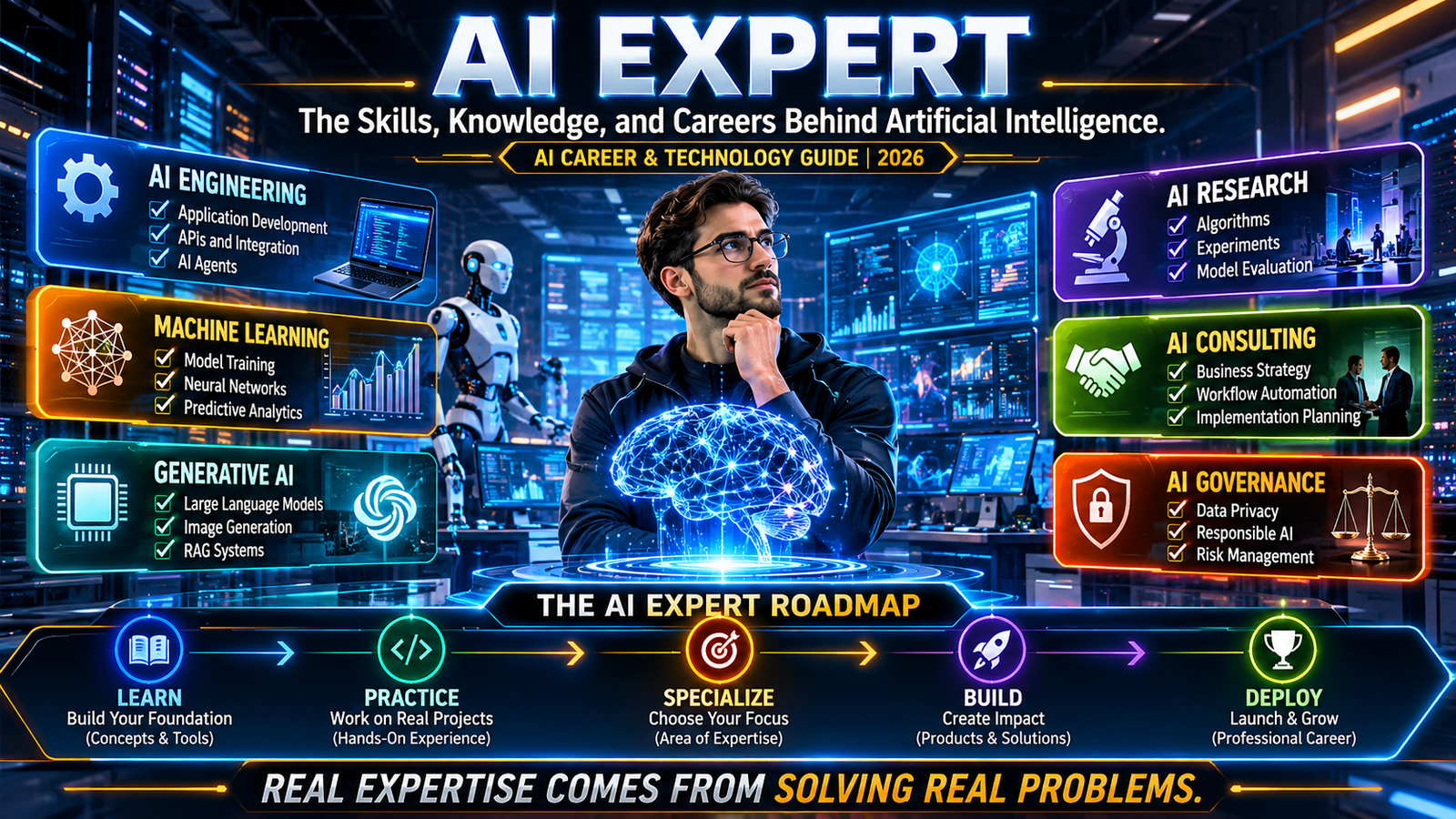
An AI expert is a professional who understands artificial intelligence and can apply, develop, evaluate, or manage AI systems to solve real-world problems. Becoming an AI expert requires a combination of technical knowledge, practical experience, critical thinking, and continuous learning as AI technologies evolve.
AI Expert at a Glance
Understanding AI expertise
Career guide
- Definition: A specialist who understands and applies artificial intelligence.
- Core knowledge: Machine learning, data science, automation, and generative AI.
- Technical skills: Python, model evaluation, APIs, and data processing.
- Non-technical skills: Problem-solving, communication, strategy, and ethics.
- Career options: AI engineer, researcher, consultant, data scientist, and AI product manager.
- Success factor: Demonstrable ability to solve real problems, not simply knowledge of AI tools.
What Is an AI Expert?
An AI expert is someone with specialized knowledge of artificial intelligence technologies, applications, and limitations. These professionals understand how intelligent systems process information, recognize patterns, generate content, and support decision-making.
However, the term does not describe one standardized occupation. Different organizations use it to describe professionals with different responsibilities.
For example, an AI researcher might develop new machine learning techniques. An AI engineer might integrate language models into business software. An AI consultant might help companies identify opportunities for automation.
An expert does not necessarily need to build AI models from scratch. Some professionals specialize in applying existing AI systems to specific industries.
The defining characteristic is the ability to make informed decisions about AI technology and deliver measurable results.
What Makes Someone an AI Expert?
Genuine AI expertise goes beyond experimenting with popular chatbots.
A capable professional should understand:
- Technical foundations: How machine learning, neural networks, and generative AI work.
- Practical applications: Where AI can improve existing processes.
- Model limitations: Why AI systems sometimes generate incorrect or misleading information.
- Data management: How data quality affects AI performance.
- System integration: How AI connects with applications, databases, and APIs.
- Responsible implementation: How to address privacy, bias, security, and transparency.
For instance, asking an AI chatbot to summarize a document demonstrates basic AI usage. Building a system that retrieves information from thousands of company documents, evaluates its answers, and protects confidential information requires considerably deeper expertise.
What Does an AI Expert Do?
The daily responsibilities of an AI expert depend on their specialization and working environment.
Some professionals develop algorithms, while others evaluate AI products, automate workflows, or guide organizational AI strategies.
Common responsibilities include:
- Identifying opportunities: Finding problems that artificial intelligence can realistically solve.
- Developing solutions: Designing machine learning models, applications, or automated workflows.
- Evaluating performance: Testing accuracy, reliability, speed, and operational costs.
- Managing data: Preparing datasets and identifying quality problems.
- Integrating systems: Connecting AI models with existing software and business processes.
- Monitoring results: Tracking performance after deployment.
- Managing risks: Addressing privacy, security, fairness, and regulatory concerns.
- Educating teams: Helping employees understand AI capabilities and limitations.
An AI expert may work independently, join a technology company, support an enterprise team, or provide consulting services.
The role is increasingly interdisciplinary because successful AI projects require both technical implementation and an understanding of business requirements.
Types of AI Experts and Their Specializations
Artificial intelligence includes several specialized disciplines. Understanding these categories helps individuals choose a suitable career path.
1. AI Engineer
An AI engineer develops and integrates artificial intelligence systems into software applications.
Their responsibilities may include:
- Building AI-powered applications.
- Integrating large language models (LLMs).
- Developing AI agents and automation systems.
- Connecting models through APIs.
- Improving application performance and reliability.
AI engineers commonly work with Python, machine learning frameworks, cloud infrastructure, and model-serving technologies.
2. Machine Learning Engineer
A machine learning engineer develops systems that learn patterns from data.
Instead of manually programming every decision, these systems use algorithms to identify relationships and make predictions.
Typical responsibilities include:
- Training machine learning models.
- Preparing and processing datasets.
- Optimizing model performance.
- Evaluating prediction accuracy.
- Deploying models into production.
This specialization requires knowledge of statistics, mathematics, programming, and machine learning algorithms.
3. Generative AI Expert
A generative AI expert specializes in systems that produce new content, including text, images, audio, video, and computer code.
Their work often involves large language models, multimodal AI, prompt design, and retrieval-based applications.
Common responsibilities include:
- Developing AI content-generation workflows.
- Building chatbot applications.
- Implementing retrieval-augmented generation (RAG).
- Evaluating generated responses.
- Integrating commercial and open-weight models.
This specialization is particularly relevant to businesses developing AI assistants and intelligent applications.
4. AI Researcher
AI researchers investigate new approaches to artificial intelligence.
They may study neural networks, computer vision, natural language processing, reinforcement learning, and advanced model architectures.
Their work can involve:
- Designing new algorithms.
- Conducting experiments.
- Publishing research papers.
- Evaluating model capabilities.
- Improving existing AI techniques.
Research positions often require advanced mathematical knowledge and postgraduate education, although requirements vary.
5. AI Consultant
An AI consultant helps organizations understand where artificial intelligence can create practical value.
Rather than necessarily developing models, consultants focus on business problems, technology selection, implementation planning, and organizational adoption.
Typical responsibilities include:
- Assessing business processes.
- Identifying suitable AI applications.
- Comparing available AI solutions.
- Estimating implementation costs.
- Planning automation projects.
- Evaluating business outcomes.
An effective AI consultant combines technology knowledge with industry experience and communication skills.
6. AI Product Manager
An AI product manager connects technical teams with business objectives and customer requirements.
They determine which AI capabilities should be developed, how success should be measured, and what limitations must be addressed.
Their responsibilities include product planning, requirements management, model evaluation, user research, and coordination between engineering and business teams.
AI Expert Specializations Compared
| Specialization | Main Responsibility | Important Skills |
|---|---|---|
| AI Engineer | Build AI applications | Python, APIs, software engineering |
| ML Engineer | Train and deploy models | Statistics, ML, data engineering |
| Generative AI Expert | Develop generative applications | LLMs, RAG, evaluation |
| AI Researcher | Advance AI techniques | Mathematics, research, deep learning |
| AI Consultant | Guide AI adoption | Strategy, analysis, communication |
| AI Product Manager | Manage AI products | Product strategy, AI literacy |
These roles overlap. A professional may develop expertise in more than one area throughout their career.
Essential Skills Every AI Expert Should Develop
The skills required depend on the intended specialization. However, several foundations are valuable across almost every AI career.
1. Understanding Artificial Intelligence Fundamentals
Start by understanding the difference between artificial intelligence, machine learning, deep learning, and generative AI.
These concepts describe related but distinct areas.
- Artificial intelligence: The broader field of creating systems that perform tasks associated with human intelligence.
- Machine learning: Techniques that allow computers to learn patterns from data.
- Deep learning: A branch of machine learning based on multilayer neural networks.
- Generative AI: Technology that generates new content based on learned patterns.
Understanding these relationships makes it easier to evaluate new technologies.
2. Programming and Technical Knowledge
Programming is especially important for professionals developing or integrating AI systems.
Python is a useful starting point because of its extensive machine learning and data science ecosystem.
Important technical skills include:
- Python programming.
- SQL and database fundamentals.
- Data structures and algorithms.
- Git and version control.
- REST APIs.
- Basic cloud computing.
- Software testing and debugging.
Not every AI specialist needs advanced programming skills. However, technical literacy helps professionals understand what AI tools can and cannot accomplish.
3. Mathematics and Statistics
Mathematical knowledge becomes increasingly important when developing or evaluating machine learning models.
Useful topics include:
- Linear algebra.
- Probability.
- Statistics.
- Calculus.
- Optimization.
- Statistical inference.
For example, understanding probability helps an expert interpret model predictions rather than treating every output as certain.
4. Machine Learning and Deep Learning
Professionals pursuing technical AI careers should understand the main machine learning approaches.
These include:
- Supervised learning.
- Unsupervised learning.
- Reinforcement learning.
- Neural networks.
- Classification and regression.
- Model training and validation.
They should also understand overfitting, data leakage, model bias, and evaluation metrics.
These concepts help determine whether an AI model performs reliably outside its training environment.
5. Generative AI and Large Language Models
Modern AI professionals increasingly work with large language models.
An LLM processes and generates language based on patterns learned during training.
Understanding these systems involves several concepts:
Prompt engineering: Designing instructions that guide a model toward a useful response.
Retrieval-augmented generation (RAG): Connecting a language model to external information sources so it can retrieve relevant context before answering.
Fine-tuning: Further training a pretrained model on specialized data to adapt its behavior.
Context window: The amount of information a model can process within a particular interaction.
Inference: The process of using a trained model to generate predictions or responses.
Model evaluation: Testing whether a model produces accurate, relevant, and reliable results.
A strong generative AI specialist understands that a convincing response is not necessarily a correct response.
6. Critical Thinking and Communication
Technical knowledge alone does not make someone an effective AI expert.
Professionals must explain complex concepts, challenge unreliable outputs, understand user requirements, and communicate technical risks.
They should also know when traditional software or human judgment is more appropriate than AI.
How to Become an AI Expert: A Practical Roadmap
Becoming an AI expert is a gradual process. You do not need to master every AI discipline before beginning.
A more effective approach is to build foundational knowledge, select a specialization, and demonstrate your skills through practical projects.
Your AI learning roadmap
- Build foundational knowledgeUnderstand AI, machine learning, neural networks, and generative AI.Starting point: AI fundamentals
- Learn essential toolsExplore Python, AI platforms, APIs, and data analysis.Starting point: practical experimentation
- Choose a specializationFocus on AI engineering, research, consulting, or generative AI.Starting point: career direction
- Build real-world projectsDevelop applications, automate workflows, or evaluate models.Starting point: practical evidence
- Develop a professional portfolioPublish projects, document results, and explain technical decisions.Starting point: professional credibility
- Continue learning and specializeFollow research, experiment with new models, and improve existing systems.Starting point: long-term development
Step 1: Learn AI Fundamentals
Begin with introductory resources covering artificial intelligence and machine learning.
Understand how AI systems learn, process information, and generate predictions.
Google Cloud’s introductory AI resources can help explain these foundations. Google Cloud
Step 2: Select the Right Learning Resources
Choose educational resources that match your experience.
Useful options include:
- University courses in computer science and data science.
- Practical Python programming tutorials.
- Machine learning courses.
- Official AI platform documentation.
- Research papers and technical demonstrations.
Avoid collecting certificates without applying what you learn.
Step 3: Practice With Real AI Tools
Experiment with different AI applications to understand their capabilities.
For example, explore language models, image-generation systems, coding assistants, and workflow automation platforms.
Compare their outputs and limitations instead of assuming that every tool performs equally well.
Step 4: Build a Project Portfolio
Practical work provides evidence of your abilities.
Consider developing projects such as:
- An AI chatbot that answers questions about uploaded documents.
- A customer-support assistant with human escalation.
- A document classification application.
- A predictive model using a public dataset.
- An AI-powered research assistant with source references.
Document the problem, technology, methodology, results, and limitations of each project.
Step 5: Gain Professional Experience
Look for internships, freelance opportunities, research collaborations, or entry-level technical positions.
Real projects teach important lessons about deployment, integration, data quality, and user requirements.
You can also contribute to open-source projects and publish technical explanations.
Step 6: Develop a Recognizable Specialty
Once you understand the foundations, develop deeper knowledge in a specific field.
For example, someone with marketing experience might specialize in AI-powered marketing systems. A software developer might focus on LLM application engineering.
Combining AI knowledge with existing professional expertise can create a valuable specialization.
Best AI Tools and Platforms for Learning and Research
AI professionals need more than one application. They use different platforms for experimentation, research, development, and discovering new technologies.
The following resources serve different purposes. They should not be treated as interchangeable qualifications or professional certifications.
| Platform | Target User | Key Strength | Pricing Transparency | Core Limitation |
|---|---|---|---|---|
| Hugging Face | Developers and researchers | Models, datasets, and demos | Public resources and separate paid services | Requires technical evaluation |
| Futurepedia | Beginners and professionals | AI tool discovery and learning resources | Varies by listed product | Directory listings do not prove quality |
| There’s An AI For That | General users and creators | Discovering AI applications | Individual tools set their prices | Listings require independent verification |
| Product Hunt | Entrepreneurs and builders | Discovering newly launched products | Depends on each product | Launch popularity is not technical validation |
| GitHub | Developers and engineers | Source code and collaborative development | Public repositories are available | Code quality and maintenance vary |
Why Hugging Face Matters
Hugging Face is particularly useful for people interested in practical machine learning.
Its Hub provides access to models, datasets, and interactive applications called Spaces. It also supports collaboration and version-controlled repositories. Hugging Face+1
An aspiring AI engineer can use the platform to:
- Explore pretrained models.
- Study model documentation.
- Compare different architectures.
- Experiment with public datasets.
- Build and demonstrate AI applications.
However, open availability does not automatically mean unrestricted commercial use. Always review individual model licenses and usage conditions.
Why AI Discovery Directories Are Useful
Futurepedia and There’s An AI For That help users discover applications across different categories.
They can reduce the time required to find tools for writing, research, automation, coding, and content creation.
However, directory placement should not be confused with independent technical validation.
Before adopting a product, examine its official documentation, pricing, limitations, data policies, and integration requirements.
Career Opportunities for AI Experts
Artificial intelligence creates opportunities across technology, healthcare, finance, education, manufacturing, marketing, and other industries.
The most appropriate career depends on your background and preferred type of work.
Popular AI Career Options
| Career | Typical Work Environment | Primary Focus |
|---|---|---|
| AI Engineer | Technology companies | AI application development |
| Machine Learning Engineer | Software and research teams | Model development |
| Data Scientist | Business and analytics teams | Data-driven insights |
| AI Researcher | Universities and research labs | New AI methods |
| AI Consultant | Consulting and enterprise teams | AI adoption |
| NLP Specialist | AI product companies | Language processing |
| Computer Vision Engineer | Robotics and imaging companies | Image and video intelligence |
| AI Product Manager | Technology organizations | AI product strategy |
Is AI a Growing Career Field?
Employment projections indicate strong demand in several occupations connected to AI.
For example, the US Bureau of Labor Statistics projected 33.5% employment growth for data scientists between 2024 and 2034. It also projected 19.7% growth for computer and information research scientists over the same period. Bureau of Labor Statistics+1
These figures apply to specific US occupational categories, not every AI-related job or every country.
Actual opportunities depend on education, experience, industry, location, and employer requirements.
How Much Does an AI Expert Earn?
There is no universal salary for an AI expert.
Compensation varies according to:
- Job title and specialization.
- Professional experience.
- Technical responsibilities.
- Industry and company size.
- Geographic location.
- Education and demonstrable skills.
An AI researcher, an AI consultant, and an AI application developer may have very different compensation structures.
For reliable salary comparisons, examine local job advertisements and occupational salary data rather than relying on generalized online income claims.
Benefits of Becoming an AI Expert
Developing AI expertise can offer several professional advantages.
1. Access to Different Industries
AI is relevant to multiple sectors. Professionals can apply their skills to healthcare, finance, education, retail, logistics, and manufacturing.
2. Opportunities for Innovation
AI specialists can develop new applications, improve existing services, and automate repetitive processes.
3. Professional Flexibility
AI knowledge can complement existing careers. A marketer, teacher, analyst, or software developer can apply AI to their existing specialization.
4. Research and Development Opportunities
People interested in advanced computing can explore machine learning research, language models, robotics, and computer vision.
5. Entrepreneurship and Consulting
AI professionals can develop specialized software, build automation services, or advise organizations on AI adoption.
However, these benefits are not guaranteed. They depend on practical ability, market demand, and the quality of the solutions delivered.
Challenges and Limitations of AI Expertise
Artificial intelligence offers significant opportunities, but becoming an AI expert also involves challenges.
Understanding these limitations is important for building reliable systems and making responsible technology decisions.
1. Rapidly Changing Technology
AI platforms, models, and development frameworks change frequently.
A technique that works well today may become outdated as new models and tools emerge.
Professionals must regularly review documentation, research, and industry developments.
2. Expensive Infrastructure
Training and deploying advanced AI models can require substantial computing resources.
Costs may include:
- Cloud computing.
- GPU infrastructure.
- API usage.
- Data storage.
- Model monitoring.
- Application maintenance.
Using an existing model through an API can reduce initial development requirements, but ongoing usage costs still matter.
3. Data Quality Problems
AI systems depend heavily on the quality of their input data.
Incomplete, outdated, biased, or inaccurate datasets can produce unreliable results.
An expert must evaluate data sources before trusting model outputs.
4. AI Hallucinations and Accuracy
Generative AI systems can produce convincing but incorrect information.
This is particularly important in legal, medical, financial, and other high-impact applications.
Professionals should use appropriate testing, source verification, human review, and safeguards.
5. Privacy and Security Risks
AI applications may process personal information, business documents, and confidential records.
Before deploying an AI system, professionals should investigate:
- Data collection practices.
- Data retention periods.
- Training-data usage policies.
- Access controls.
- Encryption.
- Third-party integrations.
- Applicable privacy regulations.
A security certification alone does not establish that a provider offers zero data retention. These are separate considerations.
6. Integration and Maintenance
An AI demonstration may work perfectly in a controlled environment but fail when connected to real business systems.
Production applications require monitoring, testing, error handling, security reviews, and ongoing maintenance.
An experienced professional considers the complete lifecycle rather than focusing exclusively on the initial model.
Responsible AI: What Every Expert Should Understand
Technical performance is only one part of successful AI implementation.
Professionals must also consider fairness, accountability, privacy, transparency, and safety.
The National Institute of Standards and Technology (NIST) provides an AI Risk Management Framework that organizes risk management around four functions:
- Govern: Establish organizational policies and responsibilities.
- Map: Understand the context and potential risks.
- Measure: Evaluate system performance and risks.
- Manage: Prioritize and address identified risks.
These functions provide a useful structure for responsible AI development and deployment. NIST+1
An AI expert should also understand that trustworthy AI involves more than accuracy. NIST identifies characteristics including reliability, security, accountability, transparency, explainability, privacy, and fairness. AIRC
For businesses, this means evaluating an AI system before deployment and continuing to monitor it afterward.
How to Identify a Genuine AI Expert
As AI becomes more accessible, it is increasingly important to distinguish genuine expertise from marketing claims.
A person who regularly uses AI applications is not automatically qualified to design complex AI systems.
Whether hiring an AI consultant, developer, or researcher, consider the following factors.
1. Examine Practical Experience
Ask about completed projects and the problems they solved.
Look for evidence of real implementation rather than impressive descriptions.
2. Review Their Portfolio
A credible professional should be able to explain their work.
Useful evidence includes:
- GitHub repositories.
- Technical demonstrations.
- Published research.
- Case studies.
- Working applications.
- Documented project results.
3. Evaluate Technical Understanding
Ask how they select models, measure accuracy, manage data, and address system limitations.
An experienced specialist should explain technical decisions in understandable language.
4. Check Relevant Industry Experience
An AI expert working in healthcare may need different knowledge from someone developing financial forecasting applications.
Domain experience can be as important as general AI knowledge.
5. Understand Their Approach to Security
Ask how they protect confidential information, manage access, and handle third-party services.
Request documentation supporting any security or privacy claims.
6. Be Careful With Unsupported Credentials
Certificates and professional titles can provide useful evidence of learning.
However, neither automatically proves practical competence.
Prioritize demonstrated ability, relevant experience, and verifiable work.
Common Mistakes People Make When Trying to Become AI Experts
Many beginners spend considerable time learning about AI without developing practical expertise.
Avoid these common mistakes:
- Learning tools without understanding fundamentals: Applications change, but foundational knowledge remains useful.
- Ignoring mathematics and data: These subjects are important for technical AI careers.
- Following every new AI trend: Focus on technologies relevant to your chosen specialization.
- Building projects without evaluation: A working demonstration does not necessarily mean a reliable solution.
- Collecting certificates without practical experience: Employers and clients need evidence of capability.
- Ignoring privacy and security: Responsible implementation should be part of the development process.
- Trying to master everything: A focused specialty is often more useful than shallow knowledge across dozens of fields.
The strongest learning strategy combines theoretical understanding, experimentation, project development, and continuous evaluation.
Who Should Become an AI Expert?
AI expertise can benefit people with different educational and professional backgrounds.
Students: Those interested in computer science, engineering, mathematics, and technology research can explore technical AI careers.
Software developers: Existing programming knowledge provides a foundation for developing AI applications and integrating language models.
Business professionals: Managers and entrepreneurs can learn how to evaluate AI opportunities and introduce automation.
Digital marketers: AI can support content research, analytics, personalization, and campaign workflows.
Researchers: Professionals in scientific disciplines can apply AI to data analysis, experimentation, and predictive modeling.
Freelancers: AI skills can complement services such as software development, automation, data analysis, and consulting.
You do not need the same learning pathway as everyone else. Choose a specialization that connects your existing knowledge with a genuine industry need.
The Future of AI Expertise
AI expertise is likely to become increasingly interdisciplinary.
Organizations need professionals who can connect advanced technology with practical requirements. This includes understanding AI models, integrating applications, evaluating outputs, and managing operational risks.
Three areas deserve particular attention.
AI Agents and Workflow Automation
AI agents can use tools and perform sequences of tasks with varying levels of autonomy.
Developers need to understand tool permissions, execution boundaries, error handling, and human approval mechanisms.
Multimodal Artificial Intelligence
Modern AI systems increasingly work with combinations of text, images, audio, and video.
This creates opportunities in accessibility, education, media production, robotics, and intelligent interfaces.
AI Governance and Evaluation
As organizations adopt AI, they need stronger methods for measuring performance and managing risks.
Experts who understand technical evaluation alongside organizational responsibilities can contribute to more reliable implementations.
The important distinction is that future expertise will not simply involve knowing which AI tool is popular. It will involve understanding how to select, evaluate, integrate, and manage technology effectively.
Conclusion
Becoming an AI expert requires more than learning how to use artificial intelligence tools. It involves understanding the technology, developing practical skills, solving real problems, and recognizing the limitations of AI systems.
The right career path depends on your interests and professional background. Some people may prefer AI engineering and machine learning, while others may find opportunities in research, consulting, product management, or business automation.
The most valuable approach is to build strong foundations, choose a specialization, develop a portfolio, and continue learning.
Ultimately, genuine AI expertise comes from applying knowledge responsibly and producing measurable results, not simply following technology trends.
Frequently Asked Questions
1. What is an AI expert?
An AI expert is a professional with specialized knowledge of artificial intelligence who can develop, evaluate, implement, or manage AI technologies. Their work may involve machine learning, generative AI, data science, automation, or AI consulting.
2. How can I become an AI expert?
Start by learning artificial intelligence fundamentals, programming, and machine learning concepts. Choose a specialization, complete practical projects, develop a portfolio, and gain professional experience. Continuous learning is essential because AI technologies evolve rapidly.
3. Do you need a degree to become an AI expert?
A degree in computer science, mathematics, engineering, or data science can provide a strong foundation. However, requirements depend on the position. Some AI application and consulting roles value practical experience, technical skills, and demonstrable project results alongside formal education.
4. What skills are most important for an AI expert?
Important skills include machine learning, Python programming, data analysis, problem-solving, model evaluation, and understanding generative AI. Communication, critical thinking, privacy awareness, and responsible AI practices are also valuable.
5. What is the difference between an AI expert and an AI engineer?
An AI expert is a broad term covering professionals with specialized artificial intelligence knowledge. An AI engineer is a more specific technical role focused on developing, integrating, deploying, and maintaining AI-powered applications and systems.
Conclusion
Becoming an AI expert is about more than learning to use artificial intelligence tools. It requires technical knowledge, practical experience, critical thinking, and the ability to solve real-world problems. Whether you choose AI engineering, machine learning, generative AI, research, or consulting, developing a focused skill set can open valuable career opportunities.
Start with the fundamentals, build practical projects, and continue exploring emerging technologies. Ultimately, a true AI expert is someone who understands the technology, recognizes its limitations, and knows how to use it responsibly to create meaningful results.