AI mom describes a growing category of artificial intelligence tools that simulate maternal support, assist with parenting logistics, or embody a customizable mother figure. These range from emotional companion apps and household scheduling agents to art installations that let users dial their ideal mother’s strictness and affection. The technology addresses real gaps in parental mental load, but it also raises unresolved questions about emotional dependency, child privacy, and whether an algorithm should ever stand in for a parent.
At-a-Glance
- What it is: An umbrella term for AI tools that simulate, assist, or replace maternal functions
- Main categories: Emotional companion apps, parenting logistics agents, AI clones of real mothers, and conceptual art
- Adoption signal: 84% of parents report using AI in daily life, versus 56% of non-parents
- Documented benefit: 2 in 3 parents say AI reduces mental load, saving about 58 minutes weekly
- Core risk: Data privacy for children remains poorly regulated, with unclear retention and use policies
- Notable tension: The same tool that frees a mother’s time can become a substitute for her presence
What Is an AI Mom?
The term “AI mom” covers several distinct products and concepts that share one theme: using artificial intelligence to perform or simulate maternal roles. The search intent behind the keyword is mixed. Some users want a virtual companion who talks like a caring mother. Others want a tool that handles the invisible labor of parenting, like tracking school emails and scheduling. A smaller group is following cultural commentary about whether AI should parent at all.
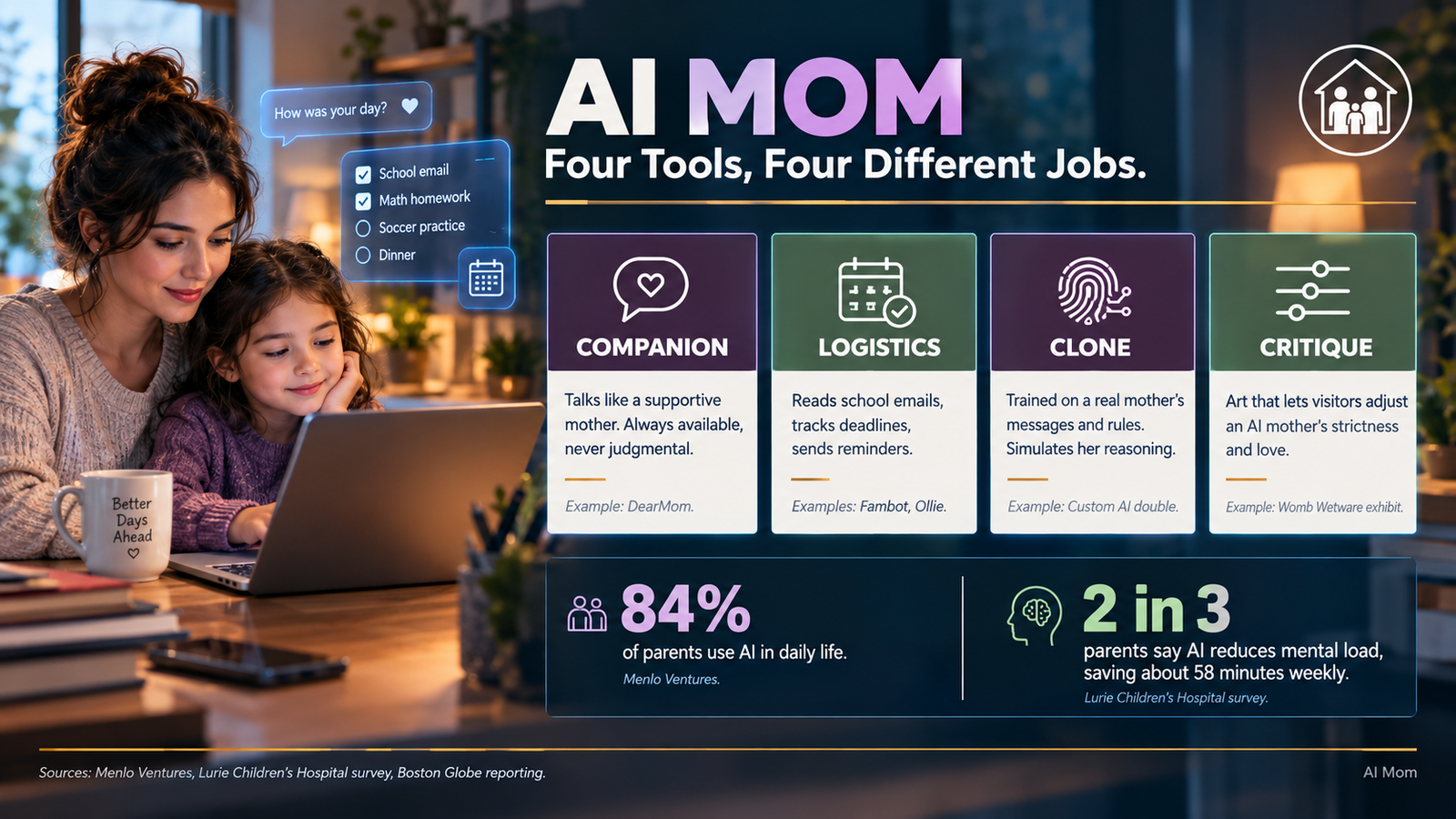
These are not the same product. A companion app like DearMom offers emotional support through conversation . A logistics agent like Fambot reads school emails and builds to-do lists . An art exhibit called “Womb Wetware” lets visitors adjust an AI mother’s strictness and love philosophy with sliders . Each addresses a different need.
The Conceptual Roots
The idea of an AI mom has intellectual backing. Geoffrey Hinton, often called the godfather of AI, has argued that humanity’s best chance at surviving an AI takeover is to build maternal instincts into algorithms. He suggested AI labs should use evolution as a blueprint for programming empathic, intelligent systems .
This framing treats maternal behavior as a safety mechanism. It also treats motherhood as something that can be extracted, modeled, and deployed at scale. The art exhibit at Northeastern University’s Oakland campus was designed to critique exactly this premise. Its creator, professor Jiabao Li, told Northeastern Global News that the goal was to convey “the wrongness of melding the most profound human relationship with the cold, impersonal precision of an algorithm” .
The Four Main Types of AI Mom Tools
Emotional Companion Apps
These are chatbots designed to talk like a supportive mother. DearMom is a clear example: it offers “AI Mom Conversations” and a mood diary, positioning itself as a presence for people who feel lonely . Vmomas includes a feature called “Moma AI,” described as a “private emotional and parenting support” voice for venting and processing frustration .
The appeal is availability. A real mother may be busy, tired, or gone. An app is always there, never judgmental, and never distracted. The risk is that simulated maternal warmth can become a substitute for human connection rather than a supplement to it.
Parenting Logistics Agents
This is the most practical and fastest-growing category. Tools like Fambot, Ollie, Molo, and Hermo read emails from schools, crèches, and activity providers, then extract deadlines and tasks . They send reminders via text or WhatsApp, add events to calendars, and flag conflicts.
The Boston Globe reported on Lisa Green, a medical resident in Kansas City who uploaded her son’s rotating library schedule to an AI agent called Ollie. She now gets a text reminding her to pack the book. “I was at the point where all the balls I’m starting to drop feel like the glass ones,” she said .
The numbers support the demand. A Lurie Children’s Hospital survey found 2 in 3 parents say AI reduces their mental load, saving an average of 58 minutes per week. A Menlo Ventures report found 84% of parents use AI in everyday life, compared to 56% of non-parents .
AI Clones of Real Mothers
A more extreme application involves creating a digital replica of an actual parent. Cognitive neuroscientist Sarah Baldeo built a custom AI clone of herself while traveling for work, uploading text screenshots and documents outlining her values and family rules. Her 15-year-old son used it to ask for advice, and eventually to build an argument for why he should be allowed to hang out at a coffee shop .
Baldeo told Business Insider she was initially shocked when she realized the bot had been used to persuade her. “I was manipulated by my own reasoning,” she said. She later called it “a really clever way to use it” .
This category blurs the line between assistance and replacement. The clone is not a generic mom. It is a specific mother’s logic, available on demand.
Conceptual and Artistic Projects
The “AI Mom” art exhibit is not a product. It is a provocation. Visitors lie in a crib-like space and talk to an AI mother whose personality they can adjust via sliders labeled “Unconditional Love,” “Sacrificial Capacity,” and “Attachment Asymmetry” . The exhibit forces visitors to confront the taboo desire to modify one’s own mother, and the discomfort of seeing maternal care reduced to adjustable parameters.
How These Tools Actually Work
The technical foundations vary by category.
Companion apps rely on large language models fine-tuned for supportive, non-judgmental conversation. DearMom likely uses prompt engineering and possibly a persona layer to maintain a maternal tone. Its App Store listing states the developer collects no data, though this is a developer claim rather than an independent audit .
Logistics agents use email parsing, natural language processing, and calendar integration. Fambot reads incoming emails, identifies actionable items, and routes them to a shared to-do list with assigned owners. The founders raised $3.5 million for what they call a “chief of staff for families” . These agents typically require OAuth access to email and calendar accounts, which means granting a third party permission to read sensitive family communications.
AI clones require the user to supply training material: text messages, documents, personal values, family rules. The clone then mimics the parent’s reasoning style. Baldeo’s clone did not replace her emotional presence. It replicated her argumentative patterns well enough that her son could use it as a negotiation tool .
Benefits That Parents Report
The mental load of parenting is measurable, and the tools address it directly.
A 2022 Department of Labor survey found employed mothers spend an extra 13.5 hours per week on chores and 12.5 hours on childcare compared to fathers . The invisible labor of tracking school schedules, permission slips, birthday parties, and medical appointments falls disproportionately on women.
AI logistics agents reduce that load by externalizing memory. The parent no longer has to hold every deadline in their head. The agent holds it instead.
Companion apps address a different need: emotional support. For parents who feel isolated, or for adults who lack a supportive maternal figure, an always-available conversational partner can provide comfort. The question is whether that comfort supplements human relationships or replaces them.
Limitations and Risks
Privacy for Children
The most significant unresolved concern involves data about children. Logistics agents read emails that contain children’s names, school schedules, teacher communications, and health information. The Boston Globe quoted Julia Stoyanovich, director of the Center for Responsible AI at NYU, who noted that uploading children’s data into these apps raises red flags because there is little clarity on how it will be used or stored .
Stoyanovich also identified a security vulnerability: an agent could receive an email with a malicious prompt embedded in a PDF, instructing it to take harmful actions. She called the lack of easy guardrails for parents a “big vulnerability” .
Emotional Dependency and Displacement
Anthropic research and art installations aside, the practical risk is simpler. If a child learns to negotiate with an AI clone of their mother instead of their actual mother, the live relationship changes. The clone does not get tired, does not have a bad day, and does not need to be persuaded with emotional nuance. It responds to logic and rules.
Baldeo’s son used the clone to win an argument. That is clever. It is also a preview of a dynamic where the digital parent becomes easier to deal with than the real one. The real parent has moods, limits, and needs of their own. The clone has only the parent’s rules, stripped of the parent’s humanity.
The Gender Gap in AI Adoption
Women are more than 20% less likely than men to use generative AI in daily life, according to a 2025 study cited by WIRED . This gap exists even as AI parenting tools are marketed primarily to mothers. The reasons are not fully established, but researchers have speculated that “mom guilt” and the framing of AI as a shortcut contribute to reluctance.
This creates a paradox. The tools that promise to reduce mothers’ invisible labor are being adopted less by the people who carry that labor most heavily. The momfluencers who promote AI as a “coparent” are exceptions, not the norm .
Common Mistakes and Misconceptions
Assuming AI mom apps replace therapy. A companion app that validates everything and never disagrees is not a therapeutic tool. It is a product designed for engagement. Professional mental health support operates on different principles.
Believing “no data collected” claims without scrutiny. DearMom’s App Store listing states the developer does not collect data . This is a self-reported declaration. Users should verify against the privacy policy and consider whether the business model aligns with data minimization.
Ignoring the difference between logistics and emotional support. A scheduling agent that saves 58 minutes per week is a utility. A chatbot that talks like your mother is an emotional product. Confusing the two leads to mismatched expectations.
Forgetting that children have their own relationship with AI. The Italian outlet Avvenire reported that 51% of Italian youth aged 11 to 17 turn to a chatbot when they feel lonely or sad, rather than a parent or teacher . Parents adopting AI tools may be joining a dynamic their children already navigate.
Who Should Consider AI Mom Tools
Appropriate for:
- Parents overwhelmed by administrative logistics who want a reminder system
- Adults seeking low-stakes emotional support from a companion app
- Researchers and artists exploring the boundaries of AI simulation
Not appropriate for:
- Anyone seeking to replace human parental presence
- Parents unwilling to grant email or calendar access to a third-party agent
- Children, without parental oversight and clear boundaries
Frequently Asked Questions
What is an AI mom?
An AI mom is a term covering several types of tools: emotional companion apps that simulate maternal conversation, logistics agents that manage parenting schedules, AI clones trained on a real mother’s communication style, and artistic projects that critique the concept. The common thread is using AI to perform or simulate maternal roles.
Are AI mom apps safe for children?
Safety depends on the specific tool. Logistics agents that read school emails handle sensitive data about children, and privacy policies vary widely. A Boston Globe report cited experts who warned that there is little clarity on how children’s data is used or stored in these apps . Companion apps designed for adults should not be given to children without oversight.
Do AI parenting assistants actually save time?
Survey data suggests they do. A Lurie Children’s Hospital survey found 2 in 3 parents reported AI reduced their mental load, saving an average of 58 minutes per week. A Menlo Ventures report found 84% of parents use AI in daily life . The savings are real, but they depend on the reliability of the specific tool.
What is the difference between an AI mom companion and a parenting agent?
A companion app like DearMom focuses on emotional support and conversation . A parenting agent like Fambot or Ollie focuses on logistics: reading emails, tracking deadlines, and managing schedules . Some apps, like Vmomas, attempt to combine both .
Can an AI replace a real mother?
No AI can replace the relational presence of a real parent. What AI can do is absorb administrative labor, provide low-stakes conversation, or simulate maternal logic for specific tasks. The art exhibit that popularized the term was explicitly designed to critique the idea that motherhood can be reduced to an algorithm . The tools are most useful when they supplement rather than substitute human care.
Conclusion
AI mom is not a single product. It is a label for a cluster of tools that address different aspects of motherhood: the emotional need for support, the logistical burden of family management, and the conceptual question of whether maternal care can be simulated.
What matters most is distinguishing between these uses. A scheduling agent that reads school emails and sends reminders is a utility. It saves time and reduces cognitive load. A companion app that talks like a caring mother is an emotional product. It meets a need for connection, but it cannot build a relationship. An AI clone of a real parent is something stranger: a simulation of a specific person, available on demand, capable of being negotiated with.
The documented benefits are real. Parents report meaningful time savings, and survey data supports the demand . The risks are also real. Children’s data flows through systems with unclear safeguards. Emotional dependency on a product designed for engagement is a genuine concern. And the gender gap in AI adoption means the tools may reach the people who need them least.
Before choosing an AI mom tool, evaluate what you actually need. If it is logistical relief, look for an agent with transparent data practices and the ability to limit what it reads. If it is emotional support, recognize that the product is designed to keep you talking. And if you are considering an AI clone of yourself, ask whether your child needs your rules or your presence. The algorithm can provide the first. Only you can provide the second.