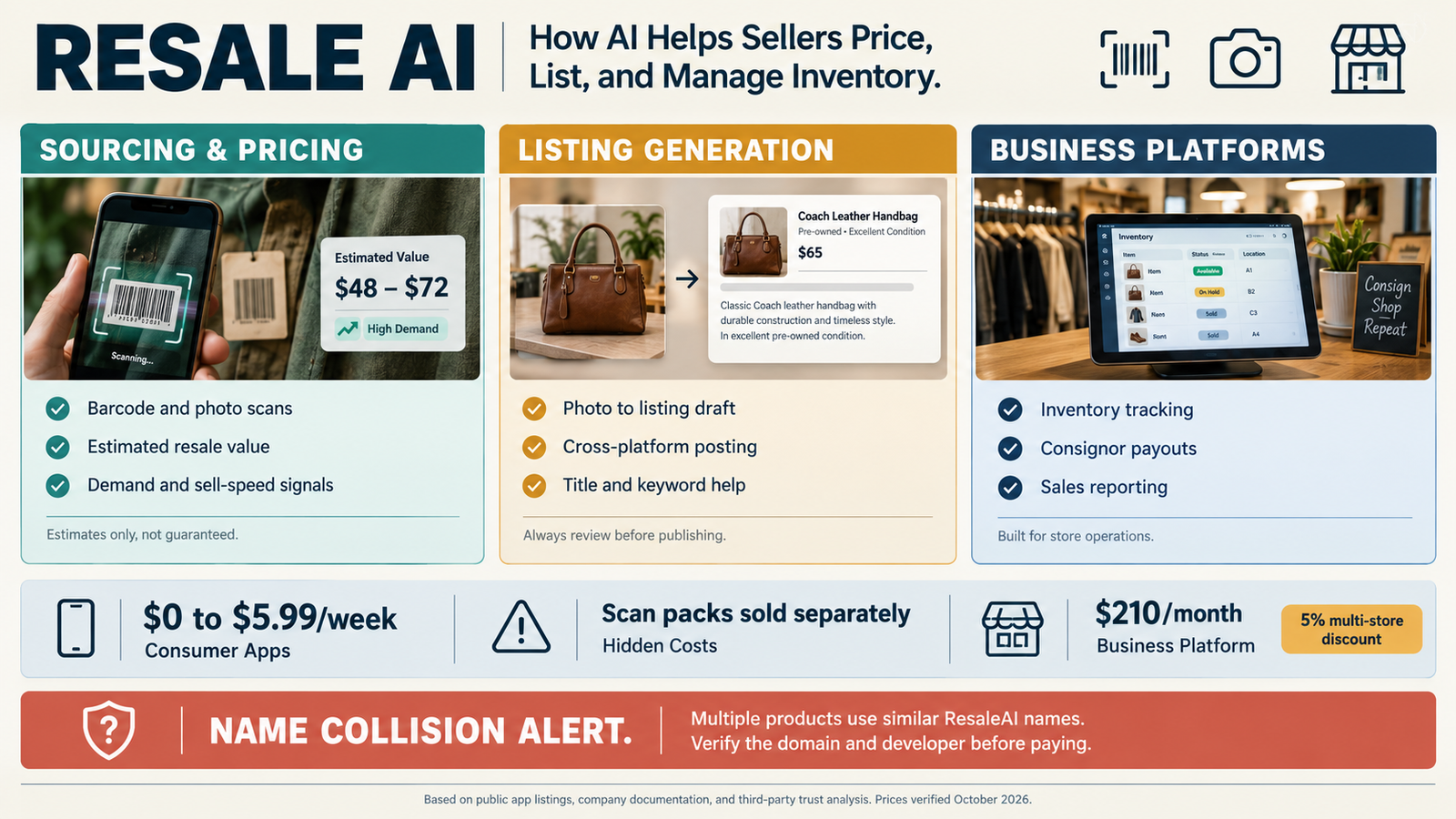
Resale AI is an umbrella term for software that uses artificial intelligence to help resellers price items, create listings, and manage inventory. It spans consumer apps that scan barcodes for resale estimates and business platforms that automate consignment operations. The category is growing quickly, but pricing models, data practices, and product quality vary widely across providers.
At-a-Glance
- What it is: AI tools for resale workflows, not a single product or company
- Main categories: Sourcing and pricing apps, listing generators, business management platforms
- Consumer pricing: Ranges from free tiers to $5.99 weekly subscriptions and $129 yearly in-app purchases
- Business pricing: ResaleAI (the platform) charges $210 per month with a 5% multi-store discount
- Key benefit: Faster pricing decisions and reduced manual listing work
- Key risk: Conflicting data practices and unclear product identities across similarly named services
What Is Resale AI?
Resale AI describes a broad toolkit rather than a specific brand. The term covers apps that scan items to estimate resale value, platforms that generate marketplace listings from photos, and software that runs consignment store operations.
This ambiguity matters for anyone searching the keyword. Multiple products use similar names. ResaleAI (the business platform) operates at resaleai.com and serves consignment shops . ResaleAI (the consumer app) appears on the Apple App Store under a different developer . A third site, resaleai.online, has been flagged by ScamAdviser with a low trust score and a registration date of May 2026 .
Users need to identify which product they are evaluating before trusting any pricing or capability claims.
The Three Main Categories
Sourcing and pricing apps. These help thrift store shoppers and online resellers decide whether an item is worth buying. Users scan a barcode or photograph, and the app returns an estimated resale value .
Listing generation tools. These turn photos into draft marketplace listings with titles and descriptions. Some also handle cross-listing across platforms like eBay and Poshmark .
Business management platforms. These serve consignment stores and larger resale operations. Features include inventory tracking, consignor payouts, and sales analytics .
How Resale AI Pricing Apps Work
The consumer-facing workflow is designed for speed. A shopper standing in a thrift store aisle takes out a phone, scans a barcode or snaps a photo, and receives a resale estimate within seconds .
FlipStart, one app in this category, claims to identify brand, item type, estimated era, materials, resale range, average sold price, demand, sell speed, and estimated profit . It also surfaces comparable sold listings so users can compare the item in hand against real market activity.
The ResaleAI consumer app describes a similar process. It promises instant value lookup, inventory tracking, and category coverage spanning electronics, collectibles, clothing, and home goods .
What These Apps Actually Deliver
The output quality depends on the underlying data and matching algorithms. FlipStart explicitly states that its estimates are “for informational purposes only” and that values, demand, authenticity, and sale outcomes are not guaranteed . This is a necessary disclaimer, not a mark of inferiority. Resale pricing is inherently uncertain.
The practical value is speed. A reseller checking fifty items in a store cannot manually research each one. An app that gets close enough to flag promising items saves time even if individual estimates miss.
Pricing and Subscription Models
Consumer resale AI apps use freemium and subscription models. The ResaleAI consumer app lists a weekly subscription at $5.99, with yearly in-app purchases priced at 129 Danish kroner . FlipStart offers free scans for new accounts, with a Pro tier unlocking more scans, three-photo analysis, Deep Analysis, and listing generation. Additional scan packs are sold separately .
The business platform ResaleAI operates on a different scale. Its help documentation states a standard price of $210 per month, month-to-month with no long-term contract. The price includes all features and integrations, with no setup fees. A 5% multi-store discount applies for operations with more than one location. Stores that are open to buy but not yet launched can use the platform for free until their grand opening .
Hidden Cost Considerations
Subscription prices are visible. What often is not visible is how quickly usage limits are consumed.
FlipStart’s free tier includes some scans, but Deep Analysis, three-photo analysis, and listing generation sit behind the Pro tier. Additional scans require separate purchases . For a regular thrifter scanning dozens of items per trip, the free allowance may not last a single outing.
The business platform’s $210 monthly fee is straightforward, but optional scanners add cost. The pricing page notes that the only additional expense would be if a store chooses to purchase an optional scanner .
Technical and Data Considerations
Resale AI apps rely on computer vision to identify products and natural language processing to generate listing text . The quality of these systems depends on training data, model architecture, and integration with marketplace APIs.
The ResaleAI consumer app’s App Store listing states that the developer does not collect any data from the app . This is a strong privacy claim, though it applies only to that specific app. Other products in the category may handle data differently.
FlipStart’s listing describes AI-generated analysis but does not disclose which models power its system or how user photos are stored and processed . The privacy policy is hosted externally on Notion, which is unusual for a consumer app and warrants scrutiny.
For business users, ResaleAI’s platform handles consignor data, sales records, and inventory. The help documentation does not address data retention, encryption, or access controls. Buyers with sensitive operational data should request this information directly.
The Name Collision Problem
The existence of multiple entities using the ResaleAI name creates genuine confusion. The App Store app, the consignment platform, and the flagged .online domain are not obviously connected .
ScamAdviser’s analysis of resaleai.online noted that the domain was registered in May 2026 and that the registrar facilitates a high number of low-rated websites. The site’s description reads “ResaleAI ? built on Replit. Update this description to reflect the app,” which suggests an unfinished or abandoned project .
Users searching for “Resale AI” should verify which domain they are visiting and which developer publishes the app they intend to download.
Who Should Use Resale AI
Thrift store and garage sale shoppers. A pricing app provides a quick final check check before buying. The value is highest for casual resellers who lack deep category knowledge.
Online resellers managing multiple platforms. Listing generation and cross-listing tools reduce repetitive data entry. The time savings compound for sellers with large inventories.
Consignment store operators. Business platforms like ResaleAI handle inventory tracking, consignor payouts, and reporting. The $210 monthly fee may be justified for stores processing enough volume .
Not a fit for: Sellers who already know their categories intimately. Experienced resellers often develop pricing instincts that outperform generic AI estimates. The subscription cost may not repay itself for low-volume sellers.
Limitations and Common Mistakes
Assuming the app knows more than it does. FlipStart’s disclaimer is explicit: values and outcomes are not guaranteed . An estimate is a starting point, not an appraisal.
Confusing similarly named products. The ResaleAI business platform and the ResaleAI consumer app are different products with different pricing and different developers. The flagged .online domain is a third entity .
Ignoring subscription costs. A $5.99 weekly subscription equals roughly $311 per year if maintained. Occasional sellers may spend more on the app than they earn from flips.
Trusting listing generation without review. AI-generated titles and descriptions can miss flaws, misstate condition, or use keywords that attract the wrong buyers. Every generated listing should be checked before publishing.
Expecting inventory management from consumer apps. The ResaleAI app offers basic inventory tracking . It is not a replacement for a proper consignment platform or marketplace seller dashboard.
Real-World Context: How Resellers Actually Use These Tools
A thrift shopper sees a vintage camera. She opens FlipStart, photographs it, and receives an estimated resale range, demand score, and suggested buy-under price . She compares the estimate against the $15 sticker price and decides to buy.
An online clothing seller photographs a jacket and uses a listing tool to generate a title and description. He reviews the output, adjusts the condition notes, and cross-lists to eBay and Poshmark . The tool automates the repetitive parts while he retains control over accuracy.
A consignment store owner uses ResaleAI to track items from drop-off to payout. The platform calculates splits and generates sales reports, reducing manual bookkeeping .
These are plausible workflows based on published product descriptions. They are not case studies with verified outcomes.
Frequently Asked Questions
Is Resale AI free?
Some consumer apps offer free tiers with limited scans. FlipStart includes free scans for new accounts, with Pro features and additional scan packs sold separately . The ResaleAI consumer app requires a paid subscription for premium features, listed at $5.99 per week . The ResaleAI business platform charges $210 per month, with free access for stores that have not yet opened .
What is the difference between ResaleAI and Resale AI?
ResaleAI is a specific business platform for consignment stores at resaleai.com . “Resale AI” is the general category term for AI tools serving resellers. A consumer app called ResaleAI also exists on the App Store under a different developer . Users should verify which product they are evaluating.
Does Resale AI actually work for pricing items?
It depends on the item and the app. Pricing estimates rely on marketplace data and image recognition. Accuracy varies by category, brand, and condition. FlipStart states that its estimates are informational and outcomes are not guaranteed . Experienced resellers should treat AI estimates as a starting point, not a final answer.
Is resaleai.online legitimate?
ScamAdviser gave resaleai.online a trust score of 39 and flagged several negative indicators, including a recent registration date and a registrar associated with low-rated sites. The site’s description appears unfinished . Users should exercise caution and verify any financial information requested by the site.
Can I use Resale AI to list items automatically?
Some tools generate listing drafts from photos, but automatic publishing without review carries risk. AI-generated descriptions may miss flaws or misstate condition. Most resellers review and edit generated listings before posting. FlipStart offers listing generation as a Pro feature , but the final decision to publish rests with the user.
Conclusion
Resale AI covers a fragmented landscape of tools with different purposes, prices, and reliability. Consumer apps promise faster sourcing decisions through barcode scans and photo analysis. Business platforms automate consignment operations at a meaningful monthly cost. The category is real and growing, but the name overlap between products creates confusion that users must resolve before spending money.
What matters most is matching the tool to the task. A casual thrifter needs a cheap or free scanning app, not a $210 monthly platform. A consignment store needs inventory and payout management, not a weekly consumer subscription. An online seller needs listing generation and cross-listing, which consumer apps may not provide.
Before choosing any Resale AI product, verify the developer identity and domain. Read the privacy policy and confirm how photos and data are handled. Check whether the subscription cost is justified by expected usage. Treat AI estimates as inputs to judgment, not substitutes for it.