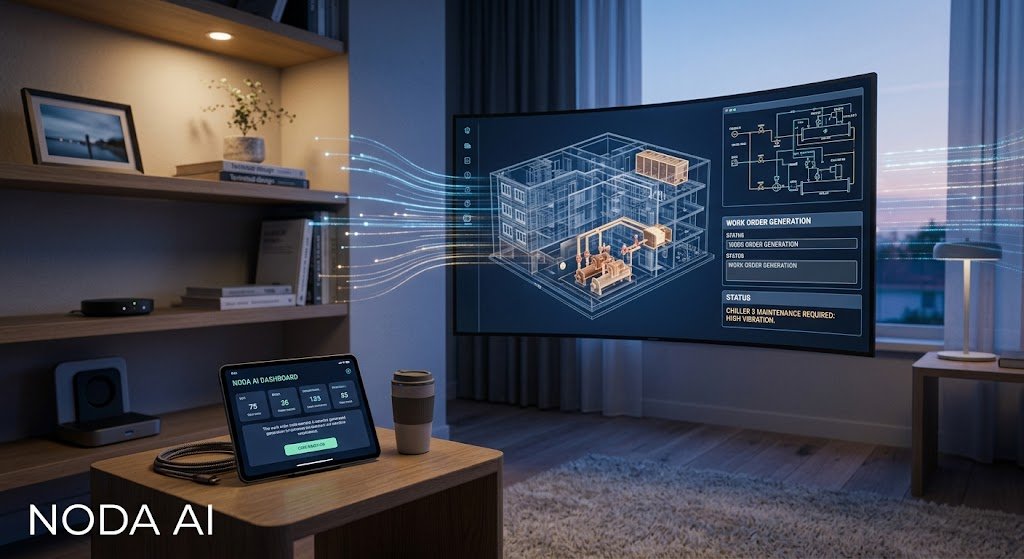
Noda AI is an agentic artificial intelligence platform that autonomously manages commercial building operations, detecting faults, executing corrective actions, and verifying financial impact across real estate portfolios. Unlike analytics dashboards that simply surface alerts, Noda AI functions as a virtual building engineer that carries work from detection through resolution. The platform targets commercial real estate owners and operators facing skilled labor shortages and rising operational costs.
At-a-Glance
- What it is: Agentic AI platform for commercial building operations, not a general chatbot
- Core function: Autonomous fault detection, root cause analysis, and work order execution
- Founded: 2018 as Infogrid, rebranded to Noda in December 2024 after merging with Aquicore and Buildings IOT
- Funding: $120M total across 6 rounds; latest Series B April 2024
- Key claim: 15–25% average annual energy reduction across deployed assets
- Notable limitation: No public developer API; enterprise onboarding is demo-based only
What Is Noda AI?
Noda AI occupies a distinct category within the building technology landscape. It is not a traditional building management system, not an energy analytics dashboard, and not a copilot that answers questions when prompted. Instead, it is an agentic AI platform designed to complete operational work autonomously .
The company traces its origins to Infogrid, founded in 2018 with a focus on IoT sensors for smart buildings . In December 2024, Infogrid unified with Aquicore and Buildings IOT under the Noda brand, consolidating three platforms into a single organization . The name Noda reflects the interconnected nodes of data within every building, according to the company .
Noda AI processes over 100 million data points daily across building management systems, IoT sensors, weather feeds, and utility signals . The platform serves commercial real estate owners and operators managing large portfolios, with customers including Hilton, JLL, CBRE, and Salesforce .
How Noda AI Differs from Traditional Building Software
| Dimension | Traditional Analytics | Noda AI |
|---|---|---|
| Primary output | Dashboards and alerts | Completed work with verified outcomes |
| Human role | Investigate and act | Review and approve |
| Fault handling | Queue for triage | Automated root cause analysis |
| Impact measurement | Estimated | Measured against baseline |
| Operating cadence | On demand | Continuous, 24/7 |
How Noda AI Works
Noda operates on a continuous loop: detect, decide, act, and verify . This cycle runs autonomously across every asset in a portfolio, without requiring users to trigger individual analyses.
Detection. The platform monitors building systems in real time, identifying operational waste, equipment faults, and performance degradation. It connects to building management systems, IoT devices, and utility data feeds .
Decision. Noda traces each issue to its root cause and groups related faults together. Rather than presenting a scattered stream of alerts, it organizes findings into economically validated projects, each sized and prioritized by financial impact .
Action. Where a fix can be executed autonomously, the system does so and follows up. Where human intervention is required, Noda assigns, sequences, and equips the engineer to act, running alongside existing teams rather than adding to their workload .
Verification. Every gain is measured against a baseline and tied to the specific asset that produced it. Financial impact is confirmed rather than estimated .
The Multi-Agent Architecture
Noda’s project generation capabilities rely on four specialized agents that hand work to each other in sequence, mirroring how a building engineer would approach a problem .
- Grouping agent: Reads fault and insight outputs and clusters everything one fix would resolve
- Refining agent: Gathers additional information, ranks projects by priority, and discards duplicates of existing work
- Root cause agent: Pulls data from suspect equipment and connected upstream and downstream systems, then commits to a cause
- Impact estimation agent: Produces annualized savings figures by writing and executing analytical code in a controlled sandbox
This progressive disclosure approach means each agent collects only the context it needs at the moment it needs it. Handing a single agent every data point in a portfolio would produce unreliable results, according to Noda’s Director of AI and Product Innovation .
Key Features and Capabilities
Energy Optimization
Noda continuously tunes HVAC and energy systems to reduce waste. The company reports energy savings of 15–25% annually across deployed assets, with maintenance savings of 5–15% and portfolio-level NOI increases of 1–2% . These figures are company claims, not independently audited results.
Autonomous Work Execution
The platform drives work to resolution. For issues that can be fixed through setpoint adjustments or load rerouting, Noda acts autonomously. For faults requiring physical intervention, it creates and assigns work orders, integrating with CMMS systems where available .
Financial Impact Verification
Every action is tied to measured savings. Noda calculates energy cost avoidance, maintenance cost reduction, and labor hours saved. The system writes and executes analytical code to project annualized savings from measured periods .
Cross-Platform Integration
Noda integrates with existing building management systems, IoT platforms, and utility data sources. The company describes its approach as an integrated data capture layer that normalizes disparate datasets .
Main Use Cases
Commercial Office Buildings
Class A office towers represent a primary use case. Noda’s published case study describes a DC office tower that achieved $166,000 in annual savings by rerouting tenant loads off a 24/7 chiller plant .
Portfolio-Wide Operations
The platform scales across portfolios, enabling a single engineer to oversee millions of square feet. This coverage ratio addresses the structural labor crisis in commercial real estate, where skilled building engineers are retiring faster than replacements enter the field .
Energy and Sustainability Programs
Noda supports net-zero and decarbonization goals by identifying and eliminating operational waste. The platform tracks performance against sustainability targets and provides audit-ready documentation of savings .
Benefits and Limitations
Documented Benefits
Labor capacity expansion. Building engineers spend roughly 70% of their time on non-wrench tasks like administration, coordination, and triage . Noda automates the diagnostic step that typically consumes engineering time, allowing existing staff to focus on physical work.
Financial visibility. The platform ties every operational change to a measured financial outcome. Property managers and asset managers can see exactly which interventions produce returns .
Continuous operation. Unlike periodic energy audits or retro-commissioning studies, Noda runs continuously. It identifies issues as they emerge rather than at scheduled assessment intervals .
Important Limitations
Enterprise-only access. Noda does not offer self-service signup, a free tier, or public API access. Onboarding requires a demo and enterprise sales engagement . This makes the platform inaccessible to small operators or individual users.
No published pricing. Noda does not disclose pricing publicly. Prospective customers must engage with sales to obtain quotes, making cost comparison difficult before commitment.
Company-reported metrics. The 15–25% energy savings and related figures come from Noda’s own reporting and case studies. Independent third-party verification is not publicly available.
Implementation dependency. Like all building technology platforms, Noda’s effectiveness depends on data quality from existing BMS and IoT systems. Buildings with poor instrumentation or legacy systems may see reduced performance.
Technical and Privacy Considerations
Noda AI is ISO 27001 certified and hosted on AWS in the United States . ISO 27001 certification confirms that the company has established an information security management system, but it does not guarantee specific data retention practices. Organizations with strict data governance requirements should verify retention and isolation terms directly with Noda.
The platform has no public developer API. All integrations are handled through enterprise onboarding . This limits customization options for technical teams that prefer to build their own workflows.
Noda AI vs. Alternatives
Noda consolidated several competitors through acquisition. Aquicore and Buildings IOT, once independent platforms, now operate under the Noda brand . This consolidation reduces direct competition but also concentrates implementation risk.
Who Should Use Noda AI
Best fit:
- Commercial real estate owners with portfolios exceeding 1 million square feet
- Asset managers responsible for NOI performance across multiple properties
- Engineering teams stretched thin by labor shortages and expanding square footage
- Sustainability officers needing audit-ready documentation of energy reductions
Poor fit:
- Small property owners or single-building operators
- Users seeking a free or self-service AI tool
- Organizations without existing BMS or IoT infrastructure
- Teams that need public API access for custom integrations
Latest Developments
Noda completed its rebrand from Infogrid in December 2024, unifying three platforms under a single brand . The company reported $120 million in total funding across six rounds, with the most recent Series B in April 2024 . Employee count stands at approximately 80 as of mid-2026 .
The company has published case studies demonstrating $166,000 annual savings from chiller optimization and $847,000 in cumulative savings across 18 properties . These are self-reported results from deployed installations.
Frequently Asked Questions
What does Noda AI do?
Noda AI autonomously manages commercial building operations. It detects equipment faults and energy waste, analyzes root causes, executes corrective actions where possible, and verifies the financial impact of each intervention. The platform functions as a virtual building engineer operating continuously across a real estate portfolio.
Is Noda AI free to use?
Noda AI does not offer a free tier, self-service signup, or public trial. Access requires enterprise onboarding through a sales process. Pricing is not published publicly and is negotiated based on portfolio size and scope.
What is the difference between Noda AI and traditional building analytics?
Traditional analytics tools surface alerts and dashboards that require human investigation and action. Noda AI carries work through to completion, executing fixes autonomously and creating work orders where human intervention is needed. The distinction is between surfacing problems and solving them .
Does Noda AI have an API?
Noda AI does not expose a public developer API. The company describes onboarding as enterprise and demo-based only . Technical teams cannot build custom integrations independently.
What results has Noda AI delivered?
Noda reports 15–25% annual energy reduction, 5–15% maintenance savings, and 1–2% NOI increases across deployed assets . A published case study describes $166,000 in annual savings from chiller plant optimization at a DC office tower . These are company-reported figures without independent third-party verification.
Conclusion
Noda AI represents a meaningful evolution in building technology. It moves beyond analytics and copilots into autonomous execution, addressing the core bottleneck in commercial building operations: the shortage of skilled engineers available to diagnose and fix problems at scale.
What matters most is understanding what Noda is and is not. It is an enterprise platform for large portfolios. It is not accessible to individual users or small operators. Its results are promising but self-reported. Its value depends on the quality of existing building data and systems.
Noda suits commercial real estate owners and operators with substantial portfolios, existing BMS infrastructure, and the resources to commit to enterprise onboarding. It does not suit small property owners, individual users, or organizations seeking a quick, low-cost AI solution. Before choosing Noda, evaluate your portfolio size, data quality, integration requirements, and whether the company’s reported results align with your operational reality.