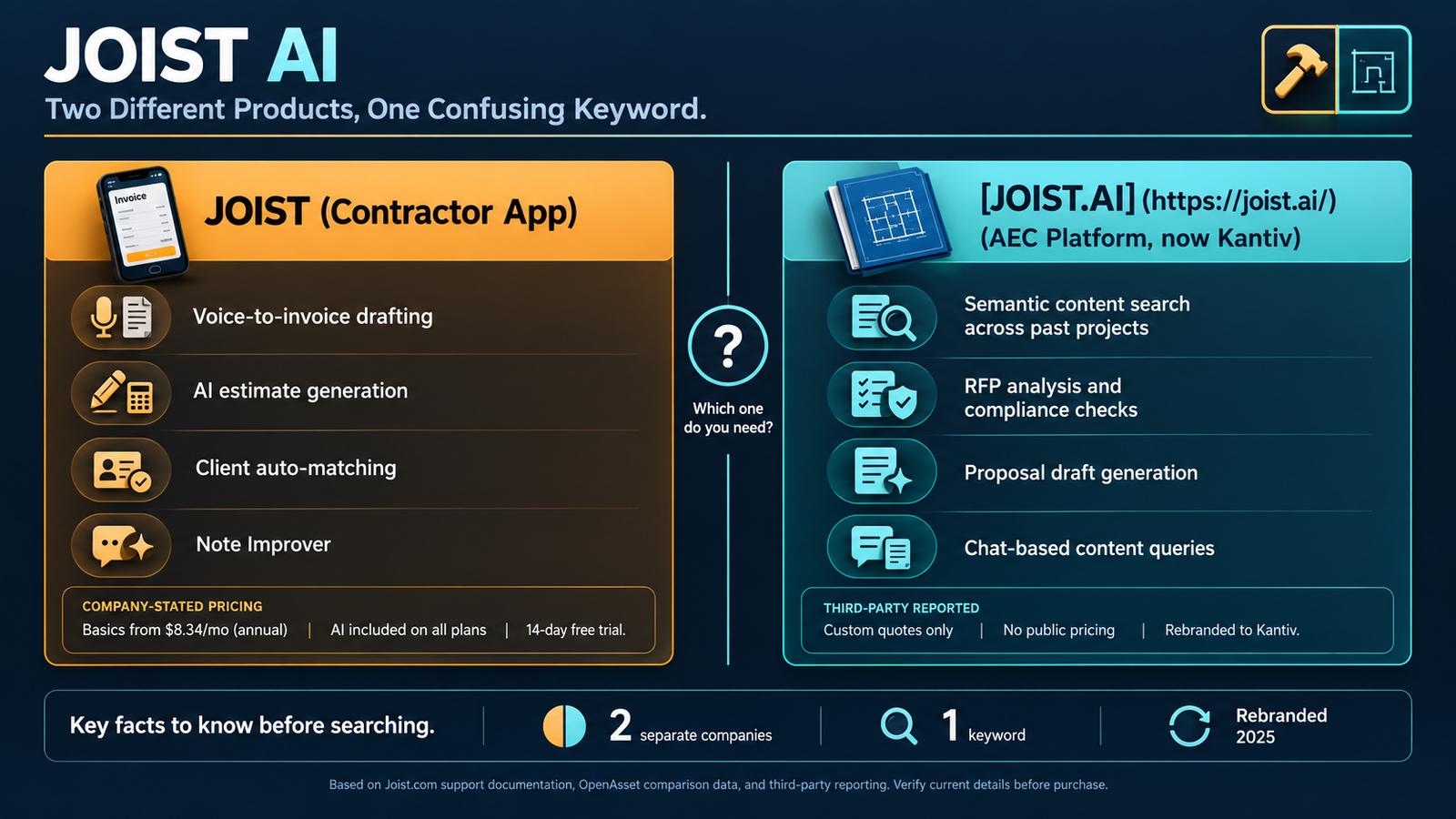
Joist AI refers to two distinct products that share a confusingly similar name. The first is the AI feature set inside Joist, a contractor estimating and invoicing app owned by EverPro, which lets tradespeople draft invoices and estimates from a short voice or text description. The second is Joist.AI, an AEC proposal automation platform founded in 2021 that has since rebranded to Kantiv. Understanding which tool you actually need is the first step before evaluating either one.
At-a-Glance
- Two products, one keyword: Joist (contractor app) and Joist.AI (AEC proposal platform, now Kantiv)
- Contractor app pricing: Starts around $8.34 to $10 per month; AI features included on all plans
- AEC platform pricing: Custom quotes only; no public pricing available
- Contractor AI strength: Voice-to-invoice drafting, client auto-matching, note polishing
- AEC platform strength: Content search across past proposals, RFP analysis, compliance checking
- Key limitation: The AEC product rebranded to Kantiv, so “Joist AI” searches increasingly point to outdated information
The Naming Problem: Why “Joist AI” Is Ambiguous
Search for “Joist AI” and you will encounter two unrelated companies. This is not a case of one brand expanding into new territory. These are separate businesses that happened to choose similar names.
Joist (joist.com) is a contractor-focused estimating and invoicing app. It is part of EverPro, a family of tools for service professionals . Its AI features are embedded directly into the invoicing and estimating workflow.
Joist.AI (joist.ai) was an AEC proposal automation platform founded in 2021 and headquartered in San Diego . It served architecture, engineering, and construction firms with content management and proposal generation tools. According to a competitor comparison published by OpenAsset, Joist.AI has rebranded to Kantiv .
This distinction matters for search intent. If you are a contractor looking to speed up invoicing, you want Joist. If you are an AEC marketing manager researching proposal software, you want Kantiv, formerly Joist.AI. Confusing the two leads to wasted time.
Joist AI for Contractors: What It Actually Does
Joist’s AI features target a specific pain point: paperwork after a long day on the job. The company’s own framing is blunt. Typing up line items and remembering costs adds up, and when invoicing gets pushed to “later,” getting paid gets pushed to later too .
AI Invoice and AI Estimate
The core feature is simple to describe. Open the app, tap “Invoice with AI” or “Estimate with AI,” then type or speak a description of the work. The system generates a draft with line items, quantities, and rates .
You review the draft before anything sends. Nothing goes out without your approval, which is a sensible guardrail for a tool handling customer-facing financial documents .
Client Auto-Matching
When you mention a client name in your prompt, the AI attempts to match it to your existing contact list. Exact matches attach the client’s address, email, and phone automatically. Ambiguous matches prompt you to select the correct client. New clients can be added after the draft is generated .
This is a small feature that saves real time. Retyping client details for every invoice is exactly the kind of friction that delays billing.
AI Note Improver
Separate from invoice and estimate generation, Note Improver polishes rough notes into professional language. The company positions it as useful for cleaning up details on any estimate or invoice . This is a lighter lift than full document generation, but it addresses the common problem of shorthand notes that look unprofessional on customer-facing paperwork.
What the AI Does Not Handle
The support documentation is refreshingly specific about limitations. When generating an invoice or estimate from a prompt, the following items are not automatically included: line item groups, markups, payment settings, deposit requests, payment schedules, and estimate expiry dates . You must add these manually after the draft is created.
This transparency is useful. It sets expectations and prevents the frustration of discovering missing features after committing to a workflow.
Joist Pricing and Availability
Joist does not offer a free plan anymore. Every plan includes a 14-day free trial .
The AI invoice and estimate features are available on all active plans, including Basics . This is a meaningful point. Many software companies gate AI features behind premium tiers. Joist includes them at the entry level.
Payment processing fees apply to online payments. The AI Receptionist, which answers missed calls and summarizes them for follow-up, is a separate add-on with its own subscription .
The Other Joist AI: AEC Proposal Automation
The AEC-focused Joist.AI served a completely different audience. Its platform helped proposal teams at architecture, engineering, and construction firms find and reuse content from past projects, analyze RFPs, and generate proposal drafts .
Core Capabilities
Content extraction and search. The platform built a centralized library by extracting content from existing documents. Users could search semantically to locate relevant project descriptions, resumes, and boilerplate .
RFP analysis. Uploading an RFQ or RFP produced an initial draft aligned with client requirements. The system identified compliance points and suggested relevant past content .
Document review. Analytics tools flagged language issues, duplications, and inconsistencies before submission .
Chat interface. A conversational interface allowed users to query the content library, generate new text, and refine outputs with filters and attached files .
The Rebrand to Kantiv
Third-party sources indicate Joist.AI now operates as Kantiv. OpenAsset’s comparison page refers to “Kantiv (formerly Joist.ai)” throughout, treating the rebrand as established fact . SoftwareFinder still lists Joist AI as an active AEC product, but its information may be outdated relative to the rebrand .
The rebrand means that searching for “Joist AI” in an AEC context may surface stale information. Buyers researching proposal software should search for Kantiv directly.
Pricing and Transparency
Neither Joist.AI nor Kantiv publishes pricing. OpenAsset’s comparison notes that Kantiv seems to price based on users, modules, and optional integrations, with each implementation configured per firm. Buyers who evaluated both Kantiv and Shred reported Kantiv coming in slightly lower .
This opacity is common in enterprise AEC software. It also makes direct comparison difficult without a sales conversation.
Which Joist AI Do You Need?
The answer depends entirely on your role.
Choose Joist (the contractor app) if:
- You are a tradesperson, remodeler, or general contractor
- You need faster invoicing and estimating
- You want AI features without an enterprise sales process
- You bill clients directly and want to get paid faster
Investigate Kantiv (formerly Joist.AI) if:
- You work in business development or marketing at an AEC firm
- Your proposal team struggles to find past content
- You respond to RFPs and need compliance checking
- You need a centralized knowledge repository for project data
Avoid confusing the two if:
- You are a contractor searching for “Joist AI” and landing on AEC proposal software pages
- You are an AEC marketer downloading the contractor invoicing app
- You are evaluating either tool based on search results that blend the two products
Common Mistakes and Misconceptions
Assuming Joist AI is one company. Two separate businesses used similar names. The contractor app and the AEC platform have no relationship beyond the naming coincidence .
Expecting Joist’s AI to handle complex billing. The AI generates drafts from descriptions, but markups, deposits, payment schedules, and expiry dates require manual entry . It accelerates simple invoices, not complex billing structures.
Believing Joist.AI is still the active brand. The AEC platform rebranded to Kantiv. Searching for “Joist AI” in that context may return outdated listings and comparisons .
Assuming the free tier exists. Joist discontinued its free plan. New users get a 14-day trial, then must choose a paid tier .
Frequently Asked Questions
What is Joist AI used for?
Joist AI refers to the invoice and estimate generation features inside the Joist contractor app. Users describe a job by voice or text, and the system produces a draft invoice or estimate with line items and client details. It is designed for tradespeople and contractors, not for AEC proposal teams .
Is Joist AI the same as Joist.AI?
No. Joist is a contractor app owned by EverPro. Joist.AI was a separate AEC proposal platform that has since rebranded to Kantiv. The similar names create search confusion, but the products serve different industries .
How much does Joist AI cost?
Joist’s AI invoice and estimate features are included on all plans. Basics starts at $8.34 per month with annual billing or $10 monthly. Pro is $14.17 annually or $17 monthly. Elite and Run tiers add more features at higher prices. A 14-day free trial is available .
Does Joist AI work on mobile?
Yes. The AI invoice and estimate features are available on web, iOS, and Android. Voice input works through the device microphone . The AEC-focused Joist.AI did not offer a mobile app according to SoftwareFinder, though that listing may predate the Kantiv rebrand .
What happened to Joist.AI?
According to a competitor comparison published by OpenAsset, Joist.AI rebranded to Kantiv. The platform continues to serve AEC firms with proposal automation, content search, and RFP analysis tools. Pricing remains custom and quote-based .
Conclusion
“Joist AI” is a keyword split between two products. The contractor app embeds AI into invoicing and estimating, making it useful for tradespeople who want to reduce paperwork without a steep learning curve. The AEC platform, now Kantiv, served a completely different market and has moved on from the Joist.AI name.
What matters most is identifying which tool matches your workflow. Contractors should evaluate Joist on its invoice drafting speed, client matching accuracy, and plan pricing. AEC proposal teams should research Kantiv directly rather than relying on outdated Joist.AI listings.
The contractor app suits small teams and solo operators who bill clients regularly. It does not suit complex billing scenarios requiring markups and payment schedules without manual work. The AEC platform suited firms with proposal-heavy workflows, but its rebrand means buyers should verify current capabilities and pricing directly with the vendor. Before choosing either, confirm that you are evaluating the right product for your industry.