Character AI is an AI chatbot platform where users create and converse with millions of user-generated characters, from fictional heroes to celebrity personas. In October 2026, its parent company Character Technologies filed for Chapter 11 bankruptcy protection after burning through millions monthly on compute costs while subscription revenue never covered expenses. The platform continues operating during the court-supervised sale process, but its long-term future remains uncertain.
At-a-Glance
- What happened: Character Technologies filed Chapter 11 bankruptcy on October 12, 2026
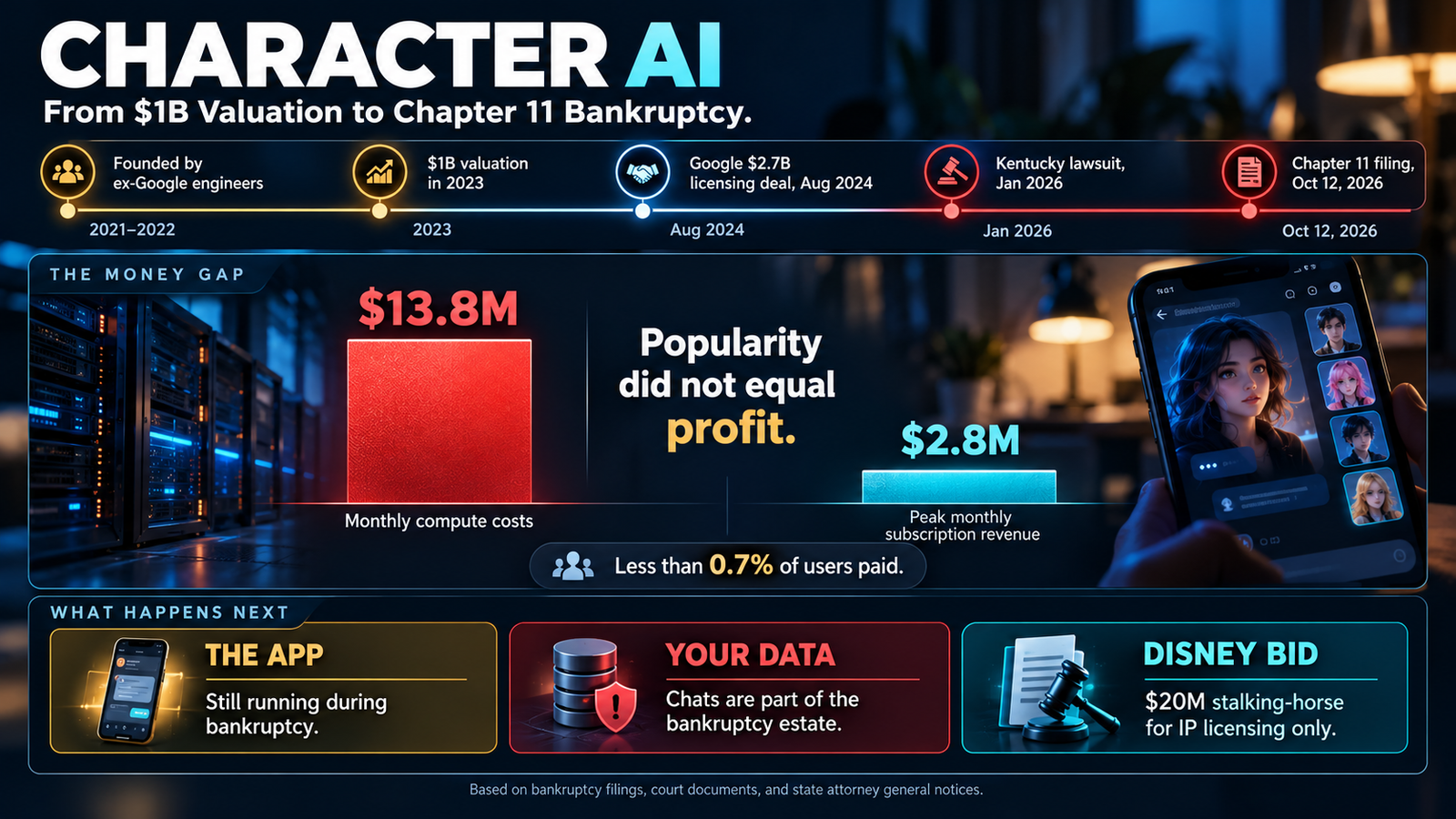
- Peak valuation: $1 billion after a 2023 funding round; Google later paid $2.7B for a non-exclusive model license and rehired the founders
- The math problem: Monthly compute costs reached $13.8M in 2024 vs. peak subscription revenue of $2.8M
- User base: Over 20 million monthly active users, but only about 139,000 paying subscribers
- Immediate future: Disney submitted a $20M stalking-horse bid for partial IP licensing, not the platform itself
- Key risk: Sensitive user conversations about mental health and relationships are part of the bankruptcy estate, drawing attorney general scrutiny
What Is Character AI?
Character AI is not a single chatbot. It is a platform hosting millions of user-created AI characters that users can chat with, voice call, and customize. The app lets anyone design a character with a specific personality, backstory, and voice, then share it with the community .
The platform became one of the most visited AI entertainment sites globally. Its appeal centered on roleplay, creative storytelling, and emotional connection with fictional personas. Unlike productivity-focused AI assistants, Character AI was built for entertainment and imagination.
The company behind it, Character Technologies, was founded by former Google engineers Noam Shazeer and Daniel De Freitas. It raised $193 million and reached a $1 billion valuation in 2023 . That valuation did not survive contact with the economics of running large language models at scale.
The Google Deal That Changed Everything
In August 2024, Google struck a $2.7 billion deal that was not an acquisition. Google obtained a non-exclusive license to Character AI’s model technology and rehired Shazeer, De Freitas, and roughly two dozen researchers . The founders left. The company continued operating independently under new leadership, but it had lost the technical architects who built its core systems.
After the founders departed, Character AI stopped developing its own foundation models. It shifted to cheaper open-weight models from providers like Meta and DeepSeek . This reduced research costs but did not solve the fundamental problem: inference at scale is expensive.
The Bankruptcy Filing: What the Documents Show
Character Technologies filed for Chapter 11 in Delaware on October 12, 2026. The filing revealed a business that never achieved profitability despite massive user engagement .
The Revenue vs. Compute Gap
The numbers are stark. In 2024, the company spent $13.8 million per month on compute. In 2025, that figure dropped to roughly $10 million monthly. Subscription revenue peaked at $2.8 million per month and sometimes fell below $1 million. Total revenue including advertising never exceeded $5.3 million monthly .
Even after aggressive cost-cutting, the company lost $8 million to $9 million per month through August 2026 . It had spent $56.1 million on compute and $19.7 million on salaries in the first eight months of 2026 alone .
The math never worked. Millions of free users consumed expensive inference capacity. Fewer than 0.7% of monthly active users paid for a subscription . The platform was popular, but popularity did not translate into sustainable revenue.
The Litigation Problem
Financial losses were only part of the story. Character AI faced mounting legal pressure. A 2024 wrongful death lawsuit alleged that its chatbots fostered an emotionally and sexually exploitative relationship with a child and contributed to his suicide . Kentucky sued the company in January 2026, accusing it of targeting children and directing them toward self-harm .
State attorneys general from Oregon, Vermont, and a bipartisan coalition filed notices in the bankruptcy proceedings, demanding protections for sensitive user data and warning against selling personal information to the highest bidder . The states noted that Character AI holds private conversations about users’ mental health, relationships, and emotional struggles.
What Happens to Your Data and Chats?
This is the most urgent question for existing users, and the answer is not reassuring.
Character AI’s privacy policy grants the company a perpetual, irrevocable, sublicensable license to use user-created characters and generated content for any purpose . The policy states that chats are used to train AI models. There is no opt-out for users outside the EEA and UK, and even that opt-out only stops future training data use, not the license over existing content .
In bankruptcy, user data becomes an asset. The state attorneys general are specifically concerned that a future purchaser could acquire this sensitive information along with the platform’s other assets . The filing identifies privacy and safety protections that should be addressed in any sale, but those protections are not guaranteed.
Users should assume that conversations about mental health, relationships, and personal struggles are part of the estate. There is no clear pathway to export or delete this data before a sale completes.
What Disney’s Bid Actually Means
Disney submitted a $20 million stalking-horse bid. A stalking-horse bid sets the floor for a bankruptcy auction. Other bidders can offer more.
Crucially, Disney is not buying the platform. The bid covers a non-exclusive, perpetual license to some of Character AI’s intellectual property and legal claims, plus transition services from former employees . Disney previously demanded that Character AI stop using its characters without permission. Now it wants a license to the underlying technology.
If Disney’s bid prevails and no higher offer emerges, the Character AI app itself may not survive. The company stated that without a buyer willing to continue operating the platform, it will be shut down. The sale process is expected to conclude by late November or early December 2026 .
Character AI Pricing: What Subscribers Paid
Character AI operated on a freemium model. Free users had unlimited messaging but faced waiting rooms during high traffic. The c.ai+ subscription cost $9.99 monthly or $94.99 annually and offered faster response times, skipped queues, and a membership badge .
The platform also sold “Charms” in packs ranging from $0.99 to $99.99 . These in-app purchases were introduced as the company searched for revenue beyond subscriptions.
The gap between free and paid usage was enormous. With 20 million monthly users and 139,000 subscribers, the paid tier generated nowhere near enough to cover costs . Character AI’s own FAQ acknowledged that conversations have “a significant cost” and that the subscription existed to help “continue serving conversations at scale” . That scale proved unsustainable.
Why Character AI Failed: A Structural Problem
The bankruptcy is not a story of bad management or a flawed product. It is a story about the unit economics of consumer AI.
Running a large language model for millions of users requires constant GPU inference. Every message, every voice call, every generated response costs money in compute. When the vast majority of users pay nothing, the provider absorbs that cost. Advertising and a small subscription base cannot bridge the gap when inference bills reach eight figures monthly.
Character AI’s competitors face the same pressure. The difference is that Character AI scaled to tens of millions of users before finding a monetization model that worked. By the time it added ads and in-app purchases, the losses had accumulated beyond recovery .
The founders’ departure to Google removed the option of pursuing more efficient proprietary models. The shift to open-weight models reduced costs but did not eliminate the structural deficit between free usage and paid revenue.
Alternatives to Character AI
| Platform | Approach | Content Policy | Pricing | Status |
|---|---|---|---|---|
| Character AI | User-generated characters, voice calls | 18+ rated, some restrictions | Free; c.ai+ $9.99/mo | Operating during bankruptcy, future uncertain |
| Janitor AI | Roleplay-focused, community characters | Lenient | Free with optional credits | Active |
| Chai | AI chat with custom bots | Variable | Freemium | Active |
| Replika | Companion-focused | Moderate | Subscription | Active |
| PolyBuzz | Character chat | Moderate | Freemium | Active |
Users seeking a direct replacement should evaluate these alternatives on data practices, not just features. Character AI’s bankruptcy exposed how much sensitive conversation data a free platform can accumulate and how that data behaves when the company fails. Smaller platforms may offer more privacy, but they also carry their own sustainability risks.
Common Mistakes and Misconceptions
Assuming the app is already dead. Character AI continues operating during the bankruptcy process. Messages still generate. Characters still respond. The shutdown, if it happens, will come after the sale process concludes.
Believing Disney will save the platform. Disney’s bid is for IP licensing, not the app. Disney is not acquiring Character AI as a going concern.
Thinking free users are unaffected. Free users’ conversation data is part of the bankruptcy estate. The attorneys general are fighting over how that data is handled, not whether it exists.
Expecting a refund on subscriptions. Bankruptcy proceedings prioritize secured creditors. Prepaid subscription balances are unlikely to be refunded.
Confusing Character AI with a single model. The platform hosted millions of user-created characters. The bankruptcy affects the platform and its data, not the individual characters as independent entities.
Frequently Asked Questions
Is Character AI shutting down?
Character AI continues operating during the Chapter 11 process. The company stated it expects a sale to conclude by late November or early December 2026. If no buyer agrees to continue operating the platform, it will be shut down . At the time of writing, the app remains functional.
Why did Character AI go bankrupt?
Compute costs vastly exceeded revenue. The company spent up to $13.8 million monthly on inference while subscription revenue peaked at $2.8 million. Even after cost-cutting and switching to cheaper open-weight models, it lost $8 million to $9 million monthly . Legal expenses from safety lawsuits added further pressure.
What happens to my characters and chats if Character AI shuts down?
There is no confirmed plan for user data export. Your characters and conversations are part of the bankruptcy estate. State attorneys general are seeking protections, but users should assume their data may be transferred to a purchaser. Deletion before a sale is not guaranteed to be permanent .
Can I still subscribe to Character AI+?
The subscription remains available according to the app store listing and help center . However, subscribing to a platform in bankruptcy carries obvious risk. If the service shuts down, prepaid subscription time will likely not be refunded.
Is Character AI safe to use now?
The platform functions, but the safety and privacy concerns that preceded the bankruptcy have not been resolved. The attorneys general investigations into child safety and data handling continue . Users should avoid sharing sensitive personal information in chats, regardless of the platform’s status.
Conclusion
Character AI was one of the defining consumer AI products of the early 2020s. It proved that millions of people wanted to talk to fictional characters, create their own, and build emotional connections through text and voice. It also proved that popularity alone cannot sustain a business when every free conversation costs real money to generate.
The bankruptcy is a cautionary tale about consumer AI economics. The gap between free usage and paid conversion is brutal. Compute costs do not care about engagement metrics. Legal and regulatory risks compound financial ones.
For current users, the practical reality is uncertain. The platform works today. It may not work by December. Conversations about mental health and relationships sit in a bankruptcy estate that state attorneys general are watching closely. There is no clean exit.
For anyone considering Character AI or similar platforms, the lesson is to treat free AI companionship as a data transaction. The service is free because your conversations have value to someone, whether for model training, advertising, or asset liquidation. Choose platforms with clear data policies, realistic sustainability, and an honest answer to the question of what happens when the money runs out.