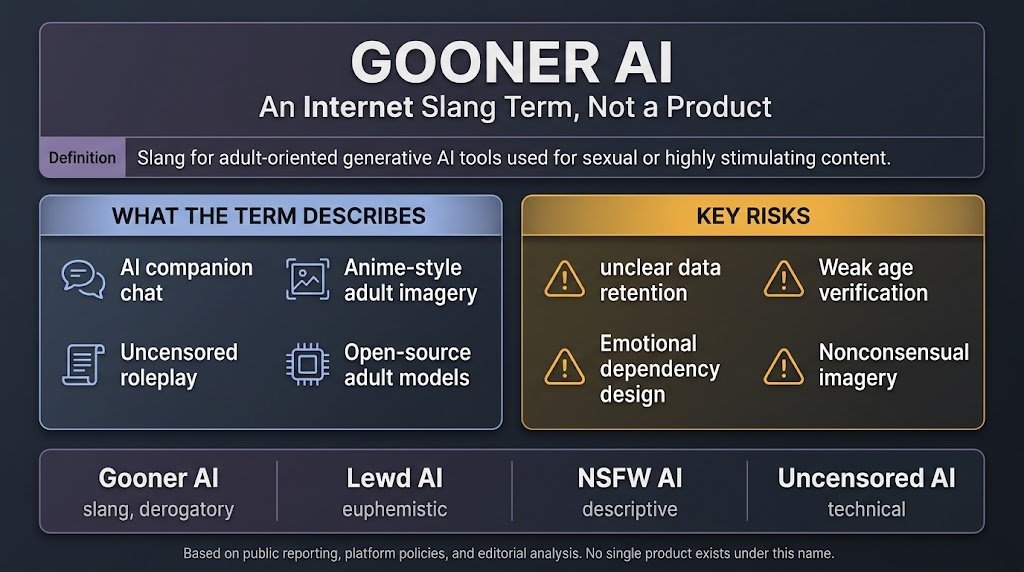
Gooner AI is an informal internet term for generative AI tools used to produce or simulate sexually explicit, highly stimulating content, particularly anime-style imagery and companion chat. It is not a specific product, company, or model. The label describes a use case and an audience, and it has appeared in mainstream coverage of platforms like Grok, alongside a cluster of dedicated adult AI services. Understanding what the term actually refers to matters more than chasing a definition, because the search intent behind it ranges from curiosity to platform discovery.
At-a-Glance
- What it is: Slang for adult-oriented AI content and companion tools, not a brand
- Origin: The term emerged from online communities discussing excessive adult content consumption
- Mainstream visibility: Rolling Stone used the phrase in coverage of Elon Musk and Grok in 2025
- Common platforms labeled: Grok companions, Candy AI, Girlfriend GPT, Joi AI, and similar services
- Core technology: Fine-tuned or uncensored LLMs and diffusion models, often hosted on third-party infrastructure
- Key concern: Weak age verification, data retention, and emotional dependency design
What Does Gooner AI Actually Mean?
The phrase combines “gooner,” internet slang for someone who engages in prolonged, excessive self-pleasure sessions, with “AI.” Put together, it describes artificial intelligence tools used for that purpose. The term is derogatory in some contexts and self-referential in others. Rolling Stone used it critically in a 2025 article about Elon Musk’s promotion of Grok’s anime companions .
This matters for anyone searching the phrase. There is no “Gooner AI” company to evaluate, no pricing page to compare, and no official feature list. The search results for this term are a mix of forum discussions, adult platform reviews, and cultural commentary. The intent behind the query is usually one of three things: understanding the slang, finding platforms, or assessing whether the trend is harmful.
Gooner AI vs. Lewd AI vs. NSFW AI
| Term | Connotation | Typical Use |
|---|---|---|
| Gooner AI | Derogatory or self-deprecating slang | Cultural commentary, forum discussions |
| Lewd AI | Broader, mildly euphemistic | Platform discovery, general adult AI discussion |
| NSFW AI | Neutral, descriptive | Product reviews, technical comparisons |
| Uncensored AI | Technical or marketing term | Model specifications, API documentation |
The terms overlap heavily. A platform described as “gooner AI” in one forum might be reviewed as “NSFW AI” on a comparison site. The distinction is tone, not technology.
Where the Term Comes From
The word “goon” in this context has a specific online history. It gained traction in adult communities and then spread into broader internet slang. The “gooner” identity is often associated with excessive consumption of pornography and, more recently, AI-generated content.
The AI connection crystallized in 2025. Musk’s public promotion of Grok’s “Ani” companion, an anime-style character designed to respond to flirtatious conversation with increasingly intimate replies, drew criticism that the product was “gooner slop” . That framing stuck. It gave a name to a pattern that observers had noticed: AI tools optimized for sexual stimulation rather than productivity or creativity.
The term also appears in discussions of AI-generated anime imagery. Grok’s Imagine feature, which generates short animated clips from text prompts, became a showcase for sexualized cartoon characters. Musk reposted and praised these generations, which critics described as “gooner AI” content .
What Platforms Get Labeled Gooner AI?
No platform markets itself as “gooner AI.” The label is applied by users and critics. The platforms that receive it share certain characteristics: minimal content filtering, anime or photorealistic adult imagery, and companion chat with romantic or sexual escalation.
Grok (xAI)
Grok is the highest-profile platform associated with the term. Its companion characters, particularly Ani, are designed for flirtatious and increasingly intimate conversation. Its image and video generation tools have produced sexualized anime content that Musk has personally promoted . Grok is available through X subscriptions and has been the subject of extensive criticism regarding its handling of adult content and minors.
Dedicated Companion Platforms
Several services operate explicitly in this space. Candy AI, Girlfriend GPT, Joi AI, and OurDream AI appear repeatedly in reviews of uncensored companion apps . These platforms offer character customization, persistent memory, and NSFW chat. Some include image generation. Their pricing typically ranges from $10 to $30 per month, with token or credit systems for media generation.
Open-Source Models
A less visible but technically significant layer involves open-weight models fine-tuned for adult content. These are distributed through Hugging Face and similar repositories. Users run them locally or through GPU rental services. Forum discussions reference tools like ComfyUI workflows and specific model checkpoints for generating adult imagery without platform restrictions .
Technical Reality Behind the Label
Most commercial “gooner AI” platforms are not building foundation models from scratch. They are wrappers around existing LLMs and image generators, often with custom fine-tuning or prompt engineering to bypass safety filters.
The typical stack involves an open-weight base model, such as Mistral or Qwen, modified to reduce refusal behavior. This process is sometimes called “abliteration” or uncensoring. The modified model is then served through a chat interface with a companion persona. Image generation typically uses Stable Diffusion derivatives fine-tuned on adult content.
This architecture has implications. Performance depends heavily on the base model and the quality of the fine-tuning. Smaller models may lose coherence in long conversations. Image consistency across generations is difficult to maintain without custom training. API latency and inference costs vary by provider, and platforms that rely on third-party APIs inherit those providers’ reliability and policy risks.
Privacy and Safety Concerns
The adult AI space presents specific risks that deserve direct attention.
Data retention is often unclear. Platforms that offer companion chat may log conversations for training, quality assurance, or moderation. Policies vary widely and are sometimes buried in terms of service. Users should assume that anything shared with a cloud-based platform could be stored or reviewed.
Age verification is weak. Most platforms rely on a checkbox or date-of-birth entry. Common Sense Media’s assessment of Grok found that teens could access adult companion features by misrepresenting their age. This is not a theoretical concern; it is a documented failure.
Emotional dependency is designed into the product. Companion characters often respond with jealousy, affection, and reward mechanics that encourage return visits. This is engagement optimization applied to intimate conversation. The long-term effects on users, particularly younger ones, are not well studied.
Nonconsensual imagery is a real harm. Grok’s image generation has been linked to sexualized deepfakes of real people, including minors. The Center for Countering Digital Hate documented thousands of such images over a short period. This is not a hypothetical risk; it is a documented consequence of removing safeguards from image generation tools.
Who Searches for Gooner AI, and Why
The audience behind this keyword is not uniform. Understanding the intent helps separate useful information from noise.
Curious observers. People who encountered the term in cultural commentary or social media and want to know what it means. They are not looking for platform recommendations.
Platform seekers. Users seeking adult AI tools and comparing options. They want to know which services exist, what they cost, and whether they are discreet.
Critics and researchers. People studying the trend, its harms, or its cultural significance. They want context and evidence, not product links.
Forum participants. Users in communities like NGA and Reddit discussing which models or services currently work for specific content types . Their discussions are practical, technical, and often focused on bypassing restrictions rather than evaluating platforms as products.
Common Mistakes and Misconceptions
Assuming there is a single “Gooner AI” tool. The phrase is a category, not a brand. Searching for it expecting a homepage will lead to confusion.
Believing “uncensored” means “private.” Many platforms log conversations and generate content on remote servers. Uncensored output does not imply secure handling of input.
Expecting consistent quality across platforms. The adult AI market is fragmented. Some services are polished products with subscription management and customer support. Others are thin wrappers around open APIs with minimal reliability.
Ignoring the legal dimension. Generating sexual imagery of real people without consent is illegal in many jurisdictions. Content involving minors is illegal everywhere. Platform terms of service do not override local law.
Frequently Asked Questions
Is Gooner AI a real app?
No. Gooner AI is an internet slang term for adult-oriented AI tools, not a specific product. If you see a website or app using the name, it is borrowing the slang for marketing rather than representing an established brand.
What is the difference between gooner AI and regular AI?
The difference is content policy and intended use. Gooner AI describes tools that permit or encourage sexual content. Regular AI assistants like ChatGPT and Claude enforce content moderation that blocks adult themes. The underlying technology is similar; the filtering and marketing are different.
Are gooner AI platforms safe to use?
Safety depends on the platform. Most services in this category have unclear data practices, weak age verification, and no independent security audits. Users should read privacy policies carefully, avoid sharing identifying information, and assume that conversations may be stored. No platform in this space has publicly demonstrated Zero Data Retention practices.
Can I generate adult content with open-source AI?
Yes. Open-weight models fine-tuned for adult content are available through repositories like Hugging Face. Running them locally requires appropriate hardware and technical setup. This approach offers more privacy control but transfers all responsibility for legal compliance and content safety to the user.
Conclusion
Gooner AI is a slang term that describes a real and growing category of AI use. It points to companion platforms, uncensored image generators, and open-source models that prioritize sexual content over safety filtering. The term itself is not useful for product research because it is not attached to a specific brand or standard.
What matters is understanding the tradeoffs. Commercial platforms offer convenience but often handle data poorly and design for engagement rather than user well-being. Open-source alternatives offer privacy and control but require technical skill and carry full legal responsibility. Neither approach is inherently safe or unsafe. The outcomes depend on how the tools are used and what safeguards the user applies.
Anyone considering these tools should evaluate data practices first, understand local laws, and recognize that an AI companion is a product designed to retain attention, not a substitute for human connection or professional support. The slang will evolve. The underlying questions about privacy, consent, and emotional manipulation will not.