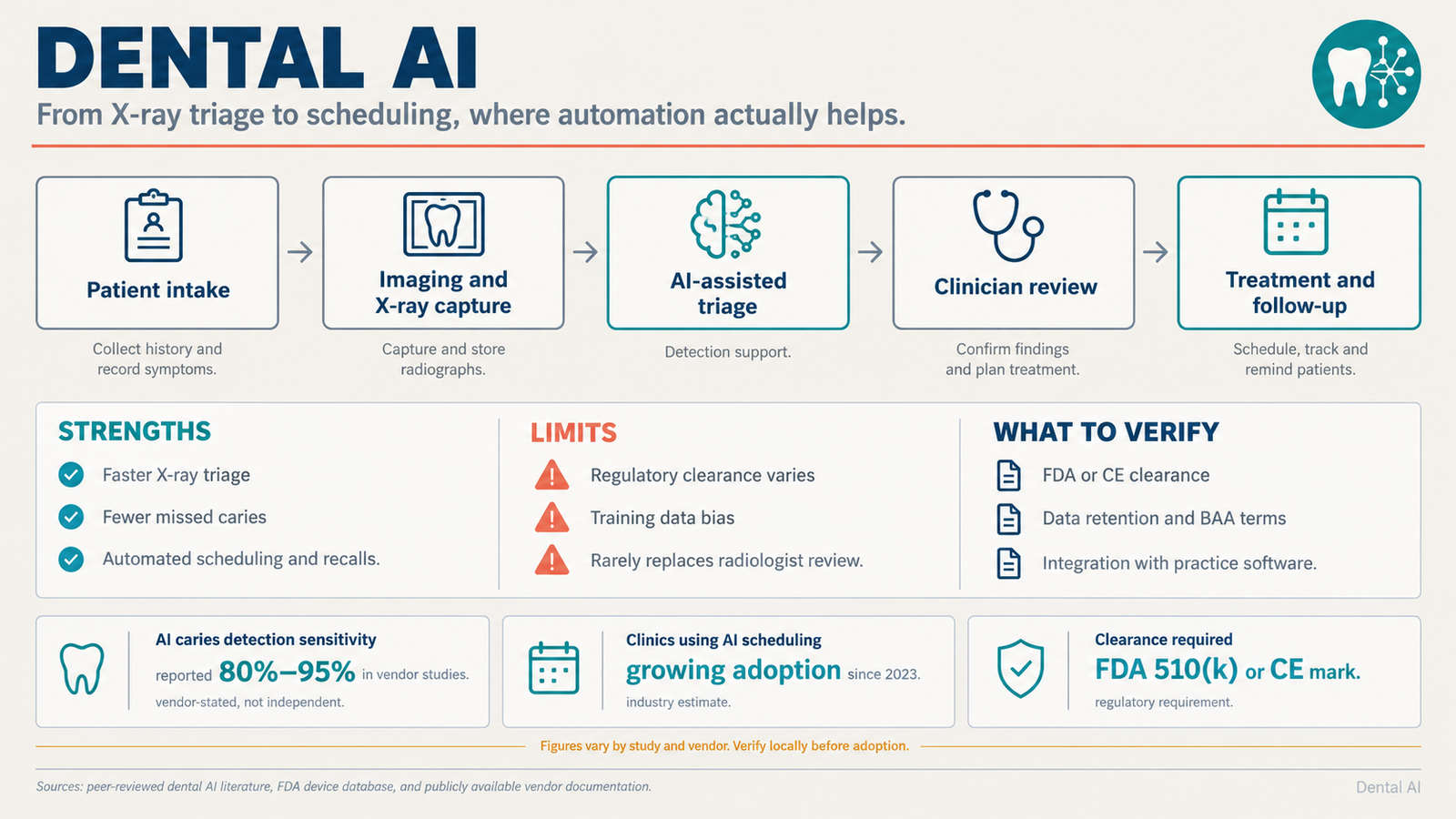
Dental AI refers to clinical software that analyzes radiographs, CBCT scans, and intraoral images to detect pathologies, flag image quality issues, and support treatment planning. Leading platforms like Overjet, Pearl, and Videa hold FDA 510(k) clearances for specific diagnostic tasks, but published research shows clinically meaningful variability across systems. Dental AI augments clinical judgment; it does not replace it.
At-a-Glance
- What it is: FDA-cleared software that assists dentists with image interpretation and workflow tasks
- Key players: Overjet, Pearl, VideaHealth, each with distinct clearance scopes and integration strategies
- Strongest claims: Overjet’s IRIS image quality check reported 98.6% specificity and 92.6% sensitivity in a 1,888-image study
- Critical limitation: A 2026 comparative study found diagnostic inaccuracies across all evaluated AI systems, including mainstream chat platforms
- Pricing reality: Vendors do not publish list prices; costs are negotiated per practice, per seat, or bundled into imaging hardware
- Adoption signal: Videa reports use by 8 of the 10 largest North American DSOs and over 50,000 professionals
What Is Dental AI?
Dental AI is a category of clinical software built specifically for dentistry. It analyzes images that dentists already capture, including bitewing X-rays, periapical films, panoramic radiographs, and cone beam computed tomography scans. The software identifies suspicious areas, measures anatomical structures, and presents findings in visual overlays that clinicians can review with patients.
The category is distinct from general-purpose AI. A chatbot asked to interpret a dental X-ray is not dental AI, even if it produces an answer. Dental AI vendors pursue FDA clearance for defined tasks, which means their claims are bounded by regulatory review rather than marketing language.
The dominant search intent behind “dental ai” is commercial investigation. Dentists, practice managers, and DSO executives want to know which platforms exist, what they actually do, and whether the investment is justified. A smaller share of searches is informational, from students or patients curious about the technology.
What Dental AI Is Not
Dental AI is not an autonomous diagnostician. Every FDA-cleared dental AI product reviewed for this article is labeled as an assistive tool. It highlights findings for a clinician to confirm. It does not issue final diagnoses, and it does not replace radiologist review for complex cases.
How Dental AI Works
The technical foundation is computer vision, specifically convolutional neural networks and transformer-based architectures trained on annotated dental images. Vendors collect large datasets of radiographs labeled by dentists, then train models to detect patterns associated with caries, bone loss, periapical lesions, and other conditions.
Image Analysis Pipeline
A typical dental AI workflow follows four stages.
Capture. The practice takes an X-ray or CBCT scan using existing sensors and imaging software. No special hardware is usually required, though some vendors sell integrated systems.
Analysis. The AI processes the image, often within seconds. It segments anatomical structures, compares them to learned patterns, and generates findings with confidence scores.
Overlay. Results appear in the practice’s imaging viewer or a companion interface. Findings are highlighted, labeled, and sometimes quantified with measurements.
Clinician review. The dentist examines the AI output, accepts or rejects each finding, and incorporates confirmed results into the treatment plan.
The Integration Factor
Integration determines whether dental AI actually gets used. A tool that requires switching applications or manually uploading images creates friction that kills adoption. Videa emphasizes that its platform integrates with over 90% of practice management and imaging systems, including native embedding in Dentrix . Overjet’s IRIS installs in ten to fifteen minutes per operatory and adds no new workflow step . Pearl’s Second Opinion 3D operates within the same interface providers already use for 2D imaging .
Key Platforms and Clearances
The dental AI market is concentrated among a small number of vendors with substantial regulatory clearances. The table below reflects publicly documented FDA clearances and company-stated capabilities as of late 2026.
Overjet
Overjet holds ten FDA clearances, more than any competitor in the dental AI space . Its CBCT Assist product, cleared in December 2025, automatically identifies and segments anatomical structures in 3D scans, reporting measurements like periodontal bone levels and airway cross-sectional area . In August 2026, Overjet received clearance for IRIS, which checks X-ray quality before the patient leaves the chair. The underlying study reported 98.6% specificity and 92.6% sensitivity across 1,888 images .
Pearl
Pearl was the first dental AI company cleared by the FDA for both 2D and 3D radiologic analysis . Its September 2026 launch of Second Opinion 3D brought CBCT interpretation to general dentists, a segment that had been underserved by specialist-oriented 3D viewers . Pearl also holds clearance for panoramic radiograph analysis, covering caries, periapical radiolucencies, and impacted third molars .
VideaHealth
Videa’s differentiator is distribution and workflow. The company reports use by eight of the ten largest North American DSOs and over 50,000 dental professionals . Its platform is designed as “ambient AI,” operating in the background without additional steps. Videa claims a 22% increase in treatment acceptance across its customer base, though this is a company-reported figure without independent verification .
The Evidence Problem
The most important information for anyone evaluating dental AI is not on the vendor websites. It is in the peer-reviewed literature, and the findings are sobering.
Comparative Treatment Planning Study
A 2026 study published in the Journal of Prosthodontics compared AI systems on multidisciplinary dental treatment planning. The researchers found that AI software generated structured, clinically relevant plans when given photographic and radiographic inputs. But they also observed “meaningful variability” in diagnostic refinement, radiographic interpretation, and thresholds for tooth preservation versus extraction .
The study’s conclusion is direct: “Clinically important diagnostic inaccuracies were observed across all evaluated platforms, highlighting the need for clinician verification of AI-generated recommendations before clinical implementation” .
This does not mean dental AI is useless. It means the technology is a decision-support tool, not an oracle. A dentist who accepts AI output without independent review is practicing below the standard of care.
Benchmark Variability
Academic benchmarks tell a similar story. ToothGPT, a research system presented at an IEEE conference in 2026, achieved 73.82% accuracy on its proprietary dataset but only 57.43% on the MMOral-Bench benchmark . That gap between controlled and generalizable performance is a recurring pattern in medical AI.
Vendor clearances are based on specific validation studies. Those studies are necessary for regulatory approval. They are not guarantees of performance on every patient population, image quality, or clinical scenario.
What Clearances Actually Mean
- An FDA 510(k) clearance means the vendor demonstrated substantial equivalence to a legally marketed predicate device for a defined intended use. It does not mean the product was proven superior to existing methods in a randomized trial. It does not mean it works equally well across all demographics. It means the regulatory bar for safety and effectiveness was met for the cleared indication.
Buyers should read the intended use statement for each clearance, not just the marketing summary.
Pricing and Procurement Reality
No major dental AI vendor publishes list prices. This is not an oversight; it reflects the enterprise sales model that dominates the category. Pricing is negotiated per practice, per location, per provider seat, or bundled into imaging hardware purchases.
What Buyers Should Ask
Is pricing per provider, per operatory, or per location? A solo practice and a 50-location DSO will face very different cost structures.
What is included in the subscription? Some vendors charge separately for AI modules. Videa’s product line includes ClinicalAI, WorkflowAI, OrthoAI, and ImplantAI, each potentially priced differently .
What are the contract terms? Multi-year commitments are common. Buyers should understand exit clauses and data portability.
Are there hidden implementation costs? Integration with existing systems may require IT work, training time, or hardware upgrades.
What happens to data if the contract ends? Dental AI vendors process patient images, which are protected health information. Data retention and deletion terms matter.
Total Cost Considerations
The advertised subscription is not the total cost. Practices must account for staff training, workflow adjustments, and the clinical time required to review AI findings. If the AI generates false positives, the practice spends time confirming that healthy teeth are healthy. That time has a cost.
Privacy and Security
Dental AI platforms handle protected health information. HIPAA compliance is table stakes, not a differentiator. Videa states it meets HIPAA and ePHI protection standards, including end-to-end encryption in transit and at rest, access controls, and activity logging .
But HIPAA compliance does not answer every privacy question. Buyers should ask:
- Where are images stored and processed? Cloud infrastructure location affects regulatory exposure.
- Are images used for model training? If so, can the practice opt out?
- Who can access patient images and AI findings? Vendor employees? Subcontractors?
- What is the data retention policy after contract termination?
None of the vendors reviewed for this article publish detailed answers to these questions on their public websites. They should be asked directly during procurement.
Who Should Consider Dental AI
Appropriate for:
- Practices with high radiographic volume seeking diagnostic consistency
- DSOs standardizing care across locations
- Clinicians who want visual tools to improve patient communication and case acceptance
- Practices that already have strong imaging infrastructure and can integrate AI without workflow disruption
Not appropriate for:
- Practices seeking an autonomous diagnostic replacement
- Offices without reliable internet or modern imaging systems
- Buyers who cannot commit to clinician oversight of every AI finding
- Anyone expecting immediate ROI without workflow changes
Common Mistakes and Misconceptions
Assuming FDA clearance equals proven superiority. Clearance establishes safety and effectiveness for a defined use. It does not prove the product outperforms a skilled clinician.
Ignoring the false positive burden. AI that flags nonexistent caries creates work. The clinical time spent confirming healthy teeth is healthy erodes the promised efficiency gains.
Underestimating integration costs. A technically capable tool that disrupts workflow will be ignored by staff. Adoption depends on fitting into existing systems, not adding new ones.
Treating company-reported metrics as independent evidence. Videa’s 22% treatment acceptance increase and Overjet’s specificity figures are company claims . They may be accurate, but they have not been independently audited.
Skipping the intended use statement. FDA clearances are indication-specific. A product cleared for bitewing caries detection is not cleared for CBCT interpretation unless a separate clearance exists.
Frequently Asked Questions
What is dental AI used for?
Dental AI assists with image interpretation, including caries detection, bone loss assessment, periapical lesion identification, and anatomical segmentation in CBCT scans. It also flags image quality problems and supports patient communication by visualizing findings. It is an assistive tool, not a replacement for clinical judgment.
Is dental AI accurate?
Accuracy varies by task, vendor, and validation method. Vendors report strong performance on their own datasets. Independent research shows meaningful variability. A 2026 study found clinically important diagnostic inaccuracies across all evaluated AI platforms, including general-purpose chat systems asked to interpret dental images . Clinician verification remains essential.
Does dental AI replace dentists?
No. Every FDA-cleared dental AI product is labeled as assistive. It highlights findings for a clinician to confirm. Diagnosis and treatment decisions remain the dentist’s responsibility.
How much does dental AI cost?
Vendors do not publish list prices. Costs are negotiated per practice, per provider, or per location. Pricing varies based on the modules selected, integration complexity, and contract length. Buyers should request detailed quotes covering implementation, training, and ongoing support.
Is dental AI HIPAA compliant?
Major platforms state HIPAA compliance, including encryption and access controls . However, HIPAA compliance does not cover every privacy concern. Buyers should ask about data storage location, training use, and retention policies before signing.
Conclusion
Dental AI has moved from experimental to commercially deployed. Overjet, Pearl, and Videa hold meaningful FDA clearances, serve thousands of practices, and have demonstrated that computer vision can identify pathologies and anatomical structures with useful accuracy. The technology is real, regulated, and increasingly integrated into routine workflows.
What matters most is the gap between vendor claims and clinical reality. Independent research shows diagnostic variability across platforms. FDA clearances are indication-specific and based on vendor-sponsored validation. Company-reported metrics like treatment acceptance increases are not independently verified. None of this makes dental AI worthless, but it does mean buyers should approach procurement with appropriate skepticism.
Dental AI suits practices that already have strong imaging infrastructure and a culture of clinical rigor. It does not suit offices seeking a shortcut to diagnosis or buyers unwilling to invest in training and workflow integration. Before choosing a platform, request the specific FDA intended use statements, ask for independent validation data, clarify total cost including hidden fees, and insist on clear answers about data handling. The technology can help, but only if the practice understands what it is actually buying.