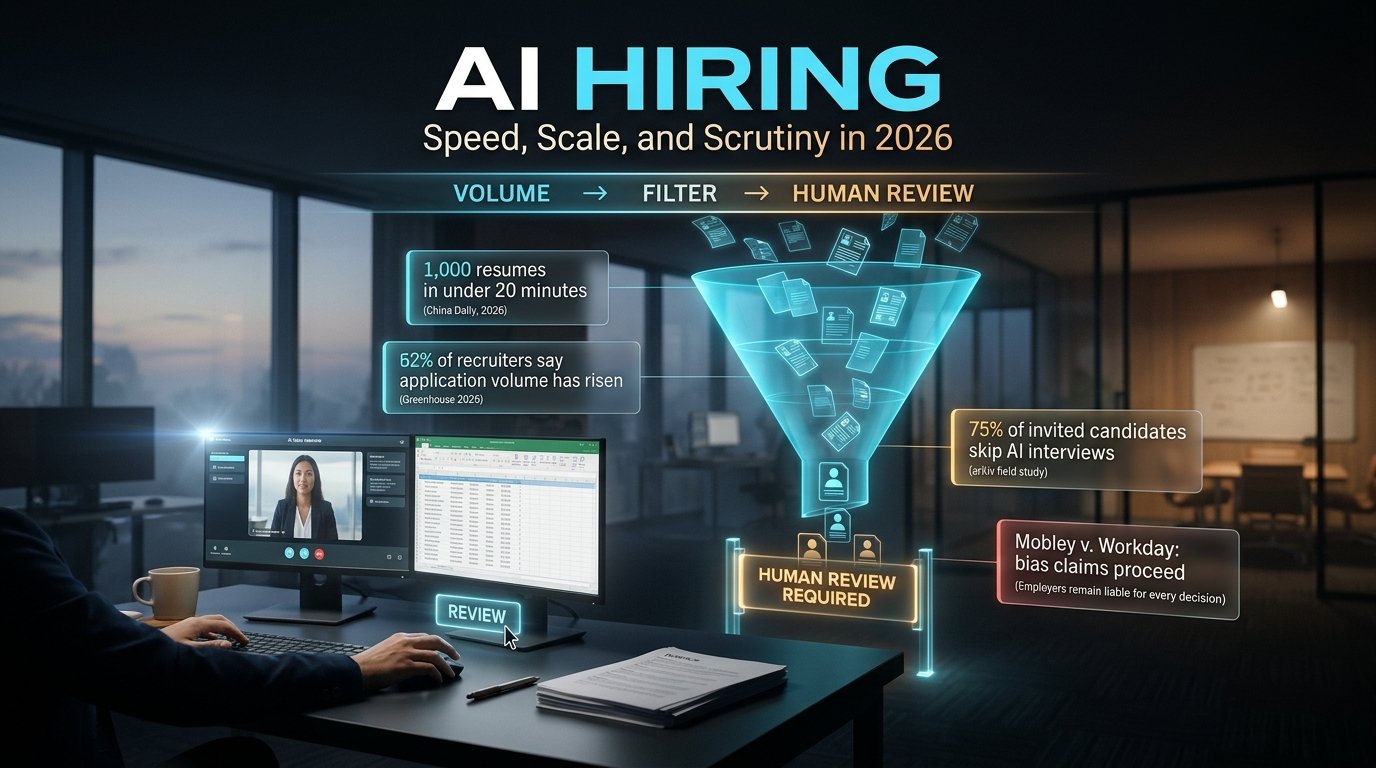
AI hiring refers to the use of artificial intelligence to automate recruitment tasks, including resume screening, candidate sourcing, interview scheduling, and initial assessments. These tools can process thousands of applications in minutes and shorten hiring cycles, but they also introduce legal risk, bias concerns, and a growing problem of AI-generated applications overwhelming the same systems built to handle volume. The field is moving fast, and the rules are still being written.
At-a-Glance
- Adoption is mainstream: Nearly 80% of companies used AI hiring tools during China’s 2025 spring recruitment season, with 52.6% using them for resume screening
- Speed gains are real: AI screening can process 1,000 resumes in under 20 minutes, compared to 8+ hours manually
- Volume is backfiring: 62% of recruiters say application volume has risen, driven partly by candidates using AI to apply
- Legal risk is escalating: The Mobley v. Workday bias lawsuit survived a key dismissal motion in June 2026, allowing discrimination claims to proceed
- Compliance is fragmented: EU AI Act rules face delay to 2027; Illinois, Colorado, and NYC have active or emerging regulations
- Human oversight is non-negotiable: Employers remain liable for hiring decisions regardless of which tools they use
What Is AI Hiring?
AI hiring describes the application of machine learning, natural language processing, and increasingly agentic AI systems to recruitment workflows. It spans a wide range of functions, from parsing resumes and ranking candidates to conducting automated interviews and coordinating schedules.
The category is not new. Resume screening algorithms have existed for years. What has changed is the sophistication of the tools and the scale of their deployment. Modern systems use large language models (LLMs) to interpret natural-language job requirements, assess candidate fit across unstructured data, and generate interview questions on the fly .
The market now includes established HR suites like Workday and Oracle, specialized platforms like Phenom and SeekOut, and newer agent-based systems from vendors like Paychex . The common thread is automation of tasks that previously consumed recruiter time.
The Two Sides of the Same Coin
A useful distinction separates employer-facing AI from candidate-facing AI. Employers use AI to screen, source, and assess. Candidates use AI to write resumes, tailor applications, and practice interviews. Both are growing.
In the United States, 70% of job seekers say they have used AI to apply for a job in the past two years; in Britain, the figure is 64% . This creates a feedback loop. AI helps candidates apply to more jobs. More applications force employers to adopt AI screening. AI screening encourages candidates to use more AI to stand out. The cycle is not stabilizing.
How AI Hiring Systems Work
The technical architecture varies by vendor, but most systems share common components.
Resume Screening and Matching
The most widely deployed application is automated resume screening. An AI system compares candidate documents against a job description and generates a match score or ranking. The system may parse skills, experience, education, and other structured fields, then apply a model trained on historical hiring data or job requirements.
China’s experience illustrates the scale. Employers can receive over 100 resumes daily for a single role. AI systems process these in seconds, generating matching reports, suggested interview questions, and risk alerts . One platform, Maimai, uses AI to interpret natural-language screening criteria that resist fixed tags, such as “excluding candidates who changed jobs twice in three years unless each move brought a promotion” .
Agentic Workflows
The newest development is agent-based systems that execute multi-step workflows rather than performing single tasks. Phenom X+ Agents handle sourcing, initial screening through conversational AI, interview scheduling, and post-interview summaries . Paychex’s WISE Hire combines AI agents for sourcing, screening, and scheduling with a network of human hiring coaches .
These systems do not make final hiring decisions. They handle the administrative and analytical work that precedes human judgment. The distinction matters for both workflow design and legal compliance.
AI Interviews
A more controversial application is the automated interview. Candidates record video responses or interact with a conversational AI, and the system analyzes their answers for content, structure, and delivery. Research suggests this can add information beyond what resumes provide. A field experiment at a recruitment platform found that candidates shortlisted with AI interview information passed final human interviews at rates 17.5 to 20 percentage points higher than candidates shortlisted from resumes alone .
The same study found a significant cost: 75% of invited candidates did not complete the AI interview . The authors interpret non-completion as a signal of job-search motivation, but it also represents a barrier that may exclude qualified candidates who are uncomfortable with the format.
The Legal Landscape
AI hiring faces its first major legal test in the United States, and the outcome will shape how employers deploy these tools.
Mobley v. Workday
The Mobley v. Workday lawsuit alleges that Workday’s AI-powered screening tools discriminated against job applicants based on race, age, and disability. In June 2026, U.S. District Judge Rita Lin largely denied Workday’s motion to dismiss the plaintiffs’ Third Amended Complaint, allowing key claims to proceed .
The ruling is significant for two reasons. First, Judge Lin held that Workday could face liability under California’s anti-discrimination statutes even for screening decisions affecting applicants outside California, because the tools were designed and controlled from the company’s Pleasanton headquarters . Second, the court allowed a disability discrimination claim to proceed based on allegations that the software used “proxy indicators” such as medical-related leave to flag and screen out applicants .
Workday has not been found liable. The case is proceeding through discovery. But the ruling signals that AI vendors, not just employers, can face discrimination claims for the tools they sell.
Regulatory Patchwork
Compliance obligations vary by jurisdiction, and the map is shifting.
EU AI Act: Hiring is classified as high-risk. Requirements include human oversight, transparency, and conformity assessments. Enforcement was originally scheduled for August 2026 but faces a potential delay to 2027 due to the Digital Omnibus Act .
Illinois AI Employment Act: Prohibits discriminatory proxy measures like ZIP codes and mandates transparency around AI usage .
New York City Local Law 144: Requires annual bias audits for automated employment decision tools.
Colorado AI Act: Mirrors the EU’s risk-based approach, assigning responsibilities to both AI providers and deployers .
Employment attorney Heather Bussing offers a practical summary: the legal frameworks do not ban AI in recruiting. They ban autonomous decision-making. A human must review and approve before any employment decision is finalized .
Benefits and Limitations
What AI Hiring Delivers
Speed and volume. AI systems process applications at a scale no human team can match. The efficiency gains are documented, not hypothetical .
Consistency. An algorithm applies the same criteria to every candidate. Human reviewers vary in attention, mood, and unconscious preference. AI can standardize the first pass .
Documentation. AI systems log their decisions. This creates an audit trail that human hiring lacks. As legal scrutiny increases, documentation becomes a defensive asset .
Where AI Hiring Fails
Volume begets volume. AI application tools have flooded recruiters with submissions. Greenhouse’s 2026 report found that 62% of recruiters say application volume has risen, and 53% now look at fewer than half the applications they receive . Qualified candidates disappear before a human reads their materials.
Bias is not solved. The Workday lawsuit alleges that AI screening can encode and amplify discrimination. Proxy indicators, such as employment gaps that correlate with medical leave, can function as discriminatory filters even when protected characteristics are not directly used .
The rubric problem. An AI screener scoring against a vague job description produces unreliable results. The quality of screening depends more on the clarity of the criteria than on the sophistication of the model .
False negatives go undetected. Teams inspect who got through the filter. Few audit who was rejected. A miscalibrated filter can silently exclude strong candidates for months before anyone notices .
Platform Comparison
Pricing for enterprise AI hiring platforms is almost universally undisclosed. Buyers negotiate contracts based on seat counts, hiring volume, or module selection. This opacity makes cost comparison difficult and favors vendors with established relationships.
Who AI Hiring Serves and Who It Does Not
Appropriate for:
- High-volume hiring where manual screening is a bottleneck
- Organizations with defined job criteria and structured evaluation rubrics
- Employers prepared to audit outcomes and maintain human oversight
- Companies with legal resources to navigate compliance obligations
Not appropriate for:
- Small employers hiring fewer than 10 people per year, where tooling costs outweigh benefits
- Organizations without a clear rubric for what “qualified” means
- Employers seeking to remove humans from the decision entirely
- Teams operating in jurisdictions where they have not reviewed applicable AI hiring laws
Common Mistakes
Automating the wrong stage. Buying a sourcing tool when the bottleneck is interviewer availability creates a faster on-ramp to a traffic jam. Measure where candidates stall before automating .
Trusting scores as performance predictions. A high assessment score predicts performance on the assessment. It weakly predicts performance on the job. Use AI to filter the bottom, not to rank the top .
Hiding AI from candidates. Candidate trust in AI evaluation is low, and opacity makes it worse. Disclosure and opt-out options are increasingly expected, and in some jurisdictions required .
Treating bias audits as one-time checks. Bias is a property of the tool, the data, and the funnel together. It drifts as candidate pools and job requirements change. Audits must be recurring .
Frequently Asked Questions
What is AI hiring and how does it work?
AI hiring uses machine learning and language models to automate recruitment tasks such as resume screening, candidate sourcing, interview scheduling, and initial assessments. These systems parse applications, match candidates to job criteria, and in some cases conduct automated interviews. They are designed to supplement human judgment, not replace it.
Is AI hiring legal?
AI hiring is legal in most jurisdictions, but it is regulated. The EU AI Act classifies hiring as high-risk and requires human oversight and transparency. U.S. state and local laws impose bias audit and disclosure requirements. The legal frameworks do not ban AI in recruiting; they ban autonomous decision-making without human review .
What is the Workday AI hiring lawsuit about?
Mobley v. Workday alleges that Workday’s AI-powered screening tools discriminated against applicants based on race, age, and disability. In June 2026, a federal judge allowed key claims to proceed, including California anti-discrimination claims and a disability bias claim. The case is ongoing and has not reached a final verdict .
Does AI hiring reduce bias?
AI hiring can reduce certain forms of inconsistency, but it does not eliminate bias. Algorithms can encode historical discrimination or use proxy indicators that correlate with protected characteristics. The Workday lawsuit specifically alleges that medical-related leave was used as a proxy for disability. Bias monitoring and human oversight remain essential .
What are the biggest mistakes companies make with AI hiring?
Common mistakes include automating a stage that is not the actual bottleneck, using AI to rank top candidates rather than filter the bottom, failing to audit rejected candidates for false negatives, hiding AI use from candidates, and treating bias audits as a one-time procurement checkbox rather than an ongoing process .
Conclusion
AI hiring is not a future scenario. It is the current operating model for most large employers, and its adoption is accelerating. The technology delivers real efficiency gains in screening and scheduling, and it creates documentation that human hiring often lacks. It also introduces risks that are now being tested in court.
What matters most is the division of labor. AI handles volume, pattern matching, and administrative coordination. Humans handle judgment, context, and accountability. The legal frameworks emerging in the EU and across U.S. states do not prohibit AI in hiring. They prohibit letting AI decide alone. Employers remain liable for every hiring outcome, regardless of which tools they use .
AI hiring may suit high-volume organizations with clear criteria, audit capacity, and legal resources. It does not suit employers seeking to automate judgment or eliminate human review. Before adopting any AI hiring tool, decision-makers should define what “qualified” means, measure where candidates actually stall in the funnel, request bias testing documentation from vendors, and plan for recurring outcome audits. The tool is not the strategy. The rubric, the oversight, and the willingness to find and fix mistakes are what determine whether AI hiring improves outcomes or simply accelerates existing problems.