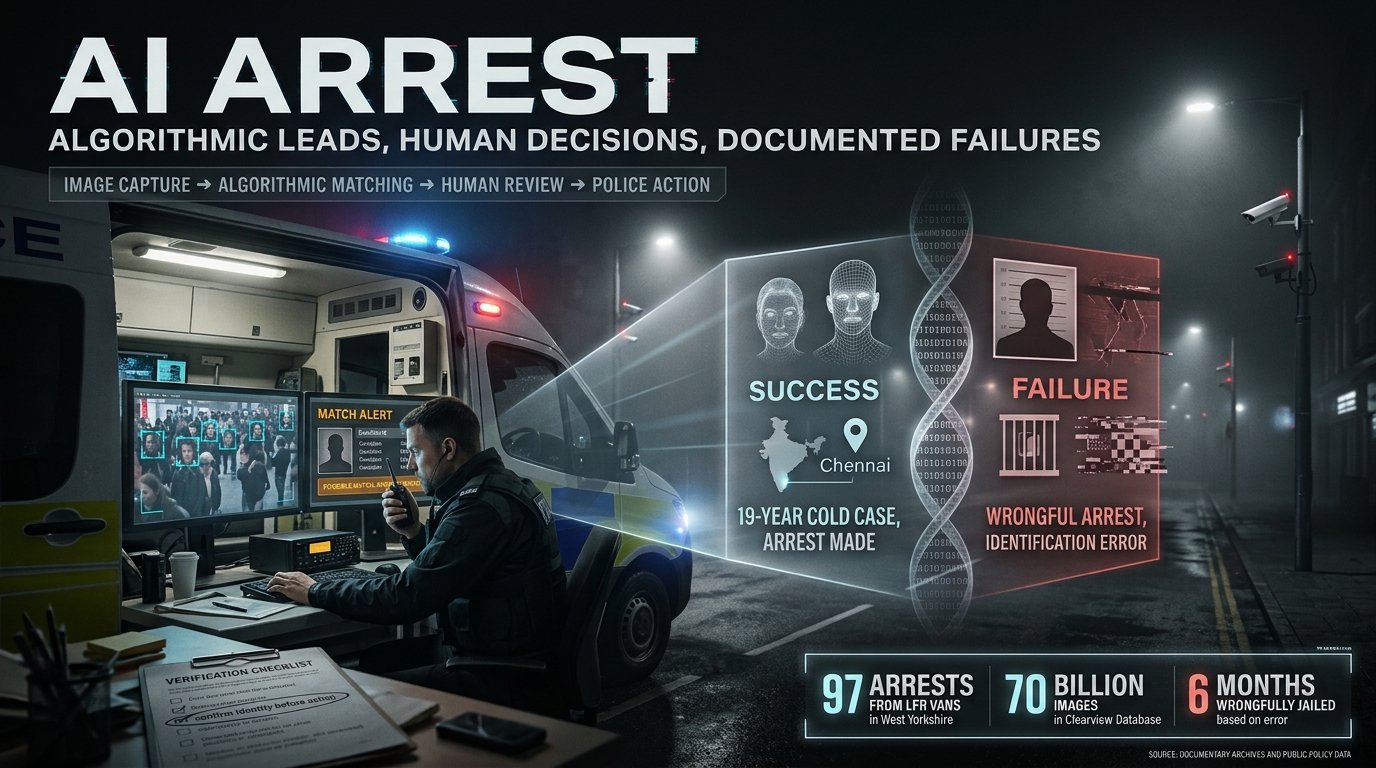
AI arrest refers to law enforcement actions where artificial intelligence tools, primarily facial recognition and predictive analytics, identify or locate a suspect. These systems scan live camera feeds, compare faces against watchlists, or estimate how a fugitive’s appearance has changed over time. The technology has solved cold cases and caught wanted suspects, but it has also put innocent people in jail, including a Tennessee woman held for nearly six months after a facial recognition match that was provably wrong.
At-a-Glance
- Core tools: Live facial recognition (LFR), retrospective facial matching, age-progression prediction, AI-assisted evidence analysis
- Verified success: Chennai police used age-progression AI to arrest a murder suspect after 19 years
- Verified failure: Angela Lipps was jailed for nearly six months after a facial recognition match, despite being in another state
- UK deployment: West Yorkshire Police made 97 arrests with LFR vans since November 2025
- Critical safeguard: Police insist no arrest happens on an AI alert alone; human confirmation is required
- Legal pressure: Judges are ordering disclosure of how facial recognition was used in specific cases
What Is AI Arrest?
The phrase covers several distinct technologies, and conflating them creates confusion. AI arrest does not mean a robot handcuffs someone. It means a software system generated a lead, flag, or match that contributed to a human officer making an arrest.
The most common form is facial recognition. Police feed an image from surveillance footage into a system, which returns potential matches from a database. A human officer reviews the candidates and decides whether to act. The arrest itself is made by a person.
A different use case involves age-progression AI. Chennai police used this approach in 2026 to locate a murder suspect who had been on the run for 19 years . The system estimated what the suspect would look like today based on an old photograph. Police then circulated the generated image and received a tip that led to the arrest.
A third category involves AI-assisted evidence analysis, where algorithms scan devices or communications for patterns. Pakistan’s National Cyber Crime Investigation Agency used AI monitoring to flag suspicious links, which eventually led to three arrests related to child exploitation material .
The Human in the Loop
Every legitimate deployment includes a human decision point. In West Yorkshire, PC Josh Brayshaw monitors the live facial recognition feed and receives an alert when a match occurs. He then approaches the person, confirms their identity, and makes the arrest decision . The system flags; the officer arrests.
This safeguard matters because AI matches are probabilistic, not certain. A facial recognition system returns a ranked list of candidates based on similarity scores. It does not say “this is the person.” It says “this face resembles these faces.” The distinction is critical, and it is where failures occur.
How Facial Recognition Arrests Work
The technical workflow follows a predictable sequence.
Step 1: Image capture. A camera captures a face, either from live footage or from an existing photograph. In retrospective cases, police may use a still from a bank camera or a social media image.
Step 2: Feature extraction. The system maps facial geometry: distances between eyes, nose shape, jawline contours. This creates a numerical template, often called an embedding.
Step 3: Database comparison. The template is compared against a watchlist or database. In the DC case involving Marquis Foster, the image was run through Clearview AI’s database of 70 billion publicly available facial images, then the resulting candidate was checked against a police mugshot database .
Step 4: Candidate review. The system returns potential matches ranked by similarity. A human officer reviews them.
Step 5: Investigation and confirmation. The officer must gather additional evidence before making an arrest. This is the step that failed in the Angela Lipps case.
What Went Wrong in Fargo
Lipps was arrested after West Fargo police used a photo from a fake ID in an unrelated case. The system identified Lipps. West Fargo passed the information to Fargo police, who assumed their colleagues had used a certified state system and a surveillance photo. They did not verify. They arrested Lipps, who was provably in Tennessee at the time .
She spent almost six months in jail, four in Tennessee awaiting extradition, before her court-appointed attorney obtained bank records showing she was buying groceries at home during the alleged crime. Fargo’s police chief initially refused to apologize and suggested Lipps was still a suspect. He resigned shortly after. His successor apologized .
The case illustrates the central risk of AI arrest: when the algorithm is wrong, the human system may fail to catch it. The officers trusted the output. They did not verify the input or the chain of assumptions.
AI Arrest Success Stories
The technology does produce results. These are documented cases, not vendor claims.
Chennai’s 19-Year Cold Case
In 2007, Pandiyamani was murdered in Thiruvottiyur. Five people were arrested, including Sheikh Abdullah, then about 20 years old. Abdullah was released on bail, stopped attending court, and disappeared. A non-bailable warrant was issued in 2010 .
In 2026, Chennai’s North Zone Serious Crimes Unit used AI age-progression technology to generate an image of what Abdullah would look like at approximately 39 years old. Police circulated the image. A tip followed. Abdullah was arrested on a Saturday in September 2026 .
This is a legitimate use of AI: a tool for generating leads when conventional methods have failed. The arrest still required human investigation and a tip from the public.
West Yorkshire’s Live Facial Recognition
West Yorkshire Police began using live facial recognition vans in November 2025. By October 2026, the system had led to 97 arrests .
The vans park in busy pedestrian areas. A camera on the roof scans faces and compares them against a watchlist in real time. When a match occurs, an alarm sounds and officers on the ground receive the information on mobile devices. They approach the person and confirm identity before arrest.
The system also flags people subject to court orders, not just wanted suspects. In one case, a convicted sex offender was stopped because he had not registered a phone with police, a violation of his Sexual Harm Prevention Order. His phone was seized .
Critics argue that thousands of innocent people are scanned for every person identified. Privacy campaigners have challenged the technology, though a High Court challenge against the Metropolitan Police’s use of LFR was dismissed in April 2026 .
AI Arrest vs. Traditional Investigation
The table reveals a paradox. AI systems are faster but not inherently more accurate. The speed of a match can create pressure to act before verification is complete. The Fargo case demonstrates how this pressure, combined with inter-departmental assumptions, produced a wrongful arrest.
The Transparency Problem
Defense attorneys are increasingly challenging how AI was used in arrests. In Washington, D.C., a judge ordered prosecutors to disclose details about how Clearview AI was used to identify Marquis Foster in a shooting case . Foster’s lawyer said she had never encountered this workflow before.
The New Jersey Supreme Court ruled in June 2026 that law enforcement must disclose its use of facial recognition during investigations as part of discovery. This includes performance metrics, the software developer’s name, reference databases, and all match candidates returned. Proprietary source code is excluded .
This is a significant development. If defense attorneys cannot examine how an AI match was generated, they cannot challenge its reliability. The disclosure requirement gives them a pathway to test the evidence.
AI-Generated Evidence in Court
A related but distinct issue involves AI-generated content presented as evidence. Courts worldwide are grappling with deepfakes and fabricated citations. In Canada, the Ontario Court of Justice took judicial notice of the “widespread proliferation of AI technology capable of producing realistic deepfake videos” and warned that this presents a “potentially serious concern to the integrity of our justice system” .
The International Bar Association has documented cases where AI-generated evidence was submitted with non-existent sources, and where genuine evidence was falsely challenged as fake . This “liar’s dividend” complicates both prosecution and defense.
For AI arrest specifically, the concern is narrower: was the match reliable, and was the human verification adequate? The broader evidentiary crisis is a separate problem.
Who Uses AI Arrest Tools
Police departments use facial recognition for suspect identification, particularly in cases with clear surveillance imagery but no known suspect. Larger departments with dedicated technology units are more likely to deploy live systems.
National agencies use AI monitoring for cybercrime and exploitation material, as Pakistan’s NCCIA demonstrated . The AI flags content; investigators then pursue leads.
Cold case units use age-progression software when a suspect has been missing for years or decades. Chennai’s case is the clearest example .
Not appropriate for: departments without clear policies on verification, disclosure, and oversight. The Fargo failure shows what happens when assumptions replace procedure.
Common Mistakes and Misconceptions
Believing an AI match is an identification. It is a lead. A match means a face resembles another face according to an algorithm. It does not mean they are the same person. The Fargo case failed because officers treated a match as identification.
Assuming human review solves the problem. Human review can fail through automation bias, where officers defer to the system’s output. The review must be structured, skeptical, and independent of the matching process.
Ignoring the database problem. Clearview AI’s database includes 70 billion publicly available images, scraped without consent . A match may come from a social media photo, not a mugshot. This raises accuracy and privacy concerns that differ from traditional police databases.
Expecting consistent legal standards. Disclosure requirements vary by jurisdiction. New Jersey requires extensive disclosure . Other states do not. Defense attorneys may not know AI was used at all.
Frequently Asked Questions
Can AI arrest someone on its own?
No. AI systems generate leads, matches, or flags. A human officer must review the output, gather additional evidence, and make the arrest decision. In West Yorkshire, PC Brayshaw emphasized that “an individual will never be arrested on the basis of an alert alone” . The technology assists; it does not decide.
How accurate is facial recognition for arrests?
Accuracy varies by system, image quality, and database composition. There is no single answer. Documented failures, like the Angela Lipps case, show that false matches can lead to wrongful imprisonment . Success stories like Chennai’s cold case show the technology can work when combined with human investigation . The critical variable is not the algorithm alone but the verification process around it.
What happened in the Angela Lipps case?
Fargo police arrested Lipps based on a facial recognition match from West Fargo, without verifying that she was in Tennessee at the time of the crime. She spent nearly six months in jail before her attorney obtained bank records proving her whereabouts. The police chief initially refused to apologize and later resigned . The case became a cautionary example of what happens when AI output is trusted without verification.
Do police need a warrant to use facial recognition?
This is unsettled law in the United States. Some jurisdictions require warrants or have internal policies; others do not. The New Jersey Supreme Court ruled that use of facial recognition must be disclosed in discovery, but that is a disclosure requirement, not a warrant requirement . Legal standards are evolving.
Is AI arrest legal?
The use of AI in investigations is legal in most jurisdictions, subject to applicable laws and policies. The arrest itself must meet standard legal requirements: probable cause, warrants where required, and constitutional protections. An AI match does not lower the legal threshold. If anything, the Fargo case suggests that some departments failed to apply the standard rigorously when AI was involved.
Conclusion
AI arrest is neither a miracle nor a catastrophe. It is a set of tools that generate leads faster than traditional methods, with documented successes and documented failures. The Chennai cold case shows what happens when AI expands the search space and human investigators follow through. The Fargo case shows what happens when an algorithm’s output replaces verification instead of supporting it.
What matters most is the process around the technology. A facial recognition match is a starting point, not a conclusion. The officers who understand this use AI effectively. The ones who treat a match as proof produce wrongful arrests and damaged lives.
Departments considering AI arrest tools should evaluate their verification procedures before their algorithms. They should define who reviews matches, what additional evidence is required before arrest, and how the use of AI is documented for discovery. The New Jersey disclosure ruling and the DC judge’s order suggest that courts will increasingly demand this transparency .
The technology will improve. Databases will grow. Match speeds will increase. None of that changes the fundamental requirement: a human must verify before a person loses their liberty.