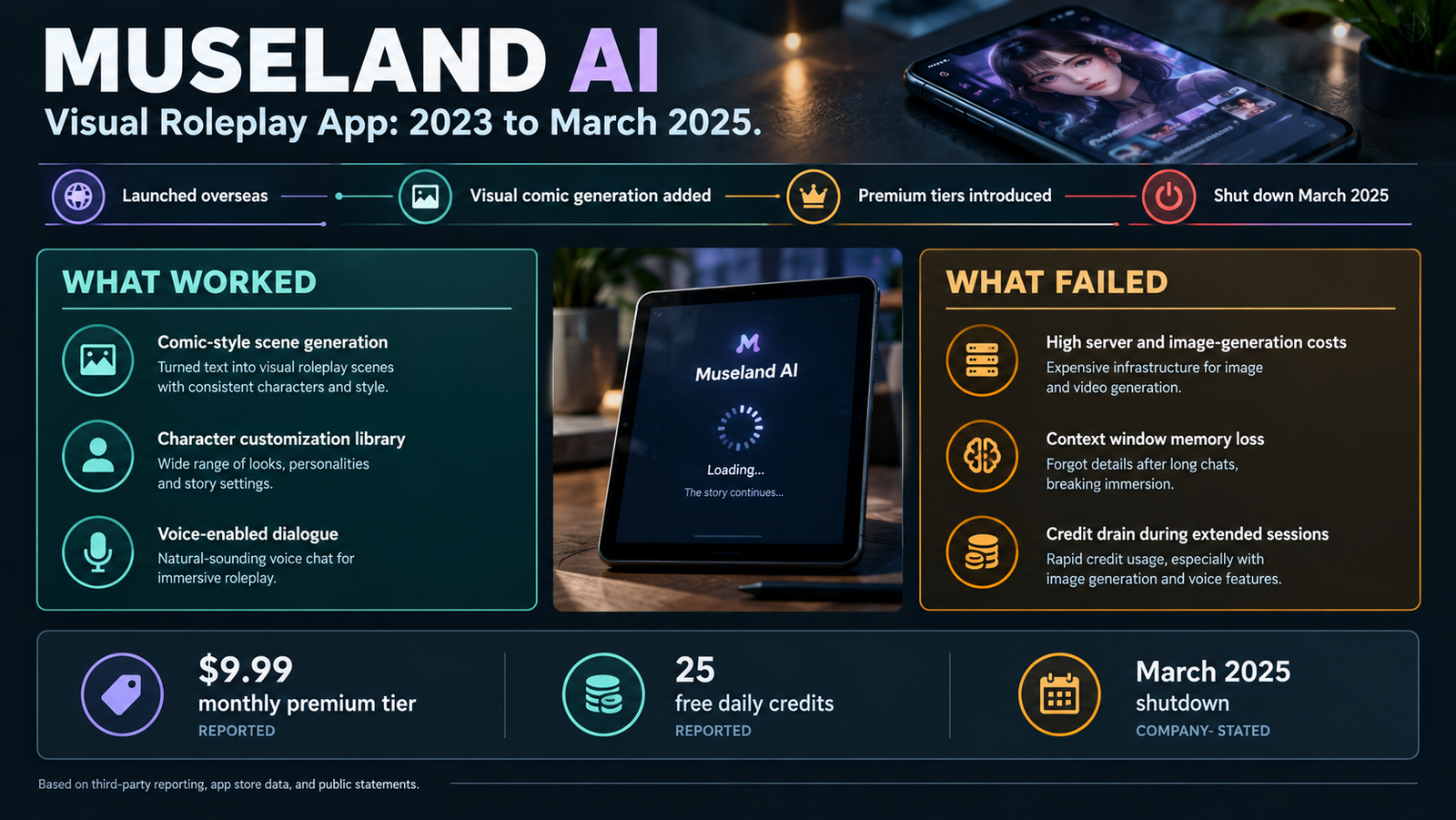
Museland AI was an AI-powered roleplay and character chat platform that combined interactive storytelling with comic-style visual generation. Developed by ZULUTION INTELLIGENCE, the app gained attention for its unfiltered creative freedom and visual storytelling engine before shutting down in March 2025. Its brief lifespan offers useful lessons about credit-based pricing, context window limitations, and the operational costs of running visually intensive AI platforms.
At-a-Glance
- What it was: An AI character chat and roleplay app with visual scene generation
- Developer: ZULUTION INTELLIGENCE PTE. LTD., linked to Musical.ly founder Yang Luyu
- Core appeal: Lenient content filters and comic-style visual responses
- Pricing model: Freemium with credits; Premium at approximately $9.99/month
- Status: Shut down in March 2025 due to operational costs
- Key limitation: Severe context window issues caused memory loss in long conversations
What Was Museland AI?
Museland AI occupied a specific corner of the AI companion market. It was not a general chatbot, and it was not a productivity tool. It was an interactive roleplay platform where users engaged with AI characters across romance, fantasy, adventure, and urban scenarios .
What distinguished Museland from competitors like Character.AI was its visual approach. Instead of returning plain text, the platform attempted to generate comic-style illustrations that matched the emotional tone of the conversation . A tense confrontation might produce dramatic lighting and expressive poses. A quiet moment might generate a softer, calmer scene.
The platform also allowed users to create and customize characters with detailed appearance, personality, and backstory settings . Community-created characters populated a large library, giving new users immediate options beyond the default roster.
The Founding Connection
Museland’s developer, ZULUTION INTELLIGENCE, is linked to Yang Luyu, the founder of Musical.ly (which later became TikTok) . The Singapore-based entity is fully owned by Shanghai Zhuluxing Information Technology, where Yang serves as legal representative. This background gave Museland a degree of industry attention that most new AI roleplay apps do not receive.
The product launched in overseas markets, with availability on iOS, Android, and web browsers . It positioned itself as a free-to-use platform with premium upgrades, a common model in the AI companion space.
How Museland AI Worked
The core interaction followed a familiar pattern for AI roleplay platforms. Users selected a character from the library or created their own, then engaged in text-based conversation. The AI responded in character, maintaining personality and scenario context .
Voice interaction was also supported. Users could listen to characters speak rather than reading text, adding a layer of immersion for dialogue-heavy scenarios . The feature was resource-intensive, consuming more credits than text-only exchanges.
The Visual Storytelling Engine
The defining technical feature was the visual generation system. Each AI response could produce accompanying illustrations styled like comic panels or anime art . This created the impression of co-writing a graphic novel with the AI, rather than simply exchanging messages.
The system was ambitious. Generating images for every message required significantly more computing power than text-only chatbots . This resource intensity contributed to the platform’s eventual financial difficulties.
The Credit System
Museland operated on a credit-based pricing model. Free users received limited daily credits, reportedly around 25 per day . These credits were consumed by interactions, with visual and voice features costing more than simple text messages.
Premium plans started at approximately $9.99 per month and included 200 monthly credits, faster refill rates, enhanced visual quality, and emotional voice responses . An annual plan offered a discount, bringing the effective monthly cost lower .
The credit system drew criticism from users. Long roleplay sessions could drain credits quickly, especially when visual generation was involved. Some users reported running out mid-story, which broke narrative immersion . The gap between free and paid tiers was substantial enough that casual users found the free experience limiting.
Why Museland AI Shut Down
Museland AI ceased operations in March 2025. The official reason cited was overwhelming server capacity demands and high operational costs . Running large language models alongside image generation for a large, active user base proved financially unsustainable.
The Technical Flaw: Context Window Limits
Beyond the financial pressures, Museland suffered from a structural technical limitation that affected user experience. The platform’s context window, the amount of conversation history the model could retain, was insufficient for long-form roleplay .
As conversations extended past roughly 100 to 150 messages, older plot points fell out of the model’s memory. The AI would then guess at missing context, leading to plot erosion, character inconsistency, and contradictory responses . For users invested in extended storylines, this “catastrophic amnesia” undermined the core appeal of immersive roleplay.
This is not a unique flaw; many AI chat platforms face similar context constraints. But Museland’s emphasis on narrative depth made the limitation more damaging. Users who wanted epic sagas discovered the platform could not support them.
The Cost of Unfiltered Freedom
Museland’s relatively lenient content filters attracted users who felt constrained by competitors like Character.AI . This creative freedom was a key differentiator. However, unfiltered platforms require more extensive safety infrastructure and moderation oversight. The combination of visual generation, voice features, and large-scale text inference created a cost structure that the subscription revenue could not cover.
The shutdown was abrupt. Users lost access to their characters, conversations, and created content. The platform’s disappearance became a cautionary tale about the risks of building creative work on centralized, proprietary systems .
Museland AI vs. Competitors
| Platform | Approach | Content Policy | Pricing Model | Status |
|---|---|---|---|---|
| Museland AI | Visual roleplay with comic generation | Lenient, mature content allowed | Credits; Premium ~$9.99/mo | Shut down March 2025 |
| Character.AI | Text-focused character chat | Strict SFW filters | Free with optional subscription | Active |
| Janitor AI | Roleplay with custom models | Variable, community-driven | Free with optional credits | Active |
| PolyBuzz | AI character chat | Moderate filtering | Freemium | Active |
Museland’s closure left a gap for users seeking visual roleplay experiences. Competitors have not fully replicated the comic-generation approach, likely because of the same cost pressures that contributed to Museland’s failure. Text-focused platforms remain more financially sustainable.
Privacy and Data Considerations
Museland’s privacy policy disclosed the collection of standard account information, including email addresses, IP addresses, and interaction data . The policy stated that the platform did not collect sensitive personal information as defined by California law, which includes data about sex life or sexual orientation .
Conversation content was used for system improvements according to third-party analysis . Data was encrypted during transmission, and users could request account deletion. However, the abrupt shutdown raised questions about what happened to user data after the platform went offline. Users had no clear pathway to retrieve or verify deletion of their information.
This is a recurring risk with smaller AI platforms. When a service closes, user data may be retained, transferred, or deleted according to policies that are difficult to enforce post-shutdown.
Common Mistakes and Misconceptions
Assuming Museland is still operational. The platform shut down in March 2025. Some app store listings and download sites may still reference it, but the service is not active .
Believing “unfiltered” meant no moderation at all. Museland allowed mature content but still restricted illegal or abusive material . The platform was not a free-for-all.
Expecting the visual generation to be consistent. Comic-style images were generated per message, not as a coherent visual narrative. Character appearances could shift between panels, which disrupted immersion for some users.
Ignoring the credit economics. The free tier’s daily credits were insufficient for extended sessions. Users who wanted meaningful roleplay needed a paid plan, and even then, visual and voice features consumed credits rapidly .
Frequently Asked Questions
Is Museland AI still available?
No. Museland AI shut down in March 2025. The app is no longer operational, and the servers have been taken offline. Some download sites and app store listings may still exist, but the service cannot be used .
Why did Museland AI shut down?
The official reason was high operational costs and server capacity issues. Running visual generation and voice features alongside text-based AI chat for a large user base proved financially unsustainable. The platform also struggled with context window limitations that affected long-form roleplay quality .
Was Museland AI free?
Museland offered a free tier with limited daily credits, reportedly around 25 per day. Premium plans started at approximately $9.99 per month and included more credits, faster refill rates, and enhanced visual and voice features . The free tier was sufficient for short sessions but limiting for extended roleplay.
What happened to characters and stories created on Museland AI?
Users lost access to their created characters and conversation history when the platform shut down. The abrupt closure meant no official export pathway existed. This outcome illustrates the platform risk of building creative work on centralized proprietary services .
What are the best alternatives to Museland AI?
Users seeking text-focused roleplay can consider Character.AI, Janitor AI, or PolyBuzz. None fully replicate Museland’s visual generation approach, but they offer active communities and ongoing service. Users should evaluate privacy policies and content policies before committing to any platform.
Conclusion
Museland AI was an ambitious attempt to merge AI roleplay with visual storytelling. It attracted users with lenient content policies, character customization, and comic-style scene generation. It failed because the economics of running visually intensive AI at scale did not match its subscription revenue, and because its context window could not support the long narratives its users wanted to create.
What matters most for anyone evaluating AI roleplay platforms today is understanding the tradeoffs. Unfiltered platforms often carry higher operational costs, which can lead to instability or abrupt closure. Credit-based pricing can obscure the true cost of sustained use. Context limitations affect every platform to some degree, but they matter more for narrative-focused experiences.
Museland suited users who wanted visual immersion and were willing to pay for credits. It did not suit users seeking unlimited free roleplay, long-form story continuity, or platform stability. Before choosing any AI companion tool, users should evaluate the provider’s sustainability, the clarity of its pricing, and the risks of investing creative energy into a service that may not last.