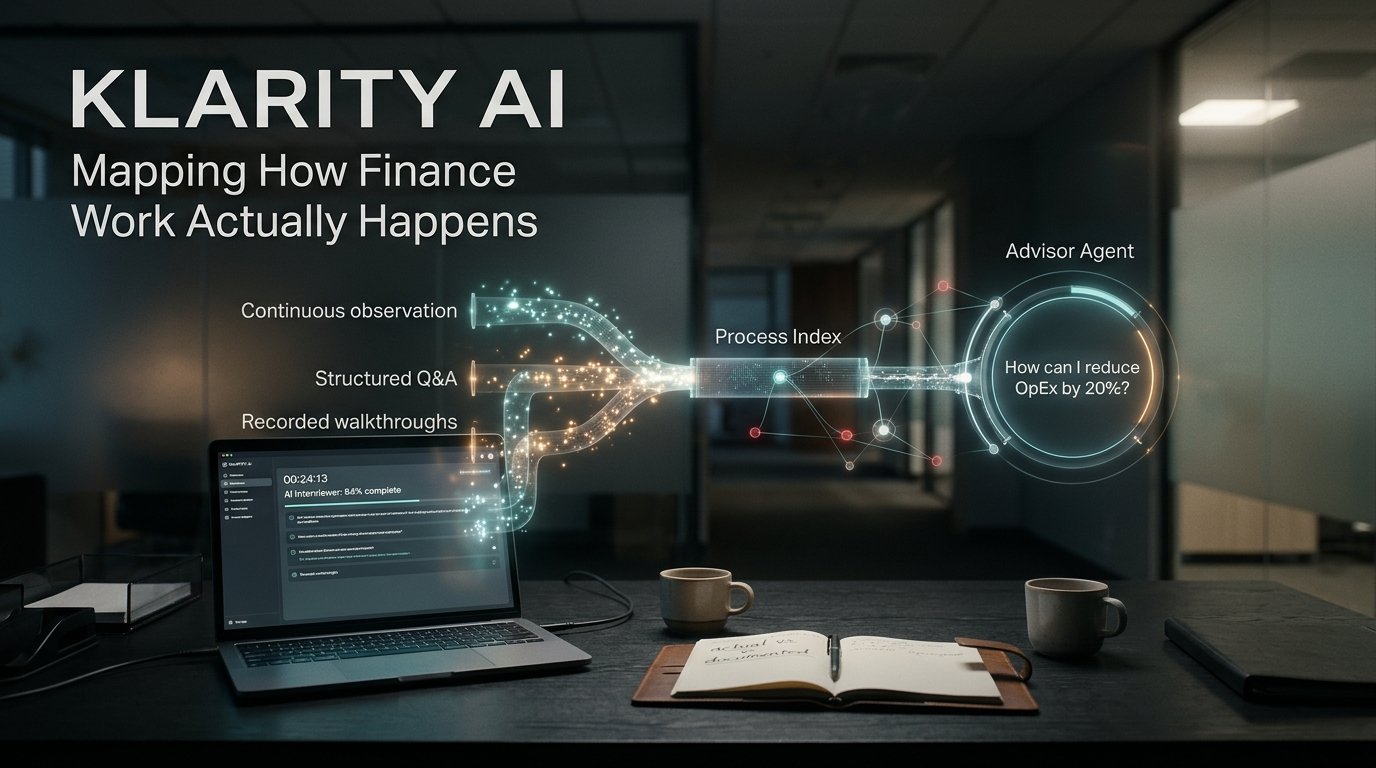
Klarity AI is a San Francisco-based platform that uses AI to observe, interview, and document how financial and accounting processes actually operate inside an organization. Rather than automating document extraction alone, it captures the real workflow through screen observation and structured interviews, then generates process documentation and surfaces transformation opportunities. The company has raised $88 million, partners with firms like Forvis Mazars, and serves customers including OpenAI, Zoom, and Cloudflare .
At-a-Glance
- What it is: An AI-powered process discovery and documentation platform for finance and accounting teams
- Founded: 2017, San Francisco; CEO Andrew Antos; Y Combinator 2018
- Funding: $88 million total, including a Series B led by Scale Venture Partners
- Core method: AI screen observation, conversational interviews, and file upload capture how work is done
- Key output: Standard operating procedures, process indexes, and transformation opportunity analysis
- Privacy posture: SOC 1 and SOC 2 Type II compliant; no model training on customer data; on-demand deletion
What Is Klarity AI?
Klarity AI is not a document extraction tool, though it began in that space. It is not a chatbot, and it is not a general-purpose AI assistant. It is a process intelligence platform built specifically for finance and accounting organizations that need to understand how their operations actually function before attempting transformation.
The distinction matters. Most enterprise software assumes the process on paper matches the process in practice. Klarity starts from the opposite assumption. It observes what people actually do on their screens, asks them questions about what it sees, and builds documentation from that evidence rather than from interviews conducted months after the fact.
From Document Automation to Process Discovery
Klarity’s origins were in document automation. Founded in 2017 by Andrew Antos and Nischal Nadhamuni, the company joined Y Combinator in 2018 and built a reputation for automating document-heavy finance workflows . Scale Venture Partners described it as “the leading document automation platform for finance and accounting organizations” when announcing its investment .
The company has since expanded into process discovery and transformation. Its March 2026 collaboration with Forvis Mazars illustrates the shift. The partnership announcement described traditional transformation intakes as requiring “up to eight hours per employee” before delivering static recommendations . Klarity’s AI observation and interview tools compress that timeline and capture a broader stakeholder set.
How Klarity AI Works
The platform operates through three capture modes, all feeding into a centralized process index.
AI Interviewer
The AI Interviewer is an interactive tool that observes a user’s screen while asking structured questions about the process being demonstrated . It runs in two modes: pure observation and guided conversation. In observation mode, it takes notes as the user demonstrates a task. In guided mode, it asks about stakeholders, business rules, errors, delays, and automation opportunities.
The output is a structured document covering objectives, scope, pain points, risk analysis, and proposed future processes . Progress tracking shows how much of the interview has been covered, and users retain full control over screen sharing, microphone access, and session termination.
Companion
Companion runs in continuous capture mode. Users go about their normal work, and the system generates a report every 30 minutes highlighting what process activities it observed . It only sees what is on the screen during the session, and users can start, pause, stop, or resume at any time. Signals, which are highlights of best practices or improvement opportunities, remain private to the process performer unless they choose to share them .
Direct Upload
For teams that prefer manual capture, Klarity accepts direct video or document uploads. Best practices recommend recording the entire activity in one session, explaining what and why at each step, and discussing metrics and pain points during the recording .
The Process Index and Advisor Agent
All captured data feeds into a Process Index, which serves as the organizational knowledge base for how work actually gets done . Process attributes like cycle time, teams involved, and systems used are extracted automatically, though human review is recommended for accuracy.
The Advisor agent then analyzes the documented processes. Users can ask strategic questions directly, such as “How can I reduce OpEx by 20%?” . The agent draws on the process documentation to generate insights and transformation opportunities.
Key Features and Use Cases
Finance Transformation Acceleration
The Forvis Mazars partnership is the clearest public example. Consultants use Klarity to accelerate current-state understanding before applying sector expertise to design and implementation . The value proposition is speed: capturing a more complete view of processes before transformation begins.
Standard Operating Procedure Generation
The platform automatically generates SOPs from recorded sessions . For finance teams with high turnover or complex handoffs, this addresses a persistent documentation gap. The AI captures not just what steps occur, but the context and rationale the performer explains during recording.
Exception and Pain Point Identification
The AI Interviewer prompts users to discuss common errors, delays, manual tasks, and system integration challenges . This surfaces operational friction that might not appear in formal process documentation.
Document Automation
Klarity’s original capability remains relevant. The platform automates document-heavy workflows for finance and accounting, pulling and pushing data between CRM, ERP, and billing systems . Customers include OpenAI, Zoom, Blackline, Coupa, DoorDash, and Cloudflare .
Pricing and Transparency
Klarity AI does not publish pricing on its public website. This is a significant gap for buyers seeking to evaluate cost before engaging sales.
Third-party directories offer conflicting and likely unreliable figures. One lifestyle AI directory lists a free plan and paid plans starting from $5 per month, but this appears to describe a different product entirely given the context and source quality . CB Insights lists Klarity’s pricing model as including a free version and free trial, without specifics . GetApp’s listing conflates Klarity with a lead generation tool called Leadiro and shows reviews from 2018, suggesting the data is stale or mismatched .
For a platform serving enterprise finance teams at companies like OpenAI and Cloudflare, a $5 monthly plan is implausible. The absence of published pricing means procurement teams must engage directly with sales. Buyers should expect annual contracts, seat-based or usage-based pricing, and implementation fees, but none of these details are publicly verifiable.
Privacy and Data Handling
Klarity publishes unusually specific privacy documentation for an enterprise software vendor, and the details matter for finance teams handling sensitive process data.
No Model Training
The company states that neither Klarity nor its third-party providers use customer data for model training . This is a company claim, but it is stated clearly and without qualification.
On-Demand Deletion
Klarity retains only the email address of the user who triggered a run. All other data, including embeddings and generated artifacts, is permanently deleted on request. GenAI subprocessors have agreed not to retain data sent from the application .
No Automated Ingestion
The platform does not integrate directly with other applications or automatically read or write to external systems. All materials, including video and audio, require direct user initiation to upload . This limits the risk of inadvertent data collection.
Certifications
Klarity is SOC 1 Type II and SOC 2 Type II compliant, with reports available on request . Data is encrypted in transit (HTTPS/TLS) and at rest (AES-256). The company states it complies with GDPR and CCPA.
Important distinction: SOC 2 Type II compliance does not automatically mean Zero Data Retention. Klarity’s documentation describes specific retention and deletion practices separately from its SOC 2 status. Buyers should review the actual data handling terms, not just the certification badge.
Limitations and Considerations
Screen Observation Requires Trust
The Companion and AI Interviewer modes observe user screens. Even with privacy controls and the promise of no model training, some employees will find this uncomfortable. Klarity’s documentation emphasizes that users control when observation starts and stops, and that signals remain private unless shared . But the platform’s core value depends on capturing real work, and that requires organizational trust.
Process Documentation Quality Depends on Input
The AI can only document what it observes or what users explain. If a performer skips steps, misstates rationale, or works around a process, the generated SOP will reflect those gaps. Klarity recommends human-in-the-loop validation for process attributes . The platform accelerates documentation; it does not guarantee accuracy without oversight.
Limited Public Technical Transparency
Klarity does not disclose which foundation models power its AI Interviewer or Advisor agent. It describes “state-of-the-art AI solutions” and “bleeding-edge AI models” but does not name providers or architectures . For enterprise buyers evaluating vendor lock-in and model dependency risks, this is a gap.
Pricing Opacity
The absence of published pricing creates friction in procurement. Buyers cannot compare Klarity against alternatives without engaging sales, and budget planning requires assumptions that may not hold.
Competitive Pressure
CB Insights identifies Klippa, Hyperscience, and Cirrus as competitors . Each operates in adjacent spaces: document automation, hyperautomation, and lending process automation respectively. Klarity’s differentiation is its specific focus on finance process discovery and its combination of observation, interview, and document automation in one platform. Whether that combination is defensible against larger automation vendors remains an open question.
Who Klarity AI Serves
Appropriate for:
- Finance and accounting teams undertaking transformation projects
- Organizations with complex, undocumented processes and high turnover risk
- Consulting firms that need faster current-state discovery
- Enterprises requiring SOC 2 compliance and clear data handling terms
Not appropriate for:
- Small businesses seeking simple document extraction at low cost
- Organizations uncomfortable with screen observation as a data collection method
- Teams that need published pricing before engaging a vendor
- Buyers seeking a general-purpose AI assistant rather than a specialized finance tool
Frequently Asked Questions
What does Klarity AI actually do?
Klarity AI observes and documents how finance and accounting processes actually work. It uses AI screen observation, conversational interviews, and file uploads to capture workflows, then generates standard operating procedures and identifies transformation opportunities. It also automates document-heavy finance workflows, extracting and entering data between systems.
Is Klarity AI secure?
Klarity is SOC 1 Type II and SOC 2 Type II compliant, encrypts data in transit and at rest, and states that customer data is never used for model training . It offers on-demand data deletion and does not automatically ingest data from external systems. SOC 2 compliance does not automatically mean zero data retention; buyers should review the specific retention terms.
How much does Klarity AI cost?
Klarity does not publish pricing. Third-party directory listings are inconsistent and appear to describe different products. For enterprise finance teams, buyers should expect to engage sales directly and negotiate contract terms. No reliable public pricing data exists for the Klarity AI platform as described here.
Who uses Klarity AI?
Customers include OpenAI, Zoom, Cloudflare, DoorDash, Blackline, and Coupa, according to Scale Venture Partners . Consulting firm Forvis Mazars uses Klarity for finance transformation engagements . The platform targets finance and accounting organizations rather than general businesses.
How is Klarity AI different from document automation tools?
Klarity began as a document automation platform and still offers that capability. Its current positioning emphasizes process discovery: observing how work actually happens, documenting it, and identifying improvement opportunities. Document automation handles structured data entry. Process discovery handles understanding the workflow itself. Klarity offers both.
Conclusion
Klarity AI occupies a specific and defensible niche. It helps finance teams see how their operations actually function, not how they are supposed to function. The combination of AI screen observation, structured interviews, and document automation gives it a broader capture surface than pure document extraction tools. The Forvis Mazars partnership and customer roster including OpenAI and Cloudflare suggest the platform delivers value in real enterprise settings.
What matters most is recognizing what Klarity is and is not. It is a process intelligence platform for finance teams undertaking transformation. It is not a low-cost automation tool, a general AI assistant, or a transparently priced SaaS product. The privacy documentation is unusually clear, but the pricing is not. The screen observation capability is powerful, but it requires organizational trust that not every workplace will extend.
Klarity suits finance organizations with complex, underdocumented processes and the appetite for transformation work. It does not suit buyers seeking published pricing, simple document extraction, or tools that avoid employee monitoring entirely. Before engaging, buyers should request the SOC 2 report, clarify data retention terms in writing, and insist on a pricing structure that reflects actual usage patterns rather than opaque enterprise contracts.