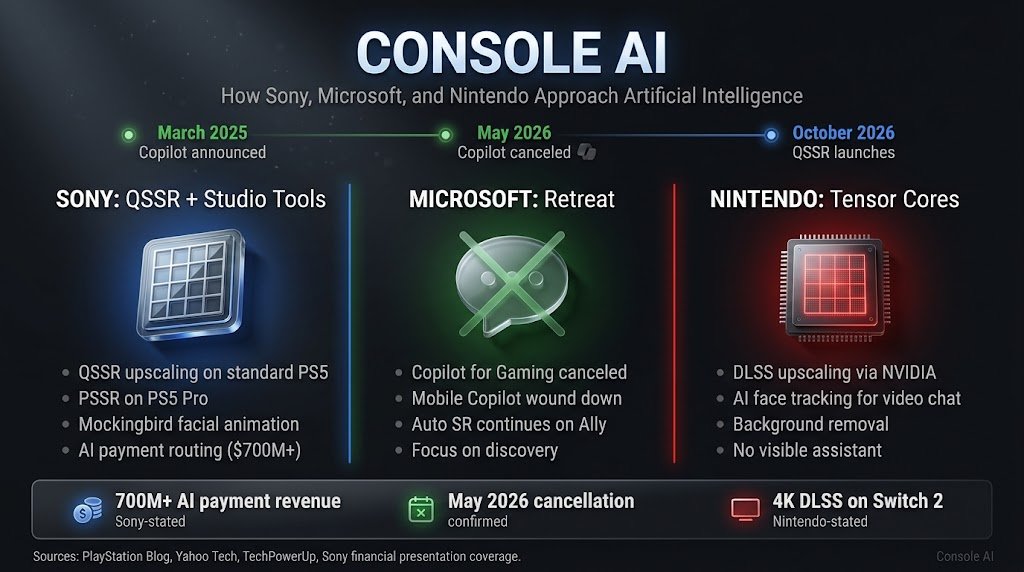
Console AI refers to artificial intelligence features built into or delivered through video game console hardware and platform services. In 2026, the three major platform holders have taken sharply different paths: Sony ships AI upscaling to standard PS5, Nintendo relies on NVIDIA tensor cores for DLSS and face tracking, and Microsoft canceled its visible Copilot assistant for Xbox consoles. The common thread is that AI works best when players do not notice it.
At-a-Glance
- Sony’s approach: QSSR upscaling arrives on standard PS5, starting with Marvel’s Wolverine and Ghost of Yōtei
- Nintendo’s approach: Switch 2 uses NVIDIA Tensor Cores for DLSS upscaling, ray tracing, and video chat face tracking
- Microsoft’s approach: Copilot for Gaming was canceled on consoles in May 2026 under new Xbox CEO Asha Sharma
- Sony’s studio tools: Internal AI like Mockingbird accelerates facial animation from performance capture
- The dividing line: AI that improves graphics and development is shipping; AI that inserts a chatbot into gameplay is not
- Key constraint: Standard PS5 lacks dedicated ML hardware, so QSSR targets lower internal resolutions than PS5 Pro’s PSSR
What Is Console AI?
Console AI is not a single product or standard. It describes the range of artificial intelligence technologies that console makers deploy to improve graphics, streamline development, or shape how players discover games.
The category spans three distinct layers. Hardware-level AI uses dedicated silicon, like the Tensor Cores in Nintendo’s custom NVIDIA chip, to run machine learning models locally. Platform-level AI handles recommendations, payment routing, and personalization on the backend. Development-facing AI gives studios tools to automate animation, testing, and asset creation.
What console AI is not, at least in 2026, is a conversational assistant sitting between you and your games. Microsoft tried that. It did not last.
Sony’s Console AI Strategy: QSSR and Studio Tools
Sony has taken the most visible hardware-facing AI step this year. In October 2026, PlayStation announced Quick Spectral Super Resolution, or QSSR, an AI upscaling technology coming to the standard PS5 .
How QSSR Works
QSSR is a lighter version of PlayStation Spectral Super Resolution, the AI upscaler that debuted on PS5 Pro. The Pro version analyzes every pixel and uses a neural network to reconstruct detail. That process was too computationally expensive for the standard PS5, which lacks the Pro’s dedicated machine learning hardware .
QSSR addresses this through two changes: a streamlined neural network architecture and a hand-tuned implementation built specifically for PS5 performance . The result is not identical to PSSR. Digital Foundry’s early analysis suggests standard PS5 will target 1440p-style upscaling rather than PS5 Pro’s 4K ambitions, but the clarity and temporal stability improvements are meaningful .
The first games to support QSSR are Marvel’s Wolverine and Ghost of Yōtei. Both received patches adding it as a graphics option on the same day .
Sony’s Internal Studio AI
Behind the scenes, Sony has deployed AI tools across PlayStation Studios. The company’s latest financial presentation highlighted Mockingbird, an internal system that converts performance capture data into animated 3D facial models. Work that previously took hours can now complete in “a fraction of a second” .
Sony also revealed an AI-assisted hair generation tool that builds strand-based 3D models from real-world footage. Naughty Dog and San Diego Studio have used these systems in released projects, including Horizon Zero Dawn Remastered .
SIE CEO Hideaki Nishino framed the strategy carefully: AI exists to “augment” developers, not replace them. The vision, design, and emotional impact of games will “always come from the talent of our studios and performers” .
The Quiet Revenue Engine
Less visible but financially significant is Sony’s use of AI in platform operations. Nishino stated that AI-powered transaction routing within PlayStation’s payment infrastructure generated more than $700 million in incremental revenue over recent years . This is console AI as commerce optimization, not gameplay feature.
Microsoft’s Console AI Retreat
Microsoft’s console AI story in 2026 is a story of cancellation.
Copilot for Gaming, 2025 to 2026
Copilot for Gaming was announced in 2025 as an AI assistant that would help players with tips, walkthroughs, game recommendations, and achievement tracking. At GDC 2026, Microsoft reaffirmed plans to bring it to current-generation consoles before the end of the year .
That plan did not survive. On May 5, 2026, new Xbox CEO Asha Sharma posted on X that Xbox would “begin winding down Copilot on mobile and will stop development of Copilot on console.” She said the feature did not align with the brand’s new direction .
Sharma took over Xbox in February 2026 following Phil Spencer’s departure. Her changes included reversing a Game Pass price hike and dropping the “This is an Xbox” marketing campaign. Canceling Copilot fit the pattern of shedding initiatives that had not resonated with players .
What Remains
Microsoft has not abandoned AI entirely. Sharma’s April 2026 post stated that Xbox would refocus AI efforts on “enhancing real-time graphics, improving discovery and deepening personalization” . Auto Super Resolution, an upscaling feature on Windows and ROG Xbox Ally handhelds, continues. AI-generated highlight reels remain available for Insiders on Ally devices.
The difference is visibility. These are background features, not a chatbot demanding attention during gameplay.
Nintendo’s Console AI: Tensor Cores and DLSS
Nintendo has taken the least publicized but most hardware-grounded approach. The Switch 2, unveiled in April 2026, runs on a custom NVIDIA processor with dedicated RT Cores and Tensor Cores .
What the Tensor Cores Enable
Tensor Cores are specialized hardware for machine learning operations. On Switch 2, they power three capabilities:
- DLSS upscaling: Deep Learning Super Sampling boosts resolution and sharpens detail without proportional performance cost
- AI-powered face tracking: Used in video chat for social gaming and streaming
- Background removal: Also for video chat, improving stream quality
The console supports up to 4K gaming in TV mode and up to 120 FPS at 1080p in handheld mode. Ray tracing runs on the RT Cores, separate from the Tensor Cores’ AI work .
Nintendo has not announced a visible AI assistant, chatbot, or generative feature for Switch 2. The company’s console AI is entirely infrastructural: the hardware runs AI workloads, but players interact with the results, not the technology.
Console AI Comparison
The contrast is stark. Sony is shipping AI as a graphics feature. Nintendo is shipping AI as hardware capability. Microsoft tried AI as an interface and retreated.
Technical Considerations
Upscaling Is Not Magic
AI upscaling improves perceived image quality by reconstructing detail from lower-resolution renders. It does not add information that was never rendered. A game running at 1440p internally and upscaled to 4K will look sharper than a native 1440p image, but it will not match a true 4K render in every case.
The quality depends on the training data and the specific implementation. DLSS on NVIDIA hardware has years of development behind it. QSSR is brand new, and Digital Foundry’s assessment is preliminary .
The Hardware Gap
Standard PS5 lacks dedicated ML hardware, which is why QSSR exists as a lighter alternative to PSSR. The Pro’s extra silicon allows a more computationally expensive upscaling pass. This gap is not a temporary limitation; it is a design difference between the two consoles.
Switch 2’s Tensor Cores give it hardware acceleration that standard PS5 lacks, despite being a less powerful device overall. The AI capability is not a measure of raw performance; it is a measure of what the hardware was designed to do.
Development Cost
Sony’s Daniel Craig stated that games already supporting PSSR can be adapted to QSSR with “a few days of tuning” . This low integration cost explains why two launch titles received same-day patches. If adaptation required months of work, the feature would arrive far more slowly.
Common Mistakes and Misconceptions
Assuming “console AI” means a chatbot. The most successful console AI in 2026 is invisible. It upscales images, tracks faces, and accelerates animation. The visible assistant Microsoft planned was canceled before release .
Believing Xbox has no AI. Microsoft canceled Copilot, not AI research. Auto SR and highlight generation continue on supported devices. The company’s AI work shifted from front-end to back-end .
Expecting DLSS on PS5. DLSS is NVIDIA technology. PlayStation uses AMD hardware. QSSR emerged from Project Amethyst, Sony’s collaboration with AMD on AI graphics . The two upscalers are not interchangeable.
Overestimating QSSR’s parity with PSSR. Sony explicitly states that “PSSR remains the gold standard on PS5 Pro” . QSSR is an improvement for standard PS5, not an equalizer.
Ignoring the studio-side AI. Console AI is not only player-facing. Mockingbird and similar tools affect how games are made, which affects what ships. The productivity gains are real, though Sony has not published independent verification of its “fraction of a second” claim .
Frequently Asked Questions
What is console AI?
Console AI describes artificial intelligence technologies built into or delivered through video game consoles. It includes AI upscaling for graphics, hardware-accelerated machine learning, development tools for studios, and platform services like recommendation engines and payment routing. It does not refer to a single product or standard.
Does the standard PS5 have AI upscaling?
Yes. Sony introduced QSSR in October 2026 for the standard PS5. It is a lighter version of the PSSR technology available on PS5 Pro. Marvel’s Wolverine and Ghost of Yōtei were the first games to support it . The standard PS5 lacks dedicated ML hardware, so QSSR targets lower internal resolutions than PSSR .
Is Copilot coming to Xbox consoles?
No. Xbox CEO Asha Sharma announced in May 2026 that development of Copilot for consoles was stopped and the mobile version was being wound down. She said the feature did not align with Xbox’s new direction . Microsoft continues to use AI for background features like Auto SR and highlight generation.
Does the Nintendo Switch 2 use AI?
Yes. The Switch 2’s custom NVIDIA processor includes Tensor Cores that power DLSS upscaling, AI face tracking, and background removal for video chat. The console supports up to 4K in TV mode and 120 FPS at 1080p in handheld mode . Nintendo has not announced a visible AI assistant for the platform.
Which console has the best AI features?
That depends on what you value. PS5 Pro has the most advanced upscaling with PSSR. Standard PS5 now has QSSR for improved image quality. Switch 2 has hardware-accelerated DLSS and video chat AI. Xbox has no visible AI assistant but continues background AI work. “Best” is not a meaningful measure across such different implementations.
Conclusion
Console AI in 2026 is defined by what ships quietly and what gets canceled loudly. Sony’s QSSR and Nintendo’s Tensor Cores represent the former: AI that works inside the graphics pipeline, improving what players see without asking for attention. Microsoft’s Copilot represents the latter: a visible feature that failed to justify its presence.
What matters most for players is understanding what these technologies actually do. QSSR and DLSS improve image quality from lower internal resolutions. They do not make games run at higher frame rates without cost, and they do not match native rendering in every scenario. The improvements are real but incremental.
The studio-side AI tools are harder to evaluate from the outside. Sony claims dramatic speedups in facial animation and asset creation. Those claims come from the company, not independent testing. Their effect on game quality and development timelines will become clearer as more titles ship.
Console AI suits players who want better visuals without thinking about the technology behind them. It does not suit anyone expecting a conversational assistant to transform their gaming experience. Microsoft tested that proposition and found the audience unwilling. The other platform holders appear to have learned from that outcome.