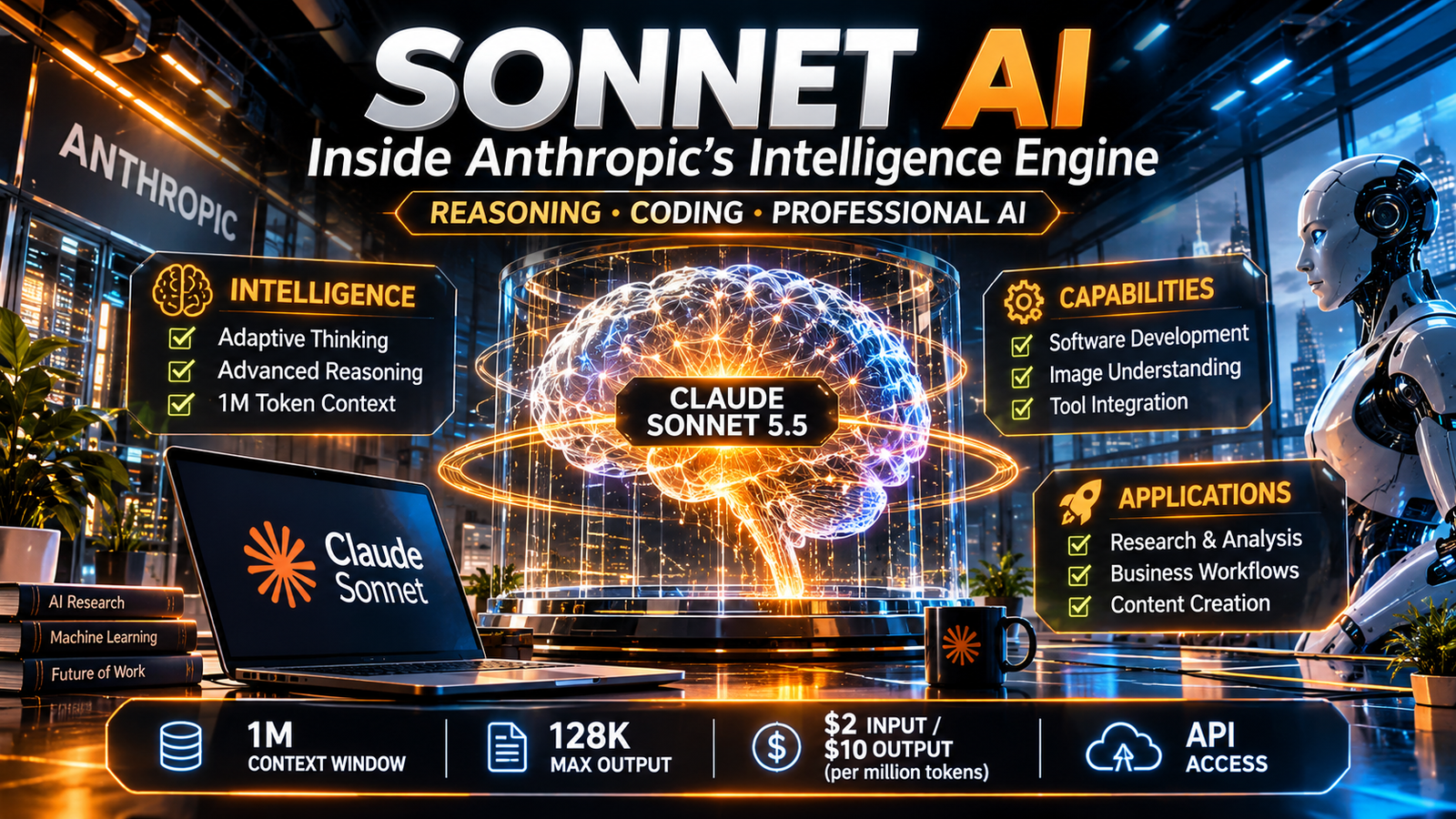
Sonnet AI commonly refers to Anthropic’s Claude Sonnet family, a series of AI models designed for coding, reasoning, writing, data analysis, and professional workflows. The latest model, Claude Sonnet 5.5, combines fast responses with advanced reasoning, a 1-million-token context window, and API access for developers.
Sonnet AI at a Glance
| Specification | Details |
|---|---|
| AI Model | Claude Sonnet 5.5 |
| Developer | Anthropic |
| Latest Version | Sonnet 5.5 |
| Primary Purpose | AI assistance, coding, reasoning, and productivity |
| Model Architecture | Proprietary Large Language Model (LLM) |
| Context Window | Up to 1 million tokens |
| Maximum Output | Up to 128,000 tokens |
| API Input Pricing | $2 per million tokens |
| API Output Pricing | $10 per million tokens |
| Availability | Claude, API, and supported cloud platforms |
Key Takeaways
- Sonnet AI is commonly used as shorthand for Anthropic’s Claude Sonnet models.
- Claude Sonnet 5.5 is the latest generation as of November 2026.
- Its applications include software development, writing, research, and business automation.
- The model supports text and image inputs, reasoning, and tool use.
- Its one-million-token context window supports substantial documents and extended workflows.
- API usage is billed separately according to token consumption.
What Is Sonnet AI?
Sonnet AI is a search term commonly associated with the Sonnet series of artificial intelligence models developed by Anthropic.
Anthropic created Claude as a family of conversational AI models. Sonnet represents one of its model tiers, positioned around a balance of intelligence, speed, and operating cost.
Rather than serving only as a chatbot, Claude Sonnet can support a wide range of professional activities. These include generating software, analyzing documents, understanding images, summarizing information, and assisting with complex workflows.
The name Sonnet also appears in third-party products and services. Therefore, users should check whether a website offers Anthropic’s official model or simply uses the same name for its own application.
Understanding the Claude Model Family
Anthropic organizes Claude models into different tiers to serve different workloads.
| Model family | Primary positioning | Typical applications |
|---|---|---|
| Claude Haiku | Speed and efficiency | Classification, extraction, simple tasks |
| Claude Sonnet | Balanced intelligence and speed | Coding, writing, analysis |
| Claude Opus | Advanced professional workloads | Complex coding and agentic projects |
| Claude Fable | Demanding reasoning and long-running agents | Extended research and complex tasks |
Anthropic’s current documentation also lists Claude Fable 5.2 and Claude Opus 5.5 alongside Sonnet 5.5. Claude Platform Docs+1
Sonnet is particularly relevant when a business needs substantial reasoning capabilities without automatically routing every request to its most expensive model.
How Does Sonnet AI Work?
Sonnet AI works through a large language model (LLM) trained to recognize patterns in language and other data. It processes user instructions, evaluates the available context, and generates responses based on learned patterns.
Its workflow can be understood through five stages.
1. Understanding User Instructions
Users provide questions, instructions, documents, code, or images.
The model interprets the request and identifies the intended task. Clear instructions generally make it easier to produce relevant results.
2. Processing Context
Sonnet analyzes the available conversation and supporting material.
Its large context window allows it to work with extensive documents, lengthy discussions, and substantial codebases, subject to actual token limits and request constraints.
3. Reasoning and Response Generation
The model processes information and generates a response.
Depending on the configuration, adaptive thinking can provide additional reasoning for more demanding tasks.
4. Tool Integration
Sonnet can work with supported tools through structured tool-use capabilities.
For example, a connected application might allow an AI workflow to retrieve information, execute code, or interact with an external service.
5. Producing Results
The model generates text based on the instructions and available information.
Depending on the application, results may include:
- Written explanations.
- Software code.
- Document summaries.
- Data analysis.
- Structured outputs.
- Recommendations and research assistance.
An important distinction: Sonnet itself does not automatically have access to every website, database, or business application. External access depends on the tools and integrations provided by the surrounding platform.
Key Features of Sonnet AI
Claude Sonnet 5.5 introduces several capabilities that make it relevant to professional and technical users.
Advanced Reasoning
Sonnet supports adaptive thinking, allowing the model to allocate reasoning effort according to the task.
This can help with complicated instructions, multi-step problems, and software development.
However, reasoning does not guarantee factual accuracy. Important outputs still require verification.
AI-Powered Coding
Software development is one of the most important applications of Sonnet.
Developers can use it to:
- Generate functions and scripts.
- Identify programming errors.
- Explain unfamiliar code.
- Refactor existing applications.
- Create unit tests.
- Review implementation approaches.
- Assist with debugging.
It can also participate in agentic coding workflows when connected to suitable development tools.
Large Context Window
One of Sonnet 5.5’s notable specifications is its one-million-token context window.
This allows developers to provide extensive supporting material within a request.
Potential applications include reviewing large codebases, analyzing multiple documents, and maintaining context across extended tasks.
However, a large context window does not mean unlimited memory. Information still needs to fit within the model’s actual request and output constraints.
Image Understanding
Sonnet supports image inputs.
Users can provide supported visual material for tasks such as:
- Understanding diagrams.
- Analyzing screenshots.
- Extracting information from visual documents.
- Interpreting charts.
- Reviewing interface designs.
Image interpretation can still produce mistakes, particularly with small text, complex charts, or unclear visual details.
Tool Use and AI Agents
Sonnet can interact with external tools through supported integrations.
This capability makes it useful for agentic workflows, where an AI system performs several connected operations rather than simply answering one question.
For example, a software development workflow could involve examining a repository, identifying an issue, proposing a modification, and running tests.
The actual actions depend on the permissions and tools available to the application.
Professional Writing and Analysis
Sonnet can assist with research summaries, business reports, content planning, document editing, and structured analysis.
Its usefulness depends on the quality of the source material and the clarity of the instructions.
Main Use Cases of Sonnet AI
Sonnet’s value becomes clearer when examined through real-world applications rather than general AI claims.
1. Software Development
Developers can use Sonnet to accelerate routine programming work.
For example, a developer building an e-commerce website might ask it to create a product filtering function, identify an error, or explain an unfamiliar API.
It can also help review code before deployment. Human review remains essential for security, performance, and correctness.
2. Content Creation and SEO
Content teams can use Sonnet for:
- Article outlines and first drafts.
- Keyword clustering.
- Content gap analysis.
- Editing and proofreading.
- Product descriptions.
- Research summaries.
- Frequently asked questions.
For SEO professionals, it can help organize search intent and identify relevant subtopics.
However, it cannot guarantee search rankings. Content quality, originality, topical relevance, technical SEO, and website authority still matter.
3. Research and Document Analysis
Researchers and business professionals often work with lengthy documents.
Sonnet can help summarize reports, compare documents, extract important information, and organize findings.
Its large context window is particularly useful when a task requires multiple supporting documents.
Users should still check important quotations, statistics, and references against original sources.
4. Business Productivity
Businesses can incorporate Sonnet into everyday workflows.
Examples include:
- Drafting internal reports.
- Preparing meeting summaries.
- Analyzing customer feedback.
- Organizing business information.
- Creating operational documentation.
- Assisting with customer support responses.
For automated workflows, businesses can connect the model to their existing software through APIs or supported integrations.
5. Education and Learning
Students and educators can use Sonnet as a learning assistant.
It can explain difficult concepts, simplify technical subjects, generate practice questions, and provide feedback on written work.
Its educational value is strongest when users ask it to explain the reasoning behind an answer rather than simply complete an assignment.
6. Data Analysis
Sonnet can assist with interpreting structured information and explaining analytical findings.
For example, a business analyst might provide sales data and request a summary of monthly performance.
More advanced workflows can connect the model to code execution and data-processing tools.
The model should not be treated as a replacement for validated calculations or professional statistical analysis.
Sonnet AI Pricing: How Much Does It Cost?
Sonnet pricing depends on how users access the model.
There is an important distinction between Claude’s consumer subscription plans and API billing.
API pricing is not the same as a monthly Claude subscription.
Claude Sonnet 5.5 API Pricing
Anthropic’s published pricing for Sonnet 5.5 is:
Claude Sonnet 5.5
Input
$2
Per 1 million tokens
Output
$10
Per 1 million tokens
USD pricing. API usage, not a monthly subscription.
Source: Anthropic’s official model pricing.
For example, consider an API workload that processes:
- 1 million input tokens.
- 100,000 output tokens.
The estimated base cost would be:
| Usage | Calculation | Cost |
|---|---|---|
| Input | 1 × $2 | $2.00 |
| Output | 0.1 × $10 | $1.00 |
| Total | $3.00 |
This is an illustrative calculation, not a fixed monthly fee.
Actual costs depend on token consumption, caching, tool usage, and other applicable charges.
Claude Subscription Options
Users who prefer a ready-to-use interface can access Claude through Anthropic’s consumer plans.
Subscription options include Free, Pro, Max, and business-oriented offerings, with availability and limits depending on the plan and region.
These plans may have usage restrictions that differ from API billing.
For current subscription details, consult the official Claude pricing page.
What Can Increase API Costs?
Several factors can affect the final bill:
- Long conversations: More conversation history can increase input tokens.
- Large documents: Processing extensive files consumes additional tokens.
- Long responses: Output tokens are more expensive than input tokens at the published base rates.
- Tool use: Tool definitions and tool results can add token consumption.
- Prompt caching: Cache writes and reads have their own pricing rules.
Businesses should test representative workloads before estimating their monthly AI budget. Claude by Anthropic+1
Sonnet AI vs. Other AI Models
Sonnet operates in a competitive market alongside models from OpenAI and Google.
The right choice depends on the workload, available integrations, performance requirements, and total operating cost.
Sonnet vs. ChatGPT
ChatGPT and Claude Sonnet serve overlapping audiences.
Both can assist with writing, programming, reasoning, research, and productivity.
The main difference is that ChatGPT is a broader consumer AI platform with its own model lineup and integrated tools, while Sonnet identifies a particular model family within Anthropic’s Claude ecosystem.
Users should compare the specific models and product features available to them rather than assuming one platform is universally better.
Sonnet vs. Google Gemini
Google Gemini offers another alternative for users who need AI assistance.
Gemini can be particularly relevant to workflows involving Google’s ecosystem and supported multimodal capabilities.
Sonnet may be attractive to developers and teams already using Anthropic’s API.
Actual performance should be evaluated against the same tasks and datasets.
Comparison Table
| Platform | Target user | Main strength | Pricing transparency | Limitation |
|---|---|---|---|---|
| Claude Sonnet 5.5 | Developers and professionals | Balanced speed and reasoning | Published API rates | Proprietary model |
| ChatGPT | General users and businesses | Broad AI platform | Published plans and API rates | Model and feature availability varies |
| Google Gemini | Google ecosystem users | Multimodal and integrated workflows | Published plans and API rates | Features vary by product |
| Open-source LLMs | Developers and researchers | Greater deployment control | Infrastructure-dependent | Hosting and maintenance requirements |
The comparison is based on product positioning, not a controlled benchmark. Independent testing is necessary before selecting a model for production.
Advantages and Limitations of Sonnet AI
No AI model is suitable for every situation. Sonnet offers useful capabilities, but users should understand its limitations.
Advantages
1. Versatile applications
Sonnet supports a broad range of professional tasks, including programming, writing, research, and analysis.
2. Large context capacity
Its one-million-token context window can support extensive inputs and document-heavy workflows.
3. Developer accessibility
API access allows developers to integrate the model into applications and automated systems.
4. Multimodal capabilities
Image understanding extends its usefulness beyond traditional text-based interactions.
5. Tool integration
Supported tool-use capabilities allow it to participate in more sophisticated workflows.
Limitations
1. It can generate incorrect information
Even advanced models can produce fabricated facts, incorrect calculations, or misleading explanations.
2. It is not open source
Anthropic does not provide Sonnet’s model weights for independent self-hosting.
3. API costs can grow
High-volume applications, long prompts, and repeated tool calls can increase operational expenses.
4. External tools require integration
The model cannot automatically access every external platform or database.
5. Large context does not guarantee perfect recall
Information may be overlooked or misunderstood, even when it fits within the context window.
6. Human supervision remains necessary
Important business decisions, production code, legal material, and sensitive information require appropriate review.
Privacy and Security: What Should Users Know?
Privacy is an important consideration when using any commercial AI model.
Sonnet can process sensitive material, including business documents, source code, customer information, and internal reports.
Before uploading such information, users should understand the applicable data policies.
Consider these precautions:
- Avoid sharing passwords, API keys, and confidential credentials.
- Review Anthropic’s data usage and retention policies.
- Understand the differences between consumer and commercial services.
- Check enterprise contractual terms before processing sensitive information.
- Apply access controls to connected tools.
- Follow applicable data protection requirements.
Does Sonnet AI Offer Zero Data Retention?
Users should not assume that API access automatically means zero data retention.
Zero Data Retention (ZDR) is a specific data-handling arrangement. It is different from general security measures, encryption, or third-party compliance certifications.
Organizations requiring ZDR should confirm eligibility, contractual terms, and the exact services covered directly with Anthropic.
Official documentation: Anthropic privacy and data policies.
Is Sonnet AI Suitable for Developers?
Sonnet is particularly relevant to developers because it combines language understanding, coding assistance, tool use, and API integration.
Developers can use the Claude API to build applications that send prompts and receive generated responses.
A typical integration follows this process:
- Create an Anthropic developer account.
- Generate an API key.
- Select an available Sonnet model.
- Configure the application to send requests.
- Process and validate model responses.
- Monitor token consumption and API costs.
Important Technical Considerations
Model selection: Use the model identifier supported by the current API documentation.
Context management: Avoid sending unnecessary conversation history.
API security: Store API keys on the server rather than exposing them in browser-side code.
Error handling: Account for rate limits, failed requests, and unexpected model outputs.
Evaluation: Test responses against real application requirements before deployment.
Migration: Review release notes before changing model versions because API parameters and behavior can change.
Developers should also consider model routing. Simple tasks may not require Sonnet, while more complex requests may justify a higher-capability model.
This approach can improve cost management without sacrificing the quality needed for demanding operations.
Sonnet AI Alternatives
Sonnet is not the only option for people looking for an advanced AI assistant.
The best alternative depends on whether the priority is coding, writing, research, affordability, or deployment flexibility.
Some alternatives worth evaluating include:
- Claude Opus: For demanding reasoning and complex professional workflows.
- Claude Haiku: For high-volume and latency-sensitive tasks.
- OpenAI GPT models: For applications requiring OpenAI’s model ecosystem.
- Google Gemini models: For multimodal applications and Google integrations.
- Llama: For developers exploring self-hosted AI deployments.
- Mistral: For teams evaluating alternative model architectures and deployment options.
Open-weight models can provide more control over deployment, but they also introduce infrastructure, maintenance, and operational responsibilities.
For developers, Hugging Face Models is a useful resource for discovering and evaluating available models.
Who Should Use Sonnet AI?
Sonnet can serve several audiences, although its usefulness varies by workload.
| User type | Potential benefit | Recommendation |
|---|---|---|
| Software developers | Coding and debugging assistance | Strong candidate |
| Content creators | Drafting and editing | Useful |
| SEO professionals | Research and content organization | Useful with fact-checking |
| Business teams | Document analysis and workflows | Suitable after testing |
| Researchers | Summarization and information analysis | Useful with source verification |
| Students | Explanations and learning assistance | Useful as a learning aid |
| AI developers | API-powered applications | Strong candidate |
Who Should Consider Another Option?
Sonnet may not be the right choice for everyone.
Users who require fully self-hosted models should investigate open-weight alternatives.
People who need specialized industry software may prefer purpose-built applications.
Organizations with strict compliance requirements should evaluate contractual privacy arrangements before deployment.
The best decision comes from testing the model against actual tasks rather than relying exclusively on marketing descriptions.
Latest Sonnet AI Developments in 2026
Anthropic’s Sonnet family has continued to evolve throughout 2026.
The following timeline highlights important developments.
Sonnet AI development timeline
- February 17, 2026Claude Sonnet 4.6 launches with improvements targeting coding, agents, and professional workflows.
- June 30, 2026Claude Sonnet 5 launches with a one-million-token context window and updated API capabilities.
- August 10, 2026Sonnet 5’s introductory API pricing of $2 input and $10 output per million tokens becomes permanent.
- September 28, 2026Claude Sonnet 5.5 launches with improvements in speed, cost efficiency, and professional workloads.
- November 23, 2026Sonnet 5.5 remains the latest Sonnet generation listed in Anthropic’s official model documentation.
Sources: Anthropic’s official announcements and platform release notes. Anthropic+3
According to Anthropic, Sonnet 5.5 runs 30% faster and costs up to 30% less for most work compared with Sonnet 5. These are company-reported improvements, not guarantees for every workload. Anthropic
For the latest technical changes, consult the official Claude release notes.
Frequently Asked Questions
1. What is Sonnet AI used for?
Sonnet AI is commonly used for coding, writing, research, document analysis, data processing, and business productivity. Anthropic’s Claude Sonnet models also support image understanding and tool-based workflows.
2. Is Sonnet AI free to use?
Claude offers a free subscription option with usage limits. Higher subscription tiers and API access have separate pricing structures. API users pay according to their model usage rather than receiving unlimited access through a free account.
3. Is Sonnet AI better than ChatGPT?
Neither platform is universally better. Claude Sonnet and ChatGPT offer different models, tools, integrations, and pricing structures. The right choice depends on the specific tasks, output quality, and workflow requirements.
4. What is the latest Sonnet AI model in 2026?
As of November 23, 2026, Anthropic lists Claude Sonnet 5.5 as its latest Sonnet model. It offers a one-million-token context window, up to 128,000 output tokens, and API pricing of $2 per million input tokens and $10 per million output tokens.
5. Can developers integrate Sonnet AI into their applications?
Yes. Developers can integrate Claude Sonnet through Anthropic’s API and supported cloud platforms. They can use it for coding assistants, document processing, AI agents, customer support workflows, and other applications.
Conclusion
Sonnet AI represents an important part of Anthropic’s Claude ecosystem.
Its combination of reasoning, coding assistance, multimodal capabilities, and API integration makes it relevant to developers, content professionals, researchers, and businesses.
Claude Sonnet 5.5 adds a substantial context window and competitive API pricing to that offering.
However, choosing an AI model requires more than comparing specifications. Users should evaluate output accuracy, actual workload performance, token consumption, privacy requirements, and integration costs.
For people seeking a versatile AI model for professional work, Sonnet is worth evaluating. The most reliable way to assess its value is to test it against real tasks and compare the results with alternative models.