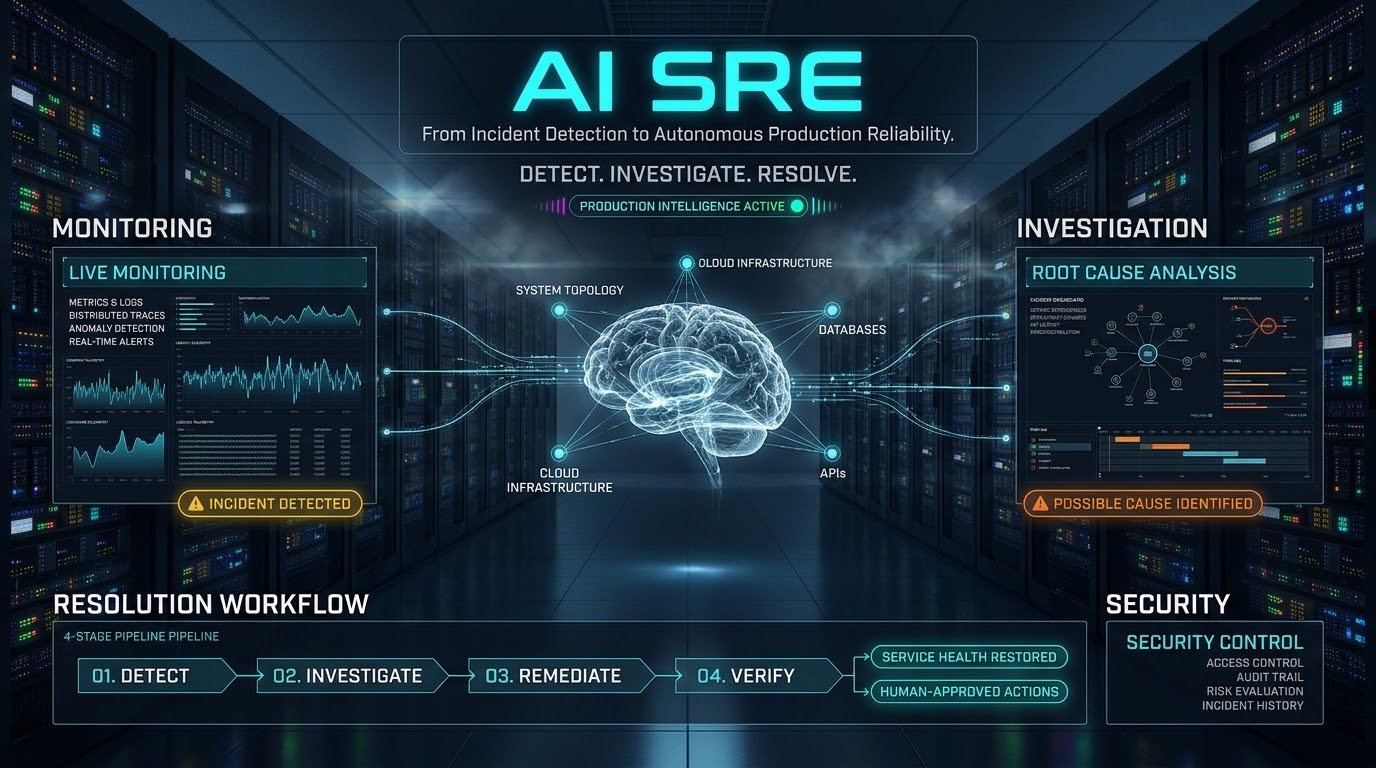
AI SRE uses artificial intelligence and intelligent agents to automate and assist site reliability engineering tasks, including incident investigation, root cause analysis, alert management, and production troubleshooting. It helps engineering teams understand system failures faster, reduce repetitive operational work, and improve service reliability while keeping humans responsible for critical decisions.
AI SRE at a Glance
- Meaning: AI-powered Site Reliability Engineering.
- Primary purpose: Improve the reliability and operational efficiency of software systems.
- Core capabilities: Incident detection, alert investigation, root cause analysis, and remediation support.
- Key technologies: Machine learning, large language models, observability data, automation, and AI agents.
- Main users: SRE teams, DevOps engineers, developers, and platform engineering teams.
- Important consideration: AI-generated diagnoses and production actions require verification, appropriate permissions, and safety controls.
What Is AI SRE?
AI SRE stands for Artificial Intelligence Site Reliability Engineering. It describes the use of AI technologies to support and automate the work involved in maintaining reliable software applications and infrastructure.
Traditional Site Reliability Engineering combines software engineering and IT operations. SRE teams monitor production systems, investigate failures, manage incidents, improve performance, and prevent recurring reliability problems.
However, modern applications have become increasingly distributed and complicated. A single application may depend on cloud infrastructure, microservices, databases, APIs, containers, and third-party services.
When something breaks, engineers often need to investigate several monitoring platforms before identifying the underlying problem.
AI SRE introduces intelligent systems that can assist with this investigation.
Instead of simply displaying an alert, an AI SRE agent can examine available logs, metrics, traces, deployment records, infrastructure changes, and historical incidents. It can then develop possible explanations and recommend appropriate actions.
Some advanced systems can also execute approved remediation workflows.
The important distinction: AI SRE is not simply another monitoring dashboard or chatbot. Its value comes from connecting operational information, investigating problems, and helping teams move from detection to resolution.
Why AI SRE Is Becoming Important
Modern software environments generate enormous amounts of operational information. Cloud-native applications, Kubernetes clusters, microservices, and continuous deployment pipelines create complex relationships between infrastructure components.
Traditional monitoring tools can identify unusual behavior. However, identifying an anomaly does not necessarily explain why it happened.
For example, an application may suddenly experience increased response times. The underlying cause could involve:
- A recent software deployment.
- Database connection exhaustion.
- Increased API latency.
- Memory pressure inside a container.
- An overloaded downstream service.
- An infrastructure configuration change.
An engineer may need to investigate several systems to connect these signals.
This process consumes valuable time, especially during high-severity incidents.
AI SRE addresses this operational challenge by automating parts of the investigation process.
Google’s November 2026 engineering publication describes an approach that combines autonomous mitigation agents, risk evaluation, authorization controls, and continuous evaluation. This illustrates how AI is moving beyond basic incident summaries toward governed operational actions. Google SRE+1
How AI SRE Works
AI SRE combines operational data, machine learning, large language models, and automation to investigate production problems.
Although implementations differ between platforms, most AI SRE systems follow a similar workflow.
1. Monitoring and Incident Detection
The process begins when a monitoring system detects unusual behavior.
Examples include:
- Increased application response times.
- Unexpected server resource consumption.
- Database connection failures.
- Elevated HTTP 500 errors.
- Kubernetes pod restarts.
- Sudden increases in failed API requests.
Monitoring systems generate alerts based on predefined thresholds, anomaly detection, or service-level objectives.
AI SRE can use these alerts as starting points for further investigation.
2. Collecting Operational Context
After receiving an alert, the AI agent gathers relevant information from connected systems.
This information may include:
- Application logs.
- Infrastructure metrics.
- Distributed traces.
- Recent deployments.
- Git commits and code changes.
- Cloud infrastructure events.
- Historical incident reports.
- Engineering documentation and runbooks.
This step is particularly important because an alert rarely contains enough information to identify the underlying cause.
3. Root Cause Analysis
The AI system examines relationships between different operational signals.
For example, an application slowdown may occur shortly after a new deployment. The agent can compare performance metrics before and after the release.
It may also inspect database queries, service dependencies, and recent configuration changes.
Using this evidence, it develops possible explanations and evaluates which ones best match the observed behavior.
This process is known as AI-assisted root cause analysis.
However, an AI-generated explanation is not automatically a verified diagnosis. Reliable systems should provide supporting evidence and allow engineers to challenge their conclusions.
4. Remediation Recommendations
Once the agent identifies a likely cause, it can recommend possible solutions.
Depending on its integrations and permissions, these recommendations might include:
- Rolling back a problematic deployment.
- Restarting an unhealthy service.
- Scaling an overloaded application.
- Adjusting infrastructure configuration.
- Reverting a faulty change.
- Updating a deployment or database setting.
Some platforms can prepare a remediation workflow or code change for human review.
Others support executing specific actions under predefined authorization policies.
5. Recovery Verification
A remediation action is not successful simply because a command executes.
The system must determine whether the original problem has actually disappeared.
AI SRE agents can monitor application health, compare performance metrics, and check whether the triggering alert has cleared.
If the problem persists, the agent may continue investigating or recommend another approach.
This creates a feedback loop:
The AI SRE incident lifecycle
- DetectIdentify an anomaly or production incident.
- InvestigateGather logs, metrics, traces, and deployment information.
- DiagnoseDevelop and evaluate root cause hypotheses.
- RemediateRecommend or execute an authorized corrective action.
- VerifyConfirm service recovery using production evidence.
Key Features of AI SRE Platforms
Not every AI SRE product provides the same capabilities. Some focus on investigation, while others concentrate on incident coordination or infrastructure remediation.
The most useful capabilities generally include the following.
Intelligent Alert Triage
AI can group related alerts, identify patterns, and help distinguish important incidents from repetitive notifications.
This reduces the need for engineers to investigate every alert independently.
Automated Root Cause Analysis
AI agents correlate operational signals to identify potential causes.
Instead of manually switching between multiple dashboards, engineers can receive an investigation containing relevant evidence, timelines, and hypotheses.
Log and Trace Analysis
Logs describe application events, while distributed traces show how requests move between services.
AI can analyze these sources together to identify errors, bottlenecks, and dependency-related failures.
Deployment and Change Analysis
Many production problems begin after software or infrastructure changes.
AI SRE tools can compare incident timelines with deployment histories, configuration updates, and code changes.
This helps engineers investigate whether a recent change contributed to the failure.
Automated Incident Documentation
Some platforms generate incident summaries, investigation timelines, handoff notes, and postmortem drafts.
These features reduce documentation work and help preserve operational knowledge.
Controlled Remediation
Advanced AI SRE agents can interact with approved operational tools.
However, production permissions should be restricted. High-impact actions should require explicit authorization unless the organization has validated a narrowly defined autonomous workflow.
AI SRE vs. Traditional SRE vs. AIOps
These terms overlap, but they describe different approaches to operational reliability.
| Area | Traditional SRE | AIOps | AI SRE |
|---|---|---|---|
| Main approach | Engineering practices and automation | AI-assisted IT operations analytics | AI-assisted or agentic reliability operations |
| Monitoring | Metrics and alerts | Anomaly detection | Intelligent monitoring and investigation |
| Incident response | Human-led | Automated correlation and prioritization | Agent-assisted investigation and response |
| Root cause analysis | Manual investigation | Pattern and event analysis | Evidence-based AI investigation |
| Remediation | Scripts and runbooks | Event-driven automation | Recommended or authorized agent actions |
| Human involvement | High | Depends on automation | Depends on autonomy and safeguards |
Is AI SRE the Same as AIOps?
No. AIOps applies AI and machine learning to IT operations, particularly event correlation, anomaly detection, and operational analytics.
AI SRE places greater emphasis on the reliability engineering workflow.
It can connect observability data with code changes, deployment history, runbooks, and incident response tools.
In practice, modern AI SRE platforms may use AIOps capabilities as part of a broader agentic workflow.
Benefits of AI SRE
AI SRE can improve operational efficiency, but its benefits depend on implementation quality, data availability, and engineering processes.
Faster Incident Investigation
Engineers often spend considerable time collecting information before they can begin solving a problem.
AI agents can automate much of this information gathering and present relevant evidence in one investigation.
This can reduce investigation time, although actual improvements must be measured within the organization’s environment.
Reduced Alert Fatigue
Repeated and unrelated notifications make it difficult to identify important incidents.
AI-based correlation can group related alerts and prioritize signals based on their operational context.
Better Operational Consistency
Human responders may investigate similar incidents differently.
AI systems can follow documented investigation procedures and reference previous incidents.
This creates more consistent troubleshooting workflows.
Improved Engineering Productivity
Developers and SREs can spend less time switching between dashboards, searching logs, and preparing incident summaries.
They can focus more attention on system improvements, reliability engineering, and preventive maintenance.
Better Knowledge Retention
Operational knowledge often becomes scattered across Slack conversations, incident reports, documentation, and individual engineers’ experience.
AI systems can retrieve relevant historical information when investigating recurring problems.
This is especially useful for teams managing complex production environments.
Real-World Example: How AI SRE Handles a Production Outage
Consider an e-commerce application experiencing unusually slow checkout requests.
Customers report failed purchases, and the monitoring system generates multiple alerts.
Here is how an AI SRE workflow could help.
Step 1: An alert appears.
The monitoring platform detects increased checkout latency and a growing number of failed requests.
Step 2: The agent investigates.
It collects application logs, database metrics, distributed traces, and recent deployment records.
Step 3: It identifies a possible cause.
The agent discovers that the latency increase began shortly after a new application release. Database connection usage also increased.
Step 4: It recommends remediation.
The system suggests investigating the latest release and preparing a rollback.
Step 5: An engineer reviews the action.
The responsible engineer verifies the evidence and approves the rollback.
Step 6: The system checks recovery.
The agent monitors checkout latency, database connections, and failed requests.
If the service returns to its expected operating condition, the investigation can be closed.
This example demonstrates the practical value of AI SRE: reducing the time between identifying a problem and understanding what needs to happen next.
AI SRE Tools and Platforms to Know in 2026
The AI SRE market includes observability vendors, incident management platforms, and dedicated agentic systems.
These categories should not be treated as interchangeable. Their capabilities, integrations, and operational permissions differ.
1. Datadog Bits AI
Datadog offers AI agents for system investigation, including Bits Investigation. Its capabilities include analyzing alerts, surfacing possible root causes, and suggesting remediation steps.
2. PagerDuty Paige
PagerDuty provides AI-assisted incident detection, triage, investigation, and response capabilities through its reliability platform.
Its SRE Agent approach focuses on combining AI agents with human responders.
3. Resolve AI
Resolve AI focuses on production engineering and agent-driven incident investigation across connected operational systems.
4. Cleric
Cleric focuses on AI-assisted production investigation, analyzing operational context and helping engineers understand changes and failures.
5. Komodor Klaudia
Komodor specializes in Kubernetes troubleshooting and operational visibility. Its Klaudia AI capabilities focus on helping teams investigate infrastructure problems.
6. Dynatrace
Dynatrace uses its Davis AI technology and dependency information to support anomaly detection, causal analysis, and operational troubleshooting.
AI SRE Platform Comparison
| Platform | Main strength | Target user | Pricing transparency |
|---|---|---|---|
| Datadog Bits AI | Observability-based investigation | Datadog users | Product-specific pricing |
| PagerDuty Paige | Incident response | On-call teams | Public platform tiers |
| Resolve AI | Cross-system investigation | Production engineering | Contact vendor |
| Cleric | AI investigation | SRE teams | Contact vendor |
| Komodor Klaudia | Kubernetes troubleshooting | Platform teams | Contact vendor |
| Dynatrace | Causal observability | Enterprise teams | Usage and commercial plans |
Comparison reflects publicly described product positioning, not independent benchmark testing. Product capabilities and commercial terms can change.
How to Choose an AI SRE Platform
Before selecting a platform, consider where your engineering team experiences the most operational friction.
- Choose observability-native AI when most operational information already lives in one monitoring platform.
- Consider dedicated AI SRE agents when engineers regularly investigate incidents across several disconnected systems.
- Consider incident management platforms when coordination, escalation, and response workflows are the primary challenges.
- Consider Kubernetes-focused solutions when infrastructure troubleshooting is the main operational bottleneck.
The most expensive platform is not necessarily the most useful. Integration quality and investigation accuracy matter more than the number of advertised AI features.
Limitations and Risks of AI SRE
Despite its potential, AI SRE is not a replacement for engineering judgment.
Production systems are complicated, and incorrect operational decisions can affect customers, data, and business operations.
1. Incorrect Root Cause Analysis
AI models can produce plausible explanations that do not match the actual failure.
A reliable platform should connect its conclusions to supporting logs, metrics, traces, and changes.
Engineers should verify important diagnoses before taking action.
2. Incomplete Observability Data
An AI agent cannot investigate information it cannot access.
Missing telemetry, inconsistent timestamps, incomplete traces, and poorly instrumented applications can reduce investigation quality.
3. Unsafe Autonomous Actions
An incorrect restart or rollback can create additional problems.
Production permissions should follow the principle of least privilege.
High-impact actions should require human approval, and automated changes should have rollback mechanisms.
4. Integration Complexity
AI SRE platforms often depend on connections to monitoring systems, cloud providers, source control, deployment pipelines, and communication tools.
Integration quality determines how much useful context the agent can access.
5. Operational Costs
AI investigations may involve model inference, data processing, API calls, and platform usage charges.
Long investigations and repeated queries can increase costs.
Organizations should measure the cost per investigation and the actual engineering time saved.
6. Security and Privacy Concerns
Operational information can contain sensitive infrastructure details, customer information, credentials, and internal code.
Before connecting an AI SRE platform, organizations should evaluate:
- Data retention policies.
- Model-provider data usage.
- Encryption practices.
- Role-based access controls.
- Audit logging.
- Data residency.
- Subprocessor access.
- Zero Data Retention availability, where required.
A SOC 2 report should not be treated as proof of Zero Data Retention. These address different aspects of security and data handling.
AI SRE Autonomy: How Much Should an AI Agent Control?
One of the most important decisions when implementing AI SRE is determining how much authority an AI agent should receive.
Not every organization is ready for fully autonomous production operations.
Google’s published AI SRE framework describes five autonomy levels. They range from human-operated workflows to systems capable of independently investigating and resolving incidents. Google SRE+1
| Level | Operating model | Human involvement |
|---|---|---|
| L0 | Manual operations | Humans perform every step |
| L1 | AI-assisted investigation | Humans approve and execute actions |
| L2 | Partial automation | Humans approve proposed actions |
| L3 | High autonomy | AI executes approved categories of actions independently |
| L4 | Full autonomy | AI manages the incident lifecycle independently |
The practical lesson is to increase autonomy gradually.
For example, an organization could initially allow an AI agent to investigate incidents and prepare remediation recommendations. After validating its performance, the organization might permit automatic remediation for specific, low-risk failures.
This approach makes it easier to evaluate reliability before expanding production permissions.
Technical Considerations Before Implementing AI SRE
Implementing AI SRE requires more than connecting a language model to a monitoring dashboard.
Organizations need reliable operational data, well-defined workflows, and appropriate security controls.
Observability Infrastructure
AI agents depend on operational context.
A useful observability environment should provide:
- Metrics for resource usage and service performance.
- Logs for application and infrastructure events.
- Distributed traces for service dependencies.
- Deployment records for change analysis.
- Historical incidents for comparison.
OpenTelemetry can help standardize the collection and transmission of telemetry across different systems.
This is particularly useful for organizations operating multiple cloud providers or observability platforms.
Integration With Existing Tools
Evaluate whether the AI SRE platform connects with your existing infrastructure.
Important integrations may include:
- AWS, Microsoft Azure, and Google Cloud.
- Kubernetes and Docker.
- GitHub and GitLab.
- Datadog, Grafana, and New Relic.
- Slack and Microsoft Teams.
- PagerDuty and incident.io.
- CI/CD pipelines and infrastructure automation tools.
An agent with limited integrations may provide incomplete investigation results.
Model Accuracy and Evaluation
AI SRE platforms should be evaluated against real operational scenarios.
Useful evaluation criteria include:
| Metric | What it measures |
|---|---|
| Mean Time to Detect (MTTD) | Time required to identify an incident |
| Mean Time to Acknowledge (MTTA) | Time required to acknowledge an incident |
| Mean Time to Restore (MTTR) | Time required to restore service |
| Root Cause Accuracy | Whether the proposed cause matches verified evidence |
| Remediation Success Rate | Percentage of successful corrective actions |
| False Positive Rate | Frequency of incorrect alerts or diagnoses |
| Cost per Investigation | AI and infrastructure cost for each investigation |
Do not evaluate an AI SRE system using response speed alone.
An agent that produces a fast but incorrect diagnosis may create more work than it saves.
Security and Permission Management
AI agents connected to production infrastructure need carefully controlled permissions.
A sensible implementation should include:
- Read-only access during initial deployment.
- Separate permissions for different environments.
- Explicit approval for high-impact actions.
- Audit trails for agent decisions and tool calls.
- Restricted credentials and short-lived access tokens.
- Emergency controls to disable automated execution.
Organizations should also protect agents against prompt injection hidden in logs, tickets, source code, and other untrusted operational data.
Should You Build or Buy an AI SRE Solution?
Some engineering organizations may consider building their own AI SRE agent using an LLM, internal APIs, observability data, and automation scripts.
This can provide greater control over workflows and infrastructure access.
However, building a reliable production agent requires more than connecting a model to several APIs.
Teams must maintain integrations, manage permissions, evaluate model behavior, prevent unsafe actions, and handle failures in the agent itself.
| Approach | Advantages | Limitations |
|---|---|---|
| Build internally | Custom workflows and infrastructure control | Requires ongoing engineering and maintenance |
| Buy a dedicated platform | Existing integrations and operational workflows | Vendor dependency and licensing costs |
| Extend existing tools | Fits current infrastructure and processes | Capabilities may be limited to the existing ecosystem |
For smaller teams, extending existing observability and incident management platforms may be a practical starting point.
Larger organizations with complex infrastructure may benefit from dedicated AI SRE platforms.
The decision should depend on operational requirements, engineering resources, security needs, and long-term ownership costs.
Who Should Use AI SRE?
AI SRE is particularly relevant for organizations managing production software at scale.
Site Reliability Engineers: Can use AI agents to investigate incidents, analyze infrastructure behavior, and reduce repetitive troubleshooting.
DevOps Engineers: Can connect AI investigation with deployment pipelines, cloud infrastructure, and automated workflows.
Platform Engineering Teams: Can use AI to investigate Kubernetes failures, service dependencies, and infrastructure changes.
Software Development Teams: Can investigate production errors and understand how recent code changes affect application reliability.
Engineering Leaders: Can evaluate incident trends, operational costs, reliability improvements, and the effectiveness of automation.
However, small applications with simple infrastructure may not need a dedicated AI SRE platform.
Traditional monitoring, clear runbooks, and straightforward automation may already provide sufficient reliability.
The Future of AI SRE in 2027 and Beyond
AI SRE is moving toward more autonomous production operations.
The next stage is not simply generating better incident summaries. It involves developing agents that can understand system behavior, investigate complex failures, and perform controlled remediation.
Several developments are worth watching.
Autonomous Incident Resolution
AI agents are increasingly being designed to investigate incidents and execute predefined remediation workflows.
The challenge will be proving that these actions are safe across different production conditions.
Persistent Operational Memory
Future systems may use historical investigations, deployment records, and incident documentation to build more useful operational knowledge.
This could help agents recognize recurring failures and avoid repeating unsuccessful troubleshooting steps.
Multi-Agent Collaboration
Different agents may specialize in monitoring, security, infrastructure, deployment analysis, and incident response.
These agents could coordinate their findings to investigate problems involving multiple systems.
Reliability Engineering for AI-Generated Software
AI coding assistants are increasing the amount of code developers can produce.
This creates additional pressure on testing, deployment verification, production monitoring, and reliability management.
Google’s AI engineering work highlights this relationship between increased development velocity and the need for more automated operational safeguards. Google SRE+1
The broader direction is clear: AI SRE will increasingly connect software development, production operations, and automated reliability management.
However, organizations will still need engineering oversight, measurable safeguards, and accountability.
Frequently Asked Questions
1. What does AI SRE stand for?
AI SRE stands for Artificial Intelligence Site Reliability Engineering. It refers to using AI technologies and intelligent agents to support reliability tasks such as monitoring, incident investigation, root cause analysis, and production remediation.
2. How is AI SRE different from traditional SRE?
Traditional SRE relies primarily on engineers, monitoring systems, automation scripts, and established operational practices. AI SRE adds intelligent agents that can analyze operational information, investigate incidents, recommend solutions, and sometimes execute authorized actions.
3. Can AI SRE resolve production incidents automatically?
Yes, some AI SRE platforms support autonomous remediation for specific scenarios. However, their permissions and capabilities vary. Organizations should begin with controlled, human-approved actions before allowing independent production changes.
4. What are the best AI SRE tools in 2026?
Relevant platforms include Datadog Bits AI, PagerDuty Paige, Resolve AI, Cleric, Komodor Klaudia, and Dynatrace. The right choice depends on existing infrastructure, integration requirements, investigation capabilities, security controls, and pricing.
5. Will AI SRE replace site reliability engineers?
No. AI SRE is designed to automate repetitive operational tasks and assist with complex investigations. Engineers remain essential for architecture decisions, incident accountability, risk management, and handling problems that require deeper technical judgment.
Conclusion
AI SRE represents an important development in modern software reliability engineering.
It combines artificial intelligence, observability, automation, and intelligent agents to help engineering teams investigate production incidents and manage increasingly complex infrastructure.
Its biggest potential advantage is reducing the manual work between detecting a problem and understanding how to resolve it.
However, successful adoption depends on more than choosing an AI platform. Organizations need reliable telemetry, effective integrations, measurable evaluation processes, and strict production access controls.
For engineering teams managing complex cloud-native applications, AI SRE is worth evaluating. The best starting point is an agent that investigates problems accurately, explains its findings, and keeps engineers in control of critical production decisions.