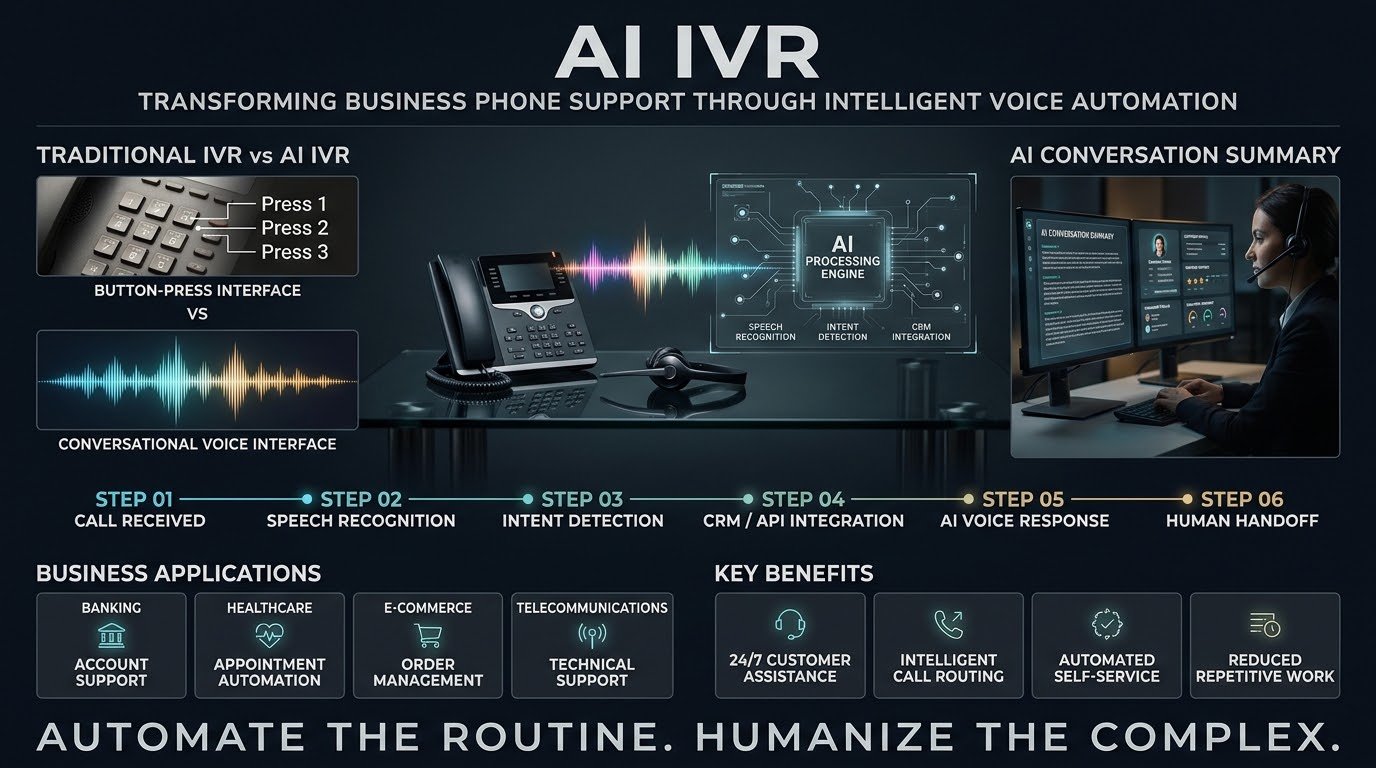
AI IVR (Artificial Intelligence Interactive Voice Response) is a phone automation system that uses speech recognition and conversational AI to understand callers, answer routine questions, and route calls without relying entirely on traditional keypad menus. It helps businesses automate customer interactions, reduce repetitive support work, and connect callers with the right assistance while preserving access to human agents.
AI IVR at a Glance
- Natural conversations: Callers can explain their needs instead of navigating lengthy phone menus.
- Intelligent call routing: AI identifies customer intent and directs calls to appropriate departments or agents.
- Automated self-service: Businesses can automate common requests, including appointment information, order updates, and account inquiries.
- Business integrations: Connections with CRM systems, databases, and APIs enable personalized responses and practical actions.
- Human escalation: Complex requests can move to live agents with relevant conversation context.
- Operational efficiency: Automation can reduce repetitive call handling and help support teams manage incoming demand.
What Is AI IVR?
AI IVR is an advanced version of Interactive Voice Response technology that uses artificial intelligence to understand spoken language and respond intelligently to customer requests.
Traditional IVR systems typically depend on predefined menus. Callers must press numbers or speak specific commands to reach their destinations.
AI-powered IVR takes a different approach. Instead of forcing customers through a fixed sequence, it allows them to explain their problems naturally.
For example, someone calling an internet service provider might say:
“I want to report that my internet connection keeps disconnecting.”
The AI IVR system identifies the issue as a technical support request. Depending on its integrations and permissions, it can check service information, offer troubleshooting instructions, or connect the customer with a technical support representative.
This changes the purpose of business phone automation. The system does not simply direct callers. It can also understand requests and complete selected tasks.
AI IVR vs. Traditional IVR
Although both technologies automate incoming calls, their underlying approaches differ.
| Feature | Traditional IVR | AI IVR |
|---|---|---|
| Customer input | Keypad or limited voice commands | Natural spoken language |
| Navigation | Predefined menus | Intent-based conversations |
| Understanding | Fixed rules and limited recognition | AI-powered language understanding |
| Call routing | Menu selections | Customer intent and available context |
| Self-service | Preconfigured transactions | More flexible automated interactions |
| Personalization | Usually limited | Possible through customer data integrations |
| Flexibility | Requires menu changes | Can use updated instructions and knowledge sources |
| Human support | Transfers based on menu logic | Can escalate with conversation context |
Traditional IVR remains useful for straightforward call flows. AI IVR becomes more valuable when customers have varied questions and need more flexible assistance.
The distinction is not that every traditional system is outdated. It is that conversational AI expands what automated phone systems can understand and accomplish. Salesforce+2
How Does an AI IVR System Work?
An AI IVR system combines several technologies to create a conversation between a caller and an automated phone platform.
The process typically involves speech recognition, language understanding, decision-making, business integrations, and voice generation.
1. Incoming Call Detection
The process begins when a customer calls a business telephone number.
The call enters the company’s telephony infrastructure through a traditional telephone network or a Voice over Internet Protocol (VoIP) service.
The system connects the caller to the configured IVR workflow.
An introductory message may explain that an AI assistant is handling the call and ask how it can help.
2. Automatic Speech Recognition
Automatic Speech Recognition (ASR) converts spoken language into text.
For example, a caller might say:
“Can you tell me when my package will arrive?”
The speech recognition engine converts that audio into a text representation that other components can process.
Recognition quality depends on several factors:
- Background noise
- Microphone and telephone audio quality
- Speaking speed
- Accents and pronunciation
- Language support
- Technical performance of the speech recognition model
Modern speech recognition can handle many conversational situations, but it is not perfect.
3. Natural Language Understanding
After transcription, Natural Language Understanding (NLU) identifies what the customer actually wants.
The system extracts two important elements:
- Intent: The purpose of the request.
- Entities: Relevant information, such as an order number, date, account identifier, or product name.
For example:
“I need to change my appointment from Monday to Wednesday.”
The system might identify:
| Component | Interpretation |
|---|---|
| Intent | Reschedule appointment |
| Current date | Monday |
| Requested date | Wednesday |
| Required action | Check appointment availability |
This allows the platform to understand requests beyond predefined keywords.
4. AI Decision-Making and Backend Integration
Once the system understands the request, it determines the appropriate next step.
It may connect to a Customer Relationship Management (CRM) platform, appointment database, order management system, or another business application.
APIs allow the AI IVR platform to retrieve information and perform authorized operations.
For example, an e-commerce customer might request an order update. The system can retrieve the order status through an API and communicate the available information.
More advanced implementations can use large language models (LLMs) to interpret complex requests and coordinate multiple actions.
However, the AI should not independently invent account information or execute sensitive transactions without appropriate verification and business rules.
5. Text-to-Speech Response
After processing the request, the system generates a spoken response.
Text-to-Speech (TTS) technology converts the response into audio.
Depending on the platform, businesses may configure:
- Voice selection
- Speaking speed
- Language
- Pronunciation
- Conversational tone
- Response style
The caller hears the answer through the telephone connection.
6. Resolution or Human Handoff
The final step depends on the customer’s needs.
If the system can safely complete the request, it provides the answer or performs the authorized action.
If the request requires human judgment, additional verification, or specialist support, the call moves to a live representative.
A well-designed handoff can include the caller’s transcript, identified intent, and information already collected.
This prevents customers from repeating the same explanation after reaching an agent.Exotel+2
Key Features of AI IVR Systems
Not every AI IVR product offers the same capabilities. Some focus primarily on conversational routing, while others support broader customer service automation.
The following features are particularly relevant when evaluating a platform.
Natural Language Conversations
Customers can describe their problems using everyday language rather than memorizing menu options.
This makes the phone experience more flexible, especially when callers do not know which department handles their request.
Intelligent Call Routing
AI identifies the reason behind an incoming call and selects an appropriate destination.
A billing inquiry can go to the billing department, while a technical problem can reach technical support.
More sophisticated systems may also consider agent availability, skills, and customer priority.
Automated Customer Self-Service
AI IVR can handle selected requests without requiring a human representative.
Depending on integrations, these may include:
- Checking order status
- Confirming appointments
- Providing business hours
- Answering frequently asked questions
- Sharing account information
- Collecting service requests
- Providing basic troubleshooting instructions
The available functions depend on the business systems connected to the platform.
CRM and API Integrations
CRM integrations help connect telephone conversations with existing customer records.
For example, an authorized system might identify a returning customer and retrieve relevant account information.
API integrations extend this functionality by connecting the IVR to operational systems.
Businesses should examine integration depth rather than assuming that a vendor’s advertised integration supports every required action.
Multilingual Voice Support
Some AI IVR platforms support multiple languages and voice configurations.
This can help international businesses and organizations serving customers with different language preferences.
However, multilingual support should be evaluated carefully. A platform supporting a language does not automatically guarantee accurate recognition of every regional accent or dialect.
Call Analytics and Reporting
AI IVR systems can provide information about customer interactions.
Depending on the platform, reporting may include:
- Call volume
- Common customer intents
- Transfer frequency
- Self-service completion
- Call abandonment
- Recognition failures
- Customer interaction trends
These insights can help businesses identify problems in their customer service workflows.
Main Use Cases of AI IVR Across Industries
AI-powered IVR is useful wherever customers regularly contact an organization for information, assistance, or routine transactions.
Its value depends on how frequently requests occur and whether the business can connect the voice system to reliable information.
1. Banking and Financial Services
Banks receive large numbers of calls about account information, card services, transactions, and payment issues.
AI IVR can help automate selected customer interactions.
Potential applications include:
- Providing branch and ATM information
- Checking selected account information after authentication
- Explaining payment procedures
- Reporting lost or stolen cards
- Routing loan and credit inquiries
- Providing transaction-related assistance
Financial institutions must apply strong identity verification and access controls. Sensitive financial actions should follow approved security procedures.
2. Healthcare and Hospitals
Healthcare organizations frequently manage appointment requests, scheduling questions, and administrative inquiries.
AI IVR can help patients access routine information without waiting for reception staff.
Common applications include:
- Appointment confirmation
- Appointment rescheduling
- Clinic opening hours
- Department information
- Appointment reminders
- Basic administrative questions
Healthcare providers must be particularly careful with patient information, call recordings, and automated responses.
An AI system should not replace qualified medical professionals or independently make clinical decisions.
3. E-commerce and Retail
Online retailers receive calls about deliveries, returns, product availability, and payment problems.
AI IVR can connect customer requests with order management and CRM systems.
For example, a customer might ask:
“Where is my order, and when should it arrive?”
The system can retrieve the available delivery information and communicate the expected status.
Other applications include:
- Return policy information
- Delivery updates
- Refund request routing
- Store opening hours
- Product inquiry routing
- Complaint registration
4. Telecommunications
Telecommunication companies manage substantial support demand involving connectivity, billing, subscriptions, and technical problems.
AI IVR can identify common issues and guide callers through approved troubleshooting procedures.
It can also route complex network or account problems to specialized teams.
For example, a customer reporting an internet outage could receive relevant service information before being transferred to technical support.
5. Travel and Hospitality
Airlines, hotels, and travel agencies frequently receive questions about bookings and reservations.
AI IVR can support:
- Booking information
- Reservation confirmation
- Check-in instructions
- Flight information
- Cancellation procedures
- Hotel service inquiries
Where systems permit, integrations can retrieve booking information and support authorized changes.
6. Education and Public Services
Educational institutions and public organizations can use AI IVR to handle repetitive inquiries.
Potential applications include:
- Admission information
- Application status inquiries
- Examination schedules
- Office hours
- Department routing
- General service information
This helps organizations provide information outside normal office hours.
Benefits of AI IVR for Businesses
The main advantage of AI IVR is not simply replacing keypad menus. It is making automated telephone interactions more useful.
Reduced Repetitive Work
Customer support teams spend considerable time answering similar questions.
AI IVR can automate suitable requests, allowing employees to concentrate on more complicated cases.
Improved Customer Accessibility
Customers can explain their needs without learning a complicated menu structure.
This can make automated support easier to navigate, particularly when businesses receive different types of inquiries.
24/7 Customer Assistance
AI IVR can operate outside traditional business hours, provided its telephony infrastructure and connected services remain available.
Customers may still access selected information or complete supported tasks when human representatives are unavailable.
More Consistent Customer Interactions
A properly configured system can deliver consistent information using approved knowledge sources and business rules.
This reduces dependence on individual agents for repetitive questions.
However, consistency depends on keeping the underlying information accurate and current.
Better Call Management
Intelligent routing can help businesses distribute incoming calls according to customer intent.
It can also reduce unnecessary transfers when the system correctly identifies the appropriate destination.
Actionable Customer Insights
Call transcripts and interaction analytics can reveal recurring questions, common complaints, and service problems.
Businesses can use these insights to improve support procedures and identify opportunities for automation.
Important distinction: These are potential operational benefits, not guaranteed outcomes. Actual improvements depend on call volume, integration quality, recognition accuracy, workflow design, and customer adoption.
AI IVR vs. Conversational IVR vs. AI Voice Agents
These terms frequently appear together in the customer service technology market.
However, they do not always describe exactly the same product.
| Technology | Primary Purpose | Typical Capability |
|---|---|---|
| Traditional IVR | Automated call navigation | Keypad menus and predefined routing |
| AI IVR | Intelligent telephone automation | Intent recognition and automated call handling |
| Conversational IVR | Natural voice interaction | Back-and-forth spoken conversations |
| AI Voice Agent | More autonomous voice assistance | Multi-step conversations and task execution |
AI IVR generally describes the intelligent telephone response system.
Conversational IVR emphasizes the natural-language experience presented to callers.
AI voice agents often describe broader systems capable of handling complete conversations and executing multiple tasks.
The boundaries overlap. Some vendors use these terms interchangeably, so buyers should evaluate actual functionality rather than marketing terminology. Exotel+2
Popular AI IVR Platforms and Technologies
The AI IVR market includes enterprise conversational AI platforms, cloud communication services, and contact center solutions.
There is no universal platform suitable for every business. The right choice depends on call volume, technical requirements, existing infrastructure, integration needs, and budget.
Here are several established providers and technologies worth investigating.
1. Cognigy
Cognigy focuses on enterprise conversational AI and customer service automation. Its AI IVR offering is relevant to organizations looking for natural-language telephone interactions and integration with existing contact center environments.
2. Exotel
Exotel provides cloud telephony and conversational AI capabilities. Its AI IVR approach focuses on understanding spoken requests, automating customer interactions, and connecting calls with appropriate support.
3. Vonage
Vonage offers communications technologies and AI-related customer interaction solutions. Its AI IVR materials discuss speech recognition, natural language processing, and automated customer service.
4. Salesforce
Salesforce provides customer service and contact center technologies. Its IVR resources explain how voice automation can connect with customer information and service workflows.
5. Twilio
Twilio offers programmable communications infrastructure that developers can use to build telephone workflows and integrate voice services with applications.
Its programmable approach can suit teams that want greater control over their IVR architecture.
Platform Comparison
| Platform | Target User | Key Strength | Pricing Transparency | Main Consideration |
|---|---|---|---|---|
| Cognigy | Large enterprises | Conversational AI | Obtain a quote | Enterprise implementation |
| Exotel | Businesses and contact centers | Cloud telephony and AI | Verify regional plans | Integration requirements |
| Vonage | Businesses and developers | Communications infrastructure | Depends on product | Product-specific capabilities |
| Salesforce | CRM-focused organizations | Customer service ecosystem | Depends on selected products | Existing ecosystem requirements |
| Twilio | Developers and technical teams | Programmable voice APIs | Usage-based pricing information available | Development and maintenance effort |
These are platform-level comparisons, not a verified ranking of AI IVR products. Some providers offer broader communications or CRM capabilities rather than a standalone AI IVR product.
How Much Does AI IVR Cost?
AI IVR pricing varies considerably because vendors package voice automation differently.
Some offer complete contact center subscriptions. Others charge for telephony usage, AI processing, or individual interactions.
A business should examine the complete cost structure rather than comparing subscription prices alone.
Common AI IVR Pricing Models
1. Monthly Subscription
Some providers charge a recurring subscription for access to their platform.
The price may depend on users, agents, features, or service tiers.
2. Per-Minute Charges
Cloud communication services may charge according to call duration.
Incoming and outgoing calls can have different rates depending on the provider and destination.
3. Usage-Based AI Charges
Some implementations involve separate costs for speech recognition, language models, and voice generation.
These expenses can increase with call volume and conversation length.
4. Enterprise Contracts
Large organizations may require customized contracts covering integrations, deployment, support, security requirements, and service-level agreements.
Hidden Costs Businesses Should Consider
The advertised subscription may not represent the total operating expense.
Review these potential costs before choosing a platform:
- Telephone numbers and call termination
- Speech-to-text processing
- Text-to-speech generation
- LLM inference and API usage
- CRM integration development
- Custom workflow configuration
- Call recording and storage
- Human-agent contact center licenses
- Maintenance and technical support
Practical advice: Request a cost estimate based on actual monthly call volume, average call duration, expected automated resolution, and the number of required integrations.
Do not assume that every provider includes AI processing and telephone usage in one price.
Limitations and Challenges of AI IVR
Despite its capabilities, AI IVR is not a perfect replacement for traditional customer service.
Businesses should understand its limitations before deploying it.
Speech Recognition Errors
Speech recognition systems can misunderstand callers because of background noise, unclear pronunciation, accents, or poor telephone connections.
A misinterpreted request can send a customer through the wrong workflow.
Businesses should test systems using real-world call recordings and representative language samples, subject to appropriate consent and privacy controls.
Complex Customer Requests
Some problems require human judgment.
A customer disputing a complicated transaction or explaining multiple unrelated issues may need a human representative.
AI IVR should recognize when it cannot reliably resolve a request.
Integration Dependencies
An AI IVR system is only as useful as the information and actions available to it.
If a connected CRM, booking system, or customer database becomes unavailable, certain automated functions may stop working.
Poor data quality can also produce incorrect answers.
Latency and Conversation Delays
AI IVR requires several components to work together.
Speech recognition, language processing, backend requests, and voice generation all contribute to response time.
Slow responses can make conversations feel unnatural.
Businesses should measure end-to-end response latency under realistic call conditions, not just individual model performance.
Customer Acceptance
Not every customer wants to interact with an automated voice assistant.
Some callers prefer speaking directly with a person, especially when dealing with complaints or sensitive issues.
Providing an accessible human-support option remains important.
Unexpected AI Responses
Systems using generative AI can occasionally produce inaccurate or unsupported information.
This becomes particularly important when answering questions about payments, policies, healthcare, or financial services.
Organizations should use approved knowledge sources, controlled actions, validation rules, and escalation procedures.
AI IVR Privacy and Security Considerations
AI IVR systems can process sensitive information, including customer names, account details, telephone numbers, voice recordings, and conversation transcripts.
Businesses must understand how this information moves through the system.
Call Recording and Consent
Organizations should establish clear recording policies.
Customers should receive appropriate disclosures, and businesses must follow applicable recording and consent laws.
Requirements vary by jurisdiction and industry.
Data Encryption
Check whether the provider protects information during transmission and storage.
Also examine how recordings, transcripts, authentication details, and integration credentials are handled.
Access Controls
Only authorized employees and services should access customer interaction data.
Role-based permissions can help restrict access according to job responsibilities.
Data Retention Policies
Ask vendors:
- How long are recordings retained?
- Are transcripts stored separately?
- Can businesses configure deletion periods?
- Are conversations used for model training?
- Which third-party AI providers process the data?
- Can customer information be excluded from model training?
- Is Zero Data Retention available for relevant processing services?
Compliance and Certifications
Organizations in regulated sectors should investigate the provider’s applicable compliance documentation.
For example, SOC 2 reports can provide information about a service organization’s controls.
However, SOC 2 does not automatically guarantee Zero Data Retention, regulatory compliance, or complete protection against data exposure.
Healthcare organizations should also examine whether the vendor supports the contractual and technical requirements applicable to their operations.
The important point is to assess the complete data-processing chain, including telephony providers, AI model providers, cloud infrastructure, and external integrations.
How to Choose the Right AI IVR System
Selecting an AI IVR platform requires more than comparing marketing features.
A system that performs well in a demonstration may struggle with real customer conversations.
Use the following evaluation criteria.
1. Understand Your Call Volume
Start by examining incoming calls and identifying the most common reasons customers contact your organization.
Look for repetitive inquiries that can be handled safely through automation.
2. Evaluate Language and Accent Support
Test the platform with the languages your customers actually speak.
For businesses serving multilingual communities, test mixed-language conversations, regional pronunciation, and code-switching.
Do not rely solely on a vendor’s language-support list.
3. Check Integration Capabilities
Determine whether the system connects with your existing:
- CRM software
- Customer databases
- Help desk applications
- Payment platforms
- Booking systems
- Order management tools
- Contact center infrastructure
Confirm whether integrations support actual data retrieval and actions or simply provide basic connectivity.
4. Examine Human Handoff
A good AI IVR should know when to stop automating.
Check whether it can transfer customers to the right department while preserving relevant conversation information.
5. Test Real Conversation Quality
Run realistic scenarios involving:
- Background noise
- Different accents
- Interrupted conversations
- Unclear requests
- Multiple questions
- Customer frustration
- Requests outside the knowledge base
Evaluate whether the system recovers from misunderstandings or repeatedly asks customers to start again.
6. Calculate Total Cost of Ownership
Compare the full cost of running the system, including telephone usage, AI processing, integration, support, and maintenance.
A lower starting subscription does not necessarily mean a lower long-term operating cost.
7. Review Security Documentation
Request relevant security documentation, data-processing agreements, retention details, and information about third-party processors.
Do not accept general claims such as “enterprise-grade security” without examining the underlying controls.
How to Implement AI IVR Successfully
A phased implementation is generally more manageable than replacing every existing telephone workflow immediately.
A practical implementation process involves six stages.
- Audit existing calls: Identify common customer questions, transfer patterns, and repetitive tasks.
- Select automation opportunities: Start with low-risk requests that have clear answers and reliable data sources.
- Choose the technology: Evaluate conversational AI, telephony infrastructure, integrations, and security requirements.
- Configure workflows: Define intents, responses, authentication rules, escalation conditions, and approved actions.
- Run a controlled pilot: Test with a limited set of call types before expanding to the entire customer service operation.
- Monitor and improve: Review unsuccessful calls, recognition errors, customer feedback, and automation outcomes.
Metrics to Measure After Deployment
Businesses should establish measurable performance indicators before launching an AI IVR system.
| Metric | What It Measures |
|---|---|
| Call containment rate | Calls completed without human-agent assistance |
| First contact resolution | Customer issues resolved during the initial interaction |
| Average handling time | Time required to handle customer interactions |
| Transfer rate | Percentage of calls transferred to human agents |
| Call abandonment rate | Calls disconnected before reaching a resolution |
| Recognition accuracy | How reliably the system understands spoken requests |
| Customer satisfaction | Customer feedback about the support experience |
| Cost per resolved call | Operating expense for each successfully resolved interaction |
One metric deserves special attention: call containment.
A high containment rate is not automatically positive. A system that prevents customers from reaching human support may report fewer transfers while creating a worse customer experience.
Measure successful resolution alongside containment.
The Future of AI IVR
AI IVR is developing beyond simple speech recognition and automated routing.
Improvements in generative AI, voice models, and agent-based systems are expanding what automated phone conversations can accomplish.
Several developments are particularly relevant.
More Natural Voice Conversations
Advances in speech recognition and voice generation are making conversational systems more flexible.
Future implementations may handle interruptions, clarifying questions, and conversational context more effectively.
LLM-Powered Customer Support
Large language models can help interpret requests that do not fit predefined categories.
When combined with approved knowledge sources and business rules, they can generate relevant responses and coordinate selected workflows.
However, generative capabilities still require validation and appropriate restrictions.
Agentic Voice Automation
AI agents can potentially coordinate multiple steps within a customer interaction.
For example, an authorized system might identify a booking request, check availability, retrieve customer information, and initiate a permitted change.
This requires reliable APIs, authentication, transaction controls, and clear escalation rules.
Better Multilingual Communication
Improved speech technologies may make it easier for organizations to support customers speaking different languages.
For businesses serving multilingual populations, recognition accuracy and natural language switching will remain important evaluation criteria.
Deeper Contact Center Integration
AI IVR is increasingly considered part of a broader customer experience environment.
Rather than operating as an isolated phone menu, it can connect voice interactions with CRM records, support tickets, analytics, and other communication channels.
The long-term opportunity is not simply replacing human operators. It is creating a more connected customer service experience in which automation handles appropriate tasks and people manage situations requiring judgment.
Who Should Use AI IVR?
AI IVR can benefit organizations with frequent incoming calls and repetitive customer service requests.
It may be particularly suitable for:
- Small and medium-sized businesses: Automating routine calls without expanding support teams for every increase in demand.
- Large enterprises: Managing high call volumes across multiple departments and locations.
- Contact centers: Improving call routing and reducing repetitive agent workloads.
- E-commerce businesses: Handling order updates, delivery inquiries, and return questions.
- Healthcare providers: Supporting appointment scheduling and administrative inquiries.
- Telecommunication companies: Automating common billing and technical support interactions.
- Financial institutions: Supporting carefully controlled account inquiries and service workflows.
Businesses with low call volumes or highly specialized customer interactions may find a conventional IVR or human-operated telephone service more practical.
The decision should depend on actual operational needs rather than the popularity of AI automation.
Frequently Asked Questions
1. What does AI IVR stand for?
AI IVR stands for Artificial Intelligence Interactive Voice Response. It refers to telephone automation technology that uses artificial intelligence, speech recognition, and natural language understanding to interpret customer requests and provide automated responses or call routing.
2. What is the difference between AI IVR and traditional IVR?
Traditional IVR generally uses predefined menus and keypad selections to navigate telephone systems. AI IVR uses speech recognition and natural language processing to understand spoken requests, allowing customers to communicate more naturally and access automated assistance.
3. Can AI IVR replace human customer service agents?
AI IVR can automate repetitive requests and resolve selected customer inquiries without human assistance. However, complex complaints, sensitive situations, and decisions requiring human judgment still benefit from live representatives. Most businesses should use AI to support human agents rather than eliminate them entirely.
4. How much does an AI IVR system cost?
AI IVR pricing depends on the provider, call volume, subscription model, telephone usage, AI processing, and integration requirements. Some platforms use monthly subscriptions, while others charge according to usage or offer customized enterprise contracts. Businesses should calculate total operating costs before selecting a solution.
5. Is AI IVR secure for banking and healthcare?
AI IVR can be deployed in banking and healthcare environments when appropriate security, authentication, access controls, encryption, and data-handling procedures are implemented. Organizations should verify vendor documentation, regulatory requirements, recording policies, and data retention practices before deployment.
Conclusion
AI IVR represents an important development in automated customer communication.
By combining speech recognition, natural language understanding, and business integrations, it allows customers to interact with telephone systems more naturally.
Its greatest value comes from automating routine requests, improving call routing, and giving human support teams more time for complicated customer problems.
However, implementation requires careful planning. Speech recognition errors, integration dependencies, privacy concerns, and unreliable automated responses can undermine the customer experience.
Businesses should evaluate platforms based on actual conversational performance, integration capabilities, security documentation, and total operating costs.
The most practical approach is to automate what AI can reliably handle while keeping human assistance accessible whenever customers need it.