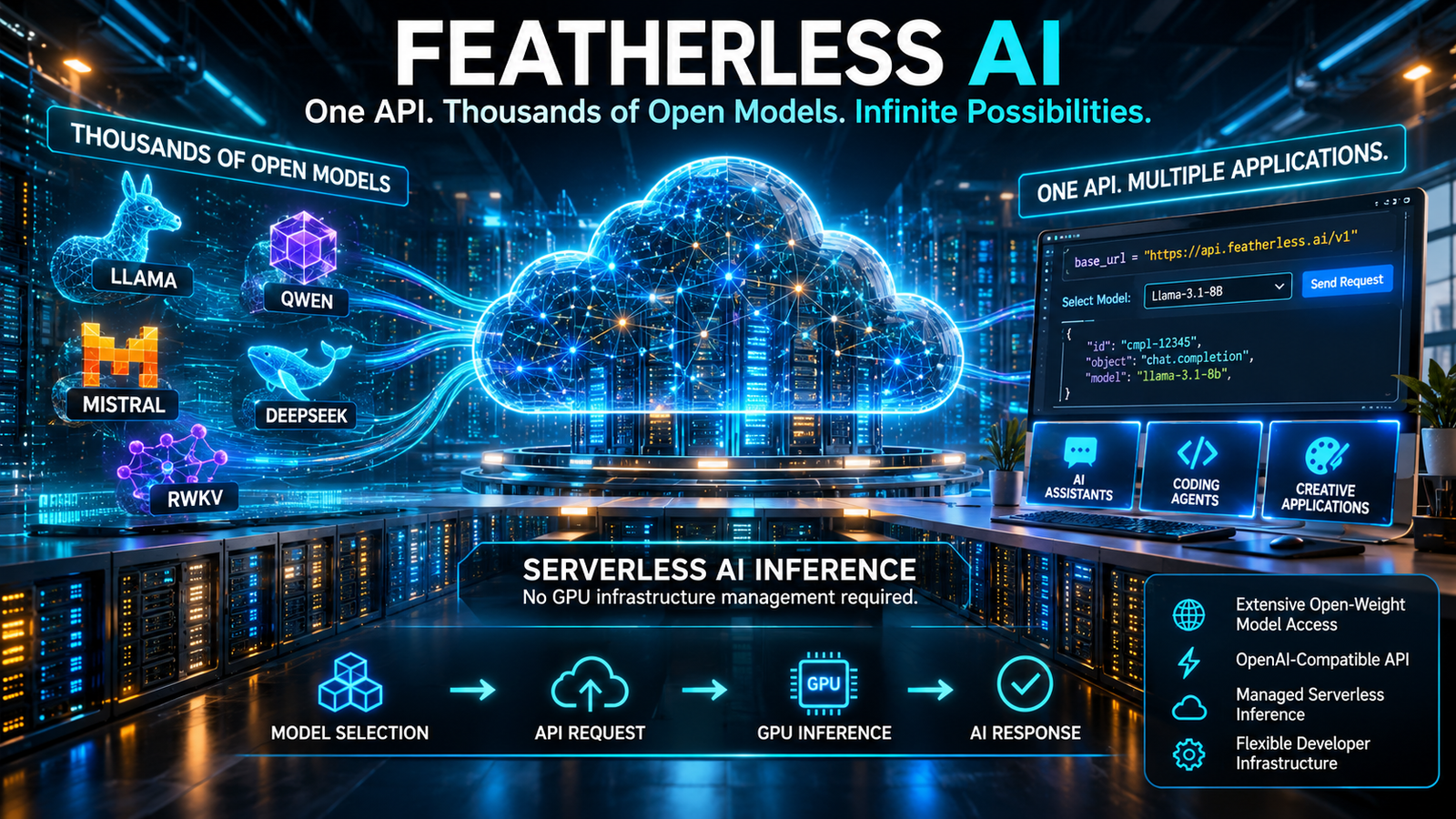
Featherless AI is a serverless AI inference platform that lets developers access thousands of open-weight language models through a unified API without managing GPU infrastructure. It simplifies model deployment, experimentation, and application development while offering usage-based API billing and subscription options.
Featherless AI at a Glance
| Category | Details |
|---|---|
| Platform Category | Serverless AI Inference |
| Primary Audience | Developers and Businesses |
| Model Ecosystem | Open-Weight AI Models |
| API Compatibility | OpenAI-Compatible |
| Chat Subscription | $25/month |
| Developer Plan | From $50 in credits |
Key Features:
- Access a large catalog of open-weight language models.
- Switch between models without managing GPU infrastructure.
- Integrate AI models through a unified API.
- Experiment with coding, conversational AI, and creative-writing models.
- Choose between interactive chat, API credits, and dedicated GPU arrangements.
- Evaluate model pricing, performance, and availability before deployment.
What Is Featherless AI?
Featherless AI is an AI infrastructure platform designed to make open-weight language models easier to access and deploy.
Instead of downloading model weights, configuring GPU servers, and managing inference software, developers can send requests to a hosted API.
The platform handles the underlying infrastructure required to run supported models.
This approach makes Featherless AI particularly relevant to developers who want to experiment with different LLMs without investing in dedicated hardware.
Its model ecosystem includes popular families such as:
- Llama
- Qwen
- Mistral
- DeepSeek
- RWKV
- Other community-developed and fine-tuned models
The platform also provides access to models designed for specialized tasks, including coding assistance, role-playing, creative writing, and conversational applications. featherless.ai+1
The important distinction: Featherless AI is not simply another chatbot. It primarily provides the infrastructure and API access that developers use to build their own AI-powered applications.
How Does Featherless AI Work?
Featherless AI uses serverless inference to simplify the process of running open-weight models.
Normally, deploying an LLM requires several technical steps. Developers must select a model, obtain its weights, configure suitable hardware, install inference software, and maintain the deployment.
1. Select an AI Model
Users explore the available model catalog and select an appropriate model.
The choice depends on the intended application.
For example:
- Coding models for software development.
- Instruction-following models for assistants.
- Creative-writing models for content generation.
- Conversational models for interactive applications.
- Vision-language models for supported image-understanding tasks.
Different models have different capabilities, context limits, and computational requirements.
2. Generate an API Key
After creating an account, developers obtain an API key through their Featherless dashboard.
This key authenticates requests sent to the platform.
It should be stored securely rather than exposed in frontend code or public repositories.
3. Connect Through the API
Featherless provides an OpenAI-compatible API.
This is important because developers can often reuse existing OpenAI SDK integrations by changing the API endpoint, authentication key, and model identifier.
4. Send Inference Requests
When an application sends a request, Featherless processes it through its inference infrastructure.
The platform manages model loading, GPU allocation, and serving.
Popular models may already be loaded, while less frequently requested models can require additional loading time. Therefore, serverless infrastructure does not automatically guarantee identical response latency for every model.
5. Receive the Generated Response
The application receives the model’s output and can use it in a chatbot, development tool, automation workflow, or another AI-powered product.
This architecture separates application development from much of the complexity of model hosting.
Key Features of Featherless AI
Featherless AI focuses on simplifying model access, inference, and integration. Its main features address common challenges associated with operating open-weight models.
1. Large Open-Weight Model Library
One of Featherless AI’s main attractions is its extensive model catalog.
The platform advertises access to more than 50,000 open models, including community fine-tunes and different model variants. featherless.ai+1
This gives developers more flexibility than relying on a single proprietary model.
They can explore different model architectures and compare their suitability for specific workloads.
However, model availability does not mean every model performs equally well. Some models may have different context limits, loading behavior, licensing requirements, or inference costs.
2. OpenAI-Compatible API
Featherless provides an API compatible with the OpenAI SDK interface.
This reduces integration work for developers who already use OpenAI-compatible applications.
For many existing projects, changing the API base URL, API key, and model identifier is enough to begin testing.
This can simplify:
- AI chatbot development.
- Backend application integration.
- Automated content generation.
- AI-powered software tools.
- Agent-based workflows.
- Custom language-model applications.
API compatibility does not guarantee that every OpenAI feature or parameter behaves identically. Developers should test the specific model and endpoint they intend to use.
3. Serverless Model Inference
Running an LLM independently requires infrastructure management.
Featherless handles much of this process through managed inference infrastructure.
Developers do not need to provision their own GPUs or manually install model-serving software for supported models.
This is especially useful for smaller development teams without dedicated machine-learning infrastructure engineers.
4. Support for Fine-Tuned Models
Different applications require different model behaviors.
A general-purpose language model may not perform well for specialized tasks without additional training or adaptation.
Featherless supports access to community fine-tuned models and provides a way to serve private fine-tunes through its Developer offering.
Dedicated infrastructure is available for certain business deployments.
Developers should still check the licensing conditions of individual models before using them commercially. featherless.ai+1
5. Multiple Model Categories
Featherless is not limited to general conversational AI.
Its catalog includes models for different development requirements.
| Model category | Potential application |
|---|---|
| Conversational LLMs | Chatbots and virtual assistants |
| Coding models | Code generation and debugging |
| Creative-writing models | Stories and content generation |
| Instruction-following models | Task automation |
| Vision-language models | Image understanding where supported |
| Fine-tuned models | Specialized application workflows |
The actual capabilities depend on the selected model and its implementation.
6. Dedicated GPU Infrastructure
Shared serverless inference is convenient, but some businesses need more predictable capacity.
Featherless offers dedicated GPU deployments through its Business arrangements.
Its published infrastructure options include H100, MI325X, B200, and B300 GPUs.
The offering also includes engineering support, with custom commercial arrangements and service-level agreements available. featherless.ai+1
This makes the platform relevant to businesses that eventually outgrow shared inference capacity.
Featherless AI Pricing: How Much Does It Cost?
Pricing is an important consideration when selecting an AI inference platform.
Featherless offers different plans for interactive users, developers, and businesses.
Its pricing structure is not simply one subscription covering every type of usage.
Current Featherless AI Pricing
Based on the published pricing information available in November 2026:
| Plan | Price | Main offering |
|---|---|---|
| Featherless Chat | $25/month | Interactive AI usage |
| Developer | From $50/month | Prepaid API credits |
| Business | Custom | Dedicated GPU infrastructure |
Serverless LLM Hosting+2
Featherless Chat Plan
The Chat plan costs $25 per month.
It is designed for individual, interactive usage rather than powering commercial applications.
Published features include:
- Access to the model catalog.
- Four concurrent units.
- Context size up to 32K tokens.
- Flat monthly subscription pricing.
There is an important restriction.
Featherless states that this plan is intended for human-driven interactive use. Reselling, application API traffic, background automation, and benchmarking are not permitted under this plan.
Developers should not confuse unlimited interactive requests with unrestricted API usage. Serverless LLM Hosting+1
Featherless Developer Plan
The Developer plan starts at $50 per month in prepaid credits.
Unlike the Chat subscription, API requests consume credits according to model-specific token pricing.
The billing calculation generally follows this structure:
Total cost = Input token cost + Output token cost
For example, a model that costs $0.50 per million input tokens and $2 per million output tokens would charge separately for those two categories.
Actual model prices vary.
The Developer offering includes:
- Credit-based API access.
- Model-specific pricing.
- Up to 100 concurrent units at the published base allocation.
- Access without a plan-level model-size restriction.
- A context allowance that can reach 256K, depending on the applicable plan and model.
Unused Developer credits roll over and do not expire, according to the billing documentation. Only successful API requests are charged. featherless.ai+1
Business Plan
The Business plan targets organizations with more demanding infrastructure requirements.
It offers dedicated GPU deployments, engineering support, and custom commercial arrangements.
Potential use cases include:
- High-volume inference.
- Private model deployments.
- Consistent production workloads.
- Specialized fine-tuned models.
- Workloads requiring a latency SLA.
Pricing is customized rather than published as a standard monthly subscription.
Hidden Costs and Pricing Considerations
The advertised subscription price does not tell the whole story.
Before selecting a plan, developers should consider several factors.
Model-specific token costs: Large models and specialized models may cost considerably more than smaller alternatives.
Concurrent-unit consumption: Larger models consume more concurrent units per request. This can reduce the number of simultaneous requests your plan can handle.
Context limits: A model’s advertised maximum context window may exceed the limit imposed by your subscription.
Credit exhaustion: Developer API calls stop when the available credit balance reaches zero or below.
Payment methods: Featherless documents card payments and several digital payment options. PayPal is not listed as a supported payment method. featherless.ai+2
The practical recommendation is to estimate monthly token consumption before committing to a production integration.
Featherless AI Privacy and Security
Privacy is particularly important when applications process customer messages, business information, or confidential documents.
Featherless publishes a privacy and logging policy stating that API prompts and completions are not logged or stored on its servers.
Its documentation also says that model usage information is collected for service-related purposes. featherless.ai+1
This distinction matters.
Not storing prompt content does not mean the company collects no account or usage information.
Does Featherless AI Store Your Prompts?
According to its current API privacy documentation, Featherless does not store API prompts or generated completions.
However, users should evaluate the complete data-handling arrangement before sending sensitive information.
Important considerations include:
- Account and payment information.
- Usage-related metadata.
- Third-party infrastructure providers.
- Model-specific licensing conditions.
- Data processing agreements.
- Applicable contractual privacy commitments.
Is Featherless SOC 2 Certified?
There is an important distinction between a security program and an independently completed compliance audit.
As of November 2026, Featherless’s Trust Center states that its SOC 2 Type II observation period began on September 1, 2026, with an expectation of audit completion by Q1 2027.
Therefore, it would be inaccurate to describe Featherless as already SOC 2 Type II certified based on this published status. Trust Center
Businesses with strict compliance requirements should request current documentation and evaluate their own regulatory obligations.
Who Should Use Featherless AI?
Featherless AI is particularly relevant to people who need access to multiple open-weight models without managing the underlying infrastructure.
Different users can benefit in different ways.
AI Developers
Developers can experiment with different LLMs through a common API.
This is useful when building chatbots, AI assistants, or applications that need flexible model selection.
Startups and Small Technology Teams
Startups often need to experiment without investing heavily in GPU infrastructure.
Featherless can reduce the operational work associated with model hosting.
However, startups should compare token costs and response latency before choosing it for a customer-facing product.
AI Researchers
Researchers can explore different model families and community fine-tunes.
This can help with prototyping, model comparisons, and early-stage experiments.
For formal benchmarking, researchers should control hardware conditions, model versions, sampling parameters, and inference configurations.
AI Enthusiasts
People interested in exploring different open-weight models can use Featherless without setting up a local GPU environment.
This is useful for testing conversational models, coding assistants, and other specialized variants.
Businesses
Businesses with predictable, high-volume inference requirements may benefit from dedicated infrastructure.
However, organizations should assess compliance, contractual privacy commitments, reliability requirements, and long-term operating costs before adopting the platform.
Featherless AI Alternatives and Competitors
Featherless AI operates in a competitive market.
Several platforms provide hosted model inference, API access, or managed AI infrastructure.
The right alternative depends on whether the priority is model variety, deployment flexibility, performance, or infrastructure control.
Leading Featherless AI Alternatives
| Platform | Target user | Key strength | Pricing transparency | Main limitation |
|---|---|---|---|---|
| Together AI | Developers and businesses | Hosted inference and fine-tuning | Published model pricing | Model availability varies |
| Fireworks AI | Production AI teams | Optimized model serving | Published usage-based pricing | Not every open model is available |
| Hugging Face | Researchers and developers | Model Hub and multiple inference providers | Varies by provider | Multiple provider configurations |
| DeepInfra | Developers | Hosted open-model inference | Published model pricing | Catalog and deployment options differ |
Hugging Face+3
Featherless AI vs. Together AI
Together AI provides hosted inference and model-training capabilities.
It is relevant for developers who need a combination of inference, fine-tuning, and broader model development services.
Featherless emphasizes its extensive open-model catalog and straightforward API access.
The better option depends on the models required and the cost of serving them at the expected traffic level.
Featherless AI vs. Fireworks AI
Fireworks AI focuses on optimized inference and production model serving.
It is worth evaluating when response speed, deployment performance, and production workloads are major priorities.
Featherless may be attractive when developers want to explore a particularly broad range of open-weight models.
Both platforms should be tested using the same workload before making performance comparisons.
Featherless AI vs. Hugging Face
Hugging Face provides a broader machine-learning ecosystem.
Its Model Hub, development libraries, and Inference Providers make it useful for researchers and developers working across different AI tasks.
Featherless is more focused on hosted model inference.
Importantly, Featherless is also listed as an inference provider within the Hugging Face ecosystem. The two platforms are therefore not entirely separate alternatives. Hugging Face+1
Featherless AI vs. DeepInfra
DeepInfra offers hosted inference for open-weight models through APIs.
Both services reduce the infrastructure work associated with deploying models.
The decision should come down to model availability, pricing, supported functionality, and measured latency for your particular application.
Important Limitations of Featherless AI
Despite its advantages, Featherless AI is not a perfect solution for every project.
Understanding its limitations can prevent unexpected development and deployment problems.
1. Model Availability Does Not Guarantee Performance
A large catalog is useful, but the number of available models does not indicate their quality.
Some models may produce inaccurate responses, struggle with complex reasoning, or perform poorly on specialized tasks.
Developers must evaluate each candidate independently.
2. Cold Model Loading Can Affect Latency
Less frequently requested models may need to load before processing a request.
This can introduce additional waiting time.
For applications requiring predictable response times, developers should test both frequently used and less frequently used models.
3. Concurrency Restrictions
Concurrent units determine how much inference work can run simultaneously under a plan.
Larger models generally consume more units.
Requests that exceed the available concurrency allowance can receive HTTP 429 errors. featherless.ai+1
This matters for AI agents and applications that generate multiple requests simultaneously.
4. Context Windows Are Not Always the Same
A model may advertise a large context window, but Featherless can serve it with a smaller effective limit.
The plan’s context restriction can also affect the maximum available context.
Developers should check the actual model and plan limits instead of assuming that published model specifications automatically apply. featherless.ai+1
5. Third-Party Model Licensing
Featherless provides infrastructure for accessing models developed by third parties.
It does not automatically transfer ownership or licensing rights to users.
The platform’s terms place responsibility on users to comply with the applicable model licenses.
Commercial developers should review the relevant license before deploying a model in a paid application. featherless.ai
6. Not Every Open Model Is Suitable for Production
A model can be accessible without being production-ready.
Developers should evaluate:
- Output consistency.
- Instruction-following ability.
- Latency.
- Token costs.
- Context handling.
- Safety behavior.
- License restrictions.
- Availability under expected traffic.
A small proof of concept is not sufficient evidence of production reliability.
Practical Tips for Getting Better Results With Featherless AI
Choosing an appropriate model is only one part of building a successful AI application.
The integration and evaluation process also matter.
Here are several practical recommendations.
Start with smaller models. Test smaller models before moving to expensive, larger alternatives. They may already satisfy your application’s requirements.
Compare multiple candidates. Use the same prompts and evaluation dataset when testing different models.
Monitor token consumption. Input and output tokens affect Developer plan costs.
Protect API credentials. Keep API keys on the server side and rotate them when necessary.
Handle API errors. Implement retry logic for temporary capacity problems and avoid repeatedly retrying invalid requests.
Test real workloads. Measure response latency, output quality, and concurrency using realistic application traffic.
Check model licenses. Confirm that the selected model permits your intended commercial or research use.
These steps help developers avoid unnecessary spending and improve application reliability.
Frequently Asked Questions
1. What is Featherless AI used for?
Featherless AI provides serverless access to open-weight language models through an API. Developers use it to build chatbots, AI assistants, coding tools, automated workflows, and other applications without managing GPU infrastructure.
2. Is Featherless AI free to use?
Featherless AI offers paid subscription and credit-based plans. Its published Chat plan costs $25 per month, while the Developer plan starts at $50 in monthly API credits. Business infrastructure is available through custom pricing.
3. Does Featherless AI support OpenAI API integration?
Yes. Featherless provides an OpenAI-compatible API. Developers can generally reuse the OpenAI SDK by changing the base URL, API key, and model identifier, although individual model capabilities and supported parameters can differ.
4. Is Featherless AI safe for private data?
Featherless states that it does not store API prompts or completions. However, users should review its privacy documentation, account-data practices, third-party subprocessors, and contractual security commitments before processing confidential information.
Conclusion
Featherless AI addresses an important challenge in the open-weight AI ecosystem: making powerful language models easier to access without requiring developers to manage complex GPU infrastructure.
Its extensive model catalog, OpenAI-compatible API, serverless inference, and flexible deployment options make it relevant to developers, startups, researchers, and businesses.
However, model availability alone should not determine your decision.
Token pricing, context limits, concurrency, response latency, licensing, and privacy requirements deserve equal attention.
For individual experimentation, the Chat subscription offers a straightforward starting point. Developers building applications should evaluate the credit-based API, while organizations with demanding workloads can investigate dedicated infrastructure.
Ultimately, Featherless AI is worth considering when flexibility and access to open-weight models matter more than controlling every part of the inference infrastructure.