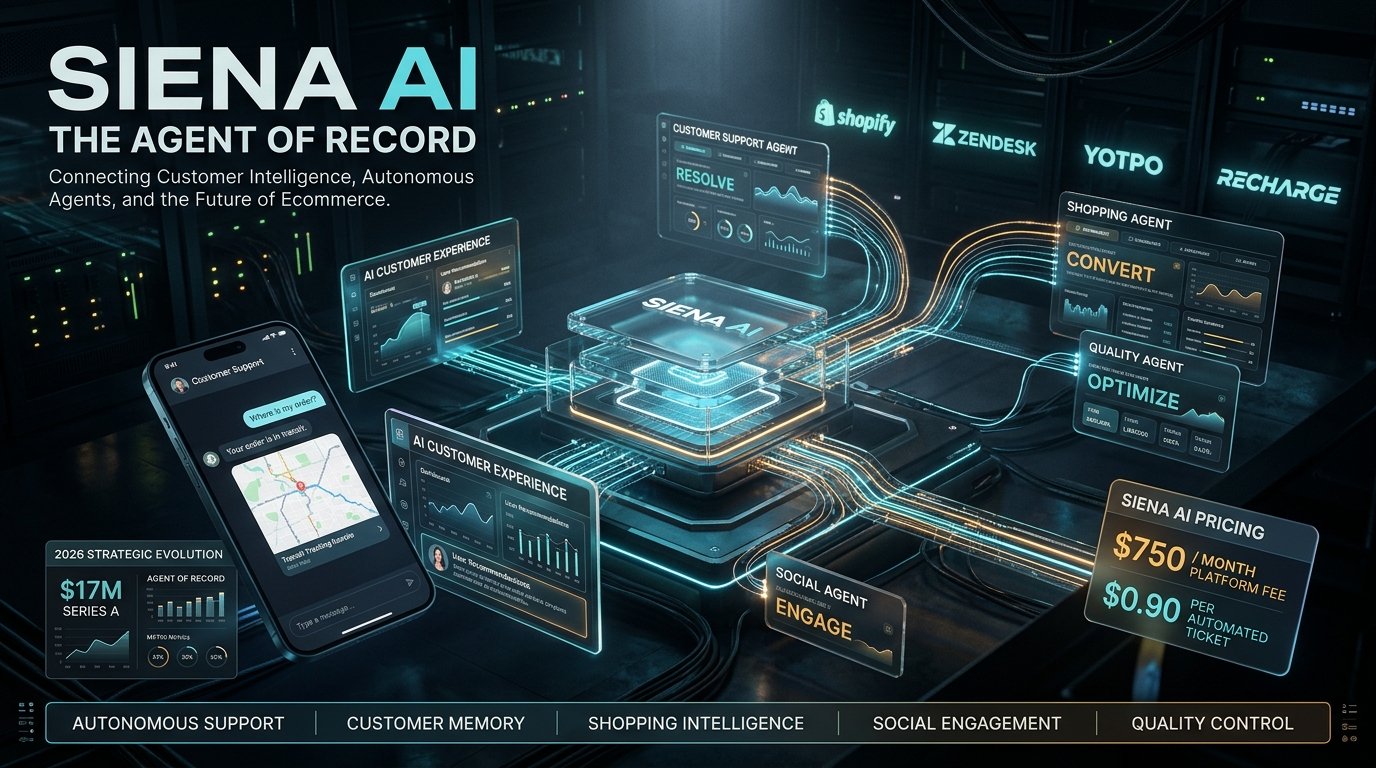
Siena AI is an AI-powered customer experience platform that helps ecommerce and consumer brands automate customer support, manage interactions, and build more personalized shopping experiences. Its evolving Agent of Record approach connects customer conversations and business information so AI agents and human teams can work with a more consistent understanding of each customer.
Siena AI at a Glance
| Category | Details |
|---|---|
| Platform Status | Active platform |
| Company | Siena Labs |
| Industry | AI Customer Experience |
| Founded | 2023 |
| Headquarters | New York, USA |
| Primary Audience | Ecommerce Brands |
| Business Model | Platform + Usage Fees |
Key takeaways
- Automates customer service conversations using AI agents.
- Connects customer context with ecommerce and support systems.
- Supports customer interactions across multiple communication channels.
- Offers additional shopping, social, and customer intelligence capabilities.
- Uses configurable brand guidelines and human escalation.
- Public pricing lists a $750 monthly platform fee and $0.90 per automated ticket.Sources: Siena’s official website, pricing page and company information. Siena AI+2
What Is Siena AI?
Siena AI is a business-focused artificial intelligence platform designed to improve customer experience for ecommerce companies and consumer brands.
Rather than functioning as a basic chatbot, it uses AI agents to understand customer questions, retrieve relevant business information, and perform supported customer service tasks.
The platform originally focused on automating ecommerce customer support. Its broader direction now centers on connecting customer interactions, purchasing information, and business knowledge through a shared intelligence layer.
This approach addresses a common problem in online retail: customer information often becomes fragmented across support tickets, order management systems, social media conversations, and marketing platforms.
For example, a customer might contact a brand about a delayed shipment, ask another question through Instagram, and later request a product recommendation.
Traditional support systems may treat these as separate interactions. Siena’s Agent of Record concept aims to preserve relevant context across those touchpoints.
The company was founded by Andrei Negrau and Lisa Popovici. Its founders previously worked in ecommerce and experienced the limitations of conventional customer service software. Siena AI+2
What Makes Siena AI Different?
Its central idea is that customer service should involve more than generating responses.
A useful customer service agent must also understand the customer’s situation and take appropriate action.
Consider a customer asking why an order has not arrived. A conventional chatbot might provide a tracking link. A more capable agent could retrieve the order, examine shipping information, explain the delay, and initiate an approved next step.
Siena’s approach focuses on this combination of:
- Customer understanding
- Business knowledge
- Automated workflows
- Brand-specific communication
- Cross-channel customer context
- Human supervision and escalation
This makes the platform particularly relevant to brands handling large volumes of repetitive customer interactions.
How Does Siena AI Work?
Siena combines AI-powered conversation handling with connected business systems and brand-specific instructions.
Its broader platform is designed around a shared intelligence layer that can make customer information useful across multiple agents.
The typical workflow involves several stages.
1. Connect Business Systems
A business connects Siena with its existing customer support and ecommerce infrastructure.
Relevant information can come from:
- Ecommerce platforms
- Help desk software
- Order management systems
- Customer knowledge bases
- Subscription services
- Reviews and loyalty systems
Siena’s website identifies integrations including Shopify, Zendesk, Yotpo, and Recharge. The exact integration scope depends on the selected workflow. Siena AI+1
2. Build Brand-Specific Knowledge
The platform uses business information, existing support guidance, and operational instructions to understand how a brand communicates.
This matters because different businesses have different policies.
For example, a clothing company might accept returns within a defined period, while a food supplement brand may have different replacement and refund requirements.
An AI agent must follow these rules rather than produce convincing but incorrect answers.
3. Understand Customer Requests
When a customer sends a message, the AI agent interprets the request and identifies the information needed to respond.
It can use relevant customer and business context to understand the situation.
This is where generative AI and conversational AI become useful. Instead of relying entirely on fixed scripts, the system can generate responses based on available information and instructions.
4. Perform Supported Actions
Depending on the connected systems and configured permissions, Siena agents can handle workflows such as:
- Checking order information
- Updating delivery addresses
- Creating return labels
- Processing eligible refunds
- Arranging product replacements
- Managing subscription changes
These are operational workflows, not simply conversational answers. However, available actions depend on integrations, permissions, and deployment configuration. VentureBeat+1
5. Escalate Complex Requests
Not every customer problem should be automated.
Refund disputes, unusual delivery problems, sensitive complaints, and situations requiring judgment may need human involvement.
A reliable implementation should establish clear escalation rules and ensure customers can reach a human when necessary.
6. Improve Customer Intelligence
Siena’s broader Agent of Record concept aims to make information from customer interactions useful beyond the original conversation.
For example, recurring complaints about a product could reveal a manufacturing issue. Questions about particular product variations could help a marketing team identify customer demand.
This creates a connection between customer service and wider business decisions.
Key Features of Siena AI
Siena’s capabilities extend beyond automated replies. Its platform combines customer support automation with tools for managing and understanding customer interactions.
The following features reflect the company’s current product positioning. Some newer agents and capabilities have different availability statuses.
1. Autonomous Customer Service Agent
Customer service automation is Siena’s original core offering.
Its AI agent can handle common ecommerce questions, retrieve relevant information, and complete supported workflows.
Typical examples include:
- Order tracking inquiries
- Shipping and delivery questions
- Return and refund requests
- Product information
- Subscription assistance
- Frequently asked questions
The objective is to reduce repetitive work while allowing human representatives to focus on complicated cases.
2. Omnichannel Customer Support
Customers rarely communicate through one channel.
They may start with website chat, continue through email, and contact the same company through social media.
Siena’s broader platform aims to connect these customer interactions and provide consistent support across channels.
However, buyers should verify which channels and integrations are included in their specific deployment.
3. Agent of Record and Customer Memory
Major 2026 development
The Agent of Record concept is one of Siena’s most important developments.
It aims to maintain a shared understanding of customer relationships across interactions.
The underlying idea is straightforward: useful customer information should not disappear when a conversation ends.
For example:
- A customer purchases a particular product.
- They contact support about a delivery issue.
- They explain why they are dissatisfied.
- The brand records relevant information.
- A future interaction can use that context.
This can make recommendations and support more relevant.
Importantly, Siena does not replace every operational database. Its intelligence layer uses information from connected business systems. VentureBeat+1
4. Shopping Agent
Siena is expanding beyond customer service into shopping assistance.
The shopping agent is designed to answer product questions, recommend relevant items, and help customers move toward purchases.
For ecommerce businesses, this creates an opportunity to connect customer support with sales.
A customer asking about product compatibility, for instance, could receive a recommendation rather than being redirected to a separate sales department.
Availability note: Siena’s October 2026 announcement describes newer shopping capabilities as early-access or rolling out, rather than universally available across every account. VentureBeat+1
5. Social Agent
Social media conversations can create substantial workloads for consumer brands.
Questions, complaints, product inquiries, and comments beneath advertisements all require attention.
Siena’s Social Agent is designed to support:
- Comment moderation
- Community engagement
- Customer assistance
- Social media direct messages
- Responses to product inquiries
This is especially relevant for brands receiving large volumes of engagement across multiple social platforms.
6. Ask Siena and Customer Intelligence
Customer conversations contain information that traditional reporting systems may overlook.
Ask Siena is designed to help teams explore that information using natural-language queries.
Instead of manually examining hundreds of support conversations, an operator could ask questions about recurring complaints, customer preferences, or product feedback.
For example:
Which product issues appeared most frequently in customer conversations this month?
The broader objective is to turn customer service data into actionable business intelligence.
7. Quality Assurance and Agent Management
Automated customer support requires continuous monitoring.
Siena describes quality assessment capabilities, agent evaluation, and tools for improving automation.
Its Autopilot and Quality Agent offerings are part of the broader agent-management direction announced in 2026.
These capabilities aim to help businesses examine agent performance, improve instructions, and compare different customer journeys.
Buyers should confirm which quality and experimentation tools are available in their selected package. Siena AI+2
Real-World Use Cases of Siena AI
Siena is particularly relevant to businesses where customer inquiries are frequent, repetitive, and connected to purchasing activity.
Here are some practical examples.
Ecommerce Order Management
An online retailer may receive hundreds of questions about delivery estimates, tracking numbers, and order changes.
Siena can use connected order information to handle supported requests without requiring an employee to respond individually.
Returns and Refunds
Returns create operational pressure for online businesses.
An AI agent can retrieve relevant order information, explain applicable policies, and initiate supported return workflows.
Human involvement remains important when a request falls outside approved policies.
Subscription-Based Businesses
Subscription companies frequently receive requests to pause, cancel, skip, or modify recurring deliveries.
Automating these interactions can reduce repetitive tickets and help customers complete straightforward account changes.
Product Discovery and Recommendations
Customers often need additional information before purchasing.
An AI shopping agent can answer questions about product characteristics and recommend relevant options.
This may reduce friction during the buying process.
Social Media Customer Engagement
Brands with active social communities must respond quickly to questions and comments.
Siena’s social capabilities aim to help businesses manage this workload without treating every interaction as a separate manual task.
Benefits of Using Siena AI
Siena’s potential value comes from combining automation with customer context.
The most relevant benefits include the following.
| Benefit | Business value |
|---|---|
| Faster responses | Customers receive assistance without waiting for an available representative. |
| Lower repetitive workload | Human agents can concentrate on complex inquiries. |
| Consistent communication | Brand instructions help standardize responses. |
| Connected customer context | Relevant information can support future interactions. |
| Workflow automation | Supported actions can reduce manual processes. |
| Customer insights | Conversation patterns can reveal operational problems. |
| Scalable support | Businesses can manage higher interaction volumes without increasing manual work at the same rate. |
What Do Customer Results Suggest?
Siena publishes customer examples involving brands such as SPANX, HexClad, Grüns, and Coterie.
One SPANX testimonial reports that Siena handles approximately 50% of conversations, maintains customer satisfaction above 90%, and cuts handling time in half.
These are company-published customer results, not independently audited industry benchmarks. Actual performance depends on ticket quality, product complexity, integrations, and automation configuration. Siena AI+1
Siena AI Pricing: How Much Does It Cost?
Public pricing available
Siena’s official pricing page currently publishes a platform fee and an additional usage charge.
Published pricing
MONTHLY PLATFORM FEE
$750
Includes access to Siena’s core AI engine and unlimited sandbox.
AUTOMATED TICKET
$0.90
Charged for each automated ticket under the published pricing model.
Additional provisions
- Expert onboarding
- Dedicated Slack support
- Implementation assistanceSource: Siena official pricing page. Verify contractual terms before purchasing.
Example Monthly Cost Calculation
The following examples use the published platform fee and automated-ticket rate. They exclude any additional charges, taxes, or negotiated terms.
| Automated tickets/month | Estimated monthly cost |
|---|---|
| 500 | $1,200 |
| 1,000 | $1,650 |
| 2,500 | $3,000 |
| 5,000 | $5,250 |
| 10,000 | $9,750 |
The calculation is:
Monthly cost = $750 + ($0.90 × automated tickets)
For example, a company automating 2,500 tickets would pay an estimated $3,000 monthly under this model.
Is Siena AI Expensive?
That depends on the company’s existing support costs.
A business should compare the platform’s total monthly expense against:
- Existing customer service staffing costs
- Outsourced support expenses
- Average ticket volume
- Percentage of successfully automated tickets
- Human escalation rates
- Additional integration and implementation expenses
The important metric is not the number of automated responses. It is the number of customer problems successfully resolved.
A cheap automated response that fails to solve the problem can increase customer dissatisfaction and create additional support work.
Siena AI Integrations and Technical Requirements
Siena works alongside existing ecommerce and customer support infrastructure.
Its website identifies integrations such as:
- Shopify: Ecommerce store and order information.
- Zendesk: Customer support operations.
- Yotpo: Customer reviews and related information.
- Recharge: Subscription-related workflows.
Siena AI+1
Why Integrations Matter
An AI customer service agent needs accurate information to perform useful work.
For instance, an agent cannot reliably answer whether an order has shipped unless it can access the appropriate order or shipping information.
This creates several technical considerations.
Data synchronization: Connected systems must provide sufficiently current information.
Permissions: Agents should only perform actions authorized by the business.
Workflow reliability: Refunds, cancellations, and address changes need appropriate validation.
Integration coverage: Businesses should test the exact workflows they intend to automate.
Human escalation: The platform should preserve conversation history when transferring an issue to an employee.
The underlying AI model is only one part of the system. Integration quality and operational controls can be equally important.
Siena AI Privacy, Security, and Reliability
Customer service platforms may process personal information, order details, contact information, and private conversations.
That makes security and data governance essential purchasing considerations.
Siena’s pricing page describes several enterprise-oriented controls, including:
- SAML single sign-on
- Granular user permissions
- Audit logs
- Brand and business-rule guardrails
- Human handoff
The page also identifies enterprise-grade safety provisions. Siena AI
However, these features should not be confused with a complete privacy assessment.
Before deployment, businesses should request documentation covering:
- Data retention and deletion policies.
- Whether customer conversations are used for model training.
- Data residency and processing locations.
- Third-party AI model providers and subprocessors.
- Encryption standards and access controls.
- Contractual data-processing obligations.
- Incident response and breach notification.
- Whether Zero Data Retention is available under the proposed contract.
Important: SAML SSO, audit logs, and SOC 2-related assurances do not automatically establish Zero Data Retention. Buyers should verify the exact security documentation and contractual commitments that apply to their account.
Can Siena AI Make Mistakes?
Yes. Like other generative AI systems, customer-facing agents can misunderstand requests or produce incorrect responses.
Potential problems include:
- Misinterpreting customer intent
- Using outdated product information
- Providing incorrect policy explanations
- Failing to recognize an unusual complaint
- Triggering an inappropriate workflow
- Escalating a conversation incorrectly
A business should test these situations before enabling extensive automation.
A controlled rollout, clear permissions, and regular conversation reviews are important safeguards.
Siena AI Alternatives and Competitors
Siena competes in the broader customer service automation and AI customer experience market.
However, not every competitor offers the same product architecture or targets the same businesses.
The following comparison highlights relevant alternatives.
| Platform | Target user | Key strength | Pricing transparency | Main consideration |
|---|---|---|---|---|
| Siena AI | Ecommerce and consumer brands | Commerce-focused agents and customer intelligence | Published usage pricing | Verify agent availability and integration scope |
| Gorgias | Shopify-focused ecommerce teams | Ecommerce help desk and AI support | Plans and usage terms vary | Evaluate AI automation costs |
| Intercom Fin | Digital businesses and support teams | AI customer service across support channels | Usage-based pricing options | Broader support focus than commerce-specific workflows |
| Zendesk AI | Mid-sized and enterprise support teams | Established customer service ecosystem | Plan-dependent | Configuration and platform complexity |
| Gladly | Customer-centric consumer brands | Customer-focused support experience | Generally quote-based | Different platform and deployment approach |
These are alternatives, not direct feature-for-feature equivalents.
1. Gorgias
Ecommerce customer service platformOfficial website
Gorgias is a relevant alternative for ecommerce businesses that want customer support, order information, and store-related workflows in one environment.
It is particularly worth evaluating for Shopify-based businesses.
Its help desk orientation makes it useful for teams comparing complete support operations rather than standalone AI automation.
2. Intercom Fin
Intercom Fin
AI-powered customer serviceOfficial website
Fin is designed to resolve customer questions using business knowledge and connected support systems.
It is worth considering for companies that want AI-powered support across a broader customer service environment.
Its pricing structure and resolution definitions should be compared with Siena’s per-ticket model.
3. Zendesk AI
Enterprise customer supportOfficial website
Zendesk AI is relevant to companies already operating within the Zendesk ecosystem.
Its established support environment may appeal to organizations with complex ticketing, reporting, and agent-management requirements.
Businesses should examine which AI capabilities require additional plans or configuration.
4. Gladly
Customer-centered service platformOfficial website
Gladly focuses on customer-centered service operations and maintaining conversation continuity.
It is relevant for consumer brands comparing AI automation with a broader customer experience platform.
Which Siena AI Alternative Should You Choose?
The best choice depends on existing infrastructure and business requirements.
- Choose Siena for commerce-oriented AI agents and its shared customer intelligence approach.
- Consider Gorgias for an ecommerce-focused help desk environment.
- Evaluate Intercom Fin for broader AI-powered customer support.
- Consider Zendesk AI when existing enterprise support infrastructure matters.
- Evaluate Gladly when customer-centered service management is a priority.
A practical trial should measure successful resolutions, escalation quality, total operating cost, and customer satisfaction.
Limitations of Siena AI
Siena has a clear business focus, but that does not make it suitable for every organization.
Its most important limitations and evaluation points include:
1. Ecommerce-Centered Positioning
The platform is primarily designed around consumer brands and commerce workflows.
Businesses outside these sectors should evaluate whether its integrations and automation capabilities match their requirements.
2. Usage-Based Expenses
The published $0.90 automated-ticket charge can become significant at higher volumes.
Companies should model costs using realistic automation forecasts rather than optimistic projections.
3. Integration Dependency
Siena’s ability to perform useful actions depends on connected business systems.
Poor data quality or incomplete integrations can limit automation effectiveness.
4. Ongoing Configuration
AI agents need continuous supervision.
Business policies change, products evolve, and customer expectations shift. Instructions and workflows must be updated accordingly.
5. Feature Availability
The wider Agent of Record vision includes capabilities at different stages of availability.
Early-access features and roadmap announcements should not be treated as guaranteed production functionality.
6. Limited Independent Performance Evidence
Siena publishes impressive customer examples, but these do not establish universal results.
Businesses should conduct their own pilot and independently measure performance.
Latest Siena AI Developments in 2026
October 6, 2026
One of the most important developments was Siena’s announcement of a $17 million Series A funding round.
The investment was led by York IE, with participation from Joyance Ventures and existing investors Aglaé Ventures, Sierra Ventures, and Super Angel Fund.
Siena reported that the funding brought its total raised capital to $29.7 million. Siena AI+1
Expansion Beyond Customer Support
The funding supports Siena’s ambition to become an Agent of Record for consumer brands.
Its expanded direction includes:
- Shared customer intelligence
- Shopping assistance
- Social media engagement
- Customer memory
- Quality assessment
- Internal business insights
- More autonomous customer-facing workflows
This represents a strategic shift from automating individual support conversations toward connecting customer relationships across business functions.
What Does Agent of Record Mean for Ecommerce?
Traditional systems generally maintain separate records for orders, subscriptions, reviews, and support tickets.
Siena wants to create a shared intelligence layer that helps its agents and human employees understand those interactions together.
For example, repeated complaints about a delivery carrier could help a brand identify a regional logistics problem.
The same information could also improve future customer communication.
This is a potentially useful direction, but its long-term value will depend on data accuracy, integration reliability, privacy controls, and the quality of its agents. VentureBeat+1
Who Should Use Siena AI?
Siena is most relevant to organizations with substantial customer interaction volumes and established ecommerce operations.
| Business type | Potential suitability | Reason |
|---|---|---|
| Shopify brands | High | Order and ecommerce support workflows |
| DTC businesses | High | Repetitive customer inquiries and product questions |
| Subscription companies | High | Recurring account and delivery requests |
| Consumer product brands | High | Customer support and product feedback |
| Small online stores | Depends | Monthly platform costs may be difficult to justify |
| Large retailers | Depends | Requires integration and enterprise evaluation |
| Non-commerce businesses | Limited fit | Its primary product positioning is commerce-focused |
Who May Want a Different Platform?
Siena may not be the right choice for:
- Individuals looking for a free personal AI assistant.
- Developers seeking an open-source LLM.
- Businesses wanting a general-purpose AI writing tool.
- Organizations requiring a completely custom-built conversational AI infrastructure.
- Companies with very low support volumes and limited automation budgets.
Its value is primarily connected to business operations, not individual productivity.
Common Mistakes Businesses Should Avoid
Buying an AI customer service platform without a clear implementation strategy can create unnecessary expenses.
Here are five mistakes worth avoiding.
1. Automating everything immediately
Start with repetitive, low-risk requests. Expand automation after testing accuracy and escalation behavior.
2. Ignoring integration quality
An AI agent cannot reliably perform order-related actions when its connected data is incomplete or outdated.
3. Measuring responses instead of resolutions
A fast response is not necessarily a successful customer service outcome.
Track actual issue resolution, repeat contacts, and customer satisfaction.
4. Overlooking usage-based pricing
Calculate the expected monthly expense using realistic automated-ticket volumes.
Include platform fees and any additional contractual charges.
5. Treating AI as a replacement for human judgment
Complex complaints and sensitive situations still require human oversight.
The most effective deployment uses automation to support human teams, not eliminate accountability.
Is Siena AI Worth Considering?
Siena AI is worth evaluating if a business wants to move beyond traditional scripted chatbots.
Its strongest proposition is the combination of ecommerce customer support, automated workflows, and shared customer intelligence.
The Agent of Record strategy also introduces an interesting possibility: customer conversations could become useful business information rather than isolated support records.
However, businesses should look beyond marketing claims.
The important questions concern successful resolution rates, integration quality, feature availability, privacy commitments, and total monthly costs.
A controlled pilot using real customer inquiries is a better purchasing decision than relying on advertised automation percentages.
Frequently Asked Questions About Siena AI
1. What is Siena AI used for?
Siena AI is used to automate customer service and improve customer experience for ecommerce businesses and consumer brands. Its capabilities include handling customer inquiries, supporting ecommerce workflows, and connecting customer information across business interactions.
2. How much does Siena AI cost?
Siena’s published pricing includes a $750 monthly platform fee and $0.90 per automated ticket. Additional onboarding and implementation support are described on its official pricing page. Actual contractual costs should be confirmed with the company.
3. Is Siena AI suitable for Shopify stores?
Yes. Siena identifies Shopify among its integrations and focuses heavily on ecommerce customer experience. Shopify merchants can evaluate it for order-related support, returns, product inquiries, and other supported workflows.
4. What is Siena AI’s Agent of Record?
Agent of Record is Siena’s approach to maintaining shared customer intelligence across customer-facing AI agents and human teams. It aims to connect information from purchases, subscriptions, reviews, and conversations to improve future interactions.
5. Is Siena AI better than Gorgias or Intercom?
There is no universal winner. Siena emphasizes commerce-focused AI agents and customer intelligence, Gorgias focuses on ecommerce customer support, and Intercom offers a broader customer service platform. Businesses should compare integrations, automation quality, pricing, and operational requirements.
Conclusion
Siena AI represents an evolving approach to customer service automation.
Instead of focusing exclusively on chatbot responses, the platform aims to connect customer interactions with business information and automated workflows.
Its Agent of Record strategy makes it particularly interesting for ecommerce companies seeking more personalized customer experiences.
The published pricing model also provides a starting point for evaluating its financial viability.
However, integration quality, data governance, human escalation, and actual resolution performance remain essential considerations.
For ecommerce brands, the most important question is whether Siena can resolve real customer problems accurately while delivering measurable operational value.
Businesses should test its capabilities, verify contractual security commitments, and calculate the full cost before adopting it.