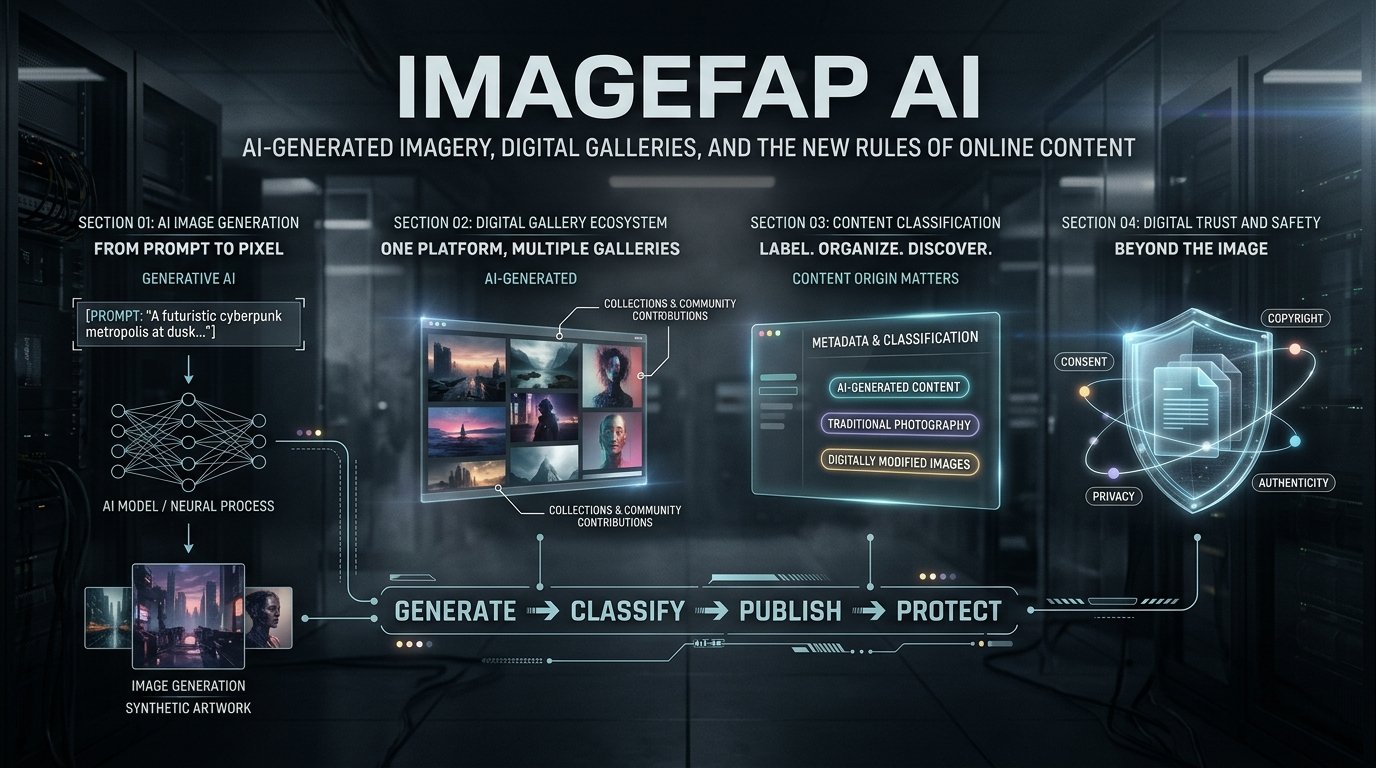
ImageFap AI generally refers to AI-generated images and galleries available through ImageFap, rather than a standalone AI image-generation application. The platform has a dedicated AI-generated category and specific classification rules, making content labeling, copyright, consent, and digital privacy important considerations.
ImageFap AI at a Glance
- Platform type: User-generated image-sharing and gallery platform.
- AI functionality: A dedicated category for AI-generated images.
- Content organization: Galleries, categories, member profiles, and search tools.
- AI classification: The platform requires AI-generated galleries to use the designated AI category.
- Pricing: The platform describes its core website as free, but this does not establish the availability or pricing of third-party AI tools.
- Main considerations: Consent, image authenticity, copyright, privacy, and appropriate content classification.
What Is ImageFap AI?
ImageFap AI is a search term associated with artificial intelligence-generated imagery shared through the ImageFap platform.
It is important to understand the distinction between the platform and the technology. ImageFap is an established adult-oriented image-sharing website. It allows users to browse galleries, explore categories, and participate in community features.
AI-generated imagery represents a separate development within this existing platform.
Instead of being limited to photographs captured using cameras, image collections can include synthetic visuals created with generative AI software.
ImageFap has introduced a dedicated category for AI-generated material. Its official homepage also displays an administrative announcement explaining how contributors must classify AI-generated galleries.
This confirms that AI-generated content has an identifiable place within its gallery structure.
However, there is no verified evidence that ImageFap operates its own proprietary AI image-generation model or provides a native text-to-image generator.
Users should therefore distinguish between three things:
- ImageFap as an image-sharing platform.
- AI-generated images created using external software.
- AI-generated galleries uploaded and categorized on ImageFap.
This distinction prevents confusion with independent AI image generators that use similar terminology.
How Does ImageFap AI Work?
Understanding ImageFap AI requires looking at two separate processes: AI image generation and gallery publishing.
1. AI Image Generation
Generative AI systems create images using machine-learning models trained on large collections of visual data.
Some systems use diffusion models. These models learn visual patterns and gradually produce an image from an initial noise representation.
Users can provide text prompts describing visual characteristics, environments, lighting, composition, and artistic styles.
Depending on the software, additional controls may include:
- Image dimensions and aspect ratios.
- Visual style and rendering quality.
- Reference-image guidance.
- Model selection.
- Image-to-image generation.
- Inpainting and editing.
These capabilities belong to the external generation software, not automatically to ImageFap.
2. Gallery Creation and Classification
After generating an image, a creator may organize eligible material into a gallery.
ImageFap provides a gallery-based publishing structure with categories and searchable collections.
Its official administrative announcement specifically addresses AI classification.
The announcement states that galleries containing AI-generated pictures must use the AI category rather than unrelated categories.
It also warns that galleries incorrectly categorized may be deleted.
This is an important distinction because the AI category identifies the nature of the material, not simply its visual subject.
3. Discovery and Browsing
Once published, galleries become part of the platform’s searchable content collection.
Visitors can explore available categories and use the website’s discovery features.
The dedicated AI-generated section makes it easier to distinguish synthetic material from other gallery types.
However, a category label should not be treated as independent proof that every image is genuinely AI-generated.
Accurate classification still depends on contributors and the platform’s enforcement processes.
Key Features of ImageFap AI
ImageFap’s AI-related functionality is best understood through its existing gallery infrastructure.
Dedicated AI-Generated Category
The platform provides a separate category for AI-generated galleries.
This helps distinguish synthetic images from conventional user-submitted photography.
It also gives contributors a specific classification option.
Community-Driven Galleries
ImageFap uses a user-generated content model.
Contributors publish galleries, while visitors discover and browse available collections.
This approach allows different creators to contribute material produced using different external tools.
Search and Category Navigation
The platform organizes content through categories and gallery listings.
This structure helps users discover material without relying exclusively on individual image filenames.
Gallery-Based Organization
Multiple images can be presented together as a collection.
This makes galleries useful for organizing related visual content.
The official FAQ states that the platform does not impose a fixed numerical limit on the number of uploaded images or galleries, although it advises contributors to consider usability when creating very large collections.
Community Interaction
ImageFap includes member profiles and community-oriented sections.
These features provide additional ways to discover contributors and their published collections.
It is important not to confuse these established platform features with advanced AI capabilities.
There is no verified evidence that features such as automated AI personalization, proprietary image enhancement, or native text-to-image generation are standard ImageFap services.
AI Technology Behind Synthetic Images
AI-generated images are produced using technologies that learn relationships between visual information and descriptive prompts.
Understanding these technologies helps explain why synthetic images can sometimes appear realistic.
Diffusion Models
Diffusion models are widely used in modern image generation.
During training, a model learns how images change when noise is progressively added.
During generation, it reverses this process to produce a new visual result.
Different implementations support different levels of prompt control, image editing, and visual consistency.
Large Multimodal Models
Some modern AI systems combine language and visual processing.
These systems can interpret image descriptions, analyze visual content, and help users organize or describe image collections.
However, multimodal analysis is not the same as image generation.
A platform needs a separate integration or model to provide these capabilities.
Image Recognition and Classification
Computer vision systems can identify visual patterns and assign labels to images.
Potential applications include:
- Recognizing objects and visual elements.
- Detecting duplicate images.
- Identifying potentially manipulated material.
- Classifying uploaded content.
- Supporting content moderation.
These are general AI capabilities. Their availability on a particular website must be verified separately.
Why AI-Generated Content Needs Separate Classification
Separating AI-generated imagery from conventional photography is more than an organizational decision.
It affects how visitors interpret visual material.
Traditional photographs generally originate from camera captures, although editing and manipulation can change their appearance.
Synthetic images may contain entirely fictional people, environments, or events.
Some images also combine real photographs with AI-generated modifications.
Without accurate labels, visitors may misunderstand the origin of the material.
Separate classification can provide several benefits:
Transparency: Visitors can better understand whether material is synthetic.
Content discovery: Users can distinguish AI-generated collections from conventional photography.
Moderation: Platforms can apply more appropriate review procedures.
Copyright awareness: Contributors can consider the rights associated with source material and generated outputs.
Trust: Accurate labels reduce the risk of presenting synthetic imagery as authentic photography.
A category label alone cannot guarantee authenticity, but it provides a useful starting point.
Benefits and Limitations
ImageFap’s AI category offers a practical way to organize synthetic visual content. However, its usefulness depends on accurate uploads and responsible publishing.
| Potential benefit | Important limitation |
|---|---|
| Dedicated AI classification | Labels depend on correct categorization |
| Gallery-based organization | Large collections can become difficult to navigate |
| Community contributions | Upload quality varies |
| Easier AI content discovery | Category membership does not prove authenticity |
| Integration with existing galleries | No verified native AI generator |
| Free core website access | External AI tools may charge separately |
The biggest limitation is the difference between hosting and generating images.
A website can provide an organized destination for AI-generated galleries without developing the models that create those images.
That distinction matters when evaluating platform capabilities.
ImageFap AI Privacy and Security Considerations
Privacy deserves particular attention when dealing with AI-generated imagery.
An image can create risks even when it looks fictional or has been digitally modified.
Protect Personal Information
Avoid uploading images containing private information.
This includes identifying details, private photographs, location information, and material belonging to another person.
Do not assume that removing an image from a public gallery automatically removes every copy.
Understand the Difference Between Synthetic and Consensual
An AI-generated image may depict a fictional individual.
However, a synthetic image can also resemble an identifiable real person.
Using someone’s face to create intimate or misleading imagery without permission can cause serious harm.
Consent should cover both the use of someone’s likeness and the intended distribution of the resulting material.
Review Copyright and Usage Rights
AI-generated content does not automatically become free of copyright restrictions.
The legal position can depend on the source material, human contributions, jurisdiction, and applicable licensing arrangements.
ImageFap’s official FAQ prohibits uploading copyrighted photographs or material for which users lack distribution permissions.
Contributors should review the rights associated with their source images and external generation software.
Review the Privacy Policy
ImageFap publishes a privacy policy identifying Youngtek Solutions Limited as the company operating the website.
The policy discusses personal-data processing and GDPR-related responsibilities.
However, the existence of a privacy policy does not independently establish that all user information is anonymous or that the service provides zero data retention.
Users should review the current policy, cookie disclosures, account settings, and applicable data rights before sharing personal information.
Avoid Unverified Third-Party Services
Searches for ImageFap AI may lead to websites advertising unrelated AI generators or modified versions of the platform.
Do not assume these services are officially affiliated with ImageFap.
Check domain names, ownership information, privacy policies, and payment requirements before providing personal details.
ImageFap AI and Non-Consensual Synthetic Imagery
One of the most important issues surrounding AI-generated visual content is the creation of images depicting real people without their consent.
Deepfake technology can manipulate photographs or generate convincing representations of identifiable individuals.
When used to create intimate or misleading material, this technology can damage reputations and violate personal privacy.
In February 2026, an international group of privacy regulators published a joint statement addressing AI-generated imagery and privacy.
The statement emphasized safeguards, transparency, effective removal procedures, and protections for children.
It also highlighted that creating non-consensual intimate imagery can constitute a criminal offence in many jurisdictions.
For Pakistani readers, the Prevention of Electronic Crimes Act and its amendments are relevant legal frameworks to review. The legal treatment of a particular image depends on the circumstances and applicable provisions.
Responsible publishing should follow several principles:
- Never create or distribute intimate synthetic imagery of someone without consent.
- Never use AI to sexualize minors or people who appear underage.
- Do not impersonate real individuals.
- Respect copyright and image ownership.
- Report harmful or unauthorized material.
- Use clear labels when publishing synthetic images.
These principles apply to AI image generators, gallery websites, social networks, and other content-sharing services.
ImageFap AI vs. Traditional AI Image Generators
A common source of confusion is the difference between an image-sharing website and an AI generation tool.
They serve different purposes.
| Platform or technology | Primary purpose | Target user | Pricing transparency | Main limitation |
|---|---|---|---|---|
| ImageFap | Hosting and discovering image galleries | Adult-content gallery visitors and contributors | Core website described as free | Not a verified native AI generator |
| Stable Diffusion | AI image generation | Creators and technical users | Depends on implementation and hosting | Requires appropriate setup and safeguards |
| Midjourney | AI image generation | Digital artists and visual creators | Subscription-based plans | Not an image-sharing gallery equivalent |
| Hugging Face Hub | Discovering and accessing AI models | Developers and researchers | Varies by model and service | Requires technical evaluation |
| Adobe Firefly | Generative creative tools | Designers and creative professionals | Plan-dependent | Different publishing purpose |
These services are not direct substitutes.
ImageFap focuses on image galleries, while the other platforms provide tools or infrastructure for creating and working with AI-generated visuals.
Users should select a service based on the task they actually need to complete.
Is ImageFap AI Free?
ImageFap describes its core website as a free image-sharing platform.
Its official FAQ also describes image and gallery upload limits as unrestricted in numerical terms.
However, this does not mean every service associated with AI-generated content is free.
External image-generation software may require:
- Monthly subscriptions.
- Paid generation credits.
- Cloud computing resources.
- API usage payments.
- Additional commercial licensing.
These costs depend on the external provider.
There is no verified standalone ImageFap AI generator subscription or official AI credit system to quote.
Always check the actual provider’s pricing page before purchasing a service advertised under the ImageFap AI name.
Who Should Understand ImageFap AI?
The topic is relevant to several groups.
General visitors: People trying to understand what the AI category represents.
Digital creators: Contributors who want to understand classification and publishing requirements.
AI enthusiasts: People interested in how synthetic imagery enters established online communities.
Researchers: Those examining AI-generated media, online content moderation, and digital authenticity.
Privacy-conscious users: Individuals concerned about image ownership, consent, and personal information.
It is not the appropriate search destination for someone specifically seeking a verified standalone AI image-generation application.
Common Misconceptions About ImageFap AI
Several assumptions can create confusion around this keyword.
Misconception 1: ImageFap AI is an independent AI generator.
There is no verified evidence of an official standalone ImageFap image-generation product.
Misconception 2: Every image in the AI category is authentic AI output.
A category label is a classification, not a technical authenticity certificate.
Misconception 3: AI-generated images have no copyright restrictions.
Source material, licensing, jurisdiction, and human creative contributions can affect legal rights.
Misconception 4: Synthetic images cannot harm real people.
AI-generated depictions can still violate privacy, damage reputations, or exploit identifiable individuals.
Misconception 5: Free gallery access means every related AI service is free.
External generation platforms may have separate subscriptions and usage charges.
Frequently Asked Questions
1. What is ImageFap AI?
ImageFap AI generally refers to AI-generated imagery and galleries available through ImageFap. The platform has a dedicated AI-generated category, but it is not a verified standalone AI image-generation application.
2. Does ImageFap have its own AI image generator?
There is no verified public evidence that ImageFap operates its own proprietary AI image generator. AI-generated images can instead be created using external software and shared through the platform’s gallery system.
3. Can users upload AI-generated images to ImageFap?
ImageFap provides a dedicated category for AI-generated galleries. Its official administrative announcement instructs contributors to select the AI category for galleries containing AI-generated pictures.
4. Is ImageFap AI free?
ImageFap describes its core website as free. However, third-party AI image-generation tools may require subscriptions, credits, or other payments.
5. Is ImageFap AI safe and private?
Safety and privacy depend on the material shared, account practices, website policies, and third-party services involved. Users should avoid uploading private images, respect consent, and review the current privacy policy before sharing personal information.
Conclusion
ImageFap AI is best understood as the intersection of generative imagery and an established image-sharing platform.
Its dedicated AI-generated category demonstrates that synthetic content has become part of its gallery ecosystem. However, this should not be confused with a proprietary AI image generator.
The most important considerations are accurate classification, copyright, consent, and privacy.
Anyone exploring or contributing AI-generated material should understand where images originate, whether their use is authorized, and how the platform handles published content.
As synthetic media becomes increasingly realistic, transparent labeling and responsible publishing will remain essential.