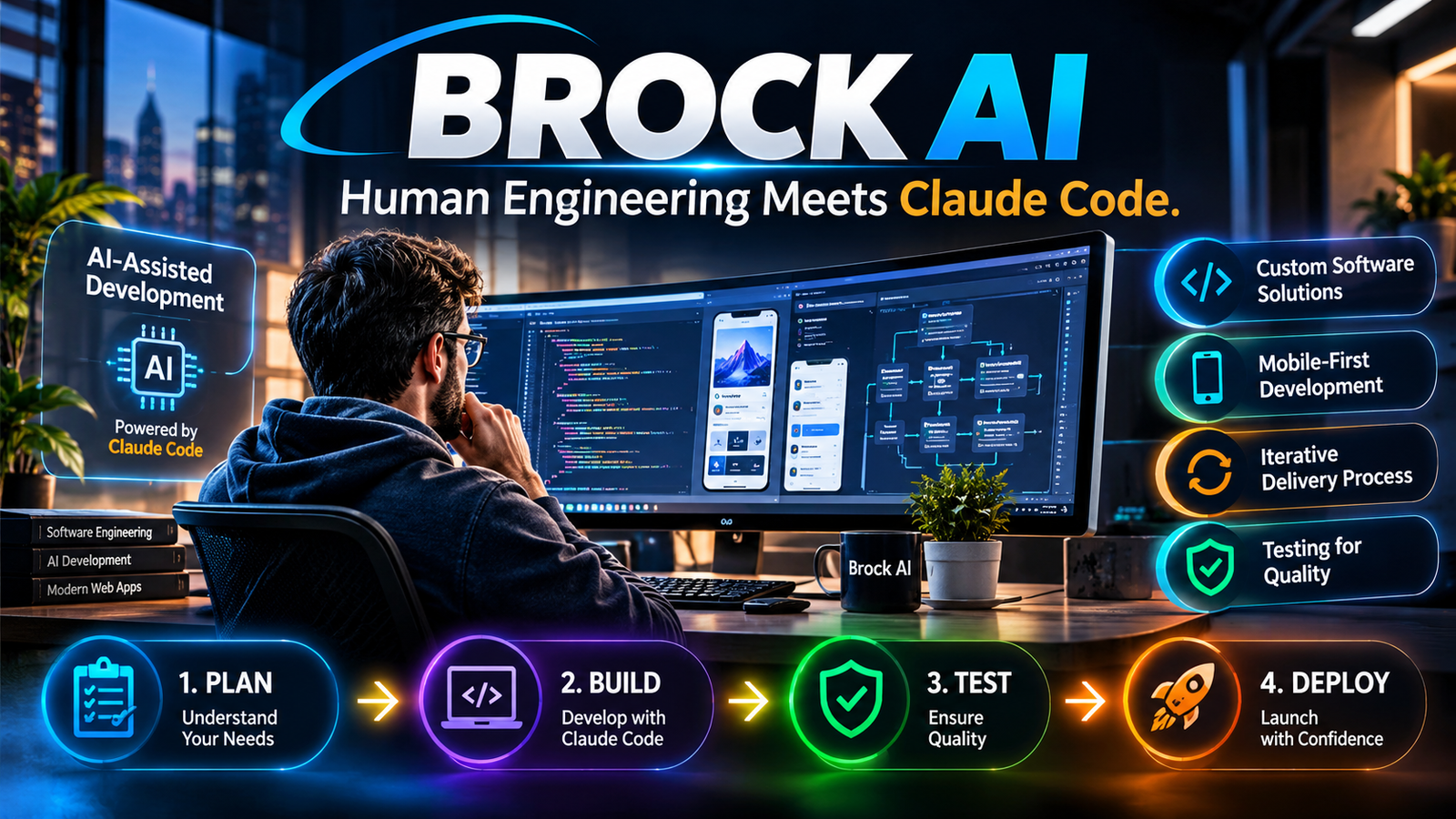
Brock AI is a software development service that combines human engineering experience with Anthropic’s Claude Code. It focuses on building mobile-first applications through an iterative process that includes planning, development, testing, and deployment.
Unlike self-service AI app builders, BrockAI presents its offering as a development service for businesses that need software tailored to their operations. This makes it relevant to companies exploring custom applications rather than simply looking for an AI coding assistant.
What Is Brock AI?
BrockAI is a software development company that uses AI-assisted coding as part of its development workflow. Its official website describes the approach as a collaboration between experienced developers and Anthropic’s Claude Code.
The company says it has more than 20 years of software development experience. Its stated focus is mobile-first applications, context-driven development, rigorous testing, and responsible software delivery.
The distinction is important: BrockAI is not an AI model or a standalone chatbot. It is a development service that uses existing AI technology to support software engineering.
Its website describes three central ideas:
- Deep context: Understanding the project, its requirements, and its technical structure.
- Rigorous testing: Checking software before making new functionality available.
- Responsible delivery: Developing and deploying software through controlled iterations.
These principles form the foundation of BrockAI’s public positioning.
How Does Brock AI Work?
BrockAI describes its development process as iterative software development. Instead of building an entire application in one large cycle, the team divides the project into smaller stages.
Each stage covers a specific set of features. The team develops and tests those features before collecting feedback and moving forward.
This approach gives clients opportunities to review working software during development.
1. Understanding the Project
Every custom application starts with a business requirement.
For example, a logistics company might need an application to manage delivery records, while a service business might need a mobile tool for employee reporting.
The development team first needs to understand the problem, intended users, essential features, and expected results.
Without clear requirements, even advanced AI coding tools can produce software that misses the actual business need.
2. Planning Features and Development Tasks
Once the requirements are understood, the project can be divided into smaller development tasks.
These might include:
- User registration and authentication.
- Application screens and navigation.
- Database structure.
- API connections.
- Reporting functionality.
- Mobile device compatibility.
Breaking the work into manageable tasks makes it easier to review progress and identify problems early.
3. Building With Claude Code
Claude Code is Anthropic’s AI coding agent. It can examine a codebase, edit files, execute development commands, and assist with software engineering tasks.
BrockAI identifies Claude Code as part of its development approach.
In practical terms, AI assistance can help developers investigate existing code, implement features, and work through technical problems. Developers still need to review the output and make important engineering decisions.
The objective is to use AI where it helps while maintaining control over the finished application.
4. Testing Each Development Cycle
Testing is particularly important when AI tools contribute to software development.
A feature may appear to work while still containing errors, security weaknesses, or compatibility problems.
BrockAI describes testing as part of each development iteration. Its website also explains that completed functionality can be made available for client acceptance testing.
For a business application, useful checks may include:
- Does each feature work as intended?
- Can users complete important tasks?
- Are errors handled correctly?
- Does the application work on supported devices?
- Do integrations return the expected information?
Testing should be based on the application’s actual requirements rather than simply checking whether the code runs.
5. Reviewing Feedback and Making Improvements
After a development cycle, clients can review the working version and provide feedback.
This helps the team identify missing functionality or changes that would improve the user experience.
The next development cycle can then address those priorities.
This process continues as the application develops. It gives businesses more visibility into progress than waiting until the entire product is finished.
6. Deployment and Delivery
Deployment makes completed software available in its intended environment.
BrockAI describes deployment as part of its iterative development cycle. However, businesses should confirm the exact hosting arrangements, release procedures, maintenance responsibilities, and support terms for their individual projects.
These details can differ significantly between applications.
What Does Brock AI Offer?
BrockAI’s public positioning focuses on custom software development rather than a large collection of self-service AI features.
Its main areas of emphasis include the following.
AI-Assisted Software Development
Claude Code supports developers with coding and codebase-related tasks.
BrockAI combines this technology with human development experience. This is different from offering customers a chatbot that automatically creates an application from a single prompt.
Mobile-First Application Development
Mobile-first development places mobile users and their workflows at the center of application design.
This can be useful for businesses whose employees work outside traditional office environments.
Examples include delivery teams, field workers, service technicians, and operational staff.
Iterative Project Delivery
The company describes a process involving planning, design, development, testing, review, and deployment.
Smaller development cycles allow clients to evaluate functionality as the project progresses.
Project-Specific Software Solutions
Custom software is useful when existing applications do not adequately support a company’s processes.
A business may require specific workflows, reporting systems, user permissions, or integrations.
The exact functionality depends on the project rather than a standard BrockAI subscription package.
Brock AI Use Cases
The strongest reason to consider custom development is a specific business problem that existing software cannot solve efficiently.
Here are several areas where BrockAI’s stated development approach may be relevant.
Business Process Management
Some companies still depend on spreadsheets, paper forms, and disconnected applications.
A custom application can bring these activities into one system.
For example, a business could develop a mobile tool for employee records, task updates, and internal reporting.
Logistics and Delivery Operations
Logistics businesses manage information about drivers, vehicles, deliveries, and daily operations.
A tailored application can help organize these processes and make information easier to access.
BrockAI’s public portfolio includes Bulk Fuel Mobile, which provides a concrete example of its focus on business-specific software.
Companies interested in this type of solution should review the product’s current functionality and suitability for their operations.
Field Service Applications
Businesses with employees working at different locations may need mobile access to job information.
A custom application could support task assignments, service records, customer information, and reporting.
The important consideration is whether the application fits the actual workflow of field employees.
Internal Business Tools
Not every business application needs to be a public-facing product.
Companies may need internal dashboards, administrative tools, reporting interfaces, or systems that connect existing software.
Custom development can address these requirements when off-the-shelf products are too restrictive.
Brock AI and Claude Code: What Is the Difference?
One common source of confusion is the relationship between BrockAI and Claude Code.
They are not the same product.
Claude Code is Anthropic’s AI coding agent. It helps developers work with software projects through natural-language instructions and development tools.
BrockAI is a software development service that identifies Claude Code as part of its workflow.
The difference becomes clearer when comparing their roles.
| Area | BrockAI | Claude Code |
|---|---|---|
| Product type | Software development service | AI coding agent |
| Provider | BrockAI | Anthropic |
| Main purpose | Building custom software for clients | Assisting developers with coding tasks |
| Intended user | Businesses and organizations | Developers and technical teams |
| Human development involvement | Part of its stated service approach | Depends on the developer using it |
| Pricing | Project terms require confirmation | Anthropic’s applicable plan or usage pricing |
In simple terms, Claude Code is a development tool, while BrockAI uses that tool within a broader software development service.
Brock AI Alternatives
BrockAI is not directly interchangeable with every AI development platform. Some alternatives provide coding tools, while others offer self-service application builders.
The right choice depends on whether a business wants to hire a development service or build software independently.
| Platform | Best suited for | Main strength | Important consideration |
|---|---|---|---|
| BrockAI | Businesses needing custom software | Human-led development with Claude Code | Project scope and costs need direct discussion |
| Claude Code | Software developers | AI-assisted work across codebases | Requires technical knowledge and review |
| Lovable | Founders and product teams | Building web applications through prompts | Complex applications need additional engineering |
| Bolt.new | Developers and rapid prototyping | Browser-based application development | Project complexity can increase technical requirements |
| Replit | Beginners and developers | Integrated coding and application deployment | Usage and hosting requirements should be evaluated |
| Cursor | Software developers | AI-assisted code editing | It is a coding environment, not a custom development service |
Claude Code
Claude Code is the closest technology comparison because BrockAI identifies it as part of its development workflow.
Developers can use it to explore codebases, make changes, and assist with development tasks.
However, using Claude Code independently means the user remains responsible for managing the software project.
Lovable
Lovable is designed for building applications through natural-language instructions.
It can help founders create early products and web application prototypes without writing every component manually.
It is a self-service platform, unlike a custom development engagement.
Bolt.new
Bolt.new offers a browser-based environment for creating and modifying applications.
It is useful for rapid experimentation and prompt-driven development.
Users should still consider code quality, integrations, testing, and deployment before using a project in a production environment.
Replit
Replit combines an online coding environment with AI-assisted application development.
It can help users build, test, and deploy projects within an integrated platform.
Its suitability depends on the technical requirements and expected usage.
Cursor
Cursor is an AI-assisted code editor for developers.
It supports people who want to work directly with application code while using AI assistance.
Unlike BrockAI, it does not represent a complete custom software development service.
Brock AI Pricing: Is It Free?
BrockAI’s public website does not establish a universal subscription price for its custom software development services in the information reviewed.
This is understandable for project-based development because costs depend on the work involved.
Before requesting a proposal, businesses should consider:
- Number of required features.
- Mobile platform requirements.
- Database and hosting needs.
- Third-party integrations.
- Testing requirements.
- Ongoing maintenance.
- Future development work.
Ask for a written estimate that separates initial development costs from recurring expenses.
Also confirm who pays for hosting, external APIs, software licenses, and infrastructure.
Do not assume that using AI-assisted development automatically makes a project inexpensive. Planning, testing, deployment, and long-term support still require resources.
Benefits and Limitations of Brock AI
BrockAI’s approach has potential advantages, but businesses should evaluate the complete service before making a decision.
Potential Benefits
Human involvement: The company describes a development process that combines experienced developers with AI assistance.
Structured development: Smaller development cycles provide opportunities to review progress.
Business-focused applications: Custom development can address requirements that generic software may not support.
Testing during development: Reviewing functionality at different stages can help identify problems earlier.
Mobile-first focus: This approach can suit businesses with employees who depend on mobile access.
Important Limitations
Limited public pricing information: Businesses need to contact the company for project-specific costs.
AI does not guarantee quality: Generated code requires review, testing, and maintenance.
Project requirements matter: Complex applications may need substantial engineering work.
Service details require confirmation: Hosting, support, maintenance, delivery timelines, and ownership terms should be agreed upon before development begins.
AI provider dependency: Since BrockAI identifies Claude Code in its workflow, businesses should ask how projects remain maintainable if the underlying AI tools change.
Is Brock AI Suitable for Small Businesses?
BrockAI may be worth considering for small businesses that need custom software but do not want to manage every development task internally.
For example, a company with a manual delivery process might benefit from an application designed around its actual operations.
Similarly, a business that relies on disconnected spreadsheets may need a central reporting system.
However, not every business needs custom development.
A ready-made application may be more practical when the requirements are simple and existing software already provides the necessary features.
Before choosing BrockAI, consider three questions:
- Does your business have a problem that existing software cannot solve?
- Is a custom application worth the development and maintenance costs?
- Can the provider demonstrate relevant experience and explain its delivery process?
If the answers are clear, requesting a project proposal is a sensible next step.
What Should You Check Before Hiring Brock AI?
A development company’s AI tools are only one part of the decision.
The contract, technical architecture, ownership arrangements, and support process matter just as much.
Before starting a project, ask:
Who owns the source code? Confirm whether your business receives full access to the application code and related documentation.
How is data protected? Ask where business information is stored, who can access it, and how sensitive information is handled during development.
What testing is included? Clarify whether the project includes functional, integration, security, and device compatibility testing.
What happens after launch? Establish whether maintenance, bug fixes, and technical support are included.
Are third-party costs separate? Confirm hosting, API usage, subscriptions, and infrastructure expenses.
Can another team maintain the application? Make sure the software is documented and does not depend unnecessarily on one developer or AI provider.
These questions help businesses understand the real cost and long-term responsibilities of custom software.
Frequently Asked Questions
What is Brock AI used for?
Brock AI is a software development service that uses AI-assisted coding to support custom application development. Its stated focus includes mobile-first applications and iterative software delivery.
Does Brock AI use Claude Code?
Yes. BrockAI identifies Anthropic’s Claude Code as part of its development workflow. The company combines AI-assisted coding with human engineering involvement.
Is Brock AI free?
BrockAI does not list a universal free plan or standardized price for its custom development services in the public information reviewed. Contact the company for project-specific pricing.
Is Brock AI suitable for small businesses?
It may suit small businesses that need custom applications, mobile workflows, or internal business tools. The decision depends on the project budget, technical requirements, and long-term maintenance costs.
What is the difference between Brock AI and Claude Code?
BrockAI is a software development service, while Claude Code is Anthropic’s AI coding agent. BrockAI uses Claude Code as part of its stated development approach.
Final Thoughts
Brock AI is best understood as an AI-assisted software development service, not another standalone AI chatbot or app builder.
Its approach combines Claude Code with human engineering and iterative development. Its mobile-first focus may appeal to businesses that need software designed around specific operational requirements.
The main consideration is whether custom development offers enough value for your business. Pricing, project scope, source-code ownership, security, and ongoing support should all be discussed before signing an agreement.
For companies that need tailored software rather than a do-it-yourself app builder, BrockAI is worth researching further.