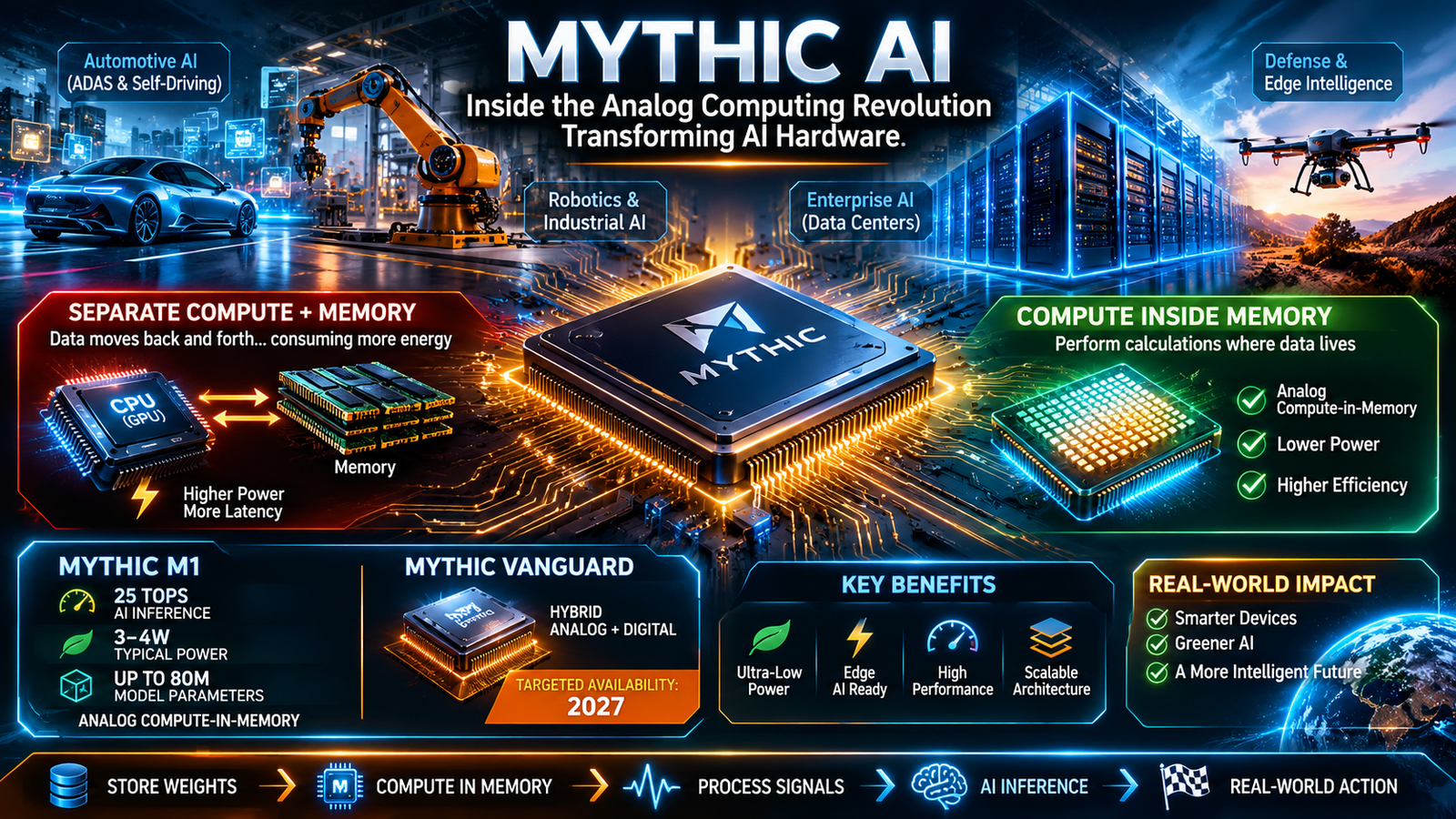
Mythic AI is a semiconductor company developing Analog Processing Units (APUs) that use analog compute-in-memory technology to accelerate artificial intelligence workloads. Its approach aims to reduce the energy consumed by AI inference by performing calculations directly where neural network data is stored, rather than repeatedly moving data between separate memory and processors.
Mythic AI at a Glance
Mythic Redefines Edge AI by Combining Analog Processing and Flash Memory – News
Mythic AI
AI semiconductor and computing infrastructure
Official website: mythic.ai
- Core technology: Analog compute-in-memory.
- Main hardware: Analog Processing Units (APUs).
- First-generation product: Mythic M1.
- M1 performance: Up to 25 TOPS, according to the company.
- Primary applications: Robotics, automotive systems, computer vision, defense, and edge AI.
- Next-generation direction: Hybrid analog and digital computing through Mythic Vanguard.
What Is Mythic AI?
Mythic AI is a semiconductor technology company focused on making artificial intelligence computing more energy-efficient.
Unlike conventional AI hardware companies that primarily improve digital processors, Mythic takes a different architectural approach. It develops chips that perform certain AI calculations directly inside memory.
This technology is called analog compute-in-memory (aCIM).
The distinction matters because modern AI systems move enormous amounts of information between memory and processing units. That movement consumes electricity and creates performance bottlenecks.
Mythic aims to reduce this overhead by placing computation closer to the data.
Its technology is particularly relevant to AI inference, where trained machine-learning models process new information to generate predictions, classifications, and other outputs.
The company’s products are designed for environments where power consumption, physical size, and computing performance must work together.
Examples include:
- Autonomous and driver-assistance systems.
- Industrial cameras and smart sensors.
- Robotics and drones.
- Security and surveillance equipment.
- Embedded AI devices.
- Enterprise AI inference infrastructure.
Mythic is therefore not another chatbot or general-purpose AI application. It operates at the hardware layer of the AI industry.Accelerate AI Innovation Today+2
How Does Mythic AI Technology Work?
To understand Mythic, it helps to understand a fundamental limitation in traditional computing architecture.
1. The Memory and Processor Bottleneck
Conventional processors generally separate memory from computation.
Memory stores the information, while the processor performs mathematical operations. During AI inference, data must travel between these components repeatedly.
This movement creates additional energy consumption.
For neural networks, the problem becomes particularly significant because models perform enormous numbers of mathematical operations using stored weights.
The more frequently information moves between memory and processing hardware, the greater the potential overhead.
This challenge is commonly associated with the memory wall or the von Neumann bottleneck.
2. Analog Compute-in-Memory
Mythic approaches this problem by storing neural network weights in flash memory and performing matrix calculations directly within the memory architecture.
Instead of constantly transferring weights to a separate processor, the hardware performs relevant computations where the data resides.
Analog AI Startup Aims to Lower Gen AI’s Power Needs – IEEE Spectrum
spectrum.ieee.org
This approach can reduce unnecessary data movement and improve energy efficiency for supported workloads.
The underlying principle is straightforward:
- Store neural network weights in memory.
- Apply input signals to the memory architecture.
- Perform analog mathematical operations.
- Convert and process resulting signals.
- Produce outputs for the AI application.
The architecture is particularly interesting for matrix multiplication, a fundamental operation in neural networks.
3. Why Analog Computing Matters
Analog computing represents information through continuously varying physical signals rather than relying exclusively on discrete digital states.
For AI inference, this can offer advantages when performing large numbers of parallel mathematical operations.
However, analog hardware also introduces engineering challenges.
Signal noise, manufacturing variations, temperature changes, and calibration requirements can affect computational accuracy.
Mythic’s approach combines specialized analog computation with supporting digital circuitry and software to make the architecture practical.
The objective is not to eliminate digital computing entirely. It is to use analog processing where it provides meaningful efficiency advantages.Mythic+2
Mythic AI Products and Hardware
Mythic’s hardware strategy focuses on scalable AI processing rather than a single-purpose consumer product.
Its product development includes existing M1 hardware and the next-generation Vanguard platform.
Mythic M1: First-Generation Analog Processing Unit
AI Processor Startup Mythic Closes $70M Series C With Plans to Hire 36 | Built In Austin
builtinaustin.com
The Mythic M1 is the company’s first-generation Analog Processing Unit.
According to its product documentation, the chip delivers up to 25 TOPS of AI inference performance.
TOPS means trillions of operations per second. It is a measure of theoretical processing throughput, not a direct measurement of real-world application speed.
Important M1 specifications published by Mythic include:
| Specification | Published information |
|---|---|
| AI performance | Up to 25 TOPS |
| Typical chip power | Approximately 3–4 watts |
| Lower-power operation | Approximately 1–2 watts for lighter workloads |
| On-chip model storage | Up to 80 million neural network parameters |
| Memory technology | Embedded flash |
| Supported frameworks | PyTorch, Caffe, TensorFlow |
| Target applications | Embedded AI and edge inference |
The M1 is designed for applications that require substantial AI processing without the power demands of larger computing systems.
Mythic also offers different hardware form factors, including M.2 modules for embedded applications.
These configurations can help manufacturers integrate AI acceleration into existing equipment.
The published specifications should be treated as vendor-provided product figures. Actual performance depends on the model, precision, workload, and implementation.Mythic
Mythic Vanguard: The Next Generation
Mythic @ Hot Chips 2018. A breakdown of Mythic’s presentation at… | by Dave Fick | Mythic | Medium
medium.com
Mythic Vanguard represents the company’s next-generation computing direction.
Unlike an architecture built around analog processing alone, Vanguard combines an analog die with a digital die.
The two components have different responsibilities:
- Analog die: Handles computationally intensive matrix operations.
- Digital die: Manages control, programmability, and supporting workloads.
This hybrid architecture is important because modern AI applications involve more than matrix multiplication.
They also require data movement, control operations, attention calculations, and other digital processing tasks.
Mythic says Vanguard is intended to support large language models, computer vision, and enterprise AI workloads.
The company lists 2027 as its expected availability year. This is a product roadmap target, not confirmation that the platform is already commercially available.Mythic
Key Applications and Real-World Use Cases of Mythic AI
Mythic’s technology targets industries where conventional AI hardware can create power, thermal, or deployment challenges.
Its potential value becomes clearer when examining specific applications.
1. Robotics and Physical AI
3D Machine Vision in Robotics: Smart Vision-Guided Automation– Tofsensors
tofsensors.com
Robots need to process information from cameras, sensors, and other input devices.
They must recognize objects, understand their surroundings, and respond to changing conditions.
Running these workloads through cloud infrastructure can introduce network delays and connectivity requirements.
Mythic’s edge-processing approach aims to bring more intelligence directly into robotic systems.
Potential applications include:
- Industrial inspection robots.
- Autonomous mobile robots.
- Smart manufacturing equipment.
- Drones and unmanned systems.
- Real-time object detection.
The biggest potential advantage is local inference with lower power requirements.
2. Automotive AI and Advanced Driver Assistance
ADAS Market Expansion Driven by Regulation, AI, and the Shift Toward Autonomous Mobility
linkedin.com
Modern vehicles increasingly depend on AI for understanding their surroundings.
Advanced Driver Assistance Systems (ADAS) use cameras and other sensors to identify pedestrians, vehicles, road markings, and potential hazards.
These systems require reliable computing within strict power and thermal limits.
Mythic announced a joint development agreement with Honda R&D in February 2026.
The companies plan to develop an automotive-grade AI system-on-chip using Mythic’s analog processing technology.
The collaboration targets future software-defined vehicles, with initial prototype testing expected in the late 2020s or early 2030s.
This is an important commercial development, but it does not mean Mythic-powered autonomous driving systems are already deployed across Honda vehicles.Mythic
3. Computer Vision and Smart Surveillance
Industrial Safety Compliance – Factory Floor Monitoring | Pixuate
pixuate.com
Computer vision systems analyze images and video to identify objects, movement, and unusual activity.
These workloads can require continuous processing.
Mythic’s low-power hardware could be useful for:
- Industrial safety monitoring.
- Smart security cameras.
- Traffic observation.
- Automated inspection.
- Visual quality control.
Processing information locally can also reduce the need to transmit every video frame to a remote server.
However, local processing does not automatically guarantee data privacy. Manufacturers still need appropriate security and data-handling controls.
4. Defense and Edge Intelligence
Defense applications often operate in environments with limited connectivity and strict power budgets.
Drones, portable sensors, and surveillance equipment may need to analyze information without relying on constant cloud access.
Mythic is developing its position in this market through its low-power inference architecture.
In September 2026, the company announced the formation of a Defense Advisory Board to support AI hardware adoption across the US national security sector.
This signals a strategic focus, not proof that every proposed defense application has entered operational deployment.Mythic+1
5. Enterprise AI and Large Language Models
AI 추론 스타트업 프렌들리AI, 2000만 달러 투자 유치…GPU 효율화 강점 – TokenPost
tokenpost.kr
Enterprise AI systems need computing infrastructure capable of handling large numbers of inference requests.
Traditional GPU-based infrastructure can consume substantial electricity, especially when running models continuously.
Mythic’s longer-term objective is to extend its analog computing architecture beyond edge devices.
Its Vanguard platform is designed to combine analog matrix processing with digital computing.
This could make the technology relevant to private AI infrastructure, enterprise language models, and specialized inference clusters.
However, the M1 and Vanguard should not be treated as interchangeable products. Their capabilities and intended deployment scales differ.
Major Benefits of Mythic AI
Mythic’s architecture offers several potential advantages over conventional AI computing approaches.
Lower Energy Consumption
Energy efficiency is the central proposition behind Mythic.
By reducing the movement of information between memory and processing units, analog compute-in-memory can reduce a major source of computing overhead.
The company promotes up to 100x system-level efficiency advantages against conventional GPU-based systems.
That figure is a company claim, not a universal benchmark. Comparisons depend on hardware configurations, workloads, performance targets, and measurement methods.
More Efficient Edge AI
Edge AI means running machine-learning models directly on devices rather than sending every task to a cloud server.
This can help manufacturers build intelligent products with fewer connectivity requirements.
Mythic’s M1 is specifically designed for embedded and power-constrained environments.
Reduced Dependence on External Memory
The M1 stores up to 80 million neural network weight parameters on-chip, according to its product documentation.
This reduces the need to repeatedly transfer model weights from external memory during supported computations.
It can also simplify hardware requirements for certain embedded applications.
Support for Established AI Frameworks
Developers do not necessarily need to build neural networks from scratch.
Mythic lists support for models developed with established frameworks, including:
- PyTorch
- TensorFlow
- Caffe
Its software workflow includes model optimization, quantization, and compilation.
Nevertheless, framework compatibility does not mean every model can run without modification. Developers should confirm operator support, precision requirements, and model conversion workflows before choosing the hardware.Mythic+1
Mythic AI vs. Traditional AI Chips
Mythic is entering a market dominated by established GPU manufacturers and specialized AI accelerator companies.
Understanding the architectural differences helps explain its position.
| Technology | Main approach | Typical strength | Main consideration |
|---|---|---|---|
| NVIDIA GPUs | Parallel digital computing | Flexible AI workloads and mature software ecosystem | Power and infrastructure requirements |
| Mythic APUs | Analog compute-in-memory | Energy-efficient inference architecture | Workload compatibility and analog precision |
| Edge AI accelerators | Specialized digital inference | Compact deployment and optimized workloads | Model and operator support |
| Traditional CPUs | General-purpose digital computing | Broad software compatibility | Less specialized AI acceleration |
Mythic AI vs. NVIDIA
NVIDIA is a major force in AI training and inference.
Its GPU ecosystem supports a broad range of workloads, development tools, and software frameworks.
Mythic takes a more specialized approach.
Instead of competing only through conventional GPU processing, it focuses on reducing the energy cost of AI inference through analog computation.
The comparison is therefore not simply about which chip performs more operations.
Businesses should examine energy consumption, throughput, accuracy, software compatibility, system cost, and deployment requirements.
Mythic AI vs. Hailo
Hailo develops specialized processors for edge AI applications.
Both companies target applications where power efficiency and local inference matter.
Their architectural approaches differ, however.
Mythic emphasizes analog compute-in-memory, while Hailo focuses on specialized digital AI processor architectures.
Mythic AI vs. Qualcomm
Qualcomm develops processors and AI technologies for mobile, automotive, and connected devices.
Qualcomm benefits from an established ecosystem of semiconductor products and device integrations.
Mythic’s differentiation lies in its analog computing architecture and focus on energy-efficient inference.
The right choice depends on the product’s power budget, AI workload, software environment, and hardware integration requirements.
Mythic AI Pricing and Availability
One important question for businesses is whether Mythic publishes standard hardware prices.
As of November 13, 2026, the company’s public product pages emphasize evaluation kits, demonstrations, and direct contact rather than a transparent retail price list.
Consequently, buyers should not assume that Mythic M1 or its next-generation products have fixed publicly advertised prices.
Pricing may depend on several factors:
- Hardware configuration.
- Order volume.
- Development and evaluation requirements.
- Software support.
- Integration services.
- Long-term production agreements.
Product availability also needs careful interpretation.
Mythic presents M1 as its available evaluation platform. Vanguard, meanwhile, is listed with a 2027 availability target.
Businesses interested in adopting the technology should contact Mythic directly to confirm current availability, development-kit access, licensing terms, and support arrangements.
Official website: Mythic AI
Latest Mythic AI Developments in 2026
Mythic’s recent announcements provide useful context for understanding its direction.
Mythic AI: 2026 Timeline
- February 6, 2026: Honda collaborationMythic announced a joint development agreement with Honda R&D for next-generation automotive AI computing.Mythic
- March 17, 2026: Microchip technology selectionMythic selected SST’s memBrain technology for next-generation APUs. The announcement highlighted a target of 120 TOPS per watt.Microchip Technology
- May 19, 2026: Videantis acquisitionMythic announced its acquisition of German processor IP company Videantis, bringing digital processing expertise into its broader computing strategy.Mythic
- September 16, 2026: Defense Advisory BoardThe company announced an advisory board focused on defense and national security applications.Mythic
- September 29, 2026: India expansionMythic announced a Bengaluru Centre of Excellence to advance next-generation analog AI chip development.Mythic
These announcements suggest that Mythic is expanding beyond its original edge AI positioning.
Its strategy increasingly connects analog computing, digital processor technology, automotive development, and enterprise inference.
Limitations and Technical Challenges
Despite its potential, Mythic’s technology should not be viewed as a universal replacement for GPUs or conventional AI processors.
Several considerations matter before adopting an analog computing platform.
1. Analog Computing Accuracy
Analog circuits can be affected by electrical noise, temperature fluctuations, and manufacturing differences.
These factors can influence computational precision.
Mythic must address these challenges through circuit design, calibration, and software optimization.
For applications such as autonomous driving, medical imaging, and industrial inspection, developers must validate accuracy under realistic operating conditions.
2. Software Compatibility
A hardware accelerator is only useful when developers can deploy their models efficiently.
Although Mythic supports established AI frameworks, compatibility still depends on the specific neural network architecture and supported operations.
Teams should check:
- Model conversion requirements.
- Supported neural network operators.
- Quantization requirements.
- Development tools and documentation.
- Debugging and profiling capabilities.
3. Limited Independent Benchmark Data
Mythic advertises substantial energy-efficiency improvements over conventional GPUs.
However, vendor comparisons require careful interpretation.
A meaningful benchmark should compare equivalent workloads, model accuracy, throughput, latency, and total system power.
Without independently reproducible results under comparable conditions, advertised efficiency figures should remain company claims rather than established industry-wide conclusions.
4. Product Roadmap and Availability
M1 and Vanguard occupy different stages of the product roadmap.
M1 is presented as an existing evaluation product. Vanguard has a stated 2027 availability target.
Companies planning large deployments should confirm production schedules, hardware supply, software maturity, and long-term support.
5. Integration Costs
Replacing an existing AI accelerator involves more than purchasing a new chip.
Businesses may need to redesign circuit boards, update firmware, optimize models, and validate complete systems.
These engineering expenses can influence the total cost of ownership.
Is Mythic AI Open Source?
Mythic is a commercial semiconductor technology company, not an open-source AI model repository.
Its hardware architecture and software development environment are part of its commercial platform.
Developers may use established machine-learning frameworks such as PyTorch and TensorFlow to prepare supported models.
However, framework support does not mean Mythic’s hardware designs, proprietary software, or complete development stack are open source.
Businesses should review the company’s licensing and software documentation before making deployment decisions.
Mythic AI vs. Other AI Discovery Platforms
Not every platform in the AI ecosystem competes directly with Mythic.
Some companies manufacture hardware, while others help users discover AI applications or machine-learning models.
The distinction is important when evaluating search results for the keyword.
| Platform | Target user | Main strength | Pricing transparency | Main limitation |
|---|---|---|---|---|
| Mythic AI | Hardware developers and businesses | Analog AI inference chips | Contact for commercial details | Specialized hardware |
| NVIDIA | AI developers and enterprises | GPU ecosystem and AI infrastructure | Product and enterprise dependent | Infrastructure costs |
| Hailo | Edge AI developers | Specialized inference processors | Configuration dependent | Workload-specific hardware |
| Qualcomm | Device manufacturers | Integrated processors and AI capabilities | Commercial inquiry | Platform-specific integration |
| Hugging Face Hub | AI developers and researchers | Model and dataset discovery | Free and paid options vary | Not an AI chip manufacturer |
| Futurepedia | General AI users | AI software discovery | Varies by listed product | Not a hardware evaluation platform |
The key distinction is that Mythic sells an AI computing architecture, whereas discovery platforms organize information about AI software and models.
For developers researching hardware alternatives, product documentation and reproducible benchmarks are more useful than general AI tool directories.
Who Should Consider Mythic AI?
Mythic is most relevant to organizations developing physical products that need efficient AI inference.
Hardware engineers may find its architecture interesting when designing custom accelerators and embedded systems.
Automotive manufacturers may explore its technology for advanced driver assistance, sensor processing, and future software-defined vehicles.
Robotics developers may investigate low-power inference for autonomous machines and industrial automation.
Enterprise AI teams may evaluate its longer-term potential for specialized inference infrastructure.
AI researchers may find analog compute-in-memory useful when investigating alternative approaches to neural network acceleration.
However, individual consumers looking for an AI chatbot, image generator, writing assistant, or productivity application are unlikely to benefit directly from Mythic’s semiconductor products.
What Should Businesses Evaluate Before Choosing Mythic AI?
A successful hardware evaluation should begin with the intended workload, not the advertised TOPS figure.
Consider the following checklist:
- Inference performance: Does the hardware meet the required throughput and latency?
- Power consumption: Measure total system power under actual operating conditions.
- Model compatibility: Confirm support for your existing neural network.
- Accuracy: Compare model outputs against the original implementation.
- Software maturity: Review development tools, documentation, and debugging support.
- Integration: Calculate engineering costs and hardware redesign requirements.
- Availability: Confirm production quantities and delivery schedules.
- Long-term support: Review firmware updates, product roadmaps, and lifecycle commitments.
A practical pilot should compare Mythic hardware against an existing GPU or edge accelerator using the same model and test data.
Measure performance per watt, accuracy, latency, and total deployment cost.
This provides a more reliable purchasing decision than relying on headline specifications alone.
Frequently Asked Questions
1. What is Mythic AI used for?
Mythic AI develops energy-efficient semiconductor hardware for artificial intelligence inference. Its applications include robotics, automotive systems, computer vision, defense equipment, and embedded AI devices.
2. Is Mythic AI a chatbot or AI software platform?
No. Mythic AI is a semiconductor company that develops Analog Processing Units (APUs). Its primary focus is AI computing hardware rather than consumer-facing chatbots or generative AI applications.
3. What is an Analog Processing Unit (APU)?
An Analog Processing Unit is a specialized processor that performs certain mathematical operations using analog computing techniques. Mythic’s APUs use compute-in-memory architecture to perform neural network calculations closer to where model weights are stored.
4. How powerful is the Mythic M1 chip?
Mythic specifies up to 25 TOPS of AI inference performance for its M1 chip. The company also lists typical power consumption of approximately 3–4 watts, with lower-power operating configurations for lighter workloads.
5. Is Mythic AI better than NVIDIA GPUs?
Not necessarily. Mythic focuses on energy-efficient analog inference, while NVIDIA GPUs provide a broader digital computing ecosystem. The better choice depends on the workload, performance requirements, software compatibility, power budget, and total system cost.
Conclusion
Mythic AI represents an interesting alternative to conventional AI semiconductor architecture.
Its analog compute-in-memory approach addresses one of the industry’s important challenges: the energy required to move information between memory and processing units.
The Mythic M1 demonstrates the company’s existing hardware direction, while Vanguard represents its next-generation hybrid analog and digital strategy.
The Honda collaboration, Microchip technology selection, Videantis acquisition, and international expansion provide additional context for its commercial ambitions.
However, advertised efficiency advantages still need to be evaluated against independent benchmarks and real-world workloads.
For automotive manufacturers, robotics developers, embedded hardware engineers, and enterprise infrastructure teams, Mythic is worth investigating.
The most important question is not whether analog computing will replace every GPU. It is whether Mythic can deliver measurable advantages for the specific AI workloads businesses need to run.