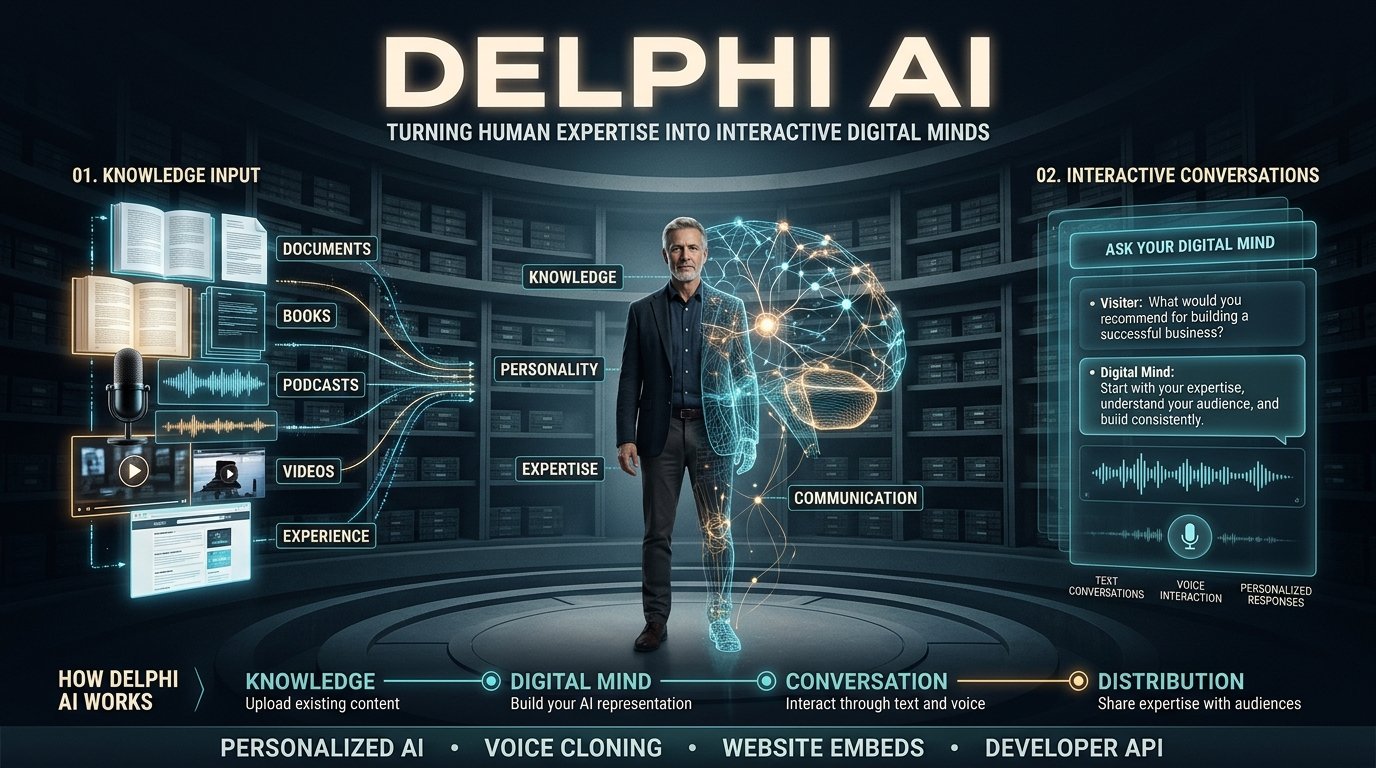
Delphi AI is a digital-mind platform that allows experts, entrepreneurs, and creators to build interactive AI versions of themselves using their existing knowledge and content. These digital minds can answer questions through text and voice, helping people share expertise, support audiences, and make their knowledge accessible without being personally available for every conversation.
Delphi AI at a Glance
Delphi AI
AI-powered digital expertise platform
Free plan available
| Category | Details |
|---|---|
| Company founded | 2022 |
| Founders | Dara Ladjevardian and Sam Spelsberg |
| Main product | Interactive Digital Minds |
| Primary audience | Experts, creators, founders, coaches |
| Interaction | Text and voice |
| Languages | 40+ advertised |
| Free plan | Available |
| Paid entry plan | $5,000/year for Scaler |
| API | Available on Scaler + API |
| Official website | delphi.ai |
Key takeaways
- Delphi creates conversational AI versions of individuals.
- Users can train their Digital Minds using existing content.
- Voice interaction is part of its product offering.
- Website embeds and third-party integrations extend accessibility.
- API access is available through a higher-priced subscription.
- Its annual paid pricing makes it more relevant to established experts than budget-conscious beginners.
What Is Delphi AI?
Delphi AI is an artificial intelligence platform designed to turn personal knowledge into interactive digital experiences.
Instead of building another generic chatbot, Delphi focuses on reproducing an individual’s expertise, communication style, and professional perspective through an AI-powered digital representation.
The platform calls these representations Digital Minds.
A Digital Mind can draw on a person’s books, articles, podcasts, videos, documents, and other knowledge sources. People can then interact with that knowledge through conversations rather than searching through hours of existing content.
For example, imagine a business consultant who receives hundreds of questions about entrepreneurship every month.
Instead of personally answering every introductory question, the consultant can create a Digital Mind trained on their published material and professional insights.
Visitors can ask questions, explore recommendations, and learn from the consultant’s accumulated knowledge.
However, there is an important distinction: a Digital Mind is an AI-generated representation, not a perfect copy of someone’s consciousness, judgment, or personality.
The Company Behind Delphi
Delphi was co-founded in November 2022 by Dara Ladjevardian and Sam Spelsberg.
The original inspiration came from Dara’s experience creating a digital version of his grandfather using his memoir. He wanted to continue asking questions and learning from his grandfather’s experience after a stroke had made meaningful conversation difficult.
That experiment eventually developed into the Delphi platform.
In June 2025, Delphi announced a $16 million Series A funding round led by Sequoia Capital, with participation from Menlo Ventures and other investors. Delphi+1
This funding announcement reflected growing investor interest in AI systems that preserve and distribute human expertise.
How Does Delphi AI Work?
Delphi follows a knowledge-based creation process. Users provide their existing content, refine the resulting digital representation, and make it accessible to an audience.
1. Upload and Connect Knowledge Sources
The first step involves collecting the information that represents your expertise.
Depending on the available integrations and content formats, users can connect or provide materials such as:
- Written articles and documents
- Books and educational resources
- Websites and online content
- Podcasts and recorded discussions
- Videos and social media content
- Professional insights and personal experiences
This material provides the knowledge foundation for the Digital Mind.
The quality of this foundation matters. A digital clone built from outdated articles or contradictory information may produce inconsistent answers.
2. Build Your Digital Mind
Delphi processes the supplied knowledge and creates an interactive representation of the individual.
The platform also provides opportunities to refine its responses through additional questions and information.
This helps the system better reflect the creator’s preferred communication style, expertise, and perspective.
Importantly, training an AI representation on someone’s content does not guarantee that every response will reproduce their actual opinions.
3. Add Voice Capabilities
Delphi supports voice-based interactions alongside text conversations.
Its pricing documentation distinguishes between standard voice cloning and Pro Voice.
This gives creators another way to make their Digital Minds feel more conversational and accessible.
Voice quality, pronunciation, language performance, and resemblance should still be tested before using the feature in a professional environment.
4. Share Your Digital Mind
Once created, a Digital Mind can be shared with an audience.
Depending on the subscription, available distribution options include:
- Website chat embeds
- Learning platforms
- Slack
- Telegram
- SMS and WhatsApp on the Immortal plan
- API-powered custom applications on eligible plans
This makes Delphi more than a personal AI experiment. It can become part of a creator’s website, educational ecosystem, or customer engagement strategy. Delphi Help Center+1
Key Features of Delphi AI
Delphi’s main selling point is the combination of personal knowledge, conversational interaction, and distribution.
Here are the features that matter most.
1. AI Digital Cloning
The central feature is the ability to create a conversational digital representation of an individual.
Rather than answering questions from general internet knowledge alone, the system uses the creator’s supplied material as its knowledge foundation.
This is particularly useful for professionals whose expertise is distributed across multiple publications and recordings.
2. Knowledge-Based Conversations
Users can interact with a Digital Mind by asking questions in natural language.
For example, someone could ask a marketing consultant:
“What should a small business prioritize when launching its first advertising campaign?”
The Digital Mind can use the consultant’s available knowledge to formulate a response.
Delphi also describes source citations and the ability to acknowledge knowledge gaps as part of its approach. These capabilities help users understand where information originates. Delphi
3. Voice Interaction
Text is not the only way to communicate with a Delphi.
Voice calls provide another interaction method, which may be useful for audiences who prefer speaking instead of typing.
This feature also creates additional considerations around consent, voice representation, and impersonation safeguards.
4. Website Embedding
Creators can integrate their Digital Minds into their websites.
This allows visitors to interact with an AI representation without leaving the creator’s digital environment.
For consultants, educators, and entrepreneurs, this can make existing content more interactive.
5. Integrations and Distribution
Delphi supports integrations with several external platforms.
| Integration | Potential Use |
|---|---|
| Website embed | Interactive visitor experiences |
| Kajabi | Course-related knowledge access |
| Thinkific | Educational communities |
| Substack | Conversational publication experiences |
| Mighty Networks | Community engagement |
| Slack | Internal or community conversations |
| Telegram | Messaging-based access |
| SMS and WhatsApp | Direct communication on eligible plans |
Availability depends on the subscription tier. Delphi Help Center
6. Developer Platform and API
Delphi also provides API access for businesses and developers who want to integrate Digital Minds into custom applications.
Its published API documentation identifies version 3 and supports operations such as creating conversations, streaming responses, managing tags, and tracking usage.
The API is not included in every subscription. Delphi Help Center
Practical Use Cases of Delphi AI
The platform becomes more interesting when applied to specific professional situations.
Its value depends less on the novelty of an AI clone and more on how effectively it makes valuable knowledge accessible.
1. Entrepreneurs and Business Founders
Founders frequently receive similar questions from employees, investors, aspiring entrepreneurs, and business communities.
A Digital Mind can make previously published advice and business insights easier to explore.
Potential applications include:
- Sharing startup lessons and experiences.
- Answering frequently asked business questions.
- Providing introductory mentorship.
- Making founder interviews more interactive.
- Helping audiences explore business philosophies.
It should not replace direct founder involvement in confidential or high-stakes decisions.
2. Coaches and Consultants
Professional coaches often repeat similar explanations across individual sessions.
Delphi can make their existing frameworks, educational materials, and coaching principles available through conversational AI.
For example, a leadership coach could create a Digital Mind that explains their management framework and answers common introductory questions.
However, AI-generated guidance should not be presented as a substitute for personalized professional services.
3. Educators and Online Course Creators
Educators can use Delphi to make their teaching materials more accessible.
Instead of requiring students to search through multiple videos and documents, learners can ask questions about the educator’s published knowledge.
Potential applications include:
- Course-related question answering.
- Interactive learning experiences.
- Explanations of difficult concepts.
- Access to previously recorded lessons.
- Additional support outside scheduled teaching hours.
The quality of answers depends on the completeness and accuracy of the underlying educational material.
4. Authors and Content Creators
Authors, podcasters, and content creators often accumulate years of valuable material.
However, audiences cannot always find the specific information they need.
A Digital Mind can turn that material into a conversational knowledge resource.
For example, someone who has published 200 podcast episodes could make their ideas easier to explore through questions instead of requiring listeners to search every episode individually.
5. Businesses and Professional Organizations
Organizations can explore digital representations of experienced employees, executives, or subject-matter experts.
Possible applications include:
- Internal knowledge sharing.
- Employee onboarding resources.
- Institutional knowledge preservation.
- Customer education.
- Access to frequently requested expertise.
These applications require additional attention to permissions, confidential information, access control, and accuracy.
Delphi AI Pricing: How Much Does It Cost?
Pricing is one of the most important considerations when evaluating Delphi.
Its pricing structure changed significantly in October 2026. Older articles still mention Builder and monthly Scaler subscriptions, but Delphi’s updated documentation identifies four current plans.
Verified against October 30, 2026 documentation
FREE PLAN
$0
For exploring Digital Minds
- 1 million training words
- Chat and standard voice clone
- Personal Delphi profile
- 40+ languages
SCALER
$5,000/year
For established professionals
- 12 million training words
- Pro Voice
- 10 integrations
- Website embeds and custom branding
- Developer Platform and hosted actions
- Slack and Telegram
- Three collaborators
SCALER + API
$10,000/year
For advanced integrations
- Everything in Scaler
- 20 million training words
- One API key
- 500 API requests per day
- Unlimited integrations
- Single sign-on for embeds
- Priority support
- 60-day onboarding support
IMMORTAL
Custom pricing
For public figures and larger deployments
- Unlimited training words
- Unlimited collaborators
- SMS and WhatsApp
- White-label capabilities
- Higher API limits
- Custom applications
- Dedicated account strategist
Paid plans are billed annually. Prices and included features reflect Delphi’s October 30, 2026 documentation. Delphi Help Center+1
Is Delphi AI Free?
Yes. Delphi offers a free plan that allows users to create a Digital Mind without purchasing a paid subscription.
However, the free plan has limitations.
It includes one million training words and standard voice functionality, while advanced integrations, Pro Voice, and API access require higher subscription tiers.
For someone exploring the concept, the free option provides an opportunity to understand the product before making a financial commitment.
Is Delphi AI Worth Its Price?
The answer depends on how much value your expertise generates.
Consider two different users.
An independent creator: Someone publishing occasional educational content may struggle to justify a $5,000 annual subscription.
An established consultant: A consultant with a large audience, extensive knowledge archive, and frequent requests for guidance may find more value in distributing expertise through an interactive digital representation.
The important calculation is not simply the subscription price.
It is whether the platform creates enough additional value through audience engagement, knowledge accessibility, and reduced repetitive work.
Important Pricing Details Competitors May Overlook
Several details deserve attention before purchasing:
- Annual commitment: The current paid Scaler subscriptions are billed yearly, not monthly.
- API limits: Scaler + API includes 500 requests per day, which developers should evaluate against expected traffic.
- Training capacity: Training-word allowances differ between subscriptions.
- Built-in payments: Delphi does not provide native payments for charging people to access a Digital Mind. Users can instead place it behind an external membership or paywall.
- Legacy subscriptions: Older Builder and monthly Scaler subscriptions are no longer available for new purchases.
- Cancellation: The documentation says subscriptions cannot be paused. After a paid subscription ends, the account moves to Free.
These details can materially affect the total cost and suitability of the platform. Delphi Help Center+1
Delphi AI Privacy and Security: What Should Users Know?
A digital clone can contain far more than ordinary website content.
It may include personal experiences, professional opinions, business strategies, recorded conversations, and other information that creators do not necessarily want publicly accessible.
Therefore, privacy deserves serious consideration.
Content Ownership
According to Delphi’s privacy documentation, creators retain ownership of the content they upload.
The company also states that creator content is stored in a private index and is not shared or used to train external models.
Its documentation describes additional data protection measures, including daily backups and private-subnet data isolation. Delphi Help Center
These are company-published statements, not an independent security audit.
Important Privacy Questions
Before uploading sensitive material, consider the following:
- What information is collected during conversations?
- How long are conversation records retained?
- Can creators delete individual sources and conversation data?
- Who can access uploaded content?
- What happens to data when a subscription ends?
- What permissions apply to voice recordings?
- What contractual protections apply to business customers?
The published privacy overview should not be interpreted as proof of Zero Data Retention (ZDR), SOC 2 certification, or a particular regulatory compliance status.
Those claims require separate, specific documentation.
Voice Cloning and Consent
Voice replication introduces another responsibility.
Creators should only use recordings they have permission to submit and replicate. Organizations should establish clear rules governing who can create, modify, and distribute digital representations of employees or public figures.
This is particularly important when an AI-generated voice could be mistaken for a real person.
Benefits and Limitations of Delphi AI
No digital-cloning platform is suitable for every situation.
Understanding its strengths and limitations provides a more realistic picture.
| Benefits | Limitations |
|---|---|
| Makes personal expertise conversational | Cannot perfectly reproduce human judgment |
| Supports text and voice interactions | Voice performance requires testing |
| Uses existing knowledge sources | Quality depends on source material |
| Supports website integrations | Advanced integrations require paid plans |
| Offers API access | API access costs significantly more |
| Provides a free starting option | Current paid subscriptions are expensive |
| Supports multiple languages | Language availability does not guarantee equal response quality |
Main Benefits
Knowledge accessibility: Audiences can explore expertise through questions instead of searching large content libraries.
Reduced repetitive communication: Common questions can be handled through an AI representation.
Content repurposing: Existing books, videos, articles, and podcasts gain another interactive distribution format.
Scalable availability: A Digital Mind can respond without requiring the original creator to participate in every conversation.
Multiple distribution channels: Integrations allow creators to make their expertise available across different platforms.
Main Limitations
Knowledge is not judgment: A digital representation cannot automatically reproduce the original person’s experience or decision-making ability.
Potentially inaccurate responses: Even knowledge-grounded AI systems can misunderstand information or produce unsupported conclusions.
Dependence on source quality: Incomplete, outdated, or contradictory material can reduce response quality.
Subscription expense: The current $5,000 annual Scaler price creates a significant entry barrier for many individual professionals.
Platform dependence: Content organization, integrations, API access, and distribution may become tied to Delphi’s ecosystem.
Limited financial flexibility: Native payments are not included, so creators may need external membership tools.
Delphi AI Alternatives: Which Platforms Should You Consider?
Delphi operates in a developing category that overlaps with AI coaching, conversational knowledge bases, digital clones, and personal AI assistants.
However, not every competitor solves the same problem.
Some platforms focus on coaching businesses, others help developers build AI applications, and some target enterprise knowledge management.
1. CoachVox AI
Designed for coaches and consultants who want AI-assisted client engagement and knowledge sharing.
Consider it for: Coaching workflows and client support.
Pricing: Its published offering has been listed at $99 monthly or $83 monthly with annual billing.
Limitation: It has a different feature emphasis from Delphi’s voice-focused digital-mind offering. Scale Your Business 24/7+1
2. Personify
A platform focused on AI clones for coaches, consultants, and course creators.
Consider it for: Lower-cost experimentation and knowledge-based coaching.
Pricing: Its published comparison lists a free plan and Pro at $39 monthly or $29 monthly with annual billing.
Limitation: Its self-service voice capabilities differ from Delphi’s. Scale Your Business 24/7+1
3. Personal AI
Focuses on personal knowledge and AI memory applications, particularly organizational use cases.
Consider it for: Organizations exploring personalized AI knowledge systems.
Pricing: Enterprise-oriented pricing; request a current quotation.
Limitation: Its enterprise deployment approach is different from Delphi’s self-service creator experience. Scale Your Business 24/7
4. Pickaxe
Helps users create and deploy custom AI-powered tools.
Consider it for: Entrepreneurs and developers building specialized AI assistants.
Pricing: Paid plans have been listed from $37 monthly, with lower annual-billing equivalents.
Limitation: Building an AI tool is not the same as creating a conversational representation of an individual’s expertise.
Delphi AI vs. Its Alternatives
| Platform | Target User | Key Strength | Pricing Transparency | Core Limitation |
|---|---|---|---|---|
| Delphi | Established experts | Digital Minds and voice | Published tiers | High annual cost |
| CoachVox | Coaches | Client engagement | Public pricing | Different voice capabilities |
| Personify | Course creators | Accessible AI cloning | Public pricing | Self-service voice limitations |
| Personal AI | Organizations | Personal knowledge systems | Sales-led | Enterprise-oriented |
| Pickaxe | AI builders | Custom AI applications | Public plans | Not primarily a digital clone platform |
Pricing and product details can change. Verify the current terms directly with each provider before purchasing.
Delphi AI vs. Traditional AI Chatbots
One important distinction is how Delphi differs from conventional AI chatbot platforms.
A traditional chatbot generally answers questions using general-purpose AI models, instructions, and supplied knowledge sources.
Delphi focuses on creating an interactive representation of a particular person’s expertise.
| Comparison | Traditional AI Chatbot | Delphi Digital Mind |
|---|---|---|
| Primary purpose | Answer general or business questions | Represent an individual’s knowledge |
| Knowledge source | General model knowledge and supplied data | Creator’s supplied content and experience |
| Personal identity | Usually brand or assistant focused | Individual expertise focused |
| Voice interaction | Depends on the chatbot | Supported |
| Content ownership | Depends on provider | Delphi states creators retain ownership |
| Main audience | Businesses and general users | Experts, founders, and creators |
This difference matters when choosing a platform.
A business that needs automated customer support may prefer a dedicated chatbot solution. An expert who wants to make personal knowledge accessible may find Delphi’s approach more relevant.
Technical Considerations Before Using Delphi AI
Although Delphi is designed for relatively straightforward setup, several technical considerations matter for professional deployments.
1. Training Data Quality
A Digital Mind is only as useful as the information supporting it.
Creators should prioritize:
- Accurate and updated documents.
- Consistent explanations of important concepts.
- Clear distinctions between personal opinions and verified facts.
- Relevant educational material.
- Removal of outdated or contradictory information.
Adding more content does not automatically produce better answers.
2. API Usage and Request Limits
Developers should review Delphi’s API restrictions before integrating it into an application.
The Scaler + API subscription includes 500 requests per day and one live API key.
For applications with significant traffic, this limit should be compared against expected usage and peak demand.
The Immortal plan offers higher API limits, but its pricing is customized. Delphi Help Center+1
3. Integration Dependencies
A Digital Mind embedded in an external website or learning platform depends on the relevant integration continuing to work.
Before launching a customer-facing experience, test:
- Authentication and access permissions.
- Website embedding behavior.
- Mobile compatibility.
- Response delivery.
- Integration failure handling.
- API availability and rate limits.
4. Knowledge Updates
Professional knowledge changes over time.
A consultant might update their pricing, a founder might change their business strategy, or an educator might publish a revised course.
Creators should establish a regular process for updating their Digital Mind’s underlying information.
Otherwise, the system may continue presenting outdated material.
5. Human Oversight
Not every question should receive an automated response.
For example, financial decisions, legal questions, medical concerns, and confidential business matters may require direct human involvement.
A Digital Mind should have clearly defined boundaries, especially when users might mistake its answers for direct advice from the original person.
Who Should Use Delphi AI?
Delphi makes the most sense for people whose knowledge has ongoing value to an audience.
Potentially suitable users
- Established entrepreneurs with extensive professional experience.
- Coaches who repeatedly answer similar educational questions.
- Authors with large libraries of published material.
- Content creators with active audiences.
- Educators who want interactive learning resources.
- Public figures interested in digital knowledge experiences.Users who should evaluate alternatives
- Beginners looking for an inexpensive chatbot.
- Small businesses needing basic customer support.
- Developers looking for a low-cost API.
- Organizations requiring strict, independently verified compliance guarantees.
- Professionals who do not have enough existing content to build a useful knowledge base.
Is Delphi AI Suitable for Small Businesses?
It can be, but the subscription cost deserves careful consideration.
A small business with a well-established expert, a valuable content archive, and recurring customer education needs might benefit.
However, a company that only needs a simple website chatbot may find a less expensive solution more practical.
The correct decision depends on whether the business needs a digital representation of expertise or simply automated responses.
Common Mistakes to Avoid When Using Delphi AI
Even a capable platform can produce disappointing results when users approach it incorrectly.
Here are five mistakes worth avoiding.
1. Uploading everything without organizing it
Large collections of unrelated documents can introduce inconsistencies. Organize content around relevant subjects and remove outdated information.
2. Expecting a perfect human replica
An AI representation cannot automatically reproduce someone’s complete personality, reasoning, or lived experience.
3. Ignoring voice permissions
Only use recordings and personal material that you have the legal right and appropriate permission to use.
4. Purchasing an expensive subscription too early
Explore the free plan and define your actual requirements before committing to an annual subscription.
5. Treating AI responses as professional decisions
AI-generated answers should not replace human judgment in sensitive or high-stakes situations.
Latest Delphi AI Developments in 2026
Delphi’s product direction has expanded beyond the original concept of creating an individual AI clone.
Three developments deserve particular attention.
1. Updated Subscription Structure
Delphi’s October 30, 2026 pricing documentation identifies four plans: Free, Scaler, Scaler + API, and Immortal.
The current structure also distinguishes between standard and professional voice capabilities, API access, and advanced integrations. Delphi Help Center
2. Expanded Developer Capabilities
The Developer Platform provides API access and hosted actions.
Its API documentation describes version 3, while hosted actions support automated workflows that can operate on schedules or wait before continuing. Delphi Help Center+1
This creates opportunities to connect Digital Minds with broader business workflows.
3. A Broader Knowledge Discovery Experience
Delphi is also developing its platform around discovering people with relevant experience.
Its public-facing discovery experience allows users to explore perspectives across topics such as leadership, business, productivity, relationships, and technology.
This represents a broader ambition: helping people learn from the experiences of others rather than simply interacting with a personal AI clone. Delphi+1
The longer-term direction is interesting, but its practical value should be judged through actual product capabilities rather than future-facing company ambitions.
Frequently Asked Questions
1. What is Delphi AI used for?
Delphi AI is used to create interactive digital representations of individuals using their existing knowledge and content. These Digital Minds allow audiences to ask questions and interact with an expert’s ideas through text and voice.
2. Is Delphi AI free to use?
Yes. Delphi offers a free plan with one million training words, chat, standard voice functionality, a personal profile, and support for 40+ languages. Advanced integrations and professional features require paid subscriptions.
3. Can Delphi AI clone your voice?
Yes. Delphi supports voice cloning, including standard voice functionality and Pro Voice on eligible subscriptions. Users should review voice permissions and test voice quality before using it commercially.
4. How much does Delphi AI cost in 2026?
Delphi offers a free plan, Scaler at $5,000 per year, and Scaler + API at $10,000 per year. Its Immortal plan uses customized pricing. Paid plans are billed annually.
5. Is Delphi AI a real human clone?
No. Delphi creates an AI-powered representation based on a person’s supplied knowledge and content. It can simulate aspects of their communication and expertise, but it does not reproduce their consciousness, complete personality, or independent human judgment.
Conclusion
Delphi AI represents an interesting development in personalized artificial intelligence.
Instead of treating expertise as static information stored in articles, books, and videos, it turns that knowledge into something people can explore through conversations.
Its Digital Minds, voice capabilities, website integrations, and developer tools create opportunities for experts, educators, founders, and content creators.
However, the platform is not automatically suitable for everyone.
Its $5,000 annual Scaler subscription is a substantial investment, and AI-generated representations still require accurate source material, regular maintenance, privacy safeguards, and human oversight.
The best approach is to explore the free plan, evaluate the quality of its responses, and calculate whether interactive access to your expertise justifies the subscription.
For people with valuable knowledge and an established audience, Delphi offers a distinctive way to extend their reach without personally participating in every conversation.