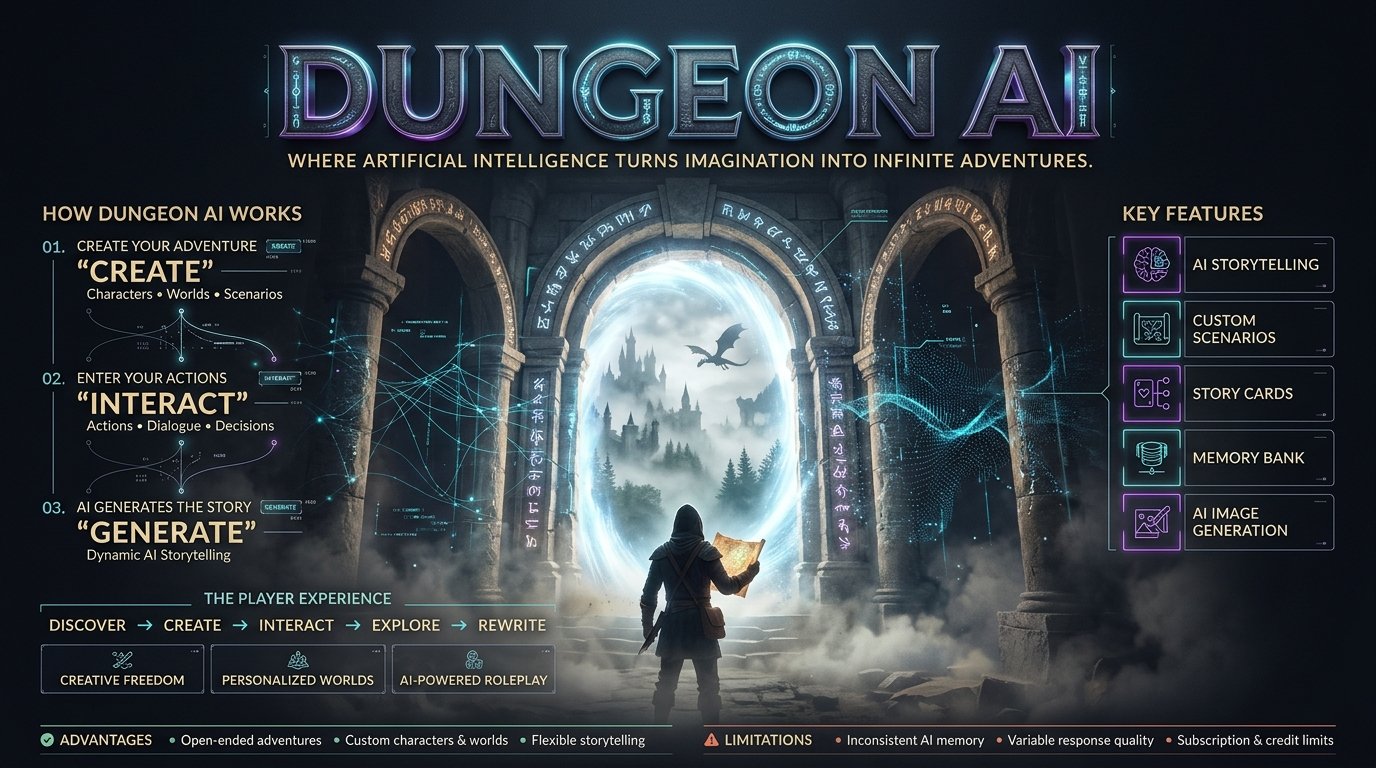
Dungeon AI commonly refers to AI Dungeon, an interactive storytelling platform where artificial intelligence creates adventures based on your actions and decisions. Developed by Latitude, it lets players build characters, explore fictional worlds, shape storylines, and experience open-ended text adventures.
Dungeon AI at a glance
- Platform: AI Dungeon, developed by Latitude.
- Main purpose: AI-generated interactive storytelling and role-playing.
- Gameplay: Players enter actions, dialogue, and story directions to influence what happens next.
- Customization: Scenarios, Story Cards, Plot Essentials, and AI Instructions help shape adventures.
- Memory: Context management, Auto Summarization, and Memory Bank help maintain story continuity.
- Pricing: Free access is available, with paid memberships offering additional models, context, memories, and credits.
What Is Dungeon AI?
Dungeon AI is a search term commonly associated with AI Dungeon.
It is not a conventional video game with a fixed sequence of missions. Instead, it uses generative AI to create story responses as players interact with fictional environments.
The experience resembles a combination of:
- Interactive fiction
- Tabletop role-playing games
- Fantasy storytelling
- AI-powered character interaction
- Choose-your-own-adventure games
Traditional games generally follow predefined dialogue and programmed events. AI Dungeon offers a more flexible experience because the narrative can respond to player-written actions.
For example, imagine starting an adventure in a medieval kingdom.
You might write:
“I enter the abandoned castle and search for evidence of the missing king.”
The AI can describe the castle, introduce characters, reveal clues, and establish new challenges. You can then decide what your character does next.
This approach gives players considerable creative freedom. The experience depends on the selected AI model, story instructions, context, and the decisions made throughout the adventure.
According to Latitude’s official getting-started guide, players can begin with a quick-start adventure or explore community-created scenarios. help.aidungeon.com+1
How Does Dungeon AI Work?
Dungeon AI uses large language models (LLMs) to generate narrative responses.
An LLM is an AI system trained to understand and generate language. It predicts suitable text based on the information provided in its prompt and the context available to it.
In AI Dungeon, that context can include the adventure’s previous events, character information, story instructions, and relevant world-building details.
1. Choose or create an adventure
Players can start with a predefined scenario or build their own fictional setting.
Possible adventure themes include:
- Medieval fantasy
- Science fiction
- Mystery and investigation
- Horror and survival
- Historical fiction
- Supernatural adventures
A scenario provides a starting point for the experience. It can also contain characters, locations, instructions, and other narrative information.
2. Enter actions and dialogue
Players interact with the story through different actions.
The basic gameplay includes:
| Action | Purpose |
|---|---|
| Do | Describe what your character attempts |
| Say | Enter dialogue spoken by your character |
| Story | Directly add narrative text or guide the plot |
| See | Request a visual representation when supported |
The AI interprets the input and generates a continuation.
This makes the experience less restrictive than conventional dialogue systems.
3. Generate the next story event
After receiving an action, the AI processes the available context and generates a response.
For example, opening a mysterious door could reveal a hidden chamber, trigger a conversation, or introduce an unexpected threat.
The result is not predetermined in the same way as a traditional scripted game.
However, AI generation is probabilistic. Repeating an action does not necessarily produce the same response.
4. Maintain story continuity
Long adventures require more than generating convincing individual paragraphs.
The system needs information about important characters, relationships, locations, previous events, and ongoing objectives.
AI Dungeon provides several tools to organize this information, including Memory Bank, Story Cards, and Plot Components.
These features help the AI reference relevant details when generating new responses. help.aidungeon.com+2
Key Features of Dungeon AI
AI Dungeon combines interactive storytelling with customization tools that help players develop more detailed fictional worlds.
1. AI-powered storytelling
The central feature is its ability to generate narrative content dynamically.
Players are not restricted to selecting from a small collection of predefined choices. They can describe unexpected actions and allow the AI to interpret them.
This works particularly well for players who enjoy experimentation and imaginative storytelling.
However, creative freedom does not guarantee perfect narrative consistency.
2. Custom scenarios
Scenarios provide reusable starting points for adventures.
Players can explore existing community scenarios or create their own.
A custom scenario can include:
- Starting situations
- Character descriptions
- World-building information
- AI Instructions
- Plot Essentials
- Story Cards
- Optional scripting
This makes scenarios useful for both casual players and people developing more structured role-playing experiences. help.aidungeon.com
3. Story Cards and world-building
Story Cards are among the most useful tools for managing complex adventures.
They store information about characters, locations, objects, organizations, and other important elements.
Each card uses trigger keywords.
When a relevant trigger appears in the player’s input or the AI’s response, the corresponding information can enter the model’s context.
For example:
| Story Card | Example information |
|---|---|
| The Dark Kingdom | Government, history, political structure |
| Princess Elara | Personality, relationships, background |
| Shadow Fortress | Location, defenses, hidden passages |
| Ancient Sword | Powers, history, limitations |
This approach helps reduce the need to repeat important details throughout an adventure.
One important limitation is that Story Cards are not permanently present in every generation. Their activation depends on triggers and context availability. help.aidungeon.com
4. Memory Bank and Auto Summarization
Long-running adventures can become difficult for language models to manage.
As a story grows, earlier events may eventually exceed the model’s available context.
AI Dungeon addresses this through its memory-related features.
- Memory Bank: Stores selected information about the adventure.
- Auto Summarization: Helps summarize previous story developments.
- Story Summary: Provides condensed information about the narrative.
- Plot Essentials: Keeps important story instructions available.
Players can enable Memory Bank and Auto Summarization through the gameplay settings.
The number of Memory Bank entries available depends on the membership tier. help.aidungeon.com+1
5. AI-generated images
AI Dungeon also supports image generation.
Players can use generated artwork to complement their adventures and visualize fictional scenes.
Credits are used for certain image-generation models and for temporarily extending context on supported models.
The credit cost depends on the selected model and generation settings. Therefore, players should check the in-product credit requirements before generating large quantities of artwork. help.aidungeon.com
6. Multiplayer storytelling
AI Dungeon also supports multiplayer experiences.
Instead of controlling an adventure alone, participants can contribute actions and dialogue to a shared narrative.
This can make fantasy campaigns, collaborative storytelling, and group role-playing more engaging.
However, multiplayer storytelling is different from a conventional multiplayer video game. The primary interaction remains AI-generated narrative rather than real-time competitive gameplay.
Dungeon AI Pricing: Is It Free?
AI Dungeon offers a free membership and several paid subscription options.
The paid plans provide additional access to AI models, larger context allowances, Memory Bank capacity, and monthly credits.
According to the official membership information available in November 2026, the regular membership structure is as follows:
| Membership | Monthly price (USD) | Monthly credits | Memory Bank |
|---|---|---|---|
| Wanderer | Free | 0 | 25 |
| Journey | $14.99 | 760 | 100 |
| Legend | $29.99 | 1,650 | 200 |
| Mythic | $49.99 | 2,750 | 400 |
| Ultimate | $99.99 | 5,200 | 800 |
Source: AI Dungeon official Memberships & Benefits page. Prices are USD and should be checked before purchasing. help.aidungeon.com
What do paid memberships provide?
Paid memberships offer several advantages:
- Access to additional AI text and image models.
- Larger context allowances.
- More Memory Bank entries.
- Monthly credits.
- Additional options for extending context.
The free Wanderer membership is useful for exploring the platform without committing to a subscription.
Journey and Legend may suit regular players who want additional capabilities. Higher tiers are intended for people with heavier usage requirements.
Understanding the credit system
Credits are not simply interchangeable with unlimited messages.
They can be used for image generation and additional context on supported models.
For some models, increasing context requires credits for every action, including retries and continuations.
This creates an important pricing consideration: the monthly subscription price does not always represent the total cost of intensive usage. help.aidungeon.com+1
Players should evaluate their expected generation volume before choosing a plan.
Advantages and Limitations of Dungeon AI
AI Dungeon offers a different approach to gaming, but its flexibility comes with trade-offs.
Main advantages
Creative freedom: Players can explore situations that traditional scripted games might not support.
Personalized adventures: Character backgrounds, settings, and story instructions help shape individual experiences.
Reusable scenarios: Players can create adventures and share their work with the community.
Flexible storytelling: The AI can respond to unexpected decisions instead of limiting every interaction to predefined options.
Accessible entry point: The free membership allows newcomers to explore the platform before purchasing a subscription.
Main limitations
Inconsistent storytelling: AI-generated responses can contradict previous events or introduce unexpected plot changes.
Limited long-term memory: Memory tools help, but they do not guarantee perfect recall across lengthy adventures.
Variable generation quality: Different models can produce noticeably different writing styles and levels of narrative consistency.
Subscription costs: Access to more capable models and larger context allowances can become expensive.
Credit consumption: Image generation and context extensions may require additional credits.
AI-generated repetition: Some responses can become predictable, repetitive, or overly descriptive.
The key distinction is that AI Dungeon provides a flexible storytelling experience, not a fully autonomous game engine with guaranteed narrative logic.
Dungeon AI Privacy and Security: What Should Players Know?
Privacy deserves attention because interactive storytelling involves sending written content to an AI service.
Players may include fictional characters, personal writing, private ideas, or sensitive information in their adventures.
AI Dungeon publishes dedicated privacy and security documentation explaining how it handles player content.
Are private adventures visible to other players?
According to Latitude’s content-visibility documentation, private adventures are the default and are available only to their creators.
Published adventures are publicly accessible. Unlisted adventures can be accessed through their sharing links.
Latitude also states that unpublished content is not routinely read by its staff without player permission. help.aidungeon.com+1
Does AI Dungeon use encryption?
Latitude states that player data, including adventure text, is encrypted.
However, encryption does not mean that story content remains encrypted throughout AI processing.
An AI model must receive readable prompt information to generate a response. The platform explains this distinction in its encryption documentation. help.aidungeon.com
Can player stories be used for AI training?
Latitude’s privacy documentation describes an optional Improve the AI setting.
According to its published guidance, participation in this improvement process is opt-in.
Players should review the current privacy policy and account settings rather than assuming that every form of data processing follows the same rules. help.aidungeon.com+1
Practical privacy recommendations
Before using Dungeon AI:
- Avoid entering real passwords or financial information.
- Do not include sensitive personal details in fictional scenarios.
- Check whether an adventure is private, unlisted, or published.
- Review optional data-sharing settings.
- Read the current privacy policy before using the service for sensitive writing.
For business, confidential research, or personal records, a consumer storytelling platform should not be treated as a private enterprise knowledge-management system.
Best Dungeon AI Alternatives in 2026
AI Dungeon is not the only platform for AI-generated stories and role-playing.
Several alternatives approach interactive fiction differently. Some emphasize creative writing, while others focus on structured tabletop campaigns or character conversations.
The right choice depends on how much control, customization, and game structure a player wants.
1. NovelAI
NovelAI is designed primarily for AI-assisted fiction writing.
It offers tools for developing stories, maintaining world information, and generating creative content.
Its Lorebook feature serves a similar purpose to AI Dungeon’s Story Cards by providing contextual information about characters and fictional settings.
Best for: Writers who want greater control over narrative style and world-building.
Main difference: NovelAI is more writing-oriented, while AI Dungeon emphasizes interactive adventures.
2. DreamGen
DreamGen focuses on AI-powered role-playing and story generation.
Users can create scenarios, define characters, and guide interactions involving multiple fictional personalities.
Its Scenario Codex helps organize information about the story world.
Best for: People interested in character-driven role-playing and longer fictional scenarios.
Main difference: DreamGen emphasizes scenario-based role-play and character interaction.
3. Friends & Fables
Friends & Fables offers an AI-powered tabletop role-playing experience.
It is particularly relevant to players who enjoy traditional fantasy campaigns, structured encounters, and Dungeons & Dragons-inspired mechanics.
Best for: Players who want more structured RPG gameplay rather than unrestricted text generation.
Main difference: It places greater emphasis on tabletop-style campaign systems.
4. SillyTavern
SillyTavern is an open-source interface for interacting with AI characters and language models.
It is different from a hosted storytelling service because users configure it with supported model providers or local AI backends.
Its flexibility makes it attractive to technically experienced users.
Best for: Advanced users who want control over character configurations and model connections.
Main difference: SillyTavern requires more setup and is not a complete hosted game service by itself.
Platform comparison
| Platform | Target user | Key strength | Pricing transparency | Core limitation |
|---|---|---|---|---|
| AI Dungeon | Interactive adventure players | Open-ended storytelling | Published subscription tiers | Memory and credit limitations |
| NovelAI | Fiction writers | Writing control and Lorebook | Published subscription plans | Less focused on multiplayer adventures |
| DreamGen | Role-play enthusiasts | Scenario-based interactions | Published plans | Model and usage limits vary |
| Friends & Fables | Tabletop RPG players | Structured campaign gameplay | Published plans | More structured than freeform storytelling |
| SillyTavern | Technical users | Customization and backend flexibility | Software is free; backend may cost money | Requires configuration |
These products are not interchangeable. A writing assistant, character-chat interface, and AI game master solve different problems.
For a more reliable comparison, evaluate them using the same story scenario and check their current subscription terms before making a decision.
Who Should Use Dungeon AI?
Dungeon AI is particularly relevant to people who enjoy interactive fiction and want more control over how fictional stories develop.
Casual gamers
Players who enjoy fantasy, mystery, and science fiction can experiment with different scenarios without learning complicated game mechanics.
Creative writers
Writers can use AI-generated interactions to explore character motivations, alternative storylines, and unexpected plot developments.
However, generated content should be reviewed and edited before being treated as finished creative work.
Role-playing enthusiasts
People who enjoy tabletop-style role-playing can use the platform to experiment with characters, settings, and narrative situations.
World-building enthusiasts
Story Cards, Plot Essentials, and custom scenarios make the platform useful for developing fictional universes.
Who might prefer something else?
Dungeon AI may be less suitable for people who want:
- A traditional game with fixed missions and predictable mechanics.
- Strict adherence to tabletop RPG rules.
- Guaranteed consistency across very long stories.
- An entirely offline storytelling environment.
- A professional writing platform with advanced editorial workflows.
How to Get Better Results from Dungeon AI
The quality of an AI adventure depends partly on how effectively players communicate their intentions.
A vague prompt often produces generic responses. Clear instructions provide the model with better narrative direction.
Here are five practical ways to improve the experience.
1. Create a clear character profile
Define your character’s background, personality, abilities, motivations, and limitations.
For example:
“A former royal investigator who distrusts political leaders but remains committed to uncovering the truth.”
This gives the AI a more consistent foundation for character-driven interactions.
2. Establish the world rules
Explain how the fictional environment works.
Include important details about:
- Geography
- Political systems
- Magic or technology
- Social structures
- Major conflicts
Use Story Cards to organize details that the AI may need later.
3. Write specific actions
Instead of writing:
“I investigate the village.”
Try:
“I question the village blacksmith about the missing travelers and carefully examine the symbols carved into his workshop door.”
The second instruction provides clearer direction and multiple narrative opportunities.
4. Keep important information organized
Use Plot Essentials for details that should remain consistently available.
Use Story Cards for information that becomes relevant in specific situations.
Avoid filling every component with unnecessary background information. Excessive context can reduce the space available for the current adventure.
5. Review the AI’s responses
Do not assume every generated detail is correct within your fictional world.
If the AI changes a character’s identity or contradicts an earlier event, correct the information directly.
For longer adventures, periodically review the story summary and memory settings.
Is Dungeon AI Worth Trying in 2026?
Whether AI Dungeon is worth using depends on what you expect from an AI-powered game.
Its biggest appeal is the ability to create and explore stories without following a strictly predefined narrative.
A player can introduce new characters, change locations, invent conflicts, and experiment with different decisions.
However, this flexibility has limitations.
AI-generated stories can lose consistency, repeat information, or introduce events that do not fit the established world.
The subscription structure also deserves consideration. Players who regularly use premium models, larger context windows, and image generation may need a higher membership.
For casual experimentation, the free tier provides a starting point. For more demanding storytelling, evaluating model quality, context allowances, and monthly credit requirements becomes more important.
The most useful approach is to test the platform with a short adventure before committing to a paid plan.
Frequently Asked Questions
1. What is Dungeon AI used for?
Dungeon AI commonly refers to AI Dungeon, a platform used for interactive storytelling, text adventures, fantasy role-playing, and AI-generated narratives. Players enter actions and dialogue, and the AI generates story developments based on their input.
2. Is Dungeon AI free to use?
Yes. AI Dungeon offers a free Wanderer membership. Paid memberships provide additional AI models, larger context allowances, more Memory Bank entries, and monthly credits.
3. Is Dungeon AI the same as AI Dungeon?
In most search contexts, yes. Dungeon AI is commonly used as an alternative search phrase for AI Dungeon, the interactive storytelling platform developed by Latitude.
4. Does Dungeon AI remember previous conversations?
AI Dungeon includes features such as Memory Bank, Auto Summarization, Story Summary, and Story Cards to support continuity. However, memory is not perfect, and players may need to organize important information manually.
5. What are the best alternatives to Dungeon AI?
Popular alternatives include NovelAI, DreamGen, Friends & Fables, and SillyTavern. NovelAI suits fiction writers, DreamGen focuses on role-playing, Friends & Fables emphasizes tabletop-style campaigns, and SillyTavern offers advanced customization.
Conclusion
Dungeon AI, commonly known as AI Dungeon, demonstrates how generative AI can transform traditional text adventures into flexible storytelling experiences.
Its biggest strengths include open-ended gameplay, customizable scenarios, AI-generated narratives, and world-building tools.
However, players should understand its limitations. Story consistency, memory management, subscription costs, and credit consumption can affect the overall experience.
For casual players, the free membership is a sensible starting point. Writers may prefer NovelAI, while tabletop RPG enthusiasts may find Friends & Fables more suitable.
Ultimately, the right choice depends on whether you prioritize creative freedom, structured gameplay, character development, or greater control over AI models.